PPC Plan Template

Free Word download β€’ Edit online β€’ Save & share with Drive β€’ Export to PDF

14 pagesβ€’30–40 min to fillβ€’Difficulty: Complex
Learn more ↓
FreePPC Plan Template

At a glance

What it is
A PPC Plan is an operational document that defines the strategy, structure, budget allocation, targeting parameters, and success metrics for a pay-per-click advertising program across one or more platforms such as Google Ads, Microsoft Advertising, or Meta Ads. This free Word download gives you a structured, editable starting point you can fill in and share with your marketing team, agency, or leadership in minutes.
When you need it
Use it when launching a new paid advertising program, onboarding a PPC agency, restructuring an underperforming account, or aligning stakeholders on campaign goals and budget before spend begins.
What's inside
Campaign objectives and KPIs, audience and keyword strategy, platform and channel selection, ad group structure, budget and bid strategy, ad copy guidelines, landing page requirements, and performance reporting cadence.

What is a PPC Plan?

A PPC Plan is an operational document that defines the full strategy for a pay-per-click advertising program β€” covering campaign objectives, target audience profiles, platform selection, keyword strategy, budget allocation, ad copy guidelines, landing page requirements, and performance reporting. It translates a business's paid acquisition goals into a structured execution brief that a marketing manager, in-house team, or external agency can act on immediately. Rather than approaching paid advertising as a series of ad hoc decisions, a PPC plan creates a single source of truth that keeps spend aligned with measurable outcomes from day one.

Why You Need This Document

Running paid advertising without a written plan is one of the fastest ways to exhaust a marketing budget without generating a return. Without defined KPIs and a documented keyword strategy, campaigns accumulate irrelevant clicks, bidding approaches change arbitrarily, and nobody can explain why ROAS declined from one month to the next. Stakeholders approving budget need to see a concrete plan that connects spend to outcomes β€” not a verbal summary of what the platform's algorithm is doing. A completed PPC plan also protects you when onboarding a new agency or handing off account management: every structural decision, targeting choice, and optimization threshold is on record. This template gives you the framework to build that plan in hours, not days, and share it in a format your team, clients, or leadership can review and approve before the first ad goes live.

Which variant fits your situation?

If your situation is…Use this template
Running paid search ads on Google and Microsoft onlyPPC Plan (Search)
Planning a full cross-channel paid media program including display and socialDigital Marketing Plan
Managing a product feed and Shopping campaigns for an e-commerce storeE-Commerce Marketing Plan
Planning a paid social campaign on Meta, LinkedIn, or TikTok specificallySocial Media Marketing Plan
Presenting a high-level advertising strategy for leadership or board sign-offMarketing Plan
Reviewing and improving an existing underperforming PPC accountPPC Audit Report
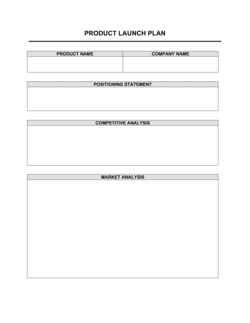
Planning ad spend as part of a broader product launch campaignProduct Launch Plan

Common mistakes to avoid

❌ Launching without conversion tracking in place

Why it matters: Without verified conversion tracking, every optimization decision β€” including smart bidding β€” is made on incomplete data, and ROI cannot be demonstrated to stakeholders.

Fix: Confirm that conversion actions (form submits, purchases, calls) are firing accurately in Google Tag Manager and the platform dashboard before a single dollar is spent.

❌ Using a single ad group for an entire campaign

Why it matters: Mixed keyword intent in one ad group means ad copy cannot match every search query closely, which lowers Quality Score, raises CPC, and reduces conversion rate across the board.

Fix: Split keywords into tightly themed ad groups of 5–15 terms each and write ad copy specifically for each theme.

❌ Activating automated bid strategies before the account has conversion history

Why it matters: Target CPA and target ROAS algorithms require a minimum of 30–50 conversions per month to optimize accurately β€” below that threshold they overspend chasing statistical noise.

Fix: Run manual CPC or enhanced CPC for the first 4–6 weeks to build conversion history, then switch to a smart bidding strategy with a real data foundation.

❌ Sending all traffic to the homepage

Why it matters: A homepage is designed for multiple audiences and goals, not for a specific ad's promise. Visitors who land on a mismatched page leave immediately, wasting the entire click cost.

Fix: Create or designate a dedicated landing page for each major ad group or campaign that mirrors the ad's headline, value proposition, and call to action.

❌ Ignoring the search terms report

Why it matters: Phrase and broad match keywords surface actual search queries that may be completely unrelated to your offer β€” and you pay for every click.

Fix: Review the search terms report weekly for the first month and add irrelevant terms as negatives at the campaign or account level.

❌ Setting and forgetting the PPC plan after launch

Why it matters: PPC auctions are competitive and dynamic β€” CPCs shift, competitors change bids, and seasonal intent patterns change. A plan that is not reviewed regularly becomes inaccurate within 60 days.

Fix: Schedule a monthly plan review against actual performance data and update the budget allocation, keyword list, and KPI targets based on what the account data shows.

The 9 key sections, explained

Campaign objectives and KPIs

Target audience and buyer personas

Platform and channel selection

Keyword strategy and match type plan

Campaign and ad group structure

Budget allocation and bid strategy

Ad copy guidelines and creative requirements

Landing page requirements

Performance reporting and optimization cadence

How to fill it out

  1. 1

    Define measurable campaign objectives

    State the primary goal β€” leads, sales, or ROAS β€” with a numeric target and deadline. Tie each objective directly to a business outcome, not a platform metric.

    πŸ’‘ Set a secondary efficiency metric (CPA or ROAS) alongside the volume target so you can identify when hitting volume comes at too high a cost.

  2. 2

    Build audience and persona profiles

    Document the demographics, job roles, and behavioral signals of your target buyer. Note which segments to exclude β€” such as existing customers or irrelevant job functions β€” to reduce wasted impressions.

    πŸ’‘ Pull data from your CRM on your best 20% of customers and build the audience profile from that cohort, not from assumptions.

  3. 3

    Select platforms and set budget splits

    Choose platforms based on where your target audience actively searches or browses. Assign a percentage of the total monthly budget to each platform and set a rationale for the split.

    πŸ’‘ Start with 80% on the highest-intent platform (usually Google Search) and reserve 20% for a secondary test channel in the first 90 days.

  4. 4

    Research and organize keywords by theme

    Use Google Keyword Planner or a third-party tool to identify core keyword themes. Group them by intent β€” branded, generic, competitor, and long-tail β€” and assign match types deliberately.

    πŸ’‘ Build your negative keyword list before the campaign goes live, not after. Start with at least 50 negatives drawn from irrelevant query data in similar accounts or tools.

  5. 5

    Map the campaign and ad group hierarchy

    Create one campaign per major product line or audience segment. Within each campaign, create tightly themed ad groups with 5–15 closely related keywords each.

    πŸ’‘ A single keyword ad group (SKAG) or close variant is worth testing for your highest-volume, highest-value terms β€” tighter grouping usually yields better Quality Scores.

  6. 6

    Write ad copy following the messaging framework

    Draft at least 3 responsive search ad headlines and 2 descriptions per ad group. Pin the primary keyword in headline 1 and the main call to action in headline 3.

    πŸ’‘ Include one specific number or proof point (e.g., 'rated 4.9/5 by 2,000+ users') in at least one headline β€” specificity reliably improves CTR.

  7. 7

    Specify landing pages and conversion requirements

    Assign a destination URL to each ad group and confirm the page contains a headline matching the ad copy, a single primary CTA, and a form with the fewest fields necessary.

    πŸ’‘ If a dedicated landing page does not yet exist for an ad group, build it before the campaign launches β€” sending traffic to a generic page while waiting costs both money and conversion data.

  8. 8

    Set the reporting cadence and optimization thresholds

    Define how often performance will be reviewed (weekly recommended), which metrics trigger action, and what the action is for each threshold β€” pause, adjust bid, add negative, or test new copy.

    πŸ’‘ Document the optimization decisions you make and why. A decision log makes it significantly faster to identify what drove performance changes over a 90-day period.

Frequently asked questions

What is a PPC plan?

A PPC plan is a structured document that defines the strategy, budget, targeting, keyword approach, ad copy guidelines, and performance metrics for a pay-per-click advertising program. It serves as the operational brief for anyone managing or approving paid advertising spend β€” from an in-house marketing team to an external agency. A completed plan ensures everyone involved understands the campaign goals, the spend limits, and how success will be measured before the first ad goes live.

What should a PPC plan include?

A complete PPC plan covers campaign objectives and KPIs, target audience profiles, platform and channel selection, keyword strategy with match types and negatives, campaign and ad group structure, budget allocation and bid strategy, ad copy guidelines, landing page requirements, and a reporting and optimization cadence. Missing any of these sections typically results in wasted spend or an inability to diagnose performance problems after launch.

What is a realistic PPC budget for a small business?

For most service-based small businesses using Google Search, a minimum of $1,000–$2,000 per month is needed to generate statistically meaningful data within 30 days. E-commerce businesses targeting competitive product categories typically need $3,000–$5,000 per month to compete effectively. Budget requirements scale with average CPC in the category β€” legal, financial services, and SaaS keywords can run $15–$80 per click, requiring higher floors to hit volume targets.

What is the difference between a PPC plan and a digital marketing plan?

A digital marketing plan covers all online channels β€” SEO, content, email, social, and paid advertising β€” at a strategic level. A PPC plan focuses exclusively on paid advertising: platform selection, keyword strategy, bidding, ad copy, and conversion tracking. The PPC plan is typically a sub-document of the broader digital marketing plan, with more operational detail on campaign mechanics and budget management.

How do I choose between Google Ads and other PPC platforms?

Google Search captures active demand β€” people searching for what you sell right now β€” making it the highest-intent option for most businesses. Microsoft Ads reaches a similar audience at 20–35% lower average CPCs and is worth testing for B2B and professional services. LinkedIn Ads are best for B2B targeting by job title or company, but CPCs run $8–$20. Meta Ads (Facebook and Instagram) are effective for visual products and remarketing but require stronger creative and a longer consideration cycle. Start where your audience actively searches, then expand.

How long does it take for a PPC campaign to show results?

Most new campaigns need 4–6 weeks before performance data is reliable enough to make meaningful optimization decisions. The first two weeks are typically spent in a learning phase where the platform's algorithm tests ad delivery. Months 2 and 3 are where most accounts see significant improvement as negative keywords accumulate and bid strategies have enough conversion data to optimize. Expecting strong ROAS in week one is a common and costly misconception.

Do I need a PPC agency or can I manage it myself?

For monthly budgets under $3,000 and campaigns limited to one or two platforms, a well-structured template and 3–5 hours per week of management time is often sufficient. Above $5,000 per month, or for competitive industries with complex account structures, an agency or specialist typically generates returns that exceed their management fee within 60–90 days. The break-even point depends on how much wasted spend the expertise eliminates.

What KPIs should I track in a PPC plan?

The core KPIs are cost per acquisition (CPA), return on ad spend (ROAS), click-through rate (CTR), conversion rate, and impression share. For e-commerce, also track revenue per click and shopping cart abandonment rate post-click. For lead generation, track cost per lead and lead-to-close rate to assess the full-funnel value of paid traffic. Tracking platform metrics like Quality Score and auction insights helps diagnose why efficiency is improving or declining.

How often should a PPC plan be updated?

Budget allocations and KPI targets should be reviewed monthly against actual performance. Keyword lists, negative keywords, and bid strategies warrant weekly attention during the first 90 days. A full plan revision β€” including audience strategy, platform mix, and landing page requirements β€” is appropriate quarterly or whenever campaign goals or business priorities shift materially.

How this compares to alternatives

vs Digital Marketing Plan

A digital marketing plan covers the full range of online channels β€” SEO, content, social, email, and paid advertising β€” at a strategic level. A PPC plan is an operational sub-document focused exclusively on paid advertising mechanics: platforms, keywords, bids, budgets, and conversion tracking. Most marketing teams need both: the digital marketing plan sets direction, and the PPC plan provides the detailed execution brief for paid channels.

vs Social Media Marketing Plan

A social media marketing plan covers both organic and paid activity across platforms like Meta, LinkedIn, and TikTok, with emphasis on content calendars, community engagement, and brand voice. A PPC plan focuses on paid search and display advertising with a more granular treatment of keyword strategy, bid management, and quality score optimization. Businesses running paid social alongside paid search need both documents.

vs Marketing Plan

A marketing plan defines the overall go-to-market strategy, positioning, target segments, and budget across all marketing activities for a planning period. A PPC plan is a channel-specific execution document within that broader strategy. The marketing plan answers 'what are we doing and why'; the PPC plan answers 'exactly how will paid advertising be structured and measured'.

vs Product Launch Plan

A product launch plan coordinates all activities required to bring a new product to market β€” development milestones, pricing, distribution, PR, and marketing. A PPC plan within a launch context is one component of that broader document, covering how paid advertising will support awareness and conversion goals during and after the launch window. A standalone PPC plan is more appropriate for ongoing campaign management beyond the initial launch.

Industry-specific considerations

E-commerce / Retail

Google Shopping and Performance Max campaigns require a product feed strategy, ROAS targets by product category, and seasonal budget scaling around promotional periods.

SaaS / Technology

High-intent branded and competitor keywords, trial or demo conversion goals, and LinkedIn Ads layered on top of Google Search for enterprise account-based targeting.

Professional Services

High CPCs in legal, financial, and consulting categories require tight geographic targeting, strong negative keyword lists, and call tracking as a primary conversion action.

Healthcare / MedTech

Google's healthcare advertising policies restrict certain ad formats and targeting options; conversion tracking must be configured to avoid capturing protected health information.

Template vs pro β€” what fits your needs?

PathBest forCostTime
Use the templateSmall business owners, in-house marketers, and consultants managing budgets under $5,000 per month on one or two platformsFree2–4 hours
Template + professional reviewTeams managing $5,000–$20,000 per month who want a specialist to validate keyword strategy, bid approach, and tracking setup$300–$1,000 for a PPC audit or strategy session1–3 days
Custom draftedEnterprise advertisers, competitive industries with CPCs above $20, or multi-platform programs requiring custom attribution modeling$2,000–$8,000+ for a full agency strategy engagement2–4 weeks

Glossary

PPC (Pay-Per-Click)
An online advertising model where the advertiser pays a fee each time a user clicks on their ad, rather than paying for impressions.
CPC (Cost Per Click)
The actual amount paid each time a user clicks an ad, calculated as total spend divided by total clicks in a given period.
CTR (Click-Through Rate)
The percentage of users who clicked an ad after seeing it, calculated as clicks divided by impressions.
Conversion Rate
The percentage of ad clicks that result in a desired action β€” a purchase, form submission, or phone call β€” on the landing page.
ROAS (Return on Ad Spend)
Revenue generated divided by total ad spend, expressed as a ratio β€” e.g., 4:1 means $4 in revenue for every $1 spent.
Quality Score
Google's 1–10 rating of ad relevance, expected CTR, and landing page experience, which directly affects ad placement and CPC.
Ad Group
A container within a campaign that groups a set of related keywords and their associated ads targeting a specific theme or product.
Negative Keywords
Terms added to a campaign to prevent ads from showing on irrelevant searches, reducing wasted spend.
Bid Strategy
The method used to set bids for ad placement β€” options include manual CPC, target CPA, target ROAS, and maximize conversions.
Landing Page
The destination page a user reaches after clicking an ad, which must align with the ad's promise to achieve a strong conversion rate.
Impression Share
The percentage of eligible auctions in which your ads actually appeared, indicating how much of the available traffic you are capturing.

Part of your Business Operating System

This document is one of 3,000+ business & legal templates included in Business in a Box.

  • Fill-in-the-blanks β€” ready in minutes
  • 100% customizable Word document
  • Compatible with all office suites
  • Export to PDF and share electronically

Create your document in 3 simple steps.

From template to signed document β€” all inside one Business Operating System.
1
Download or open template

Access over 3,000+ business and legal templates for any business task, project or initiative.

2
Edit and fill in the blanks with AI

Customize your ready-made business document template and save it in the cloud.

3
Save, Share, Send, Sign

Share your files and folders with your team. Create a space of seamless collaboration.

Save time, save money, and create top-quality documents.

β˜…β˜…β˜…β˜…β˜…

"Fantastic value! I'm not sure how I'd do without it. It's worth its weight in gold and paid back for itself many times."

Managing Director Β· Mall Farm
Robert Whalley
Managing Director, Mall Farm Proprietary Limited
β˜…β˜…β˜…β˜…β˜…

"I have been using Business in a Box for years. It has been the most useful source of templates I have encountered. I recommend it to anyone."

Business Owner Β· 4+ years
Dr Michael John Freestone
Business Owner
β˜…β˜…β˜…β˜…β˜…

"It has been a life saver so many times I have lost count. Business in a Box has saved me so much time and as you know, time is money."

Owner Β· Upstate Web
David G. Moore Jr.
Owner, Upstate Web

Run your business with a system β€” not scattered tools

Stop downloading documents. Start operating with clarity. Business in a Box gives you the Business Operating System used by over 250,000 companies worldwide to structure, run, and grow their business.

Free Forever PlanΒ Β·Β No credit card required