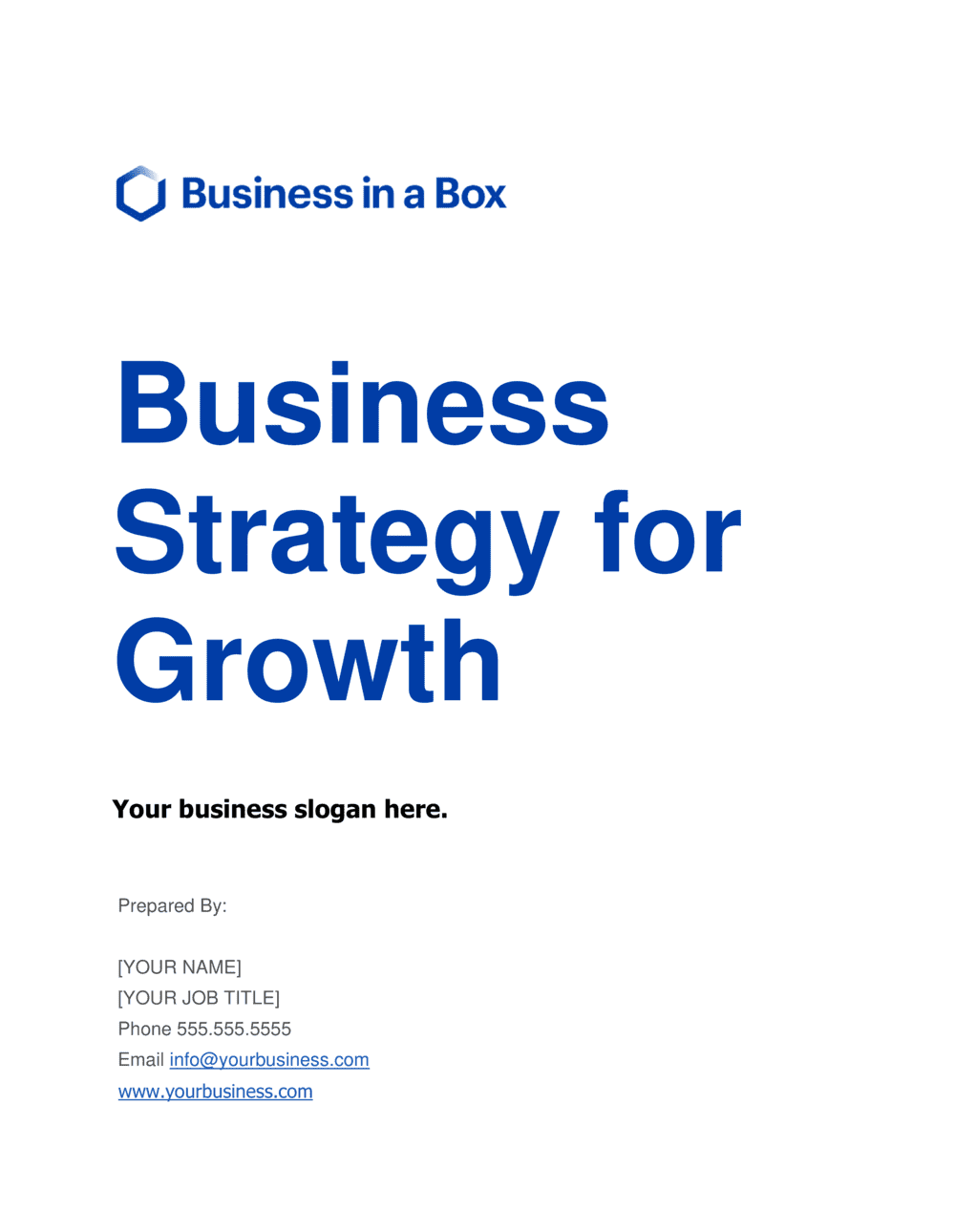
Business Strategy For Growth

Free Word download β€’ Edit online β€’ Save & share with Drive β€’ Export to PDF

14 pagesβ€’25–35 min to fillβ€’Difficulty: Complex
Learn more ↓
FreeBusiness Strategy For Growth Template

At a glance

What it is
A Business Strategy For Growth is a structured planning document that translates a company's growth ambitions into a concrete, actionable roadmap β€” covering market opportunity, competitive positioning, financial targets, and the initiatives required to hit them. This free Word download gives you a proven framework you can edit online and export as PDF to share with leadership teams, boards, or investors.
When you need it
Use it when entering a new market, launching a major product line, pursuing an acquisition, or realigning an existing business around a step-change revenue or profitability target. It is also the document boards and investors request when evaluating whether a management team has a credible plan behind their growth projections.
What's inside
Executive summary, current state assessment, growth objectives and KPIs, market and competitive analysis, strategic initiatives with owners and timelines, resource and budget requirements, risk assessment, and a performance monitoring framework.

What is a Business Strategy For Growth?

A Business Strategy For Growth is a structured planning document that translates a company's growth ambitions into a concrete, prioritized roadmap β€” identifying which markets to pursue, which initiatives to fund, what resources are required, and how progress will be measured. It moves beyond high-level vision statements by connecting growth targets directly to funded initiatives with named owners, sequenced timelines, and defined KPIs. Unlike a general strategic plan, it is specifically focused on answering one question: how does this company grow faster, and what exactly will it take to get there?

Why You Need This Document

Without a written growth strategy, leadership teams execute against conflicting assumptions about which markets matter most, which initiatives are funded, and what success looks like in 24 months. The result is budget fragmented across too many programs, each underfunded to produce measurable results. Boards and investors lose confidence not because the ambition is wrong but because there is no credible, specific plan behind the numbers. A well-structured growth strategy forces the prioritization conversation before capital is committed β€” surfacing the trade-offs between market entry, product investment, and headcount growth while there is still time to make deliberate choices. This template gives you the framework to build that plan, present it to stakeholders who will hold you accountable, and track performance against it every quarter.

Which variant fits your situation?

If your situation is…Use this template
Planning overall company direction for 3–5 yearsStrategic Plan
Mapping a new market entry in detailMarket Entry Strategy
Outlining a new product launch and go-to-marketProduct Launch Plan
Growing through an acquisition or partnershipBusiness Development Plan
Building a detailed marketing growth engineMarketing Plan
Presenting growth projections to investors or lendersBusiness Plan
Aligning teams around annual growth priorities and budgetsAnnual Operating Plan

Common mistakes to avoid

❌ Setting targets without funding the initiatives to reach them

Why it matters: A growth target without a corresponding budget and headcount plan is aspirational, not strategic. Boards and investors will identify the gap immediately and lose confidence in the plan.

Fix: For every target, trace the path back to a specific funded initiative. If you cannot, either fund the initiative or lower the target.

❌ Prioritizing too many initiatives simultaneously

Why it matters: Spreading budget and management attention across six or more growth programs consistently produces underperformance across all of them, rather than outperformance on a focused few.

Fix: Cap strategic initiatives at five. Use an effort-vs-impact scoring exercise to select which programs to run and which to defer to the next planning cycle.

❌ Using only top-down market sizing

Why it matters: Claiming 1% of a $10B market sounds like a low bar, but if reaching 1% requires 5,000 enterprise deals and you have a five-person sales team, the number is not credible.

Fix: Build a bottom-up estimate alongside the top-down figure: number of reachable customers Γ— win rate Γ— average contract value = realistic SAM.

❌ Omitting a risk assessment section

Why it matters: A strategy document that presents only upside signals to boards and investors that the leadership team has not stress-tested the plan. It erodes trust rather than building it.

Fix: Identify the four to six most plausible risks with specific mitigations and named owners. A credible risk register demonstrates analytical rigor, not pessimism.

❌ Launching all initiatives in the same quarter

Why it matters: Simultaneous launches overload functional teams, compress the time available to fix early problems, and make it impossible to isolate what is and isn't working.

Fix: Sequence initiatives by dependency and resource availability. Stagger start dates by at least one quarter wherever the same team or budget is involved.

❌ Defining KPIs without a monitoring cadence

Why it matters: KPIs with no review owner or frequency become decoration. If no one is accountable for reporting a metric on a fixed schedule, it will not be tracked when performance gets uncomfortable.

Fix: For every KPI, name the owner, state the review frequency, and define the escalation trigger β€” the specific threshold that prompts a remediation conversation.

The 10 key sections, explained

Executive Summary

Current State Assessment

Growth Objectives and KPIs

Market and Competitive Analysis

Strategic Growth Initiatives

Go-to-Market and Customer Acquisition Plan

Resource and Budget Requirements

Risk Assessment and Mitigation

Implementation Roadmap

Performance Monitoring Framework

How to fill it out

  1. 1

    Complete the current state assessment before setting targets

    Document current revenue, growth rate, gross margin, customer count, and the top two or three constraints limiting faster growth. Use actuals, not estimates.

    πŸ’‘ A SWOT analysis completed before this step will surface the constraints and opportunities that should drive your choice of growth initiatives.

  2. 2

    Set specific, time-bound growth objectives

    Define 3–5 KPIs with baseline values, targets, and deadlines. Use the OKR format β€” one qualitative objective supported by 2–5 measurable key results β€” to keep targets actionable.

    πŸ’‘ If a target cannot be expressed as a number with a date, it is not a KPI β€” it is a direction. Push until you can quantify it.

  3. 3

    Size the market opportunity from two angles

    Find a credible top-down TAM figure from an industry report. Then build a bottom-up estimate by counting reachable customers in your target segment and multiplying by average contract value.

    πŸ’‘ If your top-down and bottom-up estimates differ by more than 40%, one of your assumptions is wrong β€” identify and fix it before presenting.

  4. 4

    Select and prioritize no more than five strategic initiatives

    List every potential growth program, then score each on expected revenue impact and ease of execution. Select the top three to five and assign an owner, budget, and deadline to each.

    πŸ’‘ Use a 2Γ—2 effort-vs-impact matrix to make the prioritization conversation explicit with your leadership team β€” it surfaces disagreements before they become execution conflicts.

  5. 5

    Build the resource and budget plan initiative by initiative

    For each initiative, estimate the headcount needed, the tools or technology required, and the marketing or sales spend. Sum these into a total incremental budget and reconcile against available capital.

    πŸ’‘ If the total budget exceeds available capital, cut an initiative rather than underfunding all of them β€” partial funding rarely produces measurable results.

  6. 6

    Map the implementation roadmap with dependencies

    Place each initiative on a quarterly timeline. Identify the inputs one initiative needs from another and sequence accordingly β€” never assume two resource-heavy initiatives can launch in the same quarter.

    πŸ’‘ Highlight the single critical path item in each quarter. If that one thing slips, the rest of the timeline shifts β€” knowing it in advance lets you monitor it more closely.

  7. 7

    Define the performance monitoring cadence

    State which KPIs are reviewed monthly versus quarterly, who owns each metric, and what action is triggered when a metric falls more than 10–15% below plan for two consecutive periods.

    πŸ’‘ Build the dashboard template now, not at the end of Quarter 1. If the data infrastructure to track a KPI doesn't exist yet, that's a task for the implementation roadmap.

  8. 8

    Write the executive summary last

    Pull the single strongest data point from each section β€” the growth target, the market opportunity size, the top initiative, and the required investment β€” and compress into one to two pages.

    πŸ’‘ Read the executive summary aloud. If it takes more than three minutes, it is too long. Boards and investors read it first; if it doesn't hold attention, the rest of the document won't be read.

Frequently asked questions

What is a business growth strategy?

A business growth strategy is a formal plan that defines how a company will increase revenue, market share, or profitability over a defined period β€” typically 1–3 years. It identifies the target markets and customer segments to pursue, the initiatives to execute, the resources required, and the KPIs that define success. Unlike a general strategic plan, a growth strategy is specifically focused on scaling the business rather than maintaining or optimizing current operations.

What sections should a business growth strategy include?

A complete growth strategy covers ten areas: an executive summary, current state assessment, growth objectives and KPIs, market and competitive analysis, strategic growth initiatives, a go-to-market plan, resource and budget requirements, a risk assessment, an implementation roadmap, and a performance monitoring framework. Shorter versions used for internal alignment can compress this to five or six sections, but investor- or board-facing documents should include all ten.

How is a growth strategy different from a business plan?

A business plan is a comprehensive document covering every aspect of the business β€” from company overview and product description to full three-statement financial projections β€” designed primarily for external audiences like investors and lenders. A growth strategy is more focused: it assumes the business already exists and concentrates specifically on the initiatives, markets, and resources required to accelerate growth from the current state. Most established businesses need both documents serving different audiences.

What are the main types of business growth strategies?

The Ansoff Matrix identifies four core pathways: market penetration (selling more of existing products to existing customers), market development (entering new geographies or customer segments with existing products), product development (launching new offerings to existing customers), and diversification (new products for new markets). Most growth strategies combine two or three of these pathways sequenced over a multi-year horizon, with market penetration typically pursued first because it carries the lowest execution risk.

How many strategic initiatives should a growth strategy include?

Three to five is the practical ceiling for most businesses. Fewer than three can signal a lack of ambition or an overly narrow view of growth levers. More than five typically means the company is either underfunding each initiative or expecting more management bandwidth than exists. Prioritize by scoring initiatives on expected revenue impact and execution feasibility, then sequence rather than parallel-run the lower-priority programs.

How do I set realistic growth targets?

Start with your current run rate and historical growth rate, then identify the specific initiatives that will accelerate growth beyond the baseline. For each initiative, model the incremental revenue it will generate β€” number of new customers Γ— ACV, or new market revenue Γ— realistic win rate. Sum the baseline plus initiative impacts to arrive at a total target. If the target still looks like a hockey stick with no supporting model, revise it until you can explain every dollar of projected growth from a specific initiative.

Who should be involved in writing a business growth strategy?

The CEO or general manager should own the document, but the core leadership team β€” heads of sales, marketing, product, and finance β€” must contribute to the sections they are accountable for executing. A strategy written by one person without buy-in from the functional leaders responsible for delivery has a very low execution rate. Board or investor input on growth objectives is valuable before the first draft, not after.

How often should a business growth strategy be updated?

A formal annual refresh aligned to the fiscal year planning cycle is standard. For high-growth or venture-backed companies, a mid-year checkpoint to update KPIs against actuals and reprioritize initiatives is also common. A growth strategy more than 18 months old without a revision should be treated as a historical artifact β€” market conditions, competitive dynamics, and internal capabilities change too fast for a static document to remain actionable beyond that window.

Can a small business use this template, or is it only for large companies?

This template is intentionally structured to scale down. Small businesses can compress the market analysis and competitive sections to one page each and limit strategic initiatives to two or three. The core structure β€” clear targets, funded initiatives, and a monitoring cadence β€” is as valuable for a 10-person company as for a 500-person one. The most common small-business mistake is skipping the resource and budget section; that omission is what turns a plan into a wish list.

How this compares to alternatives

vs Strategic Plan

A strategic plan covers the full scope of organizational direction β€” mission, values, multi-year goals, and resource allocation across all functions including operations, HR, and finance. A business growth strategy is narrower, focusing specifically on how the company will increase revenue or market share. Most companies need both: the strategic plan sets direction; the growth strategy operationalizes the growth component of it.

vs Business Plan

A business plan is a comprehensive external document designed for investors and lenders β€” covering company history, product description, and three-statement financial projections from scratch. A business growth strategy assumes the business already exists and focuses specifically on the initiatives, markets, and capital needed to accelerate from the current baseline. Lenders request business plans; boards and leadership teams work from growth strategies.

vs Marketing Plan

A marketing plan details the campaigns, channels, and messaging tactics that will drive customer acquisition and brand growth β€” it is one functional component of a broader growth strategy. A business growth strategy encompasses marketing alongside product development, geographic expansion, partnerships, and operational scaling. Use the growth strategy to set direction and budgets; use the marketing plan to execute the demand-generation component.

vs Annual Operating Plan

An annual operating plan (AOP) translates the current fiscal year's budget, headcount targets, and departmental goals into a detailed 12-month execution plan. A business growth strategy is typically a 2–3 year document focused on strategic direction and initiative prioritization rather than month-by-month operational detail. The AOP should be derived from and aligned to the growth strategy, not the other way around.

Industry-specific considerations

SaaS / Technology

Growth strategy centers on ARR expansion through new logo acquisition, net revenue retention improvement, and geographic or vertical market entry β€” with CAC payback and NRR as the primary KPIs.

Retail / E-commerce

Growth levers include new channel expansion (marketplace, DTC, wholesale), average order value improvement, and customer repeat-purchase rate β€” with contribution margin per order as the critical guardrail metric.

Professional Services

Growth strategy typically combines new service line development, geographic office expansion, and key account penetration β€” constrained by billable utilization rates and the time required to hire and credential senior staff.

Manufacturing

Growth initiatives focus on capacity expansion, new product introduction, and distribution channel development β€” with capex requirements and lead times for equipment or facility build-out as the primary execution constraints.

Healthcare / MedTech

Growth strategy must account for regulatory approval timelines, reimbursement pathways, and clinical validation requirements that can extend time-to-revenue by 12–36 months beyond what a standard growth model would project.

Food & Beverage

Growth through new SKU launches, regional distribution expansion, or foodservice channel entry β€” each requiring detailed gross margin analysis given the tight cost structures and spoilage risks in this sector.

Template vs pro β€” what fits your needs?

PathBest forCostTime
Use the templateSmall and mid-size businesses building an internal growth plan or preparing for a board presentationFree2–3 weeks (30–50 hours)
Template + professional reviewGrowth-stage companies preparing a plan for Series A investors or a bank growth-financing application$500–$2,500 for a strategy advisor or CFO review session3–5 weeks
Custom draftedPre-IPO companies, private equity-backed businesses, or those pursuing a major acquisition requiring a board-approved growth plan$5,000–$20,000+ for a management consulting engagement6–12 weeks

Glossary

Growth Strategy
A deliberate plan describing how a company intends to increase revenue, market share, or profitability over a defined period.
Strategic Initiative
A discrete, resourced project or program specifically designed to close the gap between current performance and a stated strategic objective.
OKR (Objectives and Key Results)
A goal-setting framework pairing a qualitative objective with 2–5 measurable key results that define what success looks like.
SWOT Analysis
A structured assessment of a company's internal Strengths and Weaknesses and the external Opportunities and Threats it faces.
Total Addressable Market (TAM)
The maximum annual revenue a company could generate if it captured 100% of its target market with no competitive loss.
Ansoff Matrix
A 2Γ—2 framework mapping four growth pathways β€” market penetration, market development, product development, and diversification β€” against market and product newness.
KPI (Key Performance Indicator)
A quantified metric tied directly to a strategic objective, used to track whether an initiative is on course to deliver the intended outcome.
Resource Allocation
The deliberate assignment of budget, headcount, and time to specific strategic initiatives in proportion to their expected return.
Competitive Moat
A durable structural advantage β€” network effects, proprietary data, brand, or switching costs β€” that makes a market position hard for competitors to replicate.
Run Rate
Annualized revenue or cost calculated by multiplying a current period's figure (e.g., monthly or quarterly) by the relevant number of periods in a year.
CAGR (Compound Annual Growth Rate)
The smoothed annual growth rate of a metric over a multi-year period, calculated as if it grew at a steady rate each year.

Part of your Business Operating System

This document is one of 3,000+ business & legal templates included in Business in a Box.

  • Fill-in-the-blanks β€” ready in minutes
  • 100% customizable Word document
  • Compatible with all office suites
  • Export to PDF and share electronically

Create your document in 3 simple steps.

From template to signed document β€” all inside one Business Operating System.
1
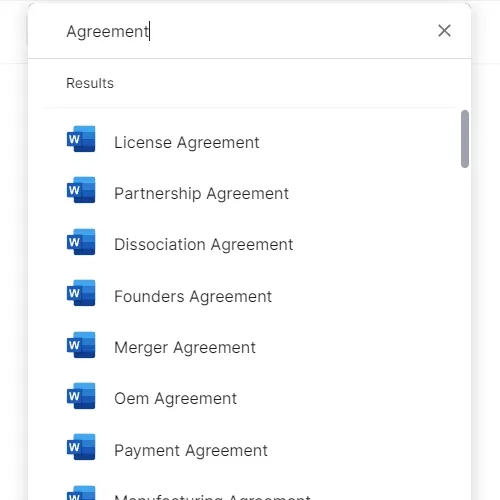
Download or open template

Access over 3,000+ business and legal templates for any business task, project or initiative.

2
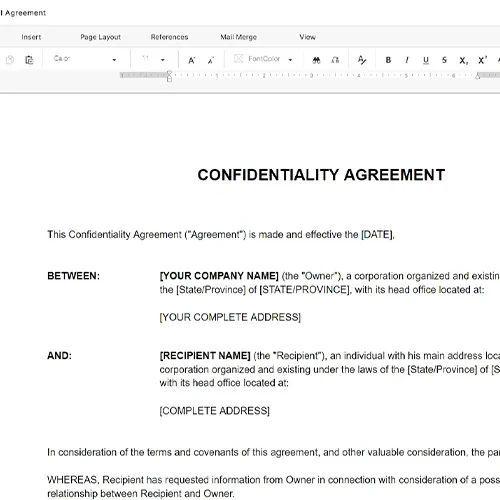
Edit and fill in the blanks with AI

Customize your ready-made business document template and save it in the cloud.

3
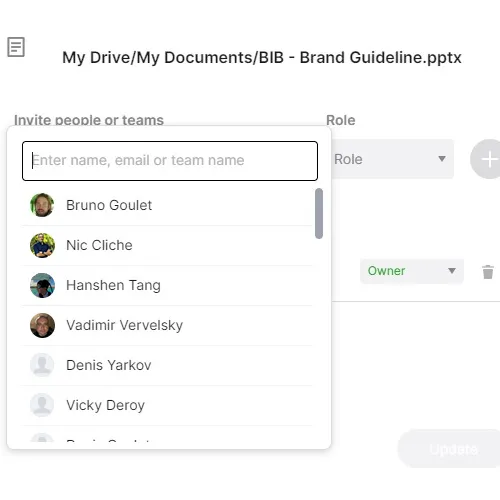
Save, Share, Send, Sign

Share your files and folders with your team. Create a space of seamless collaboration.

Save time, save money, and create top-quality documents.

β˜…β˜…β˜…β˜…β˜…

"Fantastic value! I'm not sure how I'd do without it. It's worth its weight in gold and paid back for itself many times."

Managing Director Β· Mall Farm
Robert Whalley
Managing Director, Mall Farm Proprietary Limited
β˜…β˜…β˜…β˜…β˜…

"I have been using Business in a Box for years. It has been the most useful source of templates I have encountered. I recommend it to anyone."

Business Owner Β· 4+ years
Dr Michael John Freestone
Business Owner
β˜…β˜…β˜…β˜…β˜…

"It has been a life saver so many times I have lost count. Business in a Box has saved me so much time and as you know, time is money."

Owner Β· Upstate Web
David G. Moore Jr.
Owner, Upstate Web

Run your business with a system β€” not scattered tools

Stop downloading documents. Start operating with clarity. Business in a Box gives you the Business Operating System used by over 250,000 companies worldwide to structure, run, and grow their business.

Free Forever PlanΒ Β·Β No credit card required