Press Release Templates
External media announcements — product launches, partnerships, milestones.
Instant downloads • Fully editable • Export to Word, Excel or PDF
12 templates
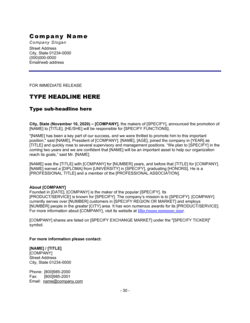
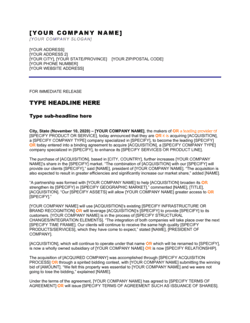
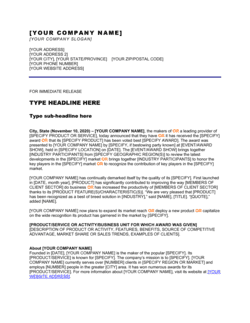
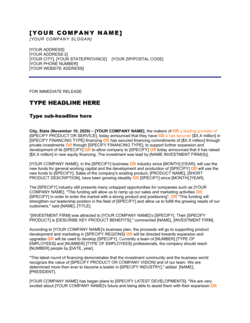
Includes Press Release — Company Reports Quarter Results, Press Release — Promotion of Employee, Press Release Acquisition Completed and 9 more.
At a glance
What it is
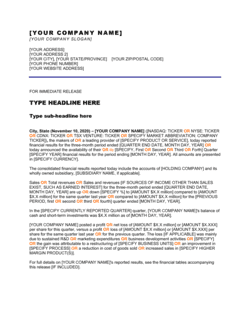
Press release templates are pre-structured documents that help businesses communicate newsworthy events — product launches, funding rounds, executive promotions, facility expansions — to journalists and media outlets in a format editors expect. Each template follows the inverted-pyramid structure: headline, dateline, lead paragraph, supporting detail, boilerplate, and contact block.
When you need one
Reach for a press release template any time your company has information that warrants external media attention — a signed partnership, a completed acquisition, a quarterly result, or a new office opening. Using a template ensures you cover every mandatory element before the release goes out, reducing back-and-forth with PR contacts.
Popular Press Release Templates
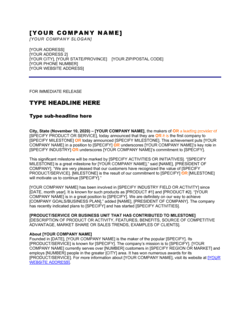
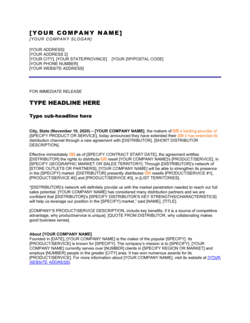
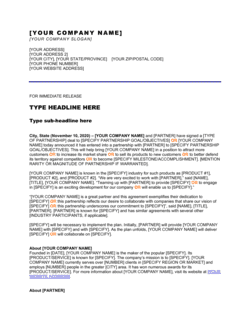
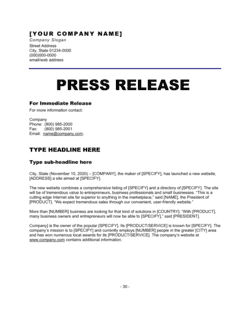
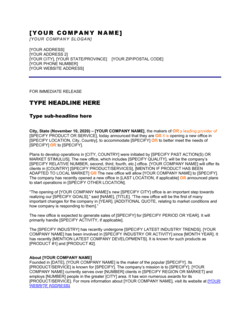
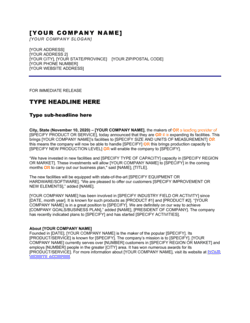
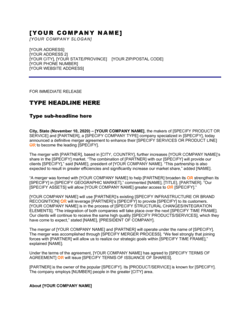
Which template fits your situation?
The right press release template depends on the type of news you are announcing. Match the scenario below to the template that fits the specific occasion — each one opens with the angle journalists expect for that story type.
How to write a press release
A press release that gets picked up by journalists follows a predictable structure; deviating from it signals inexperience and reduces coverage chances.
Choose the right template for your announcement type
Match the occasion — merger, award, promotion, milestone — to the specific template in this filter so the lead angle is pre-calibrated for that story.
Write a clear, factual headline
State the news directly in 10 words or fewer; avoid superlatives and focus on what actually happened or is happening.
Complete the lead paragraph first
Answer who, what, when, where, and why before expanding into supporting detail — editors read this paragraph and stop if it does not hook them.
Add one attributed executive quote
Write a quote that adds perspective rather than restating the lead, and attribute it to a named individual with a job title.
Fill in the boilerplate
Use a consistent company description paragraph of 50–75 words that you will reuse across every release you issue.
Verify all facts, names, and dates
Errors in a press release damage credibility with journalists and may require a correction release, so review before distribution.
Add media contact details and end notation
Include a direct phone number and email for your PR contact, then close with ### so editors know the document is complete.
Glossary
- inverted pyramid
- A writing structure that places the most important information first and progressively less critical details afterward, allowing editors to cut from the bottom without losing the core story.
- dateline
- The city name and release date that appear at the start of the first paragraph, indicating the geographic origin and timing of the announcement.
- boilerplate
- A standardized paragraph at the end of a press release that describes the issuing company and is reused across all releases.
- wire service
- A distribution service such as PR Newswire or Business Wire that transmits press releases to subscribing newsrooms simultaneously.
- embargo
- An agreement between a company and a journalist that the release contents will not be published until a specified date and time.
- lead paragraph
- The opening paragraph of a press release, which must answer who, what, when, where, and why in two to three sentences.
- media contact
- The named individual whose contact details appear at the bottom of a press release for journalists to reach out to for interviews or clarification.
- end notation
- The symbol ### or the word -END- placed after the final paragraph of a press release to signal to editors that the document is complete.
- media release form
- A signed permission document authorizing a company to use an individual's or organization's likeness, name, or content in its own media.
- earned media
- Media coverage generated by journalists covering your news, as opposed to paid advertising or owned content channels.
- media relations policy
- An internal document (such as D1394) that sets rules for who in a company is authorized to speak to journalists and how media inquiries are handled.
Browse other document types
Frequently asked questions
What press release templates are available?
12 press release templates, including Press Release — Company Reports Quarter Results, Press Release — Promotion of Employee, Press Release Acquisition Completed, Press Release Award Win, Press Release Company Has Received Financing.
What is the standard format for a press release?
A standard press release opens with a headline, followed by a dateline, a lead paragraph answering the five Ws, two to four supporting paragraphs, an executive quote, a boilerplate company description, a media contact block, and an end notation (###). This structure follows the inverted-pyramid style journalists use for their own articles. Sticking to this format increases the chance an editor will use the release with minimal rewriting. The templates in this filter are pre-built around this structure so you only need to fill in the specifics.
How long should a press release be?
Most press releases run between 400 and 600 words, fitting on a single printed page. Anything longer risks losing an editor's attention; anything shorter may not provide enough context for a reporter to write a story without calling you. The templates here are sized appropriately, with placeholder text that guides you to the right level of detail for each section.
Do I need a different template for each type of announcement?
Yes — the opening angle and required details differ by announcement type. A merger release needs deal terms and regulatory approvals; a promotion release needs the individual's background and new responsibilities; a financing release leads with round size and investor names. Using a template built for the specific occasion ensures you include the details editors look for in that story type.
What is the difference between a press release and a media release form?
A press release is an outbound announcement you send to journalists to generate coverage. A media release form (such as D12887 or D12886) is an inbound permission document — signed by an individual or organization — that authorizes your company to use their likeness, content, or name in your own media and marketing materials. Both appear in this filter because they relate to external media activity, but they serve opposite purposes.
When should I use the 'Responding to Inaccurate Press' template?
Use template D1395 when a published article, broadcast segment, or social media post contains factual errors about your company that could damage your reputation or mislead customers. It provides a structured, measured rebuttal format that states the facts without escalating conflict. Before issuing it, consider consulting a communications lawyer, particularly if the inaccurate coverage involves potential defamation.
Can I use one boilerplate paragraph across all my press releases?
Yes, and you should. A standard boilerplate describing your company — what it does, when it was founded, and where it operates — is intended to be reused verbatim across every release. Update it only when material facts change, such as a rebrand, new headquarters, or significant product pivot.
What goes in the media contact block?
The media contact block should include the full name, job title, direct phone number, and email address of the person journalists should contact for interviews or follow-up questions. This is typically a PR manager, communications director, or — in smaller companies — the CEO or founder. Make sure the contact listed is actually available and prepared to respond within a business day of the release going out.
Is a press release legally binding?
A press release is not a contract and is not legally binding in the way an agreement or notice is. However, statements made in a press release about public companies may be subject to securities disclosure regulations in many jurisdictions, and factually false statements could expose a company to defamation or fraud claims. Always ensure the information in your release is accurate, and consider having legal counsel review releases that involve financial results, litigation, or regulatory matters.
One document. A more organized business.
Your documents are part of how your business operates. Business in a Box brings the work, people and information around them into one workspace.
Start with the template you need. Bring the rest of your business together when you're ready.
How our templates are made
Every template is written by the Business in a Box editorial team and published by Bruno Goulet, CEO & Editor-in-Chief. Business in a Box has published business and legal templates for more than 20 years. Each document page explains what the template covers and how to fill it in; for legal documents, have a qualified professional review the final version when the stakes warrant it.