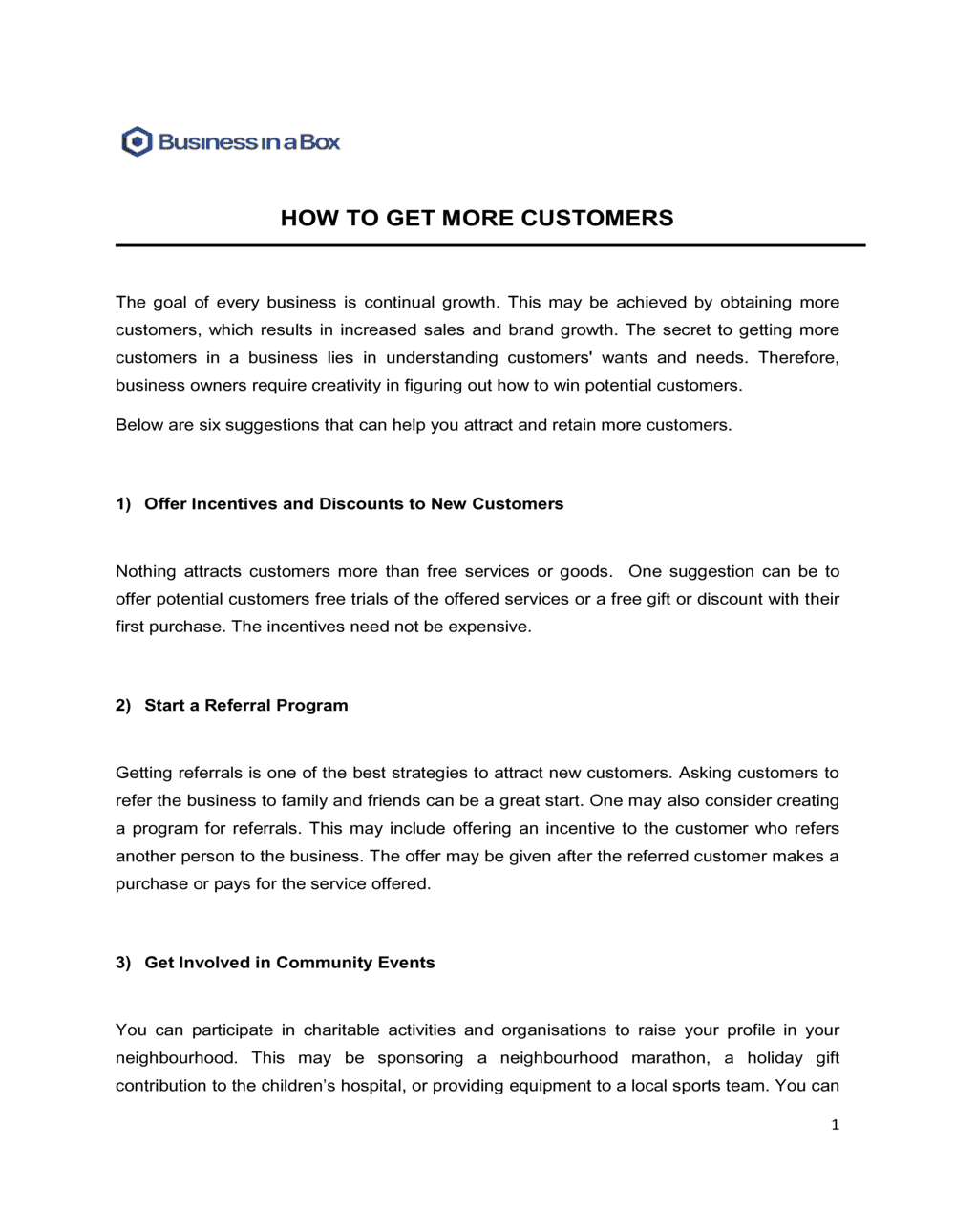
How To Get More Customers

Free Word download β€’ Edit online β€’ Save & share with Drive β€’ Export to PDF

2 pagesβ€’20–30 min to fillβ€’Difficulty: Standard
Learn more ↓
FreeHow To Get More Customers Template

At a glance

What it is
A How To Get More Customers plan is a structured operational document that maps your target customer profile, acquisition channels, conversion tactics, and measurable goals into a single actionable plan. This free Word download gives you a step-by-step framework you can edit online and export as PDF to align your sales, marketing, and operations teams around a concrete customer-growth strategy.
When you need it
Use it when revenue has plateaued, when you are entering a new market, or when you need to replace lost customers with a systematic approach rather than ad hoc tactics. It is equally useful for a first-year business building its initial customer base and an established business scaling into a new segment.
What's inside
Ideal customer profiles, a channel-by-channel acquisition plan, referral and retention hooks, a conversion funnel map, KPIs with targets, a 90-day action calendar, and a budget summary. The plan covers both inbound and outbound acquisition so every growth lever is accounted for in one document.

What is a How To Get More Customers Plan?

A How To Get More Customers plan is a structured operational document that translates the goal of growing your customer base into a concrete, channel-by-channel action plan with measurable targets and assigned owners. It defines exactly who your ideal customer is, which channels will reach them most efficiently, how prospects will be converted through the funnel, and which KPIs will confirm whether the strategy is working. Unlike a generic marketing plan, this document is built around a specific customer-number target and a 90-day execution calendar β€” making it immediately actionable for a small team without a large marketing department.

Why You Need This Document

Without a written acquisition plan, growth efforts default to whatever tactic is most visible or most comfortable β€” a social post here, a cold email there β€” with no way to measure what is actually working or why. The cost of that approach compounds over time: budget is spread too thin to produce results on any channel, follow-up sequences are never built, and the team cannot identify whether a slow month reflects a broken funnel or simply under-investment. A completed acquisition plan replaces those guesses with data-backed channel priorities, a specific 90-day calendar, and outcome metrics that surface problems before they become revenue gaps. For any business that depends on adding new customers to grow, this template provides the operational structure that turns intention into a repeatable, improvable process.

Which variant fits your situation?

If your situation is…Use this template
Starting from zero customers and needing a full go-to-market strategyGo-To-Market Strategy Plan
Focused entirely on digital and online channel growthDigital Marketing Plan
Growing an existing customer base through upsell and cross-sellCustomer Retention Plan
Building a structured outbound sales pipelineSales Plan
Launching a referral or affiliate program to generate leadsReferral Program Plan
Entering a new geographic or demographic market segmentMarket Expansion Plan
Tracking new-customer acquisition performance against targetsSales Report

Common mistakes to avoid

❌ No defined ideal customer profile

Why it matters: Without a specific ICP, every channel targets a different audience and messaging is generic. Sales and marketing spend is dispersed across prospects who are unlikely to convert or retain.

Fix: Spend one hour profiling your five best current customers before writing any other section. The ICP is the filter every other decision runs through.

❌ Prioritizing too many channels simultaneously

Why it matters: Running six acquisition channels with split budgets means none reaches the spend threshold needed to generate reliable data or volume, and the team cannot execute any channel well.

Fix: Pick two channels to own completely for the first 90 days. Add a third only after the first two are producing consistent, measurable results.

❌ Tracking activity instead of outcomes

Why it matters: Measuring emails sent, posts published, or ads launched tells you nothing about whether customers are being acquired. Teams optimize for the metric they track, so activity metrics produce activity, not customers.

Fix: Replace activity KPIs with outcome KPIs: leads generated, demos booked, trials started, and customers closed. Review these weekly.

❌ Ignoring the middle of the funnel

Why it matters: Generating leads without a nurture sequence or follow-up process means prospects who showed genuine interest simply go cold. Industry data consistently shows that 50% of qualified leads are not followed up with more than once.

Fix: For every lead-generation tactic in the plan, write the corresponding follow-up sequence β€” email cadence, call timing, and re-engagement trigger β€” before launching.

❌ Setting a budget without reference to CAC data

Why it matters: A $2,000/month budget sounds concrete, but if the channel's CAC is $800 per customer, it produces 2.5 new customers per month β€” which may fall far short of the stated growth goal.

Fix: Work backward from the customer target: multiply target new customers by estimated CAC per channel to derive the minimum required budget, then allocate from there.

❌ Writing the plan but not assigning owners

Why it matters: Plans without named owners for each action are aspirational documents. When accountability is shared, it is owned by no one β€” and deadlines slip without consequence.

Fix: Every action in the 90-day calendar must have a single named owner and a specific due date. Review the calendar in the weekly team meeting.

The 10 key sections, explained

Executive Summary and Growth Goal

Ideal Customer Profile (ICP)

Competitive Landscape and Positioning

Acquisition Channel Plan

Conversion Funnel and Tactics

Referral and Partnership Strategy

Messaging and Offer Framework

KPIs and Targets

90-Day Action Calendar

Budget Summary

How to fill it out

  1. 1

    Define your growth goal with a baseline

    Enter your current active customer count, the target number for the plan period (90 days or 12 months), and the revenue each new customer represents on average. This baseline anchors every other section.

    πŸ’‘ If you do not know your average revenue per customer, calculate it from the last 12 months of sales divided by total active customers β€” even an approximate number is better than a blank.

  2. 2

    Build your ideal customer profile from your best current customers

    Identify your top 10 current customers by revenue or lifetime value. List what they have in common β€” industry, size, job title, buying trigger. Use those commonalities to write a one-paragraph ICP.

    πŸ’‘ Customers who referred others, renewed without prompting, or expanded their spend are better ICP anchors than your largest one-time buyers.

  3. 3

    Select and rank your acquisition channels

    List every channel available to you and estimate the CAC for each based on past results or industry benchmarks. Rank them by CAC from lowest to highest, then assign budget to the top two or three before adding others.

    πŸ’‘ Referrals and organic SEO typically have the lowest CAC but the longest ramp time; paid search has a higher CAC but generates results within days. Balance quick wins with long-term capacity.

  4. 4

    Map the conversion funnel for each channel

    For each priority channel, write out the specific sequence from first impression to closed sale β€” the ad, the landing page, the lead magnet, the nurture email, the sales call, and the close. Assign a realistic conversion rate to each transition.

    πŸ’‘ Industry benchmark conversion rates: SaaS free trial to paid 15–25%, B2B demo to proposal 30–50%, proposal to close 25–40%. If your current rates are below benchmark, the funnel section is where to identify the constraint.

  5. 5

    Write channel-specific messaging

    Draft a headline and call to action for each channel that speaks directly to the ICP's pain point and your specific differentiator. Avoid generic value propositions like 'save time and money.'

    πŸ’‘ The strongest acquisition messages name the specific problem, the specific outcome, and the timeframe β€” for example, 'Get your first 10 paying customers in 30 days without cold calling.'

  6. 6

    Set KPIs and assign owners

    For each channel and each funnel stage, assign a numerical target and a named owner. Enter these into the KPI table and confirm the review cadence β€” weekly for pipeline metrics, monthly for CAC and conversion rates.

    πŸ’‘ Limit KPIs to five to seven metrics total. A dashboard with 20 metrics is never reviewed seriously β€” pick the two or three that most directly predict new customer volume.

  7. 7

    Build the 90-day action calendar

    Convert each channel plan into specific weekly actions with owners and due dates. Check that lead generation actions in the first month are paired with follow-up and close actions in months two and three.

    πŸ’‘ Treat Week 1 actions as non-negotiable setup tasks β€” CRM configuration, ad account setup, email sequence drafting. Delaying setup by two weeks compresses your results window to 60 days.

  8. 8

    Validate the budget against the CAC target

    Divide total planned spend by the target number of new customers. If the implied CAC is higher than your LTV allows, cut low-priority channels or extend the plan timeline rather than exceeding the LTV:CAC ratio of 3:1 or better.

    πŸ’‘ A 3:1 LTV-to-CAC ratio is the standard minimum benchmark for sustainable acquisition. Below 3:1, you are acquiring customers at a loss even before accounting for overhead.

Frequently asked questions

What is a customer acquisition plan?

A customer acquisition plan is a structured document that defines who your target customers are, which channels you will use to reach them, how you will convert them from prospects to paying customers, and what KPIs you will track to measure success. It replaces ad hoc tactics with a coordinated, measurable process that sales and marketing can execute together over a defined period β€” typically 90 days or 12 months.

How do I get more customers for a small business?

Start by identifying your best current customers and defining what they have in common β€” that is your ideal customer profile. Then rank your available acquisition channels by cost per customer and focus your first 90 days on the two channels with the lowest CAC and fastest time-to-result. Pair every lead-generation tactic with a follow-up sequence, set a specific weekly new-customer target, and review progress against it every week. Consistency in two channels outperforms sporadic effort across eight.

What is the most cost-effective way to acquire new customers?

Referrals from existing customers consistently produce the lowest CAC across most industries β€” typically 3–5x lower than paid advertising. SEO and content marketing have near-zero marginal CAC once assets are built, but require 6–12 months to generate meaningful volume. For immediate results, a targeted outbound sequence to a well-defined ICP list typically outperforms broad paid advertising for B2B businesses. The right answer depends on your ACV, sales cycle length, and existing customer base.

How many acquisition channels should I use at once?

Two to three channels is the practical limit for most teams without a dedicated marketing function. Running more dilutes budget below the spend threshold needed to generate reliable data, splits team attention, and makes it impossible to identify which channel is driving results. Add a new channel only after the existing ones are producing consistent, measurable output β€” typically after 60–90 days of data.

What KPIs should I track in a customer acquisition plan?

The five core metrics are: new customers per month (the headline outcome), blended CAC (total acquisition spend divided by new customers), lead-to-customer conversion rate (efficiency of the funnel), LTV-to-CAC ratio (sustainability of the acquisition economics, target 3:1 or better), and channel-level lead volume (to identify which channels are scaling). Track these weekly for pipeline metrics and monthly for CAC and LTV calculations.

How is a customer acquisition plan different from a marketing plan?

A marketing plan covers the full scope of marketing activity β€” brand, content, campaigns, events, and communications β€” for a business over a year or more. A customer acquisition plan is narrower and more immediately operational: it focuses specifically on the channels, tactics, budget, and actions needed to add a defined number of new customers in a defined period. The acquisition plan is one component of a broader marketing plan, not a replacement for it.

How long does it take to see results from a customer acquisition plan?

Outbound channels β€” cold email, paid search, direct outreach β€” can generate leads within 1–2 weeks of launch. SEO and content channels typically require 3–6 months before producing measurable customer volume. Referral programs produce results in direct proportion to how actively you ask for referrals β€” a passive program takes months; a direct ask to your top ten customers can produce referrals within days. Plan your 90-day calendar to include at least one fast channel and one long-term channel.

Should I use inbound or outbound tactics to get more customers?

The right balance depends on your average contract value and sales cycle. B2B businesses with ACV above $5,000 and a multi-touch sales cycle typically see better ROI from outbound β€” direct outreach to a targeted list produces qualified conversations faster than waiting for inbound volume. B2C and lower-ACV businesses usually benefit more from inbound channels where the economics of content and paid advertising scale at lower margins. Most businesses need both; the acquisition plan should specify which channels are prioritized and why.

What is a good LTV-to-CAC ratio?

A 3:1 ratio β€” where the lifetime value of a customer is at least three times the cost to acquire them β€” is the standard minimum benchmark for sustainable acquisition economics. Below 3:1, you are acquiring customers at a loss once overhead is included. Above 5:1 often indicates you are under-investing in acquisition and leaving growth on the table. SaaS businesses typically target 3:1 with a CAC payback period of 12 months or less; e-commerce often targets a shorter payback window of 3–6 months.

How this compares to alternatives

vs Marketing Plan

A marketing plan covers the full scope of marketing activity β€” brand positioning, content calendar, campaign schedule, and communications β€” typically for a 12-month period. A customer acquisition plan is narrower and more operationally immediate: it focuses on the specific channels, conversion tactics, and actions needed to hit a new-customer number in 90 days. Use the marketing plan for annual strategic direction and the acquisition plan for sprint-level execution.

vs Sales Plan

A sales plan focuses on the pipeline, quota, territory, and process for the sales team to close revenue from leads already in the funnel. A customer acquisition plan starts upstream β€” it defines how those leads are generated in the first place. The two documents are complementary: the acquisition plan feeds the top of the funnel that the sales plan then works to close.

vs Digital Marketing Plan

A digital marketing plan covers online channels specifically β€” SEO, paid search, email, social, and content β€” with detailed campaign-level planning. A customer acquisition plan is channel-agnostic and includes offline acquisition methods such as events, direct mail, referrals, and partnerships alongside digital channels. Use the digital marketing plan when online channels are your primary growth lever; use the acquisition plan when you need to coordinate online and offline tactics together.

vs Business Plan

A business plan addresses the full company strategy β€” market, team, operations, and financials β€” for an investor or lender audience. The customer acquisition section of a business plan is typically 2–4 pages. A standalone customer acquisition plan expands that section into a fully operational document with channel-level tactics, a 90-day action calendar, and specific KPIs β€” built for the team executing growth, not a capital-raise audience.

Industry-specific considerations

Professional Services

Referral programs and LinkedIn outreach dominate acquisition; the plan should quantify referral conversion rates and specify a structured client-ask process alongside any paid channel.

Retail / E-commerce

Paid social and email re-engagement drive the majority of new customer volume; the plan should model CAC payback against average order value and repeat purchase rate.

SaaS / Technology

Free trial and freemium conversion funnels require a specific activation milestone in the plan; CAC payback period and MRR per new customer are the key financial metrics.

Food & Beverage / Restaurant

Local SEO, Google Business Profile optimization, and loyalty program enrollment are the highest-ROI acquisition levers; the plan should include a first-visit offer to convert walk-ins to repeat customers.

Construction and Trades

Referrals from completed jobs and Google Reviews are the primary acquisition channels; the plan should include a post-job review-request process and a referral incentive for past clients.

Healthcare / Wellness

Patient referrals, local SEO, and insurance-network listing are the dominant channels; acquisition messaging must comply with applicable advertising regulations and avoid unsubstantiated outcome claims.

Template vs pro β€” what fits your needs?

PathBest forCostTime
Use the templateSmall business owners, startup founders, and sales or marketing managers building or refreshing a customer acquisition strategyFree3–6 hours to complete the plan
Template + professional reviewBusinesses spending more than $5,000/month on acquisition or preparing the plan for a board or investor audience$300–$1,500 for a growth consultant or fractional CMO review1–3 days with review and revision
Custom draftedSeries A+ companies, businesses entering a new market, or organizations that need a fully researched competitive analysis and financial model built alongside the plan$2,000–$8,000 for a marketing strategy agency or growth consultant2–4 weeks

Glossary

Ideal Customer Profile (ICP)
A detailed description of the type of company or individual most likely to buy, retain, and refer your product or service β€” used to focus acquisition resources on high-probability targets.
Customer Acquisition Cost (CAC)
Total sales and marketing spend divided by the number of new customers acquired in the same period β€” the primary efficiency metric for any acquisition plan.
Conversion Rate
The percentage of prospects at a given stage who advance to the next stage of the funnel β€” for example, leads who become paying customers.
Lead Generation
The process of attracting potential customers and collecting their contact information or intent signals for follow-up by sales or marketing.
Inbound Marketing
A strategy that attracts customers through content, SEO, and organic channels β€” prospects find you rather than you reaching out to them.
Outbound Marketing
A strategy that proactively reaches prospects through cold email, cold calling, paid advertising, or direct mail β€” you initiate contact.
Sales Funnel
The staged sequence a prospect moves through from first awareness to closed sale, typically: awareness, interest, consideration, intent, and purchase.
Net Promoter Score (NPS)
A customer satisfaction metric based on one question β€” 'How likely are you to recommend us?' β€” scored 0–10 and used to predict referral behavior.
Customer Lifetime Value (LTV)
The total gross profit expected from a single customer over the full duration of the relationship β€” used to determine how much you can afford to spend on acquisition.
Churn Rate
The percentage of customers who stop buying within a given period β€” directly subtracts from the net customer growth any acquisition plan produces.
Channel Mix
The combination of acquisition channels β€” paid search, social, email, referral, events, outbound β€” that together drive new customer volume.

Part of your Business Operating System

This document is one of 3,000+ business & legal templates included in Business in a Box.

  • Fill-in-the-blanks β€” ready in minutes
  • 100% customizable Word document
  • Compatible with all office suites
  • Export to PDF and share electronically

Create your document in 3 simple steps.

From template to signed document β€” all inside one Business Operating System.
1
Download or open template

Access over 3,000+ business and legal templates for any business task, project or initiative.

2
Edit and fill in the blanks with AI

Customize your ready-made business document template and save it in the cloud.

3
Save, Share, Send, Sign

Share your files and folders with your team. Create a space of seamless collaboration.

Save time, save money, and create top-quality documents.

β˜…β˜…β˜…β˜…β˜…

"Fantastic value! I'm not sure how I'd do without it. It's worth its weight in gold and paid back for itself many times."

Managing Director Β· Mall Farm
Robert Whalley
Managing Director, Mall Farm Proprietary Limited
β˜…β˜…β˜…β˜…β˜…

"I have been using Business in a Box for years. It has been the most useful source of templates I have encountered. I recommend it to anyone."

Business Owner Β· 4+ years
Dr Michael John Freestone
Business Owner
β˜…β˜…β˜…β˜…β˜…

"It has been a life saver so many times I have lost count. Business in a Box has saved me so much time and as you know, time is money."

Owner Β· Upstate Web
David G. Moore Jr.
Owner, Upstate Web

Run your business with a system β€” not scattered tools

Stop downloading documents. Start operating with clarity. Business in a Box gives you the Business Operating System used by over 250,000 companies worldwide to structure, run, and grow their business.

Free Forever PlanΒ Β·Β No credit card required