Procedure Templates
Standard operating procedures, how-to operational instructions.
Instant downloads • Fully editable • Export to Word, Excel or PDF
11 templates
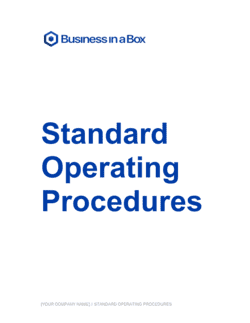
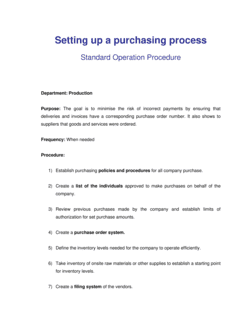
Includes SOP, How To Setup A Purchasing Process, Change Management Procedure and 8 more.
At a glance
What it is
Procedure templates are structured documents that capture how a task or workflow should be performed, step by step, so that any employee can execute it consistently. This filter surfaces every standard operating procedure, process guide, how-to instruction, and workflow checklist in the catalog — from hotel and restaurant SOPs to accounting procedures and change management workflows.
When you need one
Operators reach for procedure templates whenever a task is repeated often enough that inconsistency creates risk — onboarding a new hire, handling a guest complaint, approving a check, or responding to an emergency. A written procedure is also the first thing an auditor, franchise partner, or new manager will ask to see.
Popular Procedure Templates
Which template fits your situation?
The right procedure template depends on the specific operational context — which department owns the task, how frequently it runs, and what the consequence of error is. Use the scenarios below to match your immediate need to the best starting point.
How to write a procedure document
A usable procedure is one that a new employee can follow without asking for help — the steps below take you from blank page to audit-ready document in a single session.
Identify the task and its owner
Name the specific repeatable task you are documenting and confirm which role is ultimately responsible for executing it correctly.
Choose the right template
Select a procedure template that matches your context — a checklist-format SOP for simple tasks, an industry-specific template for hospitality or finance, or the general Standard Operating Procedures template for everything else.
Define scope and affected roles
List every department, job title, or location the procedure touches so readers know immediately whether it applies to them.
Draft the step-by-step instructions
Write each action as a short imperative sentence, numbered in the exact sequence an executor should follow, and flag any decision points where the path can branch.
Add references and required resources
Link to or list every form, system login, tool, or supporting document the executor needs before they begin.
Test the procedure with a real user
Have someone unfamiliar with the task follow the draft exactly and note every point where they needed to ask a question — those gaps become revision targets.
Publish, train, and schedule a review date
Store the approved procedure in a shared location, brief affected staff, and set a calendar reminder to review it at least annually or after any significant process change.
Glossary
- standard operating procedure (SOP)
- A written document that describes the exact steps an employee must follow to complete a specific recurring task consistently and correctly.
- process documentation
- The practice of capturing how a business process works in writing — including inputs, outputs, responsible parties, and step sequences — so it can be repeated, trained, and improved.
- scope
- The section of a procedure that defines which roles, locations, or situations the document applies to and any explicit exclusions.
- version control
- A system for tracking changes to a procedure document over time, typically by recording the date of each revision, what changed, and who approved the update.
- decision point
- A step in a procedure where the executor must choose between two or more paths depending on conditions — usually written as an if/then statement.
- process owner
- The individual or role accountable for ensuring a procedure is current, followed, and improved over time.
- checklist SOP
- A procedure document formatted as a sequential list of verifiable action items rather than a narrative, suited to tasks where the executor already has background knowledge.
- business process mapping
- The creation of a visual diagram — often a flowchart — that shows the sequence of activities, handoffs, and decision points within a business process.
- change management procedure
- A documented workflow that governs how proposed changes to systems, processes, or structures are submitted, evaluated, approved, communicated, and rolled back if needed.
- records retention
- The policy-driven requirement to save evidence that a procedure was followed, specifying the format, storage location, and minimum retention period for those records.
- continuous improvement
- An ongoing cycle of reviewing procedure performance, identifying inefficiencies or errors, making targeted changes, and measuring the effect of those changes.
Procedure Templates by department
Browse other document types
Frequently asked questions
What procedure templates are available?
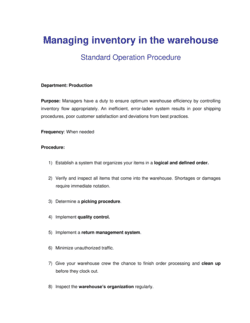
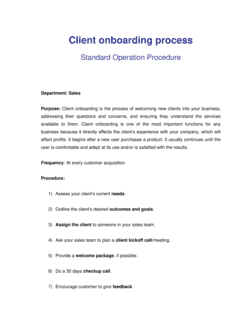
11 procedure templates, including SOP, How To Setup A Purchasing Process, Change Management Procedure, How To Manage Inventory In The Warehouse, Client Onboarding Process.
What is a standard operating procedure (SOP) template?
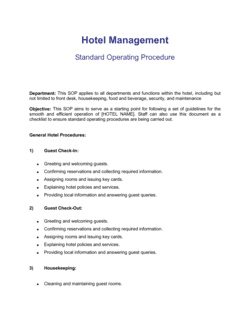
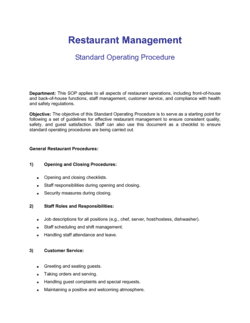
An SOP template is a pre-structured document that gives you the headings, sections, and formatting conventions for writing a step-by-step operational instruction — you fill in the task-specific content rather than building the document architecture from scratch. Business in a Box offers both general SOP templates and industry-specific ones, such as the Hotel Standard Operating Procedure and the Restaurant Standard Operating Procedure, so you can start from a context that already matches your operation.
How is a procedure different from a policy?
A policy states the rule — what is required, permitted, or prohibited. A procedure describes exactly how to comply with that rule in practice. Most well-run organizations maintain both: the policy provides the authority and the rationale; the procedure provides the step-by-step execution path. This catalog includes both policy and procedure templates, and many operators use them together.
Do I need a separate SOP for every task in my business?
Not necessarily. SOPs add the most value for tasks that are repeated frequently, involve multiple people or handoffs, carry a compliance or safety risk, or are difficult to retrain from memory alone. Low-frequency tasks with minimal consequences are often better handled by a simple checklist. The Checklist Standard Operating Procedure template in this filter is a good middle ground — it gives you structure without requiring a full narrative document.
How long should a procedure document be?
Length should match complexity, not perceived importance. A straightforward front-desk check-in procedure might need two pages; a multi-department accounts-payable procedure might run to ten or more. The test is whether a new employee can follow it without asking questions — if the answer is yes, the document is long enough.
Can I use these templates for ISO or other compliance audits?
Procedure templates from this catalog are structured to meet common documentation standards, including the components auditors typically look for: purpose, scope, responsibilities, steps, records, and revision history. However, specific certification requirements (ISO 9001, ISO 27001, etc.) may impose additional formatting or content rules. Review the relevant standard and, if needed, consult a certified management-systems consultant before submitting documentation for formal audit.
How often should I review and update my procedures?
Industry best practice suggests a formal review at least once a year for routine operational procedures, and immediately following any system change, regulatory update, incident, or significant personnel change that affects the task. The review-and-revision schedule section included in most templates in this filter helps you track version history and communicate changes to affected staff.
What is the difference between a procedure template and a process map?
A process map is a visual diagram — typically a flowchart — that shows the flow of activities, decision points, and handoffs across roles or departments. A procedure document is a written narrative or numbered list that an individual executor follows. Both serve the same underlying goal: operational consistency. This filter includes both the Process Documentation Template for written procedures and the Business Process Mapping template for visual workflows; many teams use them together.
Are these procedure templates specific to any industry?
The filter includes both general-purpose procedure templates and industry-specific ones. The Hotel Standard Operating Procedure and Restaurant Standard Operating Procedure are tailored to hospitality operations; the Accounting Policies and Procedures template is built for finance teams. The general Standard Operating Procedures template and the Checklist Standard Operating Procedure template can be adapted to any industry with minimal modification.
Can a small business benefit from formal procedure documents?
Yes — in many cases more than a large one. A small business typically cannot afford the rework, customer complaints, or compliance failures that inconsistent execution causes. Written procedures also make it significantly faster to onboard new employees, delegate tasks to contractors, or hand off operations to a manager, which is critical for owners who want to scale or step back from day-to-day involvement.
One document. A more organized business.
Your documents are part of how your business operates. Business in a Box brings the work, people and information around them into one workspace.
Start with the template you need. Bring the rest of your business together when you're ready.
How our templates are made
Every template is written by the Business in a Box editorial team and published by Bruno Goulet, CEO & Editor-in-Chief. Business in a Box has published business and legal templates for more than 20 years. Each document page explains what the template covers and how to fill it in; for legal documents, have a qualified professional review the final version when the stakes warrant it.