RV Repair Shop Business Plan Template

Free Word download β€’ Edit online β€’ Save & share with Drive β€’ Export to PDF

38 pagesβ€’3h 5m – 4h 10m to fillβ€’Difficulty: Expert
Learn more ↓
FreeRV Repair Shop Business Plan Template

At a glance

What it is
An RV Repair Shop Business Plan is a structured document that defines the strategy, operations, market opportunity, and financial projections for a recreational vehicle repair and service business. This free Word download gives you a complete, investor- and lender-ready framework you can edit online and export as PDF to support a bank loan application, attract investors, or guide internal growth planning.
When you need it
Use it when launching a new RV repair shop, applying for an SBA or conventional business loan, seeking an investor partner, or formalizing the growth strategy for an existing shop. It is also essential when pursuing a franchise or dealership service agreement that requires a written operating plan.
What's inside
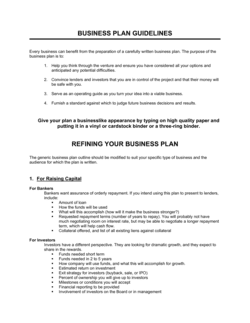
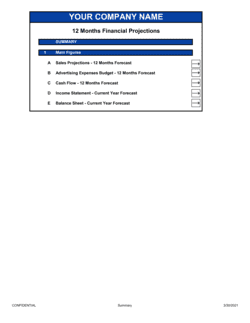
Executive summary, company overview, market and competitive analysis, services and pricing structure, marketing and customer acquisition strategy, operations and staffing plan, and three-to-five year financial projections including startup costs, P&L, and cash flow statements.

What is an RV Repair Shop Business Plan?

An RV Repair Shop Business Plan is a structured planning and financing document that maps the complete strategy for launching or growing a recreational vehicle repair and service business β€” covering market opportunity, service offerings, operations, staffing, and three-to-five year financial projections. Unlike a general auto repair plan, it addresses the specialized systems unique to RVs: propane and 120V electrical, slideout mechanisms, roof sealing, freshwater and wastewater plumbing, and integrated appliances. The result is a document that demonstrates both technical credibility and financial viability to lenders, investors, and business partners reviewing the plan.

Why You Need This Document

Without a written business plan, SBA and conventional lenders will not process a loan application β€” and no bank will approve equipment financing or a commercial lease without documented revenue projections tied to realistic operating assumptions. Beyond financing, the planning process itself forces you to confront the variables that determine whether the shop survives its first year: how many bays you need to break even, whether your local market can support your target labor rate, how long it will take to hire certified technicians, and how much working capital you need before revenue reaches a sustainable level. Shops that open without this analysis routinely underestimate startup costs by 30–40% and overestimate first-year revenue by a similar margin. This template gives you a structured, lender-ready framework that turns those blind spots into decisions you can act on before they cost you the business.

Which variant fits your situation?

If your situation is…Use this template
Opening a full-service brick-and-mortar RV repair facilityRV Repair Shop Business Plan
Operating a mobile RV repair service from a service vehicleMobile Auto Repair Business Plan
Quick internal planning or early concept validationOne-Page Business Plan
Raising equity investment from angel investors or partnersInvestor Business Plan
Applying for an SBA 7(a) or conventional equipment loanBank Loan Business Plan
Expanding an existing RV shop to a second locationBusiness Expansion Plan
Adding an RV parts retail or accessory sales divisionRetail Business Plan

Common mistakes to avoid

❌ Projecting revenue as a percentage of the local market

Why it matters: Claiming '2% of the $50M local RV service market' tells a lender nothing about whether your specific bays can generate that revenue. The math often doesn't survive scrutiny.

Fix: Build projections from the ground up: number of bays Γ— billable hours per day Γ— labor rate + parts revenue. Show the assumptions explicitly in a separate row.

❌ Omitting working capital from startup costs

Why it matters: Most RV repair shops take 4–8 months to reach cash-flow breakeven. Shops that open undercapitalized exhaust their reserves before word-of-mouth and referrals reach critical mass.

Fix: Include a minimum of 6 months of fixed operating costs as a working capital line in your startup budget, separate from equipment and build-out.

❌ Using a single flat labor rate for all service types

Why it matters: Chassis and drivetrain work carries different margin and time profiles than appliance repair or cosmetic restoration. A blended rate produces a misleading average ticket and masks which service lines are actually profitable.

Fix: Break out labor rates or flat-rate pricing by service category and calculate gross margin per service type so you can prioritize high-margin work in your scheduling.

❌ Ignoring technician availability in the hiring plan

Why it matters: RVIA-certified technicians are in short supply in most US markets. Projecting full bay utilization at Month 1 without a credible hiring plan makes the entire revenue model unbelievable to lenders.

Fix: Build your hiring timeline into the financial model β€” show reduced revenue for the first 2–3 months until the full technician team is in place, and document your active recruiting strategy.

The 10 key sections, explained

Executive Summary

Company Overview

Market Analysis

Competitive Analysis

Services and Pricing

Marketing and Customer Acquisition

Operations and Staffing Plan

Management Team

Financial Projections

Startup Costs and Funding Requirements

How to fill it out

  1. 1

    Complete the company overview and define your service model

    Enter your legal entity name, formation date, location, facility size, and number of service bays. Choose your primary service model β€” full-service shop, mobile, or hybrid β€” and state it clearly here.

    πŸ’‘ Confirm your bay count before filling in any financial projections β€” every revenue figure flows from the number of bays multiplied by billable hours per day.

  2. 2

    Research and localize your market data

    Pull registered RV counts for your county or metropolitan area from your state DMV database or RVIA's annual ownership report. Calculate the number of RV owners within your target service radius using a mapping tool.

    πŸ’‘ Cross-reference the local campground and RV park count within 30 miles β€” each park is a referral partner and a proxy for local RV traffic density.

  3. 3

    Map competitors and define your differentiation

    List every dealer service department, independent shop, and mobile technician within 25 miles. Record their labor rates, wait times, certifications, and customer reviews. Then write one specific paragraph on why your shop wins.

    πŸ’‘ Call competitors posing as a customer to confirm actual scheduling wait times β€” this is your most powerful differentiator if you can guarantee same-week service.

  4. 4

    Build your services menu with average ticket values

    List every service category you will offer and assign an average labor time, parts cost, and total ticket value. Sum across expected weekly volume to produce a weekly revenue estimate you can use as a sanity check on your financial model.

    πŸ’‘ Seasonal services β€” winterization, de-winterization, pre-trip inspections β€” are high-margin, bookable in advance, and excellent for cash-flow smoothing. Feature them prominently.

  5. 5

    Define your marketing channels and budget

    Select two to three primary acquisition channels and assign a monthly budget and expected customer acquisition cost to each. Tie the customer volume from your marketing section directly to the revenue line in your financial model.

    πŸ’‘ Google Local Services Ads with RVIA certification badge typically deliver lower CAC than general Google Search for RV repair β€” set up a separate campaign for each service category.

  6. 6

    Build the financial model from bay hours up

    Start with your bay count and multiply by estimated billable hours per day, days per month, and your labor rate to get a monthly labor revenue ceiling. Add parts revenue at your target margin. Then layer in fixed costs β€” rent, payroll, insurance, utilities β€” to calculate breakeven.

    πŸ’‘ Model a conservative scenario at 55% bay utilization and a base case at 70% β€” most SBA lenders want to see the business survive at below-average utilization.

  7. 7

    Itemize startup costs and state the funding ask

    List every pre-opening expense in a table with a dollar amount and source quote where possible. Total them, add six months of working capital, and state the funding amount, instrument, and equity injection clearly.

    πŸ’‘ Get actual equipment quotes from lift and diagnostic tool suppliers before writing the startup cost section β€” estimated ranges undermine lender confidence.

  8. 8

    Write the executive summary last

    Compress the most compelling data point from each section into a 1–2 page summary: market size, competitive advantage, team credentials, Year 1 and Year 3 revenue, and the funding ask with expected ROI or loan payback period.

    πŸ’‘ Your SBA loan officer will read the executive summary and financials first. If the numbers in the summary do not match the model exactly, the application stalls.


Frequently asked questions

What is an RV repair shop business plan?

An RV repair shop business plan is a structured document that outlines the strategy, services, market opportunity, operations, staffing, and financial projections for a recreational vehicle repair and service business. It is used to secure bank or SBA financing, attract investors or partners, and serve as an internal operating roadmap. A complete plan covers 10 core sections and includes a three-to-five year financial model anchored to service bay capacity.

How much does it cost to open an RV repair shop?

Startup costs for a typical full-service RV repair shop range from $150,000 to $500,000 depending on facility size, equipment, location, and whether you are leasing or purchasing real estate. The largest line items are typically facility build-out or leasehold improvements ($50,000–$150,000), vehicle lifts and diagnostic equipment ($30,000–$80,000), initial parts inventory ($20,000–$50,000), and six months of working capital. Mobile-first operations can launch for $40,000–$80,000.

Do I need RVIA certification to open an RV repair shop?

No law requires RVIA certification to operate an RV repair shop, but certification is a significant competitive differentiator and is required to perform warranty work for most RV manufacturers. The RVIA/RVDA certification program covers electrical, plumbing, appliance, and chassis systems. Certified shops typically command higher labor rates and gain access to manufacturer warranty reimbursement programs that non-certified competitors cannot serve.

How do I calculate how many service bays I need?

Start with your Year 1 revenue target and work backward. Divide target monthly revenue by your expected average ticket value to get the number of jobs per month. Divide jobs per month by the number of working days to get daily throughput. Each bay can typically handle one to two RV jobs per day depending on service complexity. Most small shops start with three to five bays and expand as utilization exceeds 75%.

What financial projections does an RV repair shop business plan need?

A lender-ready plan requires a monthly P&L for Year 1, annual P&L for Years 2–5, a monthly cash flow statement for Year 1, a projected balance sheet, and a startup cost schedule with use-of-funds breakdown. The revenue model must show bay count, estimated billable hours per day, labor rate, and parts revenue separately so lenders can verify the assumptions. A breakeven analysis showing the minimum monthly billable hours required to cover fixed costs is also expected.

Is the RV repair industry growing?

Yes. RV ownership in the United States reached approximately 11.2 million households by 2022 according to RVIA data, a 26% increase from 2016. Pandemic-era demand accelerated unit sales significantly, creating a large installed base of vehicles that will require increasing service and repair as they age. The RVIA estimated a shortage of over 10,000 certified RV technicians nationally, creating strong pricing power for well-staffed independent shops.

What is a good gross margin target for an RV repair shop?

Most well-run RV repair shops target 55–65% gross margin on labor and 20–35% gross margin on parts, blending to an overall gross margin of 45–55% on total revenue. Net margins of 10–18% are achievable once the shop reaches steady-state utilization. Shops that rely heavily on warranty work at manufacturer-set reimbursement rates typically see lower margins than those focused on retail customer pay work.

How long does it take an RV repair shop to reach breakeven?

Most new RV repair shops reach cash-flow breakeven between Month 4 and Month 8 of operations. The primary variable is how quickly the shop fills its bay schedule β€” word-of-mouth, Google reviews, and campground referrals are the fastest drivers of early volume. Shops that launch with a pre-built referral network (RV dealer, campground, or roadside assistance partnership) typically break even 2–3 months earlier than those starting with no existing relationships.

Can I use this business plan template for a mobile RV repair business?

The template covers the core sections applicable to both mobile and fixed-location operations, but you will need to adapt the operations and financial sections for a mobile model. Replace bay count and facility costs with vehicle and equipment costs, adjust the revenue model to reflect drive-time as a non-billable cost, and note that mobile service commands a premium over shop rates in most markets due to convenience.

What SBA loan programs are available for an RV repair shop?

The SBA 7(a) loan program is the most common financing vehicle for RV repair shop startups, covering working capital, equipment, and leasehold improvements up to $5M. The SBA 504 program suits owners purchasing real estate or major equipment assets. Both programs require a complete business plan, personal financial statements, and typically 10–20% owner equity injection. Some states also offer small business development loans and equipment grants for automotive and specialty vehicle service businesses.

How this compares to alternatives

vs General Auto Repair Shop Business Plan

A general auto repair plan focuses on passenger vehicle service with standardized parts sourcing and flat-rate labor guides. An RV repair plan must address the higher complexity of integrated living systems β€” propane, 120V shore power, slideouts, and water systems β€” along with much larger average ticket values and longer job cycle times. The two documents share structure but differ significantly in the services, certifications, and equipment sections.

vs One-Page Business Plan

A one-page plan is useful for rapid concept validation or internal alignment but lacks the financial depth, competitive analysis, and startup cost detail that SBA lenders and investors require. Use the one-page version to test your concept early, then build this full plan before any capital raise or loan application.

vs Financial Projections Template

A standalone financial projection covers the numbers but provides no market context, competitive positioning, or operational rationale to explain why the projections are credible. Banks and investors never evaluate financial projections in isolation β€” the full business plan is the document that makes the numbers believable.

vs Strategic Plan

A strategic plan focuses on multi-year goals, initiatives, and KPIs for an existing operating business. A business plan is an externally-facing capital document that adds market sizing, competitive analysis, startup costs, and a funding ask. An established RV repair shop may need both β€” the business plan for refinancing or expansion capital, and the strategic plan for internal annual operating alignment.

Industry-specific considerations

Automotive and Vehicle Services

RV repair shares diagnostic, electrical, and chassis skills with general automotive service but requires specialized appliance, propane, and slideout system expertise unique to recreational vehicles.

Tourism and Hospitality

Campground operators and RV parks are a natural referral channel β€” shops located near high-traffic camping corridors benefit from breakdown-driven demand and seasonal maintenance surges.

Retail and Parts Distribution

Many RV repair shops layer in a parts and accessories retail counter to capture additional margin on components sold over the counter to DIY owners between service appointments.

Franchise and Dealer Networks

RV dealerships frequently outsource service overflow to independent certified shops, creating a B2B warranty-work revenue stream that requires a formal operating plan to negotiate dealer service agreements.

Template vs pro β€” what fits your needs?

PathBest forCostTime
Use the templateOwner-operators applying for an SBA loan under $500K or seeking a single equity partnerFree3–5 weeks (50–80 hours including financial modeling)
Template + professional reviewFirst-time business owners or applicants to competitive SBA lender programs who want a financial model review$500–$2,000 for a SCORE mentor session or small business advisor review4–6 weeks
Custom draftedMulti-location expansion, franchise territory applications, or raises above $1M from institutional lenders$3,000–$8,000 for a professional business plan writer5–8 weeks

Glossary

Labor Rate
The hourly charge billed to customers for technician time, distinct from parts markup; typically ranges from $100–$175/hr for RV specialists.
Bay Utilization Rate
The percentage of available service bay hours that are billed to customers in a given period β€” a primary efficiency metric for repair shops.
Parts Margin
The markup applied to wholesale parts costs before billing the customer, commonly 20–40% for RV repair shops.
Warranty Work
Repairs performed under a manufacturer or extended warranty, reimbursed at rates set by the warrantor rather than the shop's standard labor rate.
Winterization
A seasonal service that prepares an RV's plumbing and systems for freezing temperatures β€” a high-volume, recurring revenue source in northern climates.
Drivable vs. Towable RV
Drivable RVs (Class A, B, and C motorhomes) have integrated engines; towable units (fifth wheels, travel trailers) require a separate tow vehicle β€” each segment has distinct repair needs and labor complexity.
Technician Certification (RVIA/RVDA)
Industry credentials issued by the RV Industry Association and RV Dealers Association that certify technician competency across electrical, plumbing, appliance, and chassis systems.
Work Order
A documented authorization from the customer for specific repair or service tasks, recording estimated and actual labor hours, parts used, and total charges.
Deferred Maintenance Backlog
The volume of repair work already identified but not yet scheduled β€” a measure of near-term revenue visibility used in shop valuation.
Breakeven Occupancy
The minimum number of billable bay hours per month required to cover all fixed costs β€” rent, payroll, insurance, and utilities β€” without profit.

Part of your Business Operating System

This document is one of 3,000+ business & legal templates included in Business in a Box.

  • Fill-in-the-blanks β€” ready in minutes
  • 100% customizable Word document
  • Compatible with all office suites
  • Export to PDF and share electronically

Create your document in 3 simple steps.

From template to signed document β€” all inside one Business Operating System.
1
Download or open template

Access over 3,000+ business and legal templates for any business task, project or initiative.

2
Edit and fill in the blanks with AI

Customize your ready-made business document template and save it in the cloud.

3
Save, Share, Send, Sign

Share your files and folders with your team. Create a space of seamless collaboration.

Save time, save money, and create top-quality documents.

β˜…β˜…β˜…β˜…β˜…

"Fantastic value! I'm not sure how I'd do without it. It's worth its weight in gold and paid back for itself many times."

Managing Director Β· Mall Farm
Robert Whalley
Managing Director, Mall Farm Proprietary Limited
β˜…β˜…β˜…β˜…β˜…

"I have been using Business in a Box for years. It has been the most useful source of templates I have encountered. I recommend it to anyone."

Business Owner Β· 4+ years
Dr Michael John Freestone
Business Owner
β˜…β˜…β˜…β˜…β˜…

"It has been a life saver so many times I have lost count. Business in a Box has saved me so much time and as you know, time is money."

Owner Β· Upstate Web
David G. Moore Jr.
Owner, Upstate Web

Run your business with a system β€” not scattered tools

Stop downloading documents. Start operating with clarity. Business in a Box gives you the Business Operating System used by over 250,000 companies worldwide to structure, run, and grow their business.

Start freeΒ Β·Β No credit card required