Business Plan Templates
★★★★★4.7from 280+ reviews· Trusted by 20M+ businesses
Write a fundable business plan for any industry in a fraction of the time.
WordEditable onlinePDF173+ business plan templates
Other Administration categories
Most popular business plan templates
Food, hospitality & retail
Health, wellness & personal services
Professional services & trades
Agriculture, industry & other sectors
More business plan templates
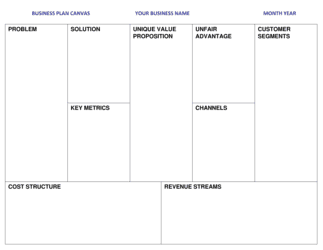
Plan formats: executive summary & one-page canvas
How to write a business plan
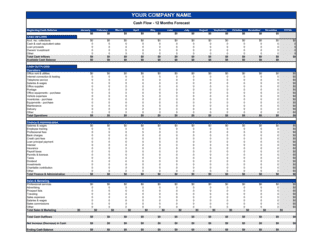
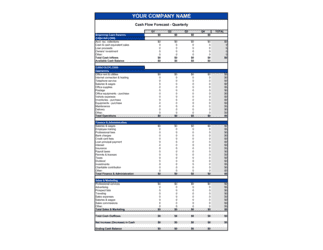
Financial projections & cashflow
Raise capital & financing
Corporate & shareholder agreements
250K+Clients
20M+Free users
20+Years
190+Countries
10,000+Law firms
50M+Downloads
Trusted across review platforms
- Capterra★★★★☆4.649 reviews
- G2★★★★☆4.713 reviews
- GetApp★★★★☆4.649 reviews
- Google Play★★★★☆4.6179 ratings
- Google Reviews★★★★☆4.567 reviews
Frequently asked questions
What should a business plan include?
A complete business plan typically includes an executive summary, company description, market analysis, products and services overview, marketing and sales strategy, operations plan, management team bios, and financial projections. Some plans also include a funding request section when the document is being submitted to a lender or investor. The depth of each section depends on the audience — banks require detailed financials while internal planning documents can be lighter.
How long should a business plan be?
Most full business plans run 15–25 pages, not counting financial appendices. A lean or short-form plan can be 5–10 pages. Longer is not better — investors and lenders value clarity over volume. Use the shortest format that still answers every question your audience will have.
Do I need a business plan to get a bank loan?
Yes. Most banks and SBA lenders require a business plan as part of the loan application. They pay particular attention to the financial projections, break-even analysis, and the management team section. Using a professional template ensures you cover all the sections a lender expects to see.
Can a startup use the same business plan format as an established business?
Not usually. Startups often lack historical financial data, so their plans emphasize market opportunity, founding team credentials, and projected traction. Established businesses can anchor their plans in actual revenue history. The Startup Business Plan template on this page is structured for pre-revenue and early-stage companies specifically.
What's the difference between a business plan and a business model?
A business model describes how a company creates and captures value — subscription, marketplace, direct sales, and so on. A business plan is the written document that explains how you will build and operate that model, backed by market research and financial projections. The business model is one input to the business plan, not a substitute for it.
How often should a business plan be updated?
Revisit your business plan at least once a year, and any time there is a significant change in strategy, market conditions, leadership, or funding needs. Many businesses update their financial projections quarterly. Treating the plan as a living document — rather than a one-time exercise — increases its practical value.
Is a lean business plan good enough for investors?
A lean plan works well for early conversations and accelerator applications, but most institutional investors and all bank lenders will ask for a full plan before making a decision. Use the lean format to test your narrative and refine your thinking, then build the complete plan when you need it.
Do I need an industry-specific business plan template?
For many industries, yes. A restaurant business plan needs sections on menu concept, table turnover, and food cost percentages that a generic template won't include. A clinic plan needs to address licensing and patient acquisition differently from a retail plan. Industry-specific templates save hours of customization and reduce the risk of missing a section your audience expects.
Business Plan vs. related documents
A pitch deck is a 10–15 slide visual presentation designed to generate investor interest quickly. A business plan is the full written document investors request after they like the pitch. Prepare the business plan first; the pitch deck is derived from it. Both are typically required before any funding round closes.
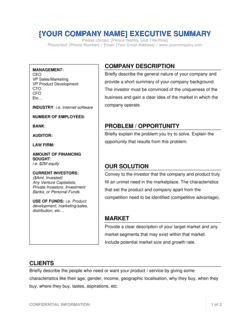
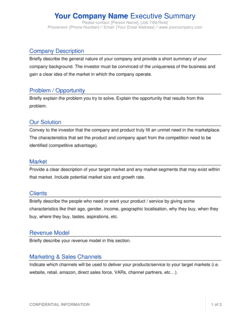
An executive summary is the first section of a business plan — a one-to-two page overview of the entire document. It is not a standalone substitute. Banks and investors read the executive summary first; if it holds their attention, they read the full plan. Never submit an executive summary alone in place of a complete plan.
A financial forecast (or financial model) projects revenue, expenses, and cash flow, usually in a spreadsheet. It is one section of a business plan, not a replacement for it. A standalone forecast answers "will this be profitable?"; a full business plan answers "why will this business succeed?"
A feasibility study evaluates whether a business idea is viable before committing to it. A business plan assumes the decision has been made and maps out execution. Companies often complete a feasibility study first, then use the findings to build the business plan.
Key clauses every Business Plan contains
Every business plan — regardless of industry — is built from the same core sections; the depth and emphasis vary by audience and business type.
- Executive summary. A one-to-two page overview of the entire plan, written last but placed first.
- Company description. Names the legal entity, ownership structure, location, and mission of the business.
- Market analysis. Defines the target market, total addressable market size, and competitive landscape.
- Products and services. Describes what the business sells, how it's differentiated, and its pricing model.
- Marketing and sales strategy. Explains how the business will acquire customers and convert them into revenue.
- Operations plan. Covers facilities, suppliers, staffing, processes, and day-to-day execution.
- Management team. Profiles the founders and key leaders, highlighting relevant experience.
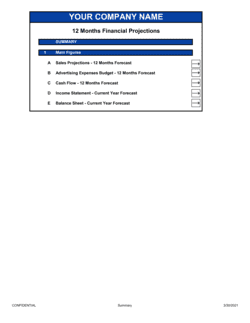
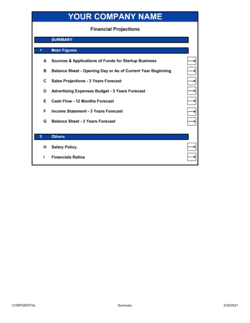
- Financial projections. Presents 3–5 year income statements, cash flow forecasts, and a break-even analysis.
- Funding request. Specifies how much capital is needed, how it will be used, and the proposed terms.
How to write a business plan
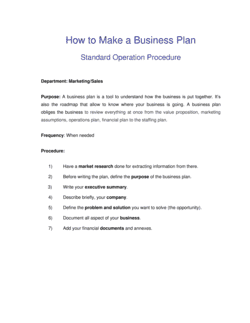
A business plan is built in sections — research first, write second, financials last. Here's the order that works.
1
Choose the right format for your audience
A bank wants a full 20-page plan; an accelerator may want a lean one-pager — pick the template that matches who will read it.
2
Define your business and value proposition
Write a clear, one-sentence statement of what your business does, who it serves, and why customers would choose you over alternatives.
3
Research your market
Quantify your target market using published data, identify your top three competitors, and note the gap your business fills.
4
Describe your product or service in detail
Explain what you sell, how it's made or delivered, what it costs you, and what you charge — include any IP or proprietary advantages.
5
Build your marketing and sales strategy
Map out the specific channels you'll use to reach customers, your customer acquisition cost estimate, and your sales process.
6
Outline your operations and team
Describe where you'll operate, who does what, key hires you plan to make, and any critical suppliers or partnerships.
7
Build the financial projections
Model 3–5 years of revenue, costs, and cash flow; include a break-even analysis and clearly label your assumptions.
8
Write the executive summary last
Summarize the full plan in one to two pages — investors read this first, so it should stand alone as a compelling snapshot.
At a glance
- What it is
- A business plan is a written document that describes what a business does, how it makes money, who its customers are, and how it will grow — supported by financial projections and a market analysis.
- When you need one
- Whenever you're launching a company, applying for a bank loan, pitching investors, or setting an annual direction, a structured business plan is the standard deliverable.
Which Business Plan do I need?
The right business plan template depends on your industry, your audience (lenders, investors, or internal planning), and how much detail you need. Match your situation below.
Your situation
Recommended template
Launching a new company and pitching outside investors
Structured for equity investment conversations with lean narrative and financial focus.Applying for a bank loan or SBA financing
Full-length format with all sections lenders expect, including financial statements.Writing a one-page or quick internal planning document
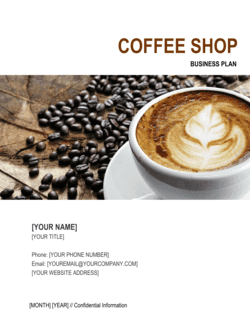
Strips the plan down to essentials — ideal for internal alignment or agile pivots.Opening a restaurant, café, or food-service business
Includes menu concept, location analysis, and food-service financial benchmarks.Starting a healthcare or medical practice
Covers regulatory requirements, patient acquisition, and clinical staffing models.Launching an online retail or direct-to-consumer business
Built for digital-first businesses with channel strategy and fulfillment planning.Opening a childcare, daycare, or preschool
Addresses licensing, enrollment capacity, and child-to-staff ratio requirements.Need a concise plan fast — under 10 pages
Covers all core sections in a condensed format that takes hours, not weeks.Glossary
- Executive summary
- A one-to-two page overview of the full business plan, placed at the front but written last.
- Total addressable market (TAM)
- The total revenue opportunity available if a business captured 100% of its target market.
- Break-even analysis
- A calculation showing the sales volume at which total revenue equals total costs — the point where the business stops losing money.
- Lean business plan
- A condensed business plan format that covers core strategy and financials in five pages or fewer.
- Financial projections
- Forward-looking estimates of revenue, expenses, and cash flow, typically covering three to five years.
- Value proposition
- A clear statement of the specific benefit a business delivers to customers and why they would choose it over alternatives.
- Market analysis
- The section of a business plan that quantifies the target market and assesses competition.
- Operating expenses (OpEx)
- Ongoing costs of running the business — rent, salaries, utilities — as distinct from one-time capital expenditures.
- Capital expenditure (CapEx)
- One-time investments in physical assets like equipment, vehicles, or facilities required to operate the business.
- Run rate
- An annualized estimate of revenue or expense based on current performance over a shorter period.
- Competitive advantage
- The specific reason customers prefer a business over alternatives — cost, quality, location, brand, or proprietary technology.
What is a business plan?
A business plan is a formal written document that defines what a business does, who its customers are, how it operates, and how it expects to grow — supported by financial projections and a market analysis. It serves two distinct purposes: an external-facing version persuades banks, investors, and partners to commit resources; an internal version keeps founders and teams aligned on goals, priorities, and milestones.
Business plans vary significantly in length and format depending on their purpose. A full-length business plan typically runs 15–25 pages and covers every operational, financial, and strategic dimension of the business. A lean business plan condenses the same thinking into five pages or fewer and is used for internal planning, accelerator applications, or early investor conversations. An industry-specific business plan — for a restaurant, clinic, construction company, or eCommerce store — goes a step further by including sections, terminology, and financial benchmarks relevant to that sector.
The 40 templates in this folder span both formats and cover more than 35 industries. Whether you're writing your first plan or updating one for a new funding round, the right starting point is a template built for your situation.
When you need a business plan
A business plan is required any time you need to prove — to yourself or to someone else — that a business idea is viable and that you have a credible path to execute it. The most common triggers:
- Applying for a small business loan, SBA loan, or line of credit
- Pitching angel investors, venture capital, or private equity
- Launching a new company or registering a new business entity
- Opening a second location or entering a new market
- Bringing on a co-founder or key executive who needs to understand the strategy
- Applying to an accelerator, incubator, or grant program
- Planning annual operations and setting team-level targets
- Preparing a business for sale or ownership transition
Skipping the business plan rarely saves time — it typically shifts the cost to later, when misaligned assumptions, underfunded operations, or a rejected loan application force the work anyway. A completed plan, built on an industry-specific template, compresses weeks of work into hours and produces the structured document that banks, investors, and partners expect to receive.
Award-winning platform
- Great Place to Work 2025
- BIG Award — Product of the Year 2025
- Smartest Companies 2025
- Global 100 Excellence 2026
- Best of the Best 2025