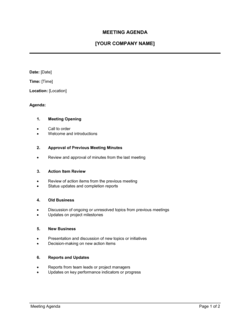
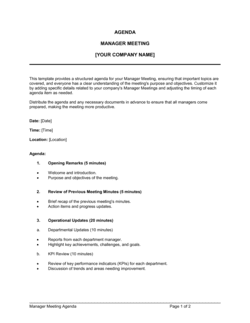
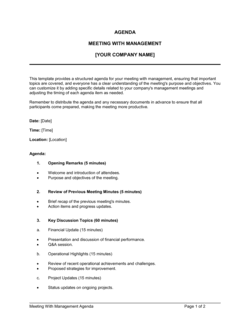
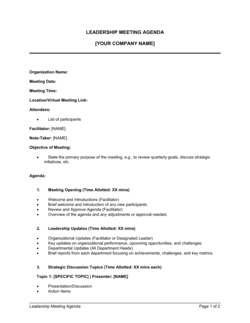
Every agenda should include the meeting title, date, time, and location; a list of attendees; the sequence of agenda items with time allocations; and the name of the person responsible for each item. A standing "action items from last meeting" section and a clear end-time help keep meetings on track.
Are meeting minutes legally required?
For corporate board and shareholder meetings, minutes are required in most jurisdictions and form part of the official corporate record. For internal staff meetings, there is no legal requirement, but written records of decisions and action items are best practice and reduce disputes. Non-profit organizations typically have stricter record-keeping obligations under their governing legislation.
What is a quorum and why does it matter?
A quorum is the minimum number of participants required for a meeting to be valid and its decisions enforceable. If quorum is not met, any votes taken are generally invalid. Your bylaws or governing documents should specify the quorum threshold — typically a simple majority of the board or membership for most organizations.
When should I use a proxy form?
Use a proxy form when a shareholder, board member, or organizational member cannot attend a meeting but wants their vote counted. A revocable proxy is appropriate for most routine situations; an irrevocable proxy is used when the delegation of authority is tied to a contractual or financial commitment that cannot be undone unilaterally.
What is the difference between bylaws and a board resolution?
Bylaws are the standing governance rules of an organization — they govern how meetings are called, how many votes are needed to pass a motion, and how officers are appointed. A board resolution is a one-time formal decision made at a specific meeting and recorded in the minutes. Bylaws change rarely; resolutions are created as needed.
How far in advance should meeting notices be sent?
Most corporate bylaws require at least 10–21 days' notice for formal board or shareholder meetings. Annual general meetings may require longer notice periods under applicable legislation. For internal team meetings, 24 hours is a practical minimum; complex meetings requiring preparation warrant several days' notice.
Can remote participants vote in a board meeting?
In most jurisdictions, yes — as long as your bylaws permit participation by telephone or video conference and all participants can hear and be heard. It is worth confirming your jurisdiction's corporate legislation and updating your bylaws if they predate widespread remote work practices.
What records should be kept after a board meeting?
Keep the signed agenda, approved minutes, any resolutions passed, copies of documents tabled at the meeting, and a record of attendance including any proxy forms submitted. Store these in your corporate minute book or a secure document management system accessible to authorized officers.
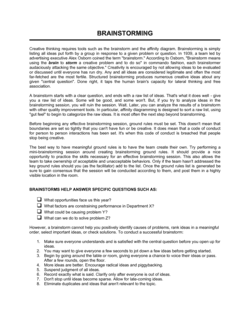
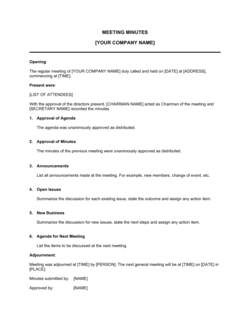
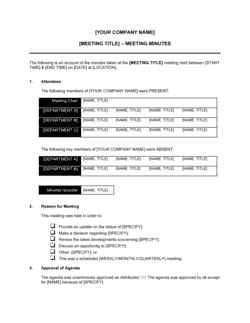
A meeting agenda is prepared before the meeting and lists topics to be discussed, responsible parties, and time allocations. Meeting minutes are recorded during or after the meeting and document what was actually discussed, decisions made, and action items assigned. Both documents are necessary: the agenda drives structure; the minutes create the official record.
Board resolution vs. bylaws
Bylaws are foundational governance documents that establish standing rules for how meetings are called, conducted, and recorded on an ongoing basis. A board resolution is a one-time formal decision made at a specific meeting. Bylaws change infrequently and require a formal amendment process; resolutions are created as needed and become part of the meeting record.
Proxy revocable vs. proxy irrevocable
A revocable proxy gives a designated representative the authority to vote on your behalf but can be cancelled at any time before the vote. An irrevocable proxy cannot be withdrawn once granted and is typically used when proxy authority is tied to a legal or financial obligation. Most routine shareholder situations call for a revocable proxy.
Team agreement vs. team work agreement
A team agreement outlines shared norms, communication expectations, and decision-making processes for how a team operates day-to-day. A team work agreement goes further to specify deliverables, schedules, and accountability structures. Use a team agreement for ongoing collaboration and a team work agreement when structured project output needs to be documented.
Key clauses every Meeting contains
Formal meeting documents — particularly bylaws, resolutions, and proxy forms — share several core components that determine their legal validity and practical usefulness.
Notice of meeting. Specifies how far in advance and by what method participants must be notified of a scheduled meeting.
Quorum requirement. Defines the minimum number of attendees or votes required for a meeting or decision to be valid.
Voting procedures. Describes how votes are cast, counted, and recorded, including rules for tied votes.
Proxy authorization. States whether and how a participant can delegate their voting rights to another person.
Agenda and order of business. Establishes the sequence of topics and ensures all required items are covered in the correct order.
Record-keeping obligations. Defines who is responsible for taking minutes, how they are approved, and where they are stored.
Amendment procedures. Explains how meeting rules or bylaws can be formally changed and what approval threshold is required.
Conflict of interest. Requires participants with a personal interest in a matter to disclose it and, typically, abstain from voting.
How to run a well-documented business meeting
Effective meeting documentation starts before the meeting and ends only when action items are confirmed and filed.
1
Define the purpose and required attendees
Confirm what decision or outcome the meeting must produce and invite only the people whose input or approval is necessary.
2
Draft and distribute the agenda in advance
Use a meeting agenda template to list each topic, the time allotted, and the person responsible — send it at least 24 hours before the meeting.
3
Check governance requirements
For board or shareholder meetings, confirm quorum rules, notice periods, and proxy procedures in your bylaws before the meeting is called.
4
Collect and process proxies
If any participants will be absent, issue and collect the appropriate proxy form before the meeting so their votes can be recorded.
5
Facilitate and record decisions
Assign one person to record minutes in real time, capturing each motion, vote outcome, and any dissenting opinions.
6
Issue a board resolution for formal decisions
Any board-level decision — approving a policy, authorizing a contract — should be documented in a signed resolution immediately after the meeting.
7
Distribute minutes and follow up on action items
Send approved minutes to all participants within 48 hours and track assigned action items until they are complete.
At a glance
What it is
Meeting templates are structured documents that help organizations plan, run, and record business meetings consistently — from a simple agenda to formal board resolutions and proxy forms.
When you need one
Any time you're scheduling a board meeting, staff meeting, or governance session, the right template ensures you cover all required items and create a reliable paper trail.
The right template depends on the type of meeting you're running and whether you need a planning document, a governance record, or a team coordination tool.
Your situation
Recommended template
Planning the agenda for an upcoming business meeting
Structures discussion topics, time slots, and action items in a single document.
Recording a formal board decision to approve a policy
Provides a compliant written record of board-level approval decisions.
Board Resolution Approving Job Description & Code of Conduct
Authorizing someone to vote on your behalf at a shareholder meeting
Grants revocable voting authority to a designated representative.
Proxy Revocable
Assigning a permanent proxy with no right of recall
Used when proxy authority must remain in place regardless of future instructions.
Proxy Irrevocable
Establishing governance rules for a newly formed corporation
Sets the operating rules for meetings, voting, and officer responsibilities.
General By-Laws
Setting up governance for a not-for-profit organization
Covers non-profit-specific governance requirements for meetings and directors.
Bylaws Not for Profit Corporation
Formalizing how a team collaborates and communicates
Documents shared expectations for meetings, communication, and decision-making.
Team Agreement
Improving how meetings are run across the organization
Practical guide covering facilitation, scheduling, and follow-up best practices.
Enhancing Meeting Efficiency For Business Professionals
Glossary
Meeting agenda
A written list of topics to be discussed at a meeting, distributed in advance to participants.
Meeting minutes
The official written record of what was discussed, decided, and assigned at a meeting.
Quorum
The minimum number of participants required for a meeting to be valid and its decisions enforceable.
Proxy
A written authorization allowing one person to vote or act on behalf of another at a meeting.
Board resolution
A formal written record of a decision made by a board of directors at a meeting.
Bylaws
The foundational governance rules of an organization that govern how meetings are called, conducted, and recorded.
Notice of meeting
The formal communication sent to participants informing them of an upcoming meeting's date, time, location, and agenda.
Action item
A specific task assigned to a named person with a deadline, arising from a meeting discussion or decision.
Advisory board
A group of external advisors who provide guidance to an organization but typically have no voting authority.
Annual general meeting (AGM)
A mandatory yearly meeting at which shareholders or members review financial performance and elect directors.
Casting vote
An additional vote given to a chair to break a tie when votes are equal.
Tabled motion
A formal proposal submitted for discussion and vote at a meeting.
What is a meeting template?
A meeting template is a pre-structured document that helps organizations plan, conduct, and record business meetings consistently. Meeting templates range from simple agenda forms that list topics and time slots to formal governance documents — bylaws, board resolutions, and proxy forms — that carry legal weight and must be maintained as part of an organization's official records.
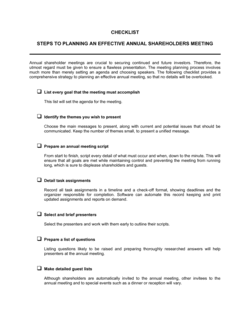
Well-run meetings share a common structure: a written agenda distributed before the meeting, a designated facilitator, a method for recording decisions, and a follow-up process that tracks action items to completion. Templates encode that structure so teams don't have to rebuild it from scratch each time. For formal meetings — board meetings, shareholder meetings, annual general meetings — templates also ensure that legally required elements like quorum rules, notice periods, and proxy procedures are consistently observed.
Meeting documents fall into three broad categories: planning documents (agendas, itineraries), governance documents (bylaws, resolutions, proxy forms), and team coordination documents (team agreements, communication checklists, remote management guides). Each category serves a different purpose but all share the goal of making meetings less ad hoc and more accountable.
When you need a meeting template
If your team holds regular meetings without a standard format, decisions go unrecorded, action items fall through, and participants arrive unprepared. For organizations with boards, shareholders, or formal governance obligations, skipping the right documentation can create legal exposure — invalid votes, missing records, and unenforceable decisions.
Common triggers:
Scheduling a board or shareholder meeting that requires formal notice and a quorum
Onboarding a new team that needs shared norms for how meetings are run
Setting up governance documents for a newly incorporated company or non-profit
Delegating voting rights to a representative when a member cannot attend
Recording a formal board decision to approve a policy, contract, or officer appointment
Establishing bylaws for a corporation, cooperative, or not-for-profit organization
Improving meeting efficiency across a distributed or hybrid team
Creating an advisory board and formalizing the terms of member participation
The cost of undocumented meetings is not always obvious until something goes wrong — a disputed decision, a missed action item, or a challenge to the validity of a board vote. Starting with the right template costs minutes; reconstructing a paper trail after the fact can cost hours, legal fees, or worse.
Award-winning platform
Great Place to Work 2025
BIG Award — Product of the Year 2025
Smartest Companies 2025
Global 100 Excellence 2026
Best of the Best 2025
Create your document in 3 simple steps.
From template to signed document — all inside one Business Operating System.
1
Download or open template
Access over 3,000+ business and legal templates for any business task, project or initiative.
2
Edit and fill in the blanks with AI
Customize your ready-made business document template and save it in the cloud.
3
Share with your team
Share your files and folders with your team. Create a space of seamless collaboration.
Save time, save money, and create top-quality documents.
★★★★★
"Fantastic value! I'm not sure how I'd do without it. It's worth its weight in gold and paid back for itself many times."
Managing Director · Mall Farm
RW
Robert Whalley
Managing Director, Mall Farm Proprietary Limited
★★★★★
"I have been using Business in a Box for years. It has been the most useful source of templates I have encountered. I recommend it to anyone."
Business Owner · 4+ years
MF
Dr Michael John Freestone
Business Owner
★★★★★
"It has been a life saver so many times I have lost count. Business in a Box has saved me so much time and as you know, time is money."
Owner · Upstate Web
DM
David G. Moore Jr.
Owner, Upstate Web
Run your business with a system — not scattered tools
Stop downloading documents. Start operating with clarity. Business in a Box gives you the Business Operating System used by over 250,000 companies worldwide to structure, run, and grow their business.