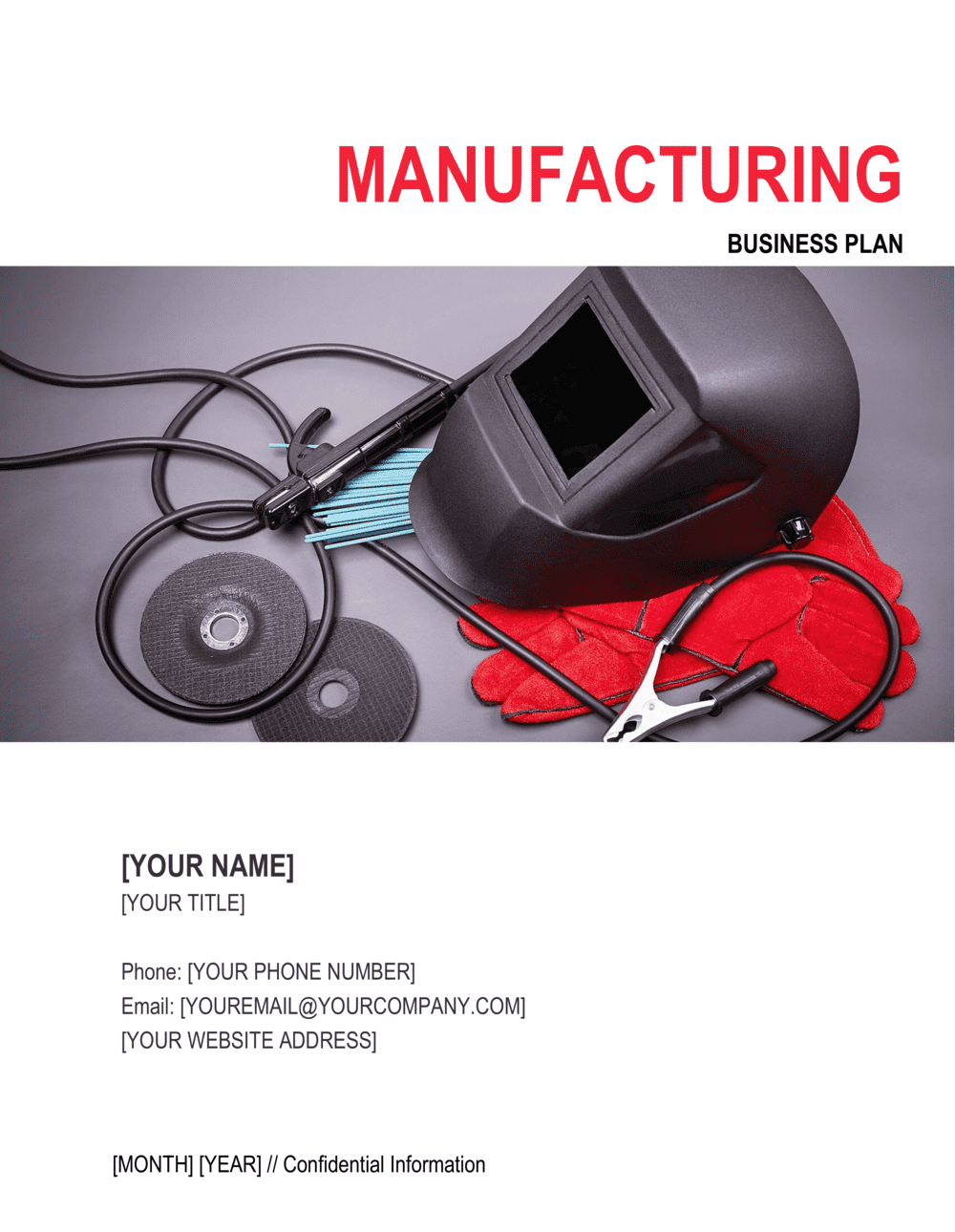
Manufacturing Business Plan Template

Free Word download β€’ Edit online β€’ Save & share with Drive β€’ Export to PDF

33 pagesβ€’2h 45m – 3h 40m to fillβ€’Difficulty: Expert
Learn more ↓
FreeManufacturing Business Plan Template

At a glance

What it is
A Manufacturing Business Plan is a structured document that defines a manufacturer's production model, target market, supply chain strategy, facility and equipment requirements, workforce plan, and 3–5 year financial projections in a single investor- and lender-ready file. This free Word download gives you a complete starting point you can edit online and export as PDF to share with banks, investors, or equipment financiers.
When you need it
Use it when launching a new manufacturing operation, applying for an SBA or equipment loan, seeking equity investment for a factory or production line, or restructuring an existing facility around a new product line or market.
What's inside
Executive summary, company overview, market and industry analysis, products and production process, facility and equipment plan, supply chain and procurement strategy, management team, and full financial projections including P&L, cash flow, break-even analysis, and capital expenditure schedule.

What is a Manufacturing Business Plan?

A Manufacturing Business Plan is a structured document that maps a manufacturer's product line, production process, facility and equipment requirements, supply chain strategy, workforce model, and 3–5 year financial projections into a single investor- and lender-ready file. Unlike a generic business plan, it includes sections specific to physical production: a unit cost breakdown built from a bill of materials, a CapEx schedule covering machinery and facility build-out, a supply chain risk assessment with contingency planning, and a capacity-constrained revenue model that ties output directly to installed throughput. This template is a free Word download you can edit online and export as PDF for banks, equipment lenders, or equity investors.

Why You Need This Document

Manufacturing businesses require capital before they generate revenue β€” equipment must be purchased, facilities fitted out, and raw material inventory stocked before a single unit ships. Without a complete, credible business plan, lenders cannot structure an asset-backed equipment loan, SBA officers will decline the application for missing financial detail, and investors will not commit to a facility they cannot evaluate operationally. The consequences of proceeding without one are concrete: loan rejections, funding delays of 3–6 months, and equity investors who discount the valuation because the operational model is unproven on paper. A well-built manufacturing business plan forces you to stress-test unit economics, capacity constraints, and supply chain dependencies before you spend capital β€” turning expensive assumptions into documented decisions you can defend at every stage of growth.

Which variant fits your situation?

If your situation is…Use this template
Launching a product-based startup seeking venture or angel fundingInvestor Business Plan
Applying for a bank loan or SBA financing for equipment or facilityBank Loan Business Plan
Quick internal alignment on a new product line before full planningOne-Page Business Plan
Planning a food production or beverage manufacturing operationRestaurant Business Plan
Documenting a 3–5 year growth strategy for an existing manufacturerStrategic Plan
Expanding an existing manufacturing operation into a new market or regionBusiness Expansion Plan
Launching a new product from an existing manufacturing baseNew Product Launch Plan

Common mistakes to avoid

❌ Omitting unit-level cost structure

Why it matters: Without a fully loaded unit cost β€” materials, direct labor, and overhead β€” readers cannot evaluate gross margin credibility or stress-test the financial model.

Fix: Build a bill of materials and a direct labor card for one unit before writing the financial projections. Enter both as appendices so reviewers can audit the inputs.

❌ Single-source supply chain with no contingency

Why it matters: A supply disruption from one unmitigated supplier can halt production entirely, and lenders and investors treat this as a bankable risk that reduces the plan's credibility.

Fix: Identify a secondary supplier for every critical input and document the price premium and lead-time difference. Include a safety-stock policy expressed in weeks of supply.

❌ CapEx and working capital combined in one funding line

Why it matters: Equipment lenders structure loans against hard assets, not blended capital needs. A combined number prevents them from sizing an asset-backed facility without requesting a revised schedule.

Fix: Separate CapEx (equipment, tooling, facility build-out) from working capital (inventory, receivables float, operating ramp) in both the use-of-funds table and the balance sheet.

❌ Revenue projections that ignore production constraints

Why it matters: A Year 2 revenue forecast that implies 120% capacity utilization from Day 1 signals the founder has not modeled how long equipment procurement, installation, and ramp-up actually take.

Fix: Build a capacity ramp schedule β€” weeks to equipment delivery, weeks to commissioning, weeks to rated throughput β€” and cap revenue projections to what installed capacity can actually produce.

❌ No break-even analysis

Why it matters: Manufacturing businesses have high fixed costs; the break-even unit volume is the single most important indicator of financial viability, and its absence raises immediate questions.

Fix: Calculate break-even as total fixed costs divided by contribution margin per unit. Present it as a monthly unit target and a timeline to reach it.

❌ Team section with no manufacturing operations experience

Why it matters: A management team with no direct production experience is the most common reason manufacturing loan applications are declined by SBA lenders.

Fix: If the founding team lacks manufacturing experience, name and commit to a VP of Operations or Plant Manager hire as a condition precedent to funding, and include their profile in the plan.

The 9 key sections, explained

Executive Summary

Company Overview

Market and Industry Analysis

Products and Production Process

Facility and Equipment Plan

Supply Chain and Procurement Strategy

Management Team and Workforce Plan

Financial Projections

Capital Requirements and Use of Funds

How to fill it out

  1. 1

    Start with the company overview and production mission

    Enter the legal entity name, founding date, facility location, and a one-sentence mission that names the product category and target market. Lock this in first β€” it anchors every section that follows.

    πŸ’‘ State the manufacturing method in the mission if it is a differentiator β€” e.g., 'domestic small-batch production' or 'automated high-volume contract manufacturing.'

  2. 2

    Build the market analysis from verified data

    Cite at least two independent market research sources for the industry size and growth rate. Then build a bottom-up estimate by counting reachable customers and multiplying by average order value.

    πŸ’‘ Bottom-up and top-down market sizes should land within 30% of each other. A larger gap signals a flawed assumption that readers will catch.

  3. 3

    Document the production process and unit economics

    Describe the production method step by step, list all certifications and quality standards, and calculate the fully loaded cost to produce one unit β€” materials, direct labor, and allocated overhead.

    πŸ’‘ Express unit economics as a BOM + labor card before rolling them into the financial model. It makes the cost structure auditable at the line-item level.

  4. 4

    Detail the facility and equipment requirements

    List the facility address (or intended location), square footage, lease or ownership terms, and every major piece of equipment with acquisition cost, lead time, and useful life.

    πŸ’‘ Get actual vendor quotes for major equipment before inserting numbers. Placeholder costs based on internet searches routinely underestimate installation, commissioning, and maintenance costs by 15–30%.

  5. 5

    Map the supply chain and identify single-source risks

    List your top five raw material inputs, the primary supplier for each, quoted price, lead time, and payment terms. Flag any single-source dependency and describe the mitigation β€” secondary supplier, safety stock, or long-term supply agreement.

    πŸ’‘ Include a tariff and currency risk note for any inputs sourced internationally. Investors financing manufacturing in 2025 expect to see this addressed explicitly.

  6. 6

    Build the three-statement financial model from units up

    Start with a monthly production volume forecast, multiply by unit revenue and unit cost to derive the P&L, then model the inventory, receivables, and payables to build the cash flow statement. Never start from a revenue target and work backward.

    πŸ’‘ Include a break-even analysis tab showing the exact unit volume at which fixed costs are covered. It is the single most-requested supplemental analysis from manufacturing lenders.

  7. 7

    Write the capital requirements section with allocation by purpose

    State the total funding amount, the instrument, and break the use of funds into at least four buckets: facility and equipment CapEx, raw material inventory, direct labor ramp, and G&A.

    πŸ’‘ Tie each spending bucket to a specific operational milestone β€” 'raw material inventory build supports [X] units/month of production by [DATE]' β€” not just a dollar amount.

  8. 8

    Write the executive summary last

    Pull the single strongest data point from each section β€” market size, unit economics, team credential, break-even timeline, and funding ask β€” and compress them into no more than two pages.

    πŸ’‘ If the summary cannot be written in two pages, the plan body has too many competing messages. Cut before you summarize.

Frequently asked questions

What is a manufacturing business plan?

A manufacturing business plan is a structured document that defines a manufacturer's product, production process, facility and equipment needs, supply chain, workforce model, and 3–5 year financial projections β€” including P&L, cash flow, and a capital expenditure schedule. It serves as both an internal operational roadmap and an external document for raising debt or equity financing to fund production capacity.

How is a manufacturing business plan different from a standard business plan?

A manufacturing plan includes sections that generic plans omit entirely: a production process description with unit cost breakdown, a facility and equipment CapEx schedule, a supply chain and procurement strategy, and a capacity utilization model tied directly to the revenue forecast. These sections are essential because manufacturing businesses have high fixed costs, long capital cycles, and operational constraints that directly determine financial performance.

What financial projections should a manufacturing business plan include?

At minimum: a monthly P&L for Year 1 and annual P&L for Years 2–5, a cash flow statement on the same cadence, a projected balance sheet, a CapEx schedule with depreciation, a break-even analysis by unit volume, and a working capital bridge showing how inventory and receivables are funded. Lenders financing equipment or facilities will also require a debt service coverage ratio calculation.

How long should a manufacturing business plan be?

A complete manufacturing business plan typically runs 25–40 pages plus a financial model appendix. The additional length compared to a service business plan reflects the facility, equipment, supply chain, and production process sections that have no equivalent in non-manufacturing plans. Executive summaries should still be held to 1–2 pages regardless of total document length.

Do I need a manufacturing business plan for an SBA loan?

Yes. SBA lenders require a complete business plan for any loan above $150,000, and manufacturing loans typically exceed that threshold given equipment and facility costs. The plan must include a detailed use-of-funds breakdown separating CapEx from working capital, three years of financial projections, and evidence of management's operational experience in the relevant production process.

What is the most common reason a manufacturing business plan is rejected by lenders?

The three most common rejection triggers are: revenue projections that exceed installed production capacity, a management team with no direct manufacturing operations experience, and a combined CapEx and working capital funding request that prevents the lender from structuring an asset-backed equipment loan. Addressing all three explicitly in the plan substantially improves approval rates.

How do I calculate the break-even point for a manufacturing business?

Divide total monthly fixed costs β€” facility rent, equipment depreciation, salaried labor, and fixed overhead β€” by the contribution margin per unit (selling price minus variable cost per unit). The result is the number of units you must produce and sell each month to cover all fixed costs. Present both the unit volume and the corresponding revenue figure, and show the month in which your production ramp is projected to reach that level.

Should I use contract manufacturing or build an in-house facility?

Contract manufacturing reduces CapEx and operational risk during early stages but typically produces gross margins 15–25 percentage points lower than in-house production at scale. In-house facilities offer cost and quality control advantages at volumes above roughly 10,000–50,000 units per month depending on the product category, but require significantly more capital upfront. Your business plan should document the make-or-buy decision explicitly and model both scenarios if the choice is not yet final.

How often should a manufacturing business plan be updated?

Update the plan before every significant capital raise, major equipment purchase, or entry into a new product line. For operating manufacturers, an annual refresh aligned to the fiscal year is standard β€” updating the financial model against actuals, revising the capacity plan, and reviewing the supply chain risk section. A plan more than 18 months old will not reflect current raw material costs, equipment lead times, or market conditions accurately enough for lender or investor review.

How this compares to alternatives

vs Standard Business Plan

A standard business plan covers market, strategy, team, and financials for any business type. A manufacturing business plan adds production process detail, facility and equipment CapEx, supply chain risk analysis, and a capacity-constrained revenue model. Use the manufacturing-specific template whenever the business produces physical goods and requires capital for production assets.

vs One-Page Business Plan

A one-page plan is a rapid-alignment tool for internal teams or early-stage ideation. It lacks the production process, equipment schedule, supply chain section, and financial depth that banks and investors require for manufacturing capital raises. Use it to test the concept, then build the full manufacturing plan before approaching any lender or investor.

vs Strategic Plan

A strategic plan defines a 3–5 year internal roadmap for an existing operation β€” goals, KPIs, and resource allocation. A manufacturing business plan is an external-facing capital document that adds market sizing, competitive positioning, production economics, and a funding request. Established manufacturers typically need both: the business plan to raise capital, the strategic plan to execute it.

vs Financial Projections Template

A financial projections template models revenue, expenses, and cash flow in isolation. A manufacturing business plan contextualizes those numbers with production capacity, supply chain assumptions, and operational strategy β€” the narrative that explains why the numbers are achievable. Lenders and investors never evaluate manufacturing financials without the operational context that supports them.

Industry-specific considerations

Industrial equipment and machinery

Long production cycles, high per-unit CapEx, and detailed capacity utilization modeling tied to order backlog and delivery lead times.

Food and beverage production

FDA registration requirements, perishable inventory constraints, food cost as a percentage of revenue, and co-packer versus owned-facility trade-off analysis.

Consumer goods and packaged products

Retailer MOQ requirements, seasonal demand curves, packaging CapEx, and the impact of SKU proliferation on production scheduling and overhead rates.

Electronics and hardware

Component lead-time risk, contract manufacturer dependency, compliance certifications (CE, UL, FCC), and the cost impact of product revision cycles on tooling CapEx.

Template vs pro β€” what fits your needs?

PathBest forCostTime
Use the templateFounders, operators, and small manufacturers seeking SBA loans under $500K or presenting to local lenders and angel investorsFree3–5 weeks (50–90 hours including financial modeling)
Template + professional reviewManufacturers seeking equipment loans above $500K, institutional lenders, or equity investors requiring audited-quality financial projections$1,000–$3,000 for a financial model review by a manufacturing-focused accountant or CFO advisor4–6 weeks
Custom draftedSeries A equity raises, regulated manufacturing sectors (food, medical devices, chemicals), or complex multi-facility operations requiring a professional business plan writer$4,000–$12,0006–10 weeks

Glossary

Capacity Utilization
The percentage of a facility's total production capacity that is actively being used β€” typically expressed as a percentage of maximum throughput per shift or per year.
Bill of Materials (BOM)
A structured list of every raw material, component, and sub-assembly required to manufacture one unit of a finished product, with quantities and unit costs.
Capital Expenditure (CapEx)
Spending on long-lived physical assets β€” machinery, tooling, facilities, and infrastructure β€” that are depreciated over their useful life rather than expensed immediately.
Cost of Goods Sold (COGS)
The direct costs of producing goods sold in a period, including raw materials, direct labor, and manufacturing overhead allocated to production.
Gross Margin
Revenue minus COGS, expressed as a percentage of revenue β€” the primary measure of production profitability before operating expenses.
Lead Time
The total elapsed time from placing a production order or purchase order to receiving finished goods, covering procurement, production, and delivery.
Break-Even Point
The production volume or revenue level at which total revenue equals total costs β€” below which the business operates at a loss, above which it generates profit.
Working Capital
Current assets minus current liabilities β€” the operating liquidity available to fund day-to-day production, inventory purchases, and receivables.
Throughput
The rate at which a manufacturing process converts raw materials into finished goods β€” usually expressed as units per hour, shift, or day.
Make-or-Buy Decision
The strategic choice between manufacturing a component in-house versus sourcing it from an external supplier, evaluated on cost, quality, lead time, and control.
Overhead Rate
The ratio of indirect manufacturing costs β€” rent, utilities, equipment depreciation, and supervision β€” allocated to each unit produced.
Inventory Turnover
COGS divided by average inventory value β€” a measure of how efficiently a manufacturer converts raw materials and WIP into sold finished goods.

Part of your Business Operating System

This document is one of 3,000+ business & legal templates included in Business in a Box.

  • Fill-in-the-blanks β€” ready in minutes
  • 100% customizable Word document
  • Compatible with all office suites
  • Export to PDF and share electronically

Create your document in 3 simple steps.

From template to signed document β€” all inside one Business Operating System.
1
Download or open template

Access over 3,000+ business and legal templates for any business task, project or initiative.

2
Edit and fill in the blanks with AI

Customize your ready-made business document template and save it in the cloud.

3
Save, Share, Send, Sign

Share your files and folders with your team. Create a space of seamless collaboration.

Save time, save money, and create top-quality documents.

β˜…β˜…β˜…β˜…β˜…

"Fantastic value! I'm not sure how I'd do without it. It's worth its weight in gold and paid back for itself many times."

Managing Director Β· Mall Farm
Robert Whalley
Managing Director, Mall Farm Proprietary Limited
β˜…β˜…β˜…β˜…β˜…

"I have been using Business in a Box for years. It has been the most useful source of templates I have encountered. I recommend it to anyone."

Business Owner Β· 4+ years
Dr Michael John Freestone
Business Owner
β˜…β˜…β˜…β˜…β˜…

"It has been a life saver so many times I have lost count. Business in a Box has saved me so much time and as you know, time is money."

Owner Β· Upstate Web
David G. Moore Jr.
Owner, Upstate Web

Run your business with a system β€” not scattered tools

Stop downloading documents. Start operating with clarity. Business in a Box gives you the Business Operating System used by over 250,000 companies worldwide to structure, run, and grow their business.

Start freeΒ Β·Β No credit card required