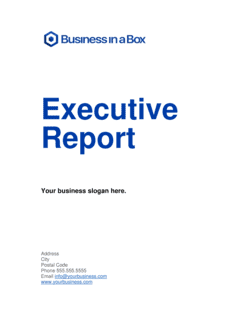
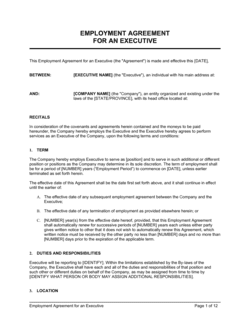
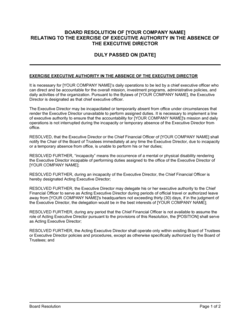
Executive Summary Template

Free to read • Save or share with one click

FreeExecutive Summary Template

At a glance

What it is
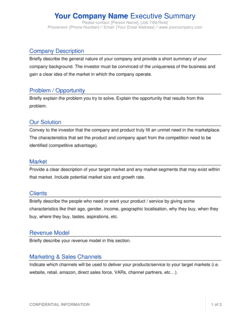
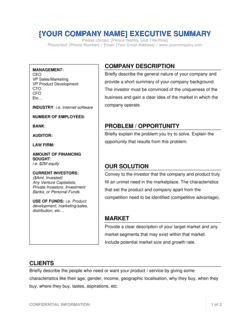
An Executive Summary is a free Word template that captures the essential argument of a business plan, proposal, or report on 1–2 pages. Download it, edit every section online in minutes, and export as PDF to share with investors, lenders, or decision-makers who need the bottom line without reading the full document.
When you need it
Use it when submitting a business plan, project proposal, grant application, or research report to a time-constrained audience that controls a decision.
What's inside
Problem or opportunity, proposed solution, target market, financial highlights, team credentials, and a single clear call to action.

What is an Executive Summary?

An Executive Summary is a 1–2 page standalone overview of a longer document — a business plan, project proposal, grant application, or research report. It presents the core argument in a sequence any decision-maker can follow: the problem, the proposed solution, the evidence it works, the key financial figures, and the specific action requested. Written well, it replaces the need to read 20–40 pages before forming a view.

Why You Need This Document

Investors, lenders, and senior executives receive more plans than they can fully read. The executive summary is the document that determines whether yours gets a meeting or a pass. A weak summary — vague problem framing, missing financials, no explicit ask — signals weak thinking about the business itself. A tight, specific, well-structured summary signals the opposite. It also serves as a forcing function: if you cannot explain your business in two pages with real numbers behind every claim, the full plan has structural gaps that need to be resolved before you pitch.

Which variant fits your situation?

If your situation is…Use this template
Summarizing a complete business plan for investors or lendersBusiness Plan Executive Summary
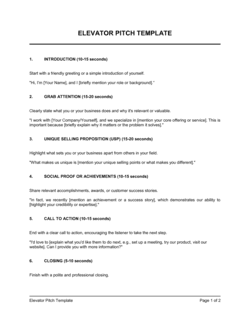
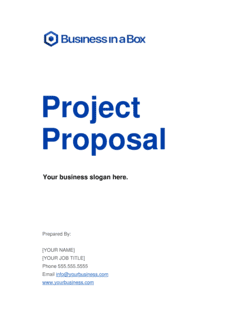
Opening a consulting or services proposalProject Proposal
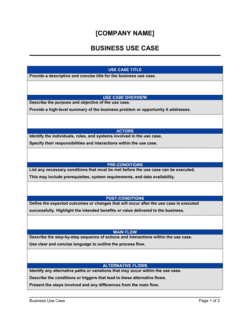
Requesting internal budget or headcount approvalBusiness Case
Summarizing findings from a research or feasibility studyFeasibility Study
Pitching a new product or feature to leadershipProduct Proposal

Common mistakes to avoid

❌ Writing the executive summary before the full document

Why it matters: Claims will be vague and unsubstantiated, and you'll likely rewrite it anyway once the full document is complete.

Fix: Draft the full document first, then extract and synthesize the key points into the summary.

❌ Exceeding two pages

Why it matters: Decision-makers use the summary to decide whether to read the full document. A 4-page summary signals poor judgment about what matters.

Fix: Set a hard limit of 500–700 words and cut the lowest-value content until you hit it.

❌ Burying the ask

Why it matters: If readers have to hunt for the funding amount or the decision requested, many will stop reading before they find it.

Fix: State the funding ask or decision request in the first or second paragraph, then support it with evidence.

❌ Using the same summary for every audience

Why it matters: A summary written for a venture investor emphasizes different metrics than one written for a bank or an internal board.

Fix: Keep a base version and create audience-specific variants that swap out the financial highlights and call to action.

The 8 key sections, explained

Header and Document Context

Problem or Opportunity

Proposed Solution

Target Market and Traction

Financial Highlights

Team

Funding Request and Use of Funds

Call to Action

How to fill it out

  1. 1

    Write it last

    Complete the full business plan, proposal, or report first. The executive summary pulls from the finished document — writing it first produces vague, unsupported claims.

    💡 Set aside 60–90 minutes after the full document is complete. The summary should take no longer than that.

  2. 2

    State the problem with a number

    Open with the problem or opportunity and anchor it to a specific figure — a market size, cost, loss rate, or frequency — to establish the stakes.

    💡 If you can't find a number, your problem statement is probably too broad. Narrow it until you can quantify it.

  3. 3

    Describe the solution in outcome terms

    Write one paragraph that explains what your solution does and the specific, measurable result it delivers for the customer.

    💡 Replace every feature claim ('our platform uses AI') with a result claim ('reduces processing time from 4 hours to 20 minutes').

  4. 4

    Select the right financial metrics for your audience

    Investors prioritize growth rate, gross margin, and runway. Lenders prioritize cash flow, debt-service coverage, and collateral. Internal executives prioritize ROI and payback period.

    💡 Use no more than 5 financial figures. Every additional number dilutes the ones that matter.

  5. 5

    Name your team's relevant credentials

    For each key leader, state one prior role or achievement that is directly relevant to executing this specific plan.

    💡 '20 years of industry experience' is weak. 'Scaled a comparable business from $0 to $8M ARR' is strong.

  6. 6

    End with one explicit call to action

    Close with the single decision or next step you want the reader to take, including a deadline or contact detail.

    💡 A specific deadline ('scheduling through March 31') increases response rates compared to open-ended invitations.

  7. 7

    Edit to fit two pages

    Print or export a PDF draft and cut until it fits 1–2 pages. Every sentence that doesn't support the core argument should be removed.

    💡 If the summary exceeds 2 pages, start cutting from the team section and the market-sizing narrative — those can be summarized most aggressively.

Frequently asked questions

What is an executive summary?

An executive summary is a 1–2 page standalone overview of a longer document — typically a business plan, project proposal, or research report. It presents the problem, proposed solution, key evidence, financial highlights, and the specific decision or action requested, so a time-constrained reader can evaluate the core argument without reading the full document.

What should be included in an executive summary?

A strong executive summary includes: the problem or opportunity with supporting data, the proposed solution and its measurable outcome, the target market size, traction or proof points, 3–5 financial highlights (revenue, margin, funding ask, break-even), the management team's relevant credentials, and a single explicit call to action. All of this should fit on 1–2 pages.

How long should an executive summary be?

One to two pages — roughly 400–700 words. For a full business plan submitted to investors, two pages is standard. For an internal project proposal, one page is often sufficient. Length beyond two pages signals that the writer hasn't identified what's essential.

Should I write the executive summary first or last?

Last. The executive summary synthesizes the conclusions and evidence from the full document. Writing it first produces unsupported claims and usually requires a complete rewrite. Allocate 60–90 minutes after the full document is finalized to draft and edit the summary.

What's the difference between an executive summary and an abstract?

An abstract describes what a document contains — it's common in academic and scientific papers. An executive summary makes the case for a decision or action and is written for a business audience. The executive summary includes financial data, a recommendation, and a call to action that an abstract typically does not.

Who typically reads an executive summary?

Investors, lenders, board members, senior executives, grant committees, and procurement decision-makers. These readers control the decision and usually review the summary before deciding whether to read the full document. The summary must stand alone and be persuasive without the supporting detail.

Do I need a professional to write an executive summary?

For most business plans and proposals, a well-structured template and clear thinking about your own business is sufficient. Engage a professional writer or consultant ($500–$2,000 for most engagements) when the stakes are high — a Series A raise, a major government tender, or a board-level strategic proposal where presentation quality directly affects the outcome.

How this compares to alternatives

vs Business Plan

A business plan is a comprehensive 15–40 page document covering strategy, operations, market analysis, and full financial projections. The executive summary is a 1–2 page synthesis of that document's core argument, written to generate a specific decision.

vs Pitch Deck

A pitch deck is a visual presentation of 10–15 slides used in live meetings. An executive summary is a written document read independently. Both cover similar ground, but the summary is more detailed and works as a leave-behind; the deck is designed for a presenter-led conversation.

vs Business Case

A business case argues for a specific internal investment or project, focused on ROI and risk. An executive summary can open a business case but is also used for external audiences — investors, lenders, and grant bodies — and covers strategy, not just cost-benefit.

vs Project Proposal

A project proposal details scope, timeline, deliverables, and budget for a specific engagement. An executive summary is a broader document opener used across business plans, reports, and proposals — it summarizes the entire argument rather than describing a scoped workstream.

Industry-specific considerations

Technology / SaaS

ARR growth rate, net revenue retention, CAC payback period, and product roadmap milestones as financial highlights.

Retail / E-commerce

Gross margin by channel, inventory turn, customer acquisition cost, and average order value as key metrics.

Professional Services

Utilization rate, revenue per billable hour, client retention, and pipeline coverage as financial highlights.

Nonprofit / Social Enterprise

Program cost per beneficiary, funding diversification, impact metrics, and grant match ratios replace revenue figures.

Template vs pro — what fits your needs?

PathBest forCostTime
Use the templateStartups, small businesses, and internal project proposals where the founder or project lead knows the business wellFree60–90 minutes
Template + professional reviewInvestor fundraising rounds, bank loan applications, and high-stakes grant submissions$500–$2,0002–5 days
Custom draftedSeries A or later fundraising, major government tenders, or M&A materials where presentation quality directly influences deal outcome$2,000–$8,000+1–3 weeks

Glossary

Executive Summary
A 1–2 page standalone overview of a longer document, written so a decision-maker can act without reading the full version.
Problem Statement
A concise description of the pain, gap, or opportunity that the proposal or plan addresses.
Value Proposition
The specific benefit the proposed solution delivers to its target audience, expressed in measurable terms.
Target Market
The defined customer segment — by size, geography, or demographic — the business or project intends to serve.
Financial Highlights
Key figures such as projected revenue, gross margin, break-even point, and funding requirement, pulled from the full financial model.
Call to Action (CTA)
The single, specific decision or commitment requested from the reader — e.g., approve funding, schedule a meeting, or sign a term sheet.
Traction
Measurable evidence that the solution works — pilot customers, revenue to date, letters of intent, or signed contracts.
Funding Ask
The specific dollar amount requested from an investor or lender, along with how it will be deployed.
Competitive Advantage
The attribute that makes the solution meaningfully better or cheaper than available alternatives.
Management Team
The core individuals responsible for execution, highlighted in the summary to signal credibility and capability.

Part of your Business Operating System

This document is one of 3,000+ business & legal templates included in Business in a Box.

  • Fill-in-the-blanks — ready in minutes
  • Compatible with all office suites
  • Export to PDF and share electronically

Create your document in 3 simple steps.

From template to signed document — all inside one Business Operating System.
1
Download or open template

Access over 3,000+ business and legal templates for any business task, project or initiative.

2
Edit and fill in the blanks with AI

Customize your ready-made business document template and save it in the cloud.

3
Save, Share, Send, Sign

Share your files and folders with your team. Create a space of seamless collaboration.

Save time, save money, and create top-quality documents.

★★★★★

"Fantastic value! I'm not sure how I'd do without it. It's worth its weight in gold and paid back for itself many times."

Managing Director · Mall Farm
Robert Whalley
Managing Director, Mall Farm Proprietary Limited
★★★★★

"I have been using Business in a Box for years. It has been the most useful source of templates I have encountered. I recommend it to anyone."

Business Owner · 4+ years
Dr Michael John Freestone
Business Owner
★★★★★

"It has been a life saver so many times I have lost count. Business in a Box has saved me so much time and as you know, time is money."

Owner · Upstate Web
David G. Moore Jr.
Owner, Upstate Web

Run your business with a system — not scattered tools

Stop downloading documents. Start operating with clarity. Business in a Box gives you the Business Operating System used by over 250,000 companies worldwide to structure, run, and grow their business.

Free Forever Plan · No credit card required