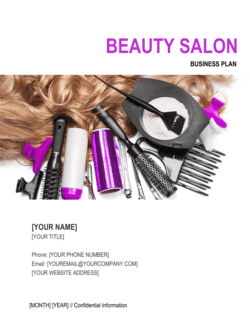
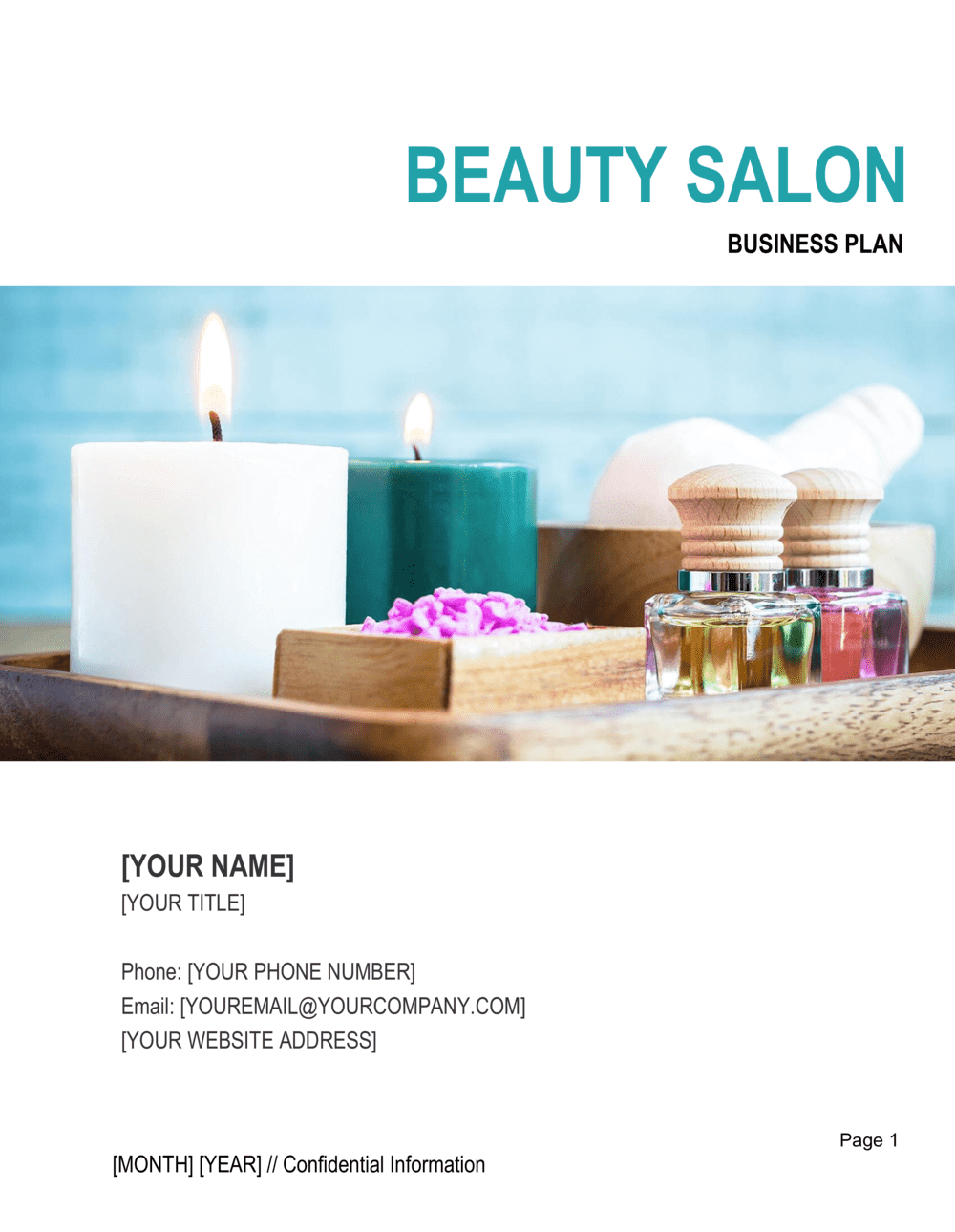
Beauty Salon Business Plan Template

Free Word download β€’ Edit online β€’ Save & share with Drive β€’ Export to PDF

24 pagesβ€’2h 10m – 2h 55m to fillβ€’Difficulty: Expert
Learn more ↓
FreeBeauty Salon Business Plan Template

At a glance

What it is
A Beauty Salon Business Plan is a structured operational and strategic document that maps your salon's concept, target clientele, service menu, staffing model, marketing approach, and 3-year financial projections into a single investor- and lender-ready file. This free Word download gives you a professionally formatted starting point you can edit online and export as PDF to present to banks, landlords, or potential partners.
When you need it
Use it when opening a new salon, applying for a small-business loan or lease, bringing on a business partner, or repositioning an existing salon around a new concept or expanded service menu.
What's inside
Executive summary, business overview and concept, market and competitor analysis, services and pricing, marketing and client acquisition strategy, staffing and operations plan, and three-year financial projections including revenue forecasts, startup costs, and a break-even analysis.

What is a Beauty Salon Business Plan?

A Beauty Salon Business Plan is a structured operational and financial document that translates a salon concept into a concrete, fundable plan β€” covering your target clientele, service menu and pricing, staffing model, marketing strategy, startup cost budget, and three-year financial projections. Unlike a generic business plan, it is built around salon-specific metrics: revenue per chair-hour, service margin by treatment category, stylist compensation model, and a capacity utilization ramp that reflects how new salons actually fill their books. The result is a document that functions as both an internal operating guide and a credible external submission for bank loans, SBA financing, commercial leases, or investor conversations.

Why You Need This Document

Opening a salon without a written business plan means committing to a lease, a build-out budget, and a staffing model before you have tested whether the numbers work. The majority of salon failures in the first two years trace back to three avoidable errors: pricing set below the margin needed to cover rent and payroll, a build-out that consumed working capital that should have funded the first six months of operations, and revenue projections that assumed full chairs from day one. A completed business plan forces you to confront each of these before you sign anything. It also gives lenders the chair-level economics they need to approve financing β€” and gives you a 12-month operating target you can actually measure against once the doors open. This template gives you the structure to produce that plan without starting from a blank page.

Which variant fits your situation?

If your situation is…Use this template
Opening a full-service hair and color salonBeauty Salon Business Plan
Launching a nail salon or nail bar conceptNail Salon Business Plan
Opening a spa with massage, facials, and body treatmentsSpa Business Plan
Starting a mobile or in-home beauty services businessMobile Beauty Services Business Plan
Quick internal planning or early concept validationOne-Page Business Plan
Expanding an existing salon into a second locationBusiness Expansion Plan
Applying for a small-business bank loanBank Loan Business Plan

Common mistakes to avoid

❌ Projecting 100% chair utilization from day one

Why it matters: New salons consistently underestimate the ramp period. Projecting full books from Month 1 produces a cash-flow model that collapses the moment reality hits, and lenders recognize the error immediately.

Fix: Model a realistic ramp: 30–40% utilization in Months 1–2, reaching 70–75% by Month 9–12. Pair the ramp with a 3-month cash reserve to cover the gap.

❌ Setting prices without calculating cost per service

Why it matters: Pricing based solely on competitor rates ignores your specific product costs, labor model, and rent load β€” and can produce a margin structure that cannot cover fixed expenses at any realistic utilization rate.

Fix: Calculate product cost and time cost per service, divide total monthly fixed costs by available chair-hours, and set prices that cover both and leave a net margin of at least 15–20%.

❌ Omitting a working capital reserve from the startup budget

Why it matters: Without 2–3 months of operating expenses in reserve, a slow pre-opening period or a slower-than-expected ramp forces the owner into personal funding or missed rent payments within the first quarter.

Fix: Add a working capital reserve line to the startup budget equal to at least 2 months of projected fixed costs, and include it in the loan request if necessary.

❌ Writing a marketing section with no budget or channel priority

Why it matters: A list of ten potential marketing channels without spending allocations or sequencing tells a lender you have not thought through execution β€” and gives you no actionable plan once you open.

Fix: Select two to three primary channels, assign a monthly dollar budget to each, and define one measurable goal per channel (e.g., 200 Instagram followers before opening day, 50 Google reviews within 90 days of opening).

❌ Using only national industry data in the market analysis

Why it matters: A lender or landlord financing a specific location needs local proof of demand β€” neighborhood demographics, competitor saturation, and foot-traffic data β€” not a headline figure for the US salon industry.

Fix: Supplement national data with a 3-mile radius competitor map, local demographic data from Census.gov, and, if available, foot-traffic estimates from tools like Placer.ai or the landlord's own data.

❌ Leaving the staffing model undefined beyond headcount

Why it matters: A plan that says 'four stylists' without specifying employment vs. booth rental, compensation rate, and hiring timeline cannot produce reliable payroll projections β€” the largest variable cost in any salon.

Fix: Specify the compensation model (commission rate or booth rent amount), the projected revenue per stylist per week, and the month each hire is planned β€” then tie those figures directly into the cash-flow model.

The 8 key sections, explained

Executive Summary

Business Overview and Concept

Market and Competitor Analysis

Services and Pricing

Marketing and Client Acquisition Strategy

Staffing and Operations Plan

Financial Projections

Startup Costs and Funding Requirements

How to fill it out

  1. 1

    Define your concept and brand position

    Write a one-paragraph description of the salon that names the target client, the price tier (budget, mid-market, or luxury), the core service focus, and the one differentiator that separates you from nearby competitors.

    πŸ’‘ Test your positioning statement on five people who fit your target demographic β€” if they can't repeat back your differentiator, it isn't clear enough.

  2. 2

    Research the local market

    Map every salon within a 3-mile radius, note their pricing, service mix, Google rating, and estimated appointment volume. Pull neighborhood demographics from the US Census or a free tool like Esri's tapestry segmentation.

    πŸ’‘ Visit two or three competitors as a client before writing this section β€” firsthand experience reveals gaps that online research misses.

  3. 3

    Build the service menu with cost-per-service calculations

    List every service, set a price, estimate appointment duration, and calculate product cost per service. Divide price by duration to get revenue per chair-hour β€” your most important operating metric.

    πŸ’‘ Target a minimum of $60–$75 per chair-hour for a mid-market salon to cover rent, payroll, and supplies at typical utilization rates.

  4. 4

    Model your staffing structure and compensation

    Decide on employed commission stylists, booth renters, or a hybrid. For employed staff, project payroll by multiplying expected service revenue per stylist by the commission rate. For booth renters, model income as flat weekly rental income.

    πŸ’‘ Model both scenarios side by side before committing β€” booth rental provides more predictable income but less control over the client experience and retail sales.

  5. 5

    Itemize startup costs in full

    Create a line-item list of every pre-opening cost: build-out, equipment, furniture, signage, licenses, initial product inventory, marketing launch budget, and a 3-month cash reserve. Get at least two contractor quotes for build-out before entering a number.

    πŸ’‘ Add a 15% contingency line to your build-out estimate β€” salon renovations almost always run over budget due to plumbing and electrical surprises.

  6. 6

    Build the three-year financial model from the chair up

    Start with the number of chairs, multiply by your average revenue per chair-hour, apply a realistic utilization ramp (30% in Month 1, reaching 75% by Month 12), and subtract fixed and variable costs to get net operating income.

    πŸ’‘ Run a break-even scenario and a 70%-of-plan downside scenario side by side so you can show a lender you have stress-tested your assumptions.

  7. 7

    Write the executive summary last

    Pull the single most compelling number from each section β€” market opportunity, Year 1 revenue, funding ask, and break-even month β€” and compress them into one page. The summary is the first and sometimes only section a busy lender reads.

    πŸ’‘ If the executive summary runs longer than one page for a salon plan, cut it. Conciseness signals that you understand your own business.

Frequently asked questions

What is a beauty salon business plan?

A beauty salon business plan is a structured document that defines your salon's concept, target clientele, service menu, staffing model, marketing strategy, and financial projections β€” typically covering 3 years. It serves as both an internal operational roadmap and an external document for securing bank loans, leases, or investment. A complete plan runs 15–25 pages plus a financial model appendix.

Do I need a business plan to open a salon?

You are not legally required to have one, but any bank, SBA lender, or commercial landlord will ask for a formal business plan before approving financing or signing a lease with a new business. Beyond funding, the planning process forces you to model your pricing, staffing costs, and break-even point before you commit to a lease β€” which is where most new salon owners discover that their initial numbers do not work.

How long should a beauty salon business plan be?

For loan or lease applications, 15–25 pages plus financial appendices is the standard range. A plan shorter than 12 pages typically lacks the market data and financial detail lenders require. For internal planning only, a condensed 8–10 page version is sufficient. Avoid padding β€” a concise, well-supported plan outperforms a lengthy one with thin analysis.

What financial projections should a salon business plan include?

At minimum: a 3-year P&L, a monthly cash-flow statement for Year 1, a startup cost itemization, and a break-even analysis. Build revenue projections from the number of chairs multiplied by average revenue per chair-hour and a realistic utilization rate β€” not as a percentage of market size. Lenders calculate chair economics independently and will flag projections that do not follow this logic.

What is a realistic break-even timeline for a new salon?

Most new salons reach monthly break-even between Month 6 and Month 12, depending on location, build-out costs, and the speed of client acquisition. Salons with high build-out costs and low starting chair counts take longer. A 3-month cash reserve and a conservative utilization ramp in the financial model are the two most effective ways to survive the pre-break-even period.

Should I use a commission model or booth rental for my stylists?

Commission employed stylists give you more control over the client experience, retail sales, and scheduling β€” but create fixed payroll obligations regardless of revenue. Booth rental produces more predictable income and lower legal exposure but means less control over how services are delivered. Many salons use a hybrid: one or two employed stylists for consistency and booth renters to fill remaining chairs. Model both in your business plan before committing.

What startup costs should I include in a salon business plan?

Leasehold improvements (typically the largest single cost, ranging from $20,000 to $150,000+ depending on build-out scope), styling chairs and backwash units ($1,500–$5,000 per station), signage, initial product inventory, POS and booking software setup, business licenses and cosmetology permits, pre-opening marketing, and a 2–3 month working capital reserve. Get contractor quotes before entering build-out numbers in the plan.

Can I write a salon business plan myself, or do I need a consultant?

A high-quality template handles the structure for most salon owners applying for loans under $250,000. Hire a business plan consultant when applying for SBA loans above $350,000, when bringing on an equity investor, or when your financial model involves complex multi-location projections. A template-plus-accountant approach β€” using the template for structure and paying an accountant to build or review the financial model β€” costs $300–$800 and suits most first-time salon owners.

How is a beauty salon business plan different from a general business plan?

The core structure is the same, but a salon plan requires industry-specific content: a service menu with per-service margin calculations, a staffing section that addresses the commission vs. booth-rental decision, a capacity model based on chair count and utilization rate, and startup cost categories specific to salon fit-out. Generic business plan templates omit these elements, which are the sections lenders scrutinize most carefully for salon applications.

How this compares to alternatives

vs One-Page Business Plan

A one-page plan is a rapid-alignment tool useful for concept validation or early internal planning. It lacks the financial depth, market analysis, and service cost modeling that any bank or SBA lender requires. Use the one-pager to test your concept, then build the full salon plan before any financing conversation.

vs Restaurant Business Plan

Restaurant and salon plans share a similar structure, but the key financial metrics differ entirely. Restaurants model covers, table turns, and food cost percentages; salons model chair utilization, revenue per chair-hour, and service margins. A restaurant template will miss the staffing model nuances β€” commission vs. booth rental β€” that are critical to salon economics.

vs Generic Business Plan

A generic business plan template provides the correct sections but omits salon-specific content: per-service margin calculations, chair capacity modeling, and cosmetology licensing cost line items. Lenders who specialize in salon financing expect these details and will flag their absence as a gap in planning.

vs Marketing Plan

A marketing plan addresses only client acquisition and retention strategy. A business plan incorporates marketing as one section within a complete operational and financial picture. Salons need both β€” the business plan to secure funding and the lease, and a standalone marketing plan to guide the first 12 months of client growth.

Industry-specific considerations

Hair and Color Salons

Chair utilization, color service margins, and stylist commission structures are the primary financial drivers β€” all require explicit modeling in the plan.

Nail Salons and Bars

High-volume, lower-ticket services require more appointment slots per day to reach break-even; staffing costs and sanitation compliance costs are central to the operations section.

Day Spas and Med Spas

Higher average tickets and licensed medical staff (for med spas) require regulatory and credentialing sections alongside standard financial projections.

Barbershops

Booth-rental models dominate; the plan should model weekly chair rent income versus projected walk-in volume and address the licensing requirements specific to barbering in the target state.

Template vs pro β€” what fits your needs?

PathBest forCostTime
Use the templateFirst-time salon owners applying for loans under $250,000 or negotiating a first commercial leaseFree1–3 weeks (20–40 hours)
Template + professional reviewOwners who want an accountant to build or audit the financial model before submitting to a lender$300–$800 for accountant review2–4 weeks
Custom draftedMulti-location salon groups, med spa concepts requiring regulatory sections, or equity investment rounds above $500,000$2,000–$6,000 for a professional business plan writer3–6 weeks

Glossary

Service Menu
The complete list of treatments a salon offers β€” haircuts, color, styling, extensions, nail services, or esthetics β€” each with a stated price and estimated duration.
Booth Rental Model
A staffing arrangement where licensed stylists pay the salon owner a weekly or monthly fee to use a chair, rather than being employed on salary or commission.
Commission Structure
A compensation model where stylists earn a percentage of the revenue they generate, typically ranging from 40% to 60% of service sales.
Average Ticket
The average revenue generated per client visit, calculated by dividing total service revenue by the number of appointments in a given period.
Client Retention Rate
The percentage of clients who return for a second or subsequent appointment within a defined window, typically 90 days.
Startup Costs
One-time expenses incurred before opening β€” leasehold improvements, equipment, furniture, signage, initial product inventory, and licensing fees.
Break-Even Point
The monthly revenue level at which total income equals total fixed and variable costs, producing neither profit nor loss.
Leaseholder Improvement Allowance
A cash contribution from a landlord toward the cost of building out a commercial space to the tenant's specifications, negotiated as part of a lease.
Retail Revenue
Income from selling professional hair care, skincare, or beauty products to clients β€” typically contributing 10–20% of a salon's total revenue.
Capacity Utilization
The percentage of available appointment slots that are booked and generating revenue, with 75–85% considered a healthy operating target for a mature salon.

Part of your Business Operating System

This document is one of 3,000+ business & legal templates included in Business in a Box.

  • Fill-in-the-blanks β€” ready in minutes
  • 100% customizable Word document
  • Compatible with all office suites
  • Export to PDF and share electronically

Create your document in 3 simple steps.

From template to signed document β€” all inside one Business Operating System.
1
Download or open template

Access over 3,000+ business and legal templates for any business task, project or initiative.

2
Edit and fill in the blanks with AI

Customize your ready-made business document template and save it in the cloud.

3
Save, Share, Send, Sign

Share your files and folders with your team. Create a space of seamless collaboration.

Save time, save money, and create top-quality documents.

β˜…β˜…β˜…β˜…β˜…

"Fantastic value! I'm not sure how I'd do without it. It's worth its weight in gold and paid back for itself many times."

Managing Director Β· Mall Farm
Robert Whalley
Managing Director, Mall Farm Proprietary Limited
β˜…β˜…β˜…β˜…β˜…

"I have been using Business in a Box for years. It has been the most useful source of templates I have encountered. I recommend it to anyone."

Business Owner Β· 4+ years
Dr Michael John Freestone
Business Owner
β˜…β˜…β˜…β˜…β˜…

"It has been a life saver so many times I have lost count. Business in a Box has saved me so much time and as you know, time is money."

Owner Β· Upstate Web
David G. Moore Jr.
Owner, Upstate Web

Run your business with a system β€” not scattered tools

Stop downloading documents. Start operating with clarity. Business in a Box gives you the Business Operating System used by over 250,000 companies worldwide to structure, run, and grow their business.

Start freeΒ Β·Β No credit card required