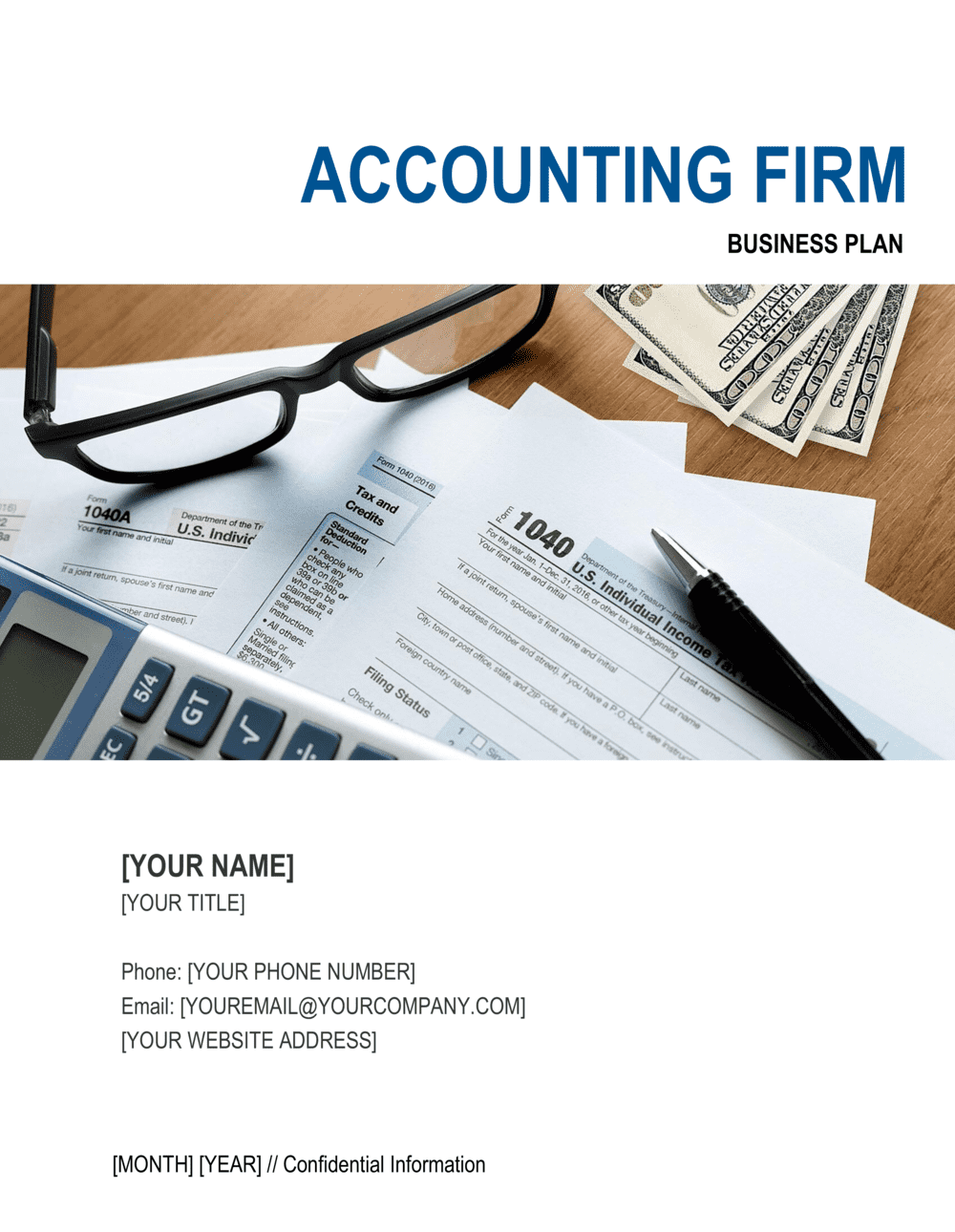
Accounting Firm Business Plan Template

Free Word download β€’ Edit online β€’ Save & share with Drive β€’ Export to PDF

33 pagesβ€’2h 45m – 3h 40m to fillβ€’Difficulty: Expert
Learn more ↓
FreeAccounting Firm Business Plan Template

At a glance

What it is
An Accounting Firm Business Plan is a structured document that maps the strategic, operational, and financial roadmap for launching or growing an accounting practice. This free Word download covers everything from service offerings and target client segments to staffing plans and 3-year financial projections β€” edit online and export as PDF for use with lenders, partners, or internal planning.
When you need it
Use it when starting a new CPA or bookkeeping practice, applying for a business loan, bringing on a partner, or repositioning an existing firm around a new service line or niche market.
What's inside
Executive summary, firm overview, market analysis, service offerings, marketing and client acquisition strategy, operations and staffing plan, management team, and three-year financial projections including revenue by service line, payroll costs, and projected EBITDA.

What is an Accounting Firm Business Plan?

An Accounting Firm Business Plan is a structured operational and strategic document that maps every material dimension of launching or growing a CPA, bookkeeping, or advisory practice β€” from service offerings and target client segments to staffing capacity, technology stack, and 3-year financial projections. Unlike a generic business plan, it is built around the metrics that define professional services firm health: utilization rates, billing rate ladders by staff level, realization rates, and recurring versus project-based revenue mix. It functions as both an internal management tool and the primary external document presented to banks, SBA lenders, and prospective partners.

Why You Need This Document

Without a written business plan, accounting firm founders typically discover their pricing model is unsustainable, their staffing timeline is incompatible with their revenue ramp, or their client acquisition assumptions are untested β€” after spending real money. Banks and SBA lenders require a formal plan for any loan application, and prospective equity partners will not enter negotiations without one. Beyond financing, the process of completing the plan forces you to validate that your billing rates cover payroll at a realistic utilization rate, that your target client segment is large enough in your geography to sustain the firm, and that your Year 1 cash position survives a slower-than-expected start. This template gives you the structure to answer all of those questions before they become expensive problems.

Which variant fits your situation?

If your situation is…Use this template
Launching a brand-new CPA or public accounting practiceAccounting Firm Business Plan (Startup)
Opening a dedicated bookkeeping or payroll services firmBookkeeping Business Plan
Pitching growth strategy to a bank for a line of creditBank Loan Business Plan
Quick one-page strategic alignment for an existing practiceOne-Page Business Plan
Planning a merger with or acquisition of another accounting firmBusiness Acquisition Plan
Mapping a three-year marketing strategy for the firmMarketing Plan
Documenting annual goals and KPIs for existing partnersStrategic Planning Template

Common mistakes to avoid

❌ Projecting revenue without modeling billable capacity

Why it matters: Accounting firm revenue is constrained by billable staff hours. A revenue forecast that implies 120% utilization is immediately flagged by any experienced lender or partner.

Fix: Build revenue projections from the staffing plan up: headcount Γ— billable hours Γ— average billing rate Γ— realization rate = realistic revenue ceiling.

❌ Ignoring client concentration risk

Why it matters: A plan that projects Year 1 revenue where two clients represent 60% of the total signals fragility β€” one lost client collapses the model.

Fix: Show a diversified client mix in your projections, and include a client acquisition target (e.g., 15 new clients in Year 1) with a channel-by-channel breakdown.

❌ Omitting the technology and practice management stack

Why it matters: Practice management software, tax platforms, and cloud accounting tools are not optional for a modern firm β€” their absence from the plan suggests operational immaturity.

Fix: List each platform, its monthly cost, and how it supports capacity, compliance, and client communication. Include onboarding timelines for software that requires setup.

❌ Presenting a vague use-of-funds section

Why it matters: A bank reviewing an SBA loan application requires a detailed schedule of how funds will be deployed β€” a single line item ('working capital: $50,000') will delay or kill the application.

Fix: Break the funding request into at least five line items: software and technology, office setup, marketing, initial payroll bridge, and contingency reserve.

The 10 key sections, explained

Executive Summary

Firm Overview

Market Analysis

Service Offerings

Competitive Analysis

Marketing and Client Acquisition Strategy

Operations and Staffing Plan

Management Team

Financial Projections

Funding Requirements and Use of Funds

How to fill it out

  1. 1

    Complete the firm overview first

    Enter the firm's legal name, entity type, founding date, state of licensure, and a one-sentence mission statement before touching any other section.

    πŸ’‘ Pull your exact registered entity name from your state's business registry β€” it must match what appears on your license application and bank documents.

  2. 2

    Build the market analysis from local data

    Research the number of small businesses, self-employed individuals, or target industry companies within your geographic service area. Multiply by estimated average annual spend on accounting services to size your SAM.

    πŸ’‘ The U.S. Census Bureau's County Business Patterns dataset and IBISWorld's accounting industry reports are the two most credible sources to cite.

  3. 3

    Define and price each service offering

    List every service the firm will offer, assign a pricing model (hourly, fixed-fee, or retainer), and estimate the number of engagements per year. This drives your revenue model in the financial projections section.

    πŸ’‘ Separate recurring revenue (monthly retainers) from project-based revenue (tax filings, audits) β€” the distinction matters to lenders evaluating revenue predictability.

  4. 4

    Map the competitive landscape honestly

    Identify at least three direct competitors β€” local CPA firms, national chains, and online accounting services β€” and write one specific paragraph explaining how your firm wins against each.

    πŸ’‘ A niche positioning (e.g., 'dedicated to e-commerce sellers' or 'specialist in nonprofit audit') is far more defensible than 'better service at lower prices.'

  5. 5

    Build the staffing and operations plan

    List every role needed to hit your Year 1 revenue target with a hire date, annual compensation, and expected billable hours. Then document your technology stack β€” practice management, tax software, and client portal.

    πŸ’‘ Calculate your target utilization rate (billable hours Γ· total available hours) and confirm it is achievable β€” 65–75% is a realistic target for a new firm.

  6. 6

    Build financial projections from the bottom up

    Model revenue by multiplying clients per service line by average fee. Layer in payroll, rent, software subscriptions, and marketing costs. Build monthly detail for Year 1 and annual summaries for Years 2–3.

    πŸ’‘ Include a scenario where Year 1 revenue comes in at 70% of plan β€” show that the firm survives and reaches breakeven by Month [X] even in the downside case.

  7. 7

    Write the executive summary last

    Distill one key data point from each completed section into a 1–2 page summary. The summary should make a lender or partner want to read the full plan.

    πŸ’‘ If the executive summary runs longer than two pages, cut it. Readers decide whether to continue based on the summary β€” brevity signals clarity of thinking.

Frequently asked questions

What is an accounting firm business plan?

An accounting firm business plan is a structured document that defines the firm's service offerings, target client base, competitive positioning, staffing model, and 3-year financial projections. It serves as both an internal roadmap for the founding partners and an external document for lenders, investors, or prospective partners evaluating the firm's viability.

What sections should an accounting firm business plan include?

A complete plan covers ten sections: executive summary, firm overview, market analysis, service offerings, competitive analysis, marketing and client acquisition strategy, operations and staffing plan, management team bios, financial projections (P&L, cash flow, and breakeven analysis), and a funding requirements schedule with use-of-funds breakdown. Most plans run 15–25 pages plus a financial model appendix.

Do I need a business plan to open an accounting firm?

No law requires it, but any bank or SBA lender will ask for one before approving a business loan. Beyond financing, a written plan forces you to stress-test your pricing model, client acquisition assumptions, and staffing capacity before you commit real capital β€” turning strategic blind spots into decisions you can adjust in a spreadsheet rather than in a cash crisis.

How do I project revenue for a new accounting firm?

Build revenue from the bottom up: estimate the number of clients you can realistically serve per service line (tax, bookkeeping, advisory), multiply by average fee or retainer, and apply a realization rate of 85–95% to account for write-offs and non-billable time. Cross-check by calculating total billable hours available from your staffing plan and confirm the implied utilization rate is realistic (65–75% for a new firm).

What financial projections should an accounting firm business plan include?

At minimum: a monthly P&L for Year 1 and annual P&L for Years 2–3, a cash flow statement showing the path to breakeven, revenue broken out by service line, payroll as a percentage of revenue, and an EBITDA projection. Lenders also want to see a sensitivity analysis showing firm survival if Year 1 revenue comes in at 70% of plan.

How is an accounting firm business plan different from a generic business plan?

The structure is similar, but the metrics and risk factors are specific to professional services. Key additions include utilization rate targets, realization rate assumptions, billing rate schedules by staff level, client concentration risk analysis, licensing and professional liability insurance requirements, and a technology stack section covering practice management and tax software. Generic business plan templates omit all of these.

How long does it take to write an accounting firm business plan?

Most practitioners spend 20–40 hours over 2–3 weeks on a complete plan. The financial model β€” particularly the revenue-by-service-line and staffing capacity model β€” typically takes 8–12 hours if built from scratch. Using a structured template reduces the structural setup time by roughly 50%, leaving your effort focused on the market research and financial modeling that requires original analysis.

Should I hire a consultant to write my accounting firm business plan?

For SBA loans under $500K or internal strategic planning, a high-quality template is generally sufficient. Consider hiring a business plan consultant ($1,500–$5,000) when the loan exceeds $500K, you are bringing on an external equity partner, or the firm is entering a heavily regulated niche such as SEC audit or forensic accounting where lender scrutiny is higher.

What makes lenders reject an accounting firm business plan?

The four most common rejection triggers are: revenue projections that imply an impossible utilization rate, a use-of-funds section with no line-item detail, a competitive analysis that claims no real alternatives exist, and a management team section with credentials but no quantified client relationship track record. Any one of these signals a founder who has not stress-tested their own model.

How this compares to alternatives

vs Generic Business Plan

A generic business plan covers the same structural sections but lacks accounting-specific metrics such as utilization rate, realization rate, billing rate schedules, and professional licensing requirements. An accounting firm plan is calibrated to how lenders and partners evaluate professional services businesses β€” using a generic template leaves critical credibility gaps.

vs One-Page Business Plan

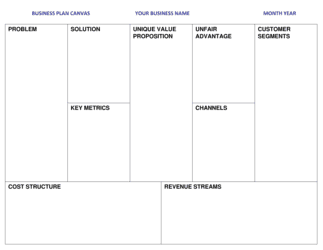
A one-page plan is useful for rapid internal alignment or early ideation but does not satisfy SBA loan requirements or partner due diligence. Use the one-page canvas to validate the concept, then build the full plan before any capital raise or formal partnership discussion.

vs Marketing Plan

A marketing plan covers only client acquisition channels, messaging, and campaign tactics. A business plan contextualizes marketing strategy within a full financial model, staffing plan, and competitive analysis. Accounting firms need both β€” the business plan funds the firm; the marketing plan fills it with clients.

vs Strategic Planning Template

A strategic plan is an internal document for existing firms mapping 3–5 year goals, initiatives, and KPIs. A business plan is an external-facing document that adds market sizing, competitive positioning, and a capital structure for lenders or partners. Established accounting firms typically need both, updated on an annual cycle.

Industry-specific considerations

Professional Services

Utilization rates, billing rate ladders by staff level, and client retention metrics are the core KPIs that distinguish accounting firm plans from other service business plans.

SaaS / Technology

Tech-focused accounting firms serving SaaS clients need revenue recognition expertise under ASC 606 and recurring revenue modeling, which should be highlighted in the service offerings section.

Healthcare

Accounting firms specializing in healthcare must address HIPAA-compliant data handling, cost report preparation, and the complexity of Medicare and Medicaid reimbursement accounting.

Retail / E-commerce

Firms targeting e-commerce clients should detail multi-state sales tax compliance capabilities, inventory accounting methods, and platform-specific integrations with Shopify or Amazon Seller Central.

Template vs pro β€” what fits your needs?

PathBest forCostTime
Use the templateSolo practitioners, small founding teams, and SBA loan applications under $500KFree2–3 weeks (20–40 hours)
Template + professional reviewFirms seeking loans above $500K or bringing on an external equity partner$500–$2,000 for a financial model review by an accountant or business advisor3–4 weeks
Custom draftedMulti-partner firm launches, mergers and acquisitions, or regulated specialty practices requiring institutional lender approval$2,500–$7,500 for a professional business plan writer with professional services experience4–6 weeks

Glossary

Realization Rate
The percentage of billable hours actually invoiced and collected, compared to total hours worked β€” a core profitability metric for accounting firms.
Billing Rate
The hourly or fixed fee charged to clients for professional services, typically set by staff level (partner, manager, senior, staff).
Client Concentration Risk
The financial exposure created when a single client or small group accounts for a disproportionate share of firm revenue.
Niche Market Strategy
A go-to-market approach in which the firm focuses on a specific industry, client size, or service type to differentiate from generalist competitors.
Recurring Revenue
Predictable, subscription-style income from ongoing engagements such as monthly bookkeeping retainers, payroll processing, or audit contracts.
Utilization Rate
The percentage of an employee's total working hours that are billed to clients, typically targeted at 65–80% for professional services firms.
Practice Management Software
Platforms such as QuickBooks, Karbon, or Thomson Reuters CS Professional Suite used to manage client work, billing, and firm operations.
CPA (Certified Public Accountant)
A licensed accounting professional who has passed the Uniform CPA Examination and met state-specific education and experience requirements.
Pro Forma Financials
Forward-looking financial statements built on revenue and cost assumptions, used to model firm performance before historical data is available.
Value Pricing
A billing model that charges clients based on the value delivered rather than hours worked β€” increasingly common in advisory and tax planning services.

Part of your Business Operating System

This document is one of 3,000+ business & legal templates included in Business in a Box.

  • Fill-in-the-blanks β€” ready in minutes
  • 100% customizable Word document
  • Compatible with all office suites
  • Export to PDF and share electronically

Create your document in 3 simple steps.

From template to signed document β€” all inside one Business Operating System.
1
Download or open template

Access over 3,000+ business and legal templates for any business task, project or initiative.

2
Edit and fill in the blanks with AI

Customize your ready-made business document template and save it in the cloud.

3
Save, Share, Send, Sign

Share your files and folders with your team. Create a space of seamless collaboration.

Save time, save money, and create top-quality documents.

β˜…β˜…β˜…β˜…β˜…

"Fantastic value! I'm not sure how I'd do without it. It's worth its weight in gold and paid back for itself many times."

Managing Director Β· Mall Farm
Robert Whalley
Managing Director, Mall Farm Proprietary Limited
β˜…β˜…β˜…β˜…β˜…

"I have been using Business in a Box for years. It has been the most useful source of templates I have encountered. I recommend it to anyone."

Business Owner Β· 4+ years
Dr Michael John Freestone
Business Owner
β˜…β˜…β˜…β˜…β˜…

"It has been a life saver so many times I have lost count. Business in a Box has saved me so much time and as you know, time is money."

Owner Β· Upstate Web
David G. Moore Jr.
Owner, Upstate Web

Run your business with a system β€” not scattered tools

Stop downloading documents. Start operating with clarity. Business in a Box gives you the Business Operating System used by over 250,000 companies worldwide to structure, run, and grow their business.

Start freeΒ Β·Β No credit card required