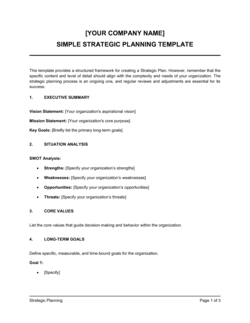
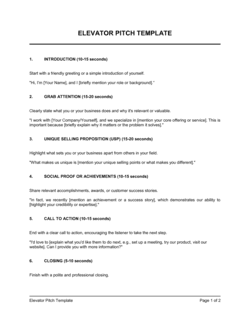
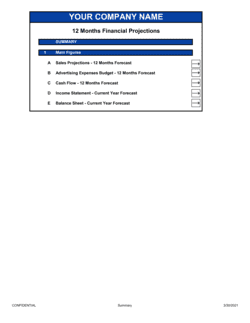
Lean Business Plan Template

Free Word download β€’ Edit online β€’ Save & share with Drive β€’ Export to PDF

9 pagesβ€’1h 10m – 1h 35m to fillβ€’Difficulty: Expert
Learn more ↓
FreeLean Business Plan Template

At a glance

What it is
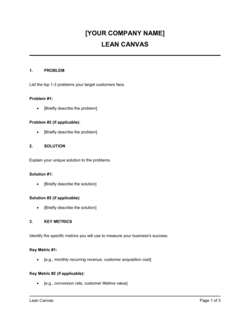
A Lean Business Plan is a concise, action-oriented planning document that distills strategy, tactics, milestones, and key financial metrics into a single structured page or short document β€” typically 1–5 pages. This free Word download gives you a ready-to-edit framework you can complete in under an hour and export as PDF to share with partners, advisors, or your team.
When you need it
Use it when you need a working plan fast β€” at launch, when pivoting, or when a full 30-page business plan would consume time better spent executing. It is also the right format for internal alignment meetings, monthly management reviews, and grant applications that ask for a summary plan.
What's inside
Identity and value proposition, target customer and problem statement, solution and key differentiators, go-to-market strategy, milestones and key metrics, team summary, and a concise financial summary covering revenue model, projected revenue, and cash runway.

What is a Lean Business Plan?

A Lean Business Plan is a concise, action-oriented planning document that compresses the core elements of a traditional business plan β€” strategy, target market, revenue model, competitive positioning, milestones, and financial summary β€” into 1–5 focused pages. Unlike a full business plan, which is written once for a bank or investor and rarely revisited, a lean plan is designed to be completed quickly, reviewed monthly, and revised as the business gathers real data from customers and the market. It draws on lean startup methodology, which treats every early assumption as a hypothesis to be tested rather than a fact to be documented.

Why You Need This Document

Skipping a plan entirely is the most common early-stage mistake β€” teams execute in different directions, financial assumptions go untested, and there is no shared milestone against which to measure progress or trigger a pivot. A full 30-page business plan solves this in theory but takes weeks to produce and quickly becomes outdated. The lean plan closes the gap: it forces you to state your customer, your revenue model, and your key milestones in writing β€” specific enough to be challenged, short enough to be updated every month. For founders preparing accelerator applications, for small business owners aligning a new hire, or for managers launching a new service line, this template provides the structure to get a credible plan on paper in hours, not weeks.

Which variant fits your situation?

If your situation is…Use this template
Raising seed or Series A capital from investorsInvestor Business Plan
Applying for a bank loan or SBA financingBusiness Plan
Mapping assumptions visually before writing any narrativeBusiness Model Canvas
Opening a specific food-service or restaurant conceptRestaurant Business Plan
Planning a product or service launch with campaign detailsNew Product Launch Plan
Setting 3–5 year organizational goals with KPIs and initiativesStrategic Plan
Summarizing the business in slides for a pitch meetingPitch Deck / Elevator Pitch

Common mistakes to avoid

❌ Treating the lean plan as a one-time document

Why it matters: A plan that is never updated becomes disconnected from reality within 60 days. Teams stop consulting it and revert to informal decision-making.

Fix: Schedule a monthly 30-minute review to update milestones, revise financial assumptions, and log what changed and why.

❌ Skipping the competitive landscape section

Why it matters: Omitting competitors signals either poor market research or wishful thinking. Any reader with industry knowledge will notice immediately and discount the entire plan.

Fix: Name at least three direct or indirect competitors with one specific strength and one specific weakness each, then state your concrete advantage over them.

❌ Activity-based milestones instead of outcome-based

Why it matters: Milestones like 'launch website' or 'run ads' can be completed without the business making any real progress. They cannot trigger a meaningful pivot decision.

Fix: Rewrite every milestone as a measurable outcome: 'acquire 50 paying customers at $[X] ACV by [DATE]' instead of 'begin customer outreach.'

❌ Revenue projections with no unit-economics foundation

Why it matters: A Year 1 revenue figure that is not backed by a customer count times an average contract value is not a projection β€” it is a wish. Advisors and investors will ask for the math immediately.

Fix: Build the revenue line from the bottom up: realistic customer acquisitions per month Γ— average revenue per customer = monthly revenue. Show the assumption, even in a footnote.

The 9 key sections, explained

Identity and value proposition

Problem and target customer

Solution and key differentiators

Revenue model and pricing

Go-to-market strategy

Competitive landscape

Team and key hires

Milestones and timeline

Financial summary

How to fill it out

  1. 1

    Write the identity and value proposition first

    Start with your company name, structure, and a single sentence that names your customer, their problem, and your specific solution. This sentence anchors every other section.

    πŸ’‘ Test the value proposition by reading it to someone unfamiliar with your business. If they cannot repeat the core idea back in their own words, revise it.

  2. 2

    Define the target customer and problem with specifics

    Describe your customer in enough detail that you could find them β€” industry, company size, job title, or demographic. Then state the problem in terms of cost, time lost, or risk.

    πŸ’‘ Use a real customer conversation or survey data to phrase the problem in the customer's own words rather than your interpretation.

  3. 3

    State your solution and three differentiators

    Describe what you offer and list no more than three specific ways it outperforms alternatives. Frame each differentiator as a customer outcome, not a product feature.

    πŸ’‘ If you cannot name three differentiators without using the word 'better,' you need more customer validation before completing the plan.

  4. 4

    Choose two primary acquisition channels

    Select the two channels where your target customer is most reachable and where you have or can build a realistic advantage. Estimate CAC and conversion rate for each.

    πŸ’‘ Choose channels you can test within 30 days with under $500. Channels you cannot test cheaply are assumptions, not strategy.

  5. 5

    Set three to six outcome-based milestones

    Write each milestone as a measurable result tied to a specific quarter β€” not an activity. Include at least one revenue milestone, one product milestone, and one team or operational milestone.

    πŸ’‘ Milestones should be ambitious enough to require focus but achievable enough that missing them triggers a real pivot decision.

  6. 6

    Complete the financial summary from unit economics up

    Calculate Year 1 revenue by multiplying your realistic customer count by average contract or transaction value. Then subtract estimated costs to get burn rate and runway.

    πŸ’‘ Build a quick spreadsheet with monthly columns before entering the summary numbers β€” a single backing model prevents embarrassing inconsistencies.

  7. 7

    Review the plan for internal consistency

    Check that the revenue model, go-to-market channels, milestones, and financial summary all tell the same story. The customer count implied by the financial summary should match what the GTM section can plausibly deliver.

    πŸ’‘ Have one person who has not read the plan review it cold and flag any section where the logic breaks or a number seems unsupported.

Frequently asked questions

What is a lean business plan?

A lean business plan is a short, action-oriented planning document β€” typically 1–5 pages β€” that covers strategy, tactics, milestones, and key financial metrics without the narrative length of a traditional business plan. It is designed to be written quickly, reviewed frequently, and revised as the business learns from customers and the market.

What is the difference between a lean business plan and a full business plan?

A full business plan runs 20–35 pages with detailed market research, competitive analysis, and three-statement financial projections and is primarily designed for raising capital from investors or lenders. A lean business plan strips out the narrative and focuses on the decisions and metrics that matter right now β€” it is a working management tool, not a formal financing document. Use the lean format for internal planning and early-stage validation; upgrade to a full plan when a bank or investor specifically requests one.

Can I use a lean business plan to raise funding?

For pre-seed conversations with angel investors and accelerator applications, a well-structured lean plan is often sufficient to start the dialogue. Most institutional investors and all bank lenders will eventually require a full plan with three-statement financial projections before committing capital. The lean plan is best used to generate early interest and as the foundation from which you build the full document.

How long does it take to write a lean business plan?

Most founders and business owners complete a first draft in 1–3 hours using a structured template. The financial summary is usually the most time-consuming section β€” expect 30–60 minutes if you are building the underlying numbers for the first time. Subsequent monthly revisions typically take 20–30 minutes.

How often should a lean business plan be updated?

A lean plan should be reviewed monthly and updated whenever a significant assumption changes β€” a new pricing model, a shift in target customer, a missed milestone, or a change in competitive dynamics. The value of the lean format is that updating it is low-friction; a plan that takes two hours to revise will not get revised.

What financial information belongs in a lean business plan?

The financial summary in a lean plan should include projected revenue for the next 12 months, monthly operating costs, burn rate, current cash runway, and any funding requirements with a stated use. Three- statement financial models (P&L, cash flow, balance sheet) belong in a full business plan β€” the lean version presents only the headline metrics that drive decisions.

Is a lean business plan the same as a Business Model Canvas?

They serve similar purposes but have different formats. A Business Model Canvas is a visual one-page framework organized into nine building blocks β€” it is excellent for mapping assumptions and facilitating team discussion. A lean business plan is a narrative document with a financial summary and time-bound milestones β€” it is better suited for sharing externally with advisors, partners, or early investors. Many founders use the canvas first and then convert it into a lean plan.

What makes a lean business plan credible to an outside reader?

Three things signal credibility: milestones expressed as measurable outcomes rather than activities, a financial summary built from unit economics rather than round-number guesses, and a competitive section that names real alternatives and explains specifically why the business wins. A lean plan that gets these three right is more persuasive than a 30-page plan that gets them wrong.

Do I need a consultant or advisor to write a lean business plan?

No. A lean plan is specifically designed to be written by the founder or business owner without professional help. A structured template handles the framework; the content comes from your direct knowledge of the customer and the business. Consider a one-hour session with an advisor or mentor to review the finished draft and challenge your key assumptions before you share it externally.

How this compares to alternatives

vs Full Business Plan

A full business plan runs 20–35 pages with detailed market research, competitive analysis, and three-statement financial projections β€” required by banks and institutional investors. A lean plan covers the same strategic logic in 1–5 pages, optimized for speed and internal use. Start with the lean format; build the full plan when a lender or investor specifically requests it.

vs Business Model Canvas

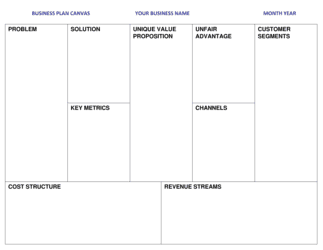
A Business Model Canvas maps nine business model components visually on a single page β€” ideal for workshop facilitation and hypothesis testing. A lean business plan adds a narrative, time-bound milestones, and a financial summary, making it more suitable for sharing with external advisors or early-stage investors. Many founders use the canvas first and then draft the lean plan from it.

vs Strategic Plan

A strategic plan focuses on a 3–5 year directional roadmap for an existing organization β€” goals, initiatives, KPIs, and resource allocation by department. A lean business plan is shorter, externally shareable, and includes a financial summary and go-to-market details that a strategic plan typically omits. Existing businesses may need both: the lean plan for external conversations, the strategic plan for internal execution.

vs Pitch Deck

A pitch deck is a 10–15 slide visual presentation designed for a 20-minute investor meeting β€” it generates interest and secures a follow-up. A lean business plan is a written document with more analytical depth, used for diligence conversations, advisor reviews, and operational planning. The deck gets you in the room; the lean plan supports the conversation that follows.

Industry-specific considerations

SaaS / Technology

MRR growth target, churn rate assumption, CAC payback period, and infrastructure cost as a percentage of revenue are the four metrics that anchor the financial summary.

Retail / E-commerce

Average order value, repeat purchase rate, fulfillment cost per order, and seasonal revenue concentration shape the milestones and financial sections.

Professional Services

Billable utilization rate, average project value, and client concentration risk are the key metrics; the team section carries more weight than in product businesses.

Food & Beverage / Restaurant

Location build-out cost, covers per day, food cost percentage (target 28–35%), and break-even covers per service define the financial summary for brick-and-mortar concepts.

Healthcare / MedTech

Regulatory pathway and timeline, reimbursement code eligibility, and clinical validation milestones must appear explicitly in the milestones section.

Professional Services

Billable utilization rate, average project value, and client concentration risk are the key metrics; the team section carries more weight than in product businesses.

Template vs pro β€” what fits your needs?

PathBest forCostTime
Use the templateFounders, small business owners, and managers who need a working plan within a dayFree1–3 hours
Template + professional reviewEarly-stage founders preparing for accelerator applications or initial investor conversations$150–$500 for a mentor or advisor review session1–2 days
Custom draftedBusinesses needing a lean plan as part of a larger fundraising or grant-application package$500–$2,000 for a business plan consultant3–7 days

Glossary

Lean Planning
An iterative planning approach that prioritizes a short, actionable document over a lengthy formal plan, designed to be reviewed and revised frequently.
Value Proposition
A one-sentence statement that explains what the business offers, who it serves, and the specific benefit that differentiates it from alternatives.
Target Market
The specific group of customers a business intends to serve, defined by demographics, behavior, industry, or geography.
Revenue Model
The mechanism by which a business generates income β€” such as subscription fees, per-unit sales, service retainers, or advertising.
Burn Rate
The rate at which a business spends its cash reserves each month before reaching profitability or securing additional funding.
Runway
The number of months a business can operate at its current burn rate before running out of cash.
Milestone
A specific, time-bound achievement used to measure progress β€” such as reaching 100 paying customers by a defined date.
KPI (Key Performance Indicator)
A measurable metric used to track progress toward a specific business objective, such as monthly recurring revenue or customer acquisition cost.
Traction
Evidence that a business model is working β€” quantified through metrics like revenue, user growth, retention, or signed letters of intent.
Pivot
A deliberate change in strategy, product, or target market based on new data or customer feedback, while retaining core capabilities.

Part of your Business Operating System

This document is one of 3,000+ business & legal templates included in Business in a Box.

  • Fill-in-the-blanks β€” ready in minutes
  • 100% customizable Word document
  • Compatible with all office suites
  • Export to PDF and share electronically

Create your document in 3 simple steps.

From template to signed document β€” all inside one Business Operating System.
1
Download or open template

Access over 3,000+ business and legal templates for any business task, project or initiative.

2
Edit and fill in the blanks with AI

Customize your ready-made business document template and save it in the cloud.

3
Save, Share, Send, Sign

Share your files and folders with your team. Create a space of seamless collaboration.

Save time, save money, and create top-quality documents.

β˜…β˜…β˜…β˜…β˜…

"Fantastic value! I'm not sure how I'd do without it. It's worth its weight in gold and paid back for itself many times."

Managing Director Β· Mall Farm
Robert Whalley
Managing Director, Mall Farm Proprietary Limited
β˜…β˜…β˜…β˜…β˜…

"I have been using Business in a Box for years. It has been the most useful source of templates I have encountered. I recommend it to anyone."

Business Owner Β· 4+ years
Dr Michael John Freestone
Business Owner
β˜…β˜…β˜…β˜…β˜…

"It has been a life saver so many times I have lost count. Business in a Box has saved me so much time and as you know, time is money."

Owner Β· Upstate Web
David G. Moore Jr.
Owner, Upstate Web

Run your business with a system β€” not scattered tools

Stop downloading documents. Start operating with clarity. Business in a Box gives you the Business Operating System used by over 250,000 companies worldwide to structure, run, and grow their business.

Start freeΒ Β·Β No credit card required