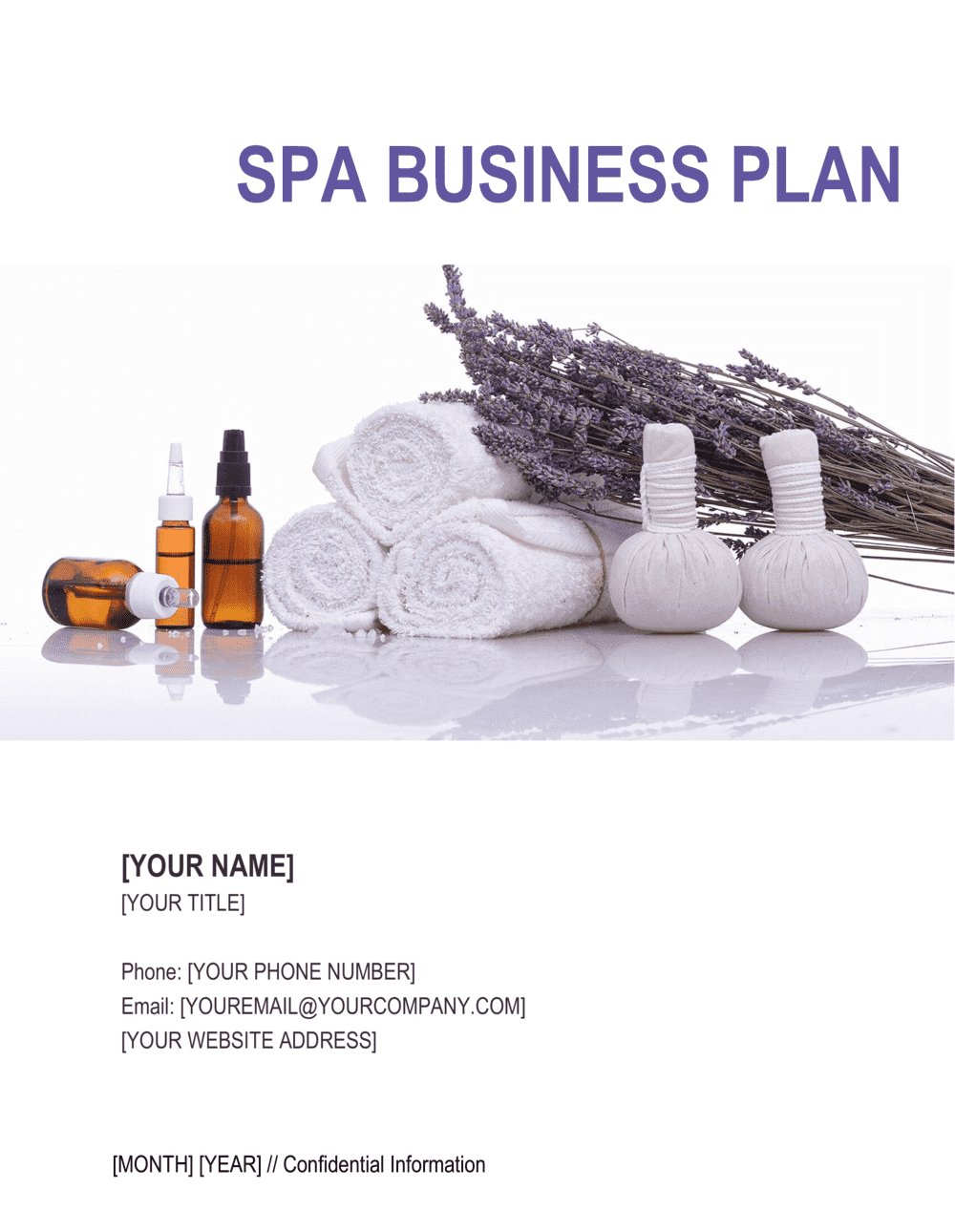
Spa Business Plan Template

Free Word download β€’ Edit online β€’ Save & share with Drive β€’ Export to PDF

41 pagesβ€’3h 15m – 4h 25m to fillβ€’Difficulty: Expert
Learn more ↓
FreeSpa Business Plan Template

At a glance

What it is
A Spa Business Plan is a structured operational document that maps your spa concept, target clientele, service menu, competitive positioning, staffing model, and 3-year financial projections into a single investor-ready file. This free Word download gives you a professionally formatted starting point you can edit online and export as PDF to share with lenders, landlords, or silent partners.
When you need it
Use it when opening a new day spa, medical spa, or wellness center, applying for a small-business loan or SBA financing, or attracting an investor or franchise partner who requires a formal written plan.
What's inside
Executive summary, company overview, market and competitive analysis, service menu and pricing, marketing and sales strategy, operations and staffing plan, and full financial projections including revenue by treatment category, payroll model, and break-even analysis.

What is a Spa Business Plan?

A Spa Business Plan is a structured operational document that defines your spa concept, target clientele, service menu, staffing model, marketing strategy, and 3-year financial projections in a single file. It translates the vision for a day spa, medical spa, or wellness center into a concrete operational and financial roadmap β€” quantifying how many treatment rooms you need, what utilization rate covers your costs, which client segments you are targeting, and how much capital is required to open and sustain operations through the ramp-up period. Written correctly, it functions both as an internal execution guide and as the formal submission document required by SBA lenders, commercial banks, and private investors.

Why You Need This Document

Without a written spa business plan, lenders will not process your loan application, investors have no basis to evaluate the opportunity, and you have no financial model to test whether your pricing and staffing structure actually generates profit. The spa industry has a high first-year failure rate, and the most common causes β€” underpriced services, overstated early utilization, insufficient working capital, and no client-retention strategy β€” are all problems a rigorous business plan forces you to confront before you sign a lease or purchase equipment. A complete plan with bottom-up financial projections and a realistic ramp model demonstrates operational credibility to every capital source and gives you a benchmark to measure actual performance against from the moment you open your doors. This template gives you the structure to produce that plan without starting from a blank page.

Which variant fits your situation?

If your situation is…Use this template
Opening a day spa offering facials, massage, and body treatmentsDay Spa Business Plan
Launching a medical spa with injectable and laser servicesMedical Spa Business Plan
Adding a spa within an existing hotel or resort propertyHotel Spa Business Plan
Quick concept validation before full planning beginsOne-Page Business Plan
Raising equity from angel investors or wellness-focused fundsInvestor Business Plan
Expanding a single location into a multi-site spa groupBusiness Expansion Plan
Opening a nail salon or hair studio under the same conceptBeauty Salon Business Plan

Common mistakes to avoid

❌ Projecting unrealistic early utilization rates

Why it matters: Showing 70%+ utilization in Month 1 produces a false cash-flow surplus and conceals the real working-capital need. Lenders who spot this immediately discount the entire financial model.

Fix: Open the model at 20–25% utilization and build to target occupancy by Month 9–12, with specific marketing milestones that justify each step up.

❌ Underpricing the service menu

Why it matters: Setting prices below the cost of labor, supplies, and room overhead means every treatment sold accelerates losses. Many first-time spa owners price based on what feels comfortable rather than what the numbers require.

Fix: Calculate the all-in cost per treatment hour β€” therapist commission, supplies, laundry, and room overhead β€” and set prices so gross margin is at least 60% per service.

❌ No working-capital reserve in the funding ask

Why it matters: Fit-out and equipment costs routinely run over estimate, and revenue ramps slowly in the first 90 days. A plan with no cash buffer shows lenders an operator who hasn't stress-tested the model.

Fix: Include a minimum of 3 months of fixed operating costs as a working-capital line in the funding requirements table.

❌ Omitting a client retention strategy

Why it matters: Acquiring a new spa client costs 5–7Γ— more than retaining an existing one. A plan that describes only acquisition channels will show structurally high marketing costs and low LTV.

Fix: Include a rebooking protocol, loyalty program, or membership model with a specific retention rate target β€” even a simple 'rebook at checkout' process measurably improves 90-day return rates.

❌ Using national industry data without local validation

Why it matters: A lender evaluating a specific address needs trade-area evidence β€” competing spa density, local demographic income data, and foot-traffic patterns β€” not a national market-size headline.

Fix: Supplement industry reports with a 3–5 mile radius demographic pull, a count of competing locations, and at least one primary source such as a mystery-shop visit or local chamber of commerce data.

❌ Understating staffing costs in the financial model

Why it matters: Payroll, commission, payroll taxes, and benefits typically represent 40–50% of spa revenue. Models that undercount staff hours or omit employer-side taxes produce margins that look healthy on paper but collapse operationally.

Fix: Build a headcount-by-role table with hours, commission rates, and employer tax burden for each position, and reconcile the total to the payroll line in the P&L.

The 10 key sections, explained

Executive Summary

Company Overview

Market Analysis

Competitive Analysis

Service Menu and Pricing

Marketing and Sales Strategy

Operations and Staffing Plan

Management Team

Financial Projections

Funding Requirements and Use of Funds

How to fill it out

  1. 1

    Define your spa concept and ownership structure

    Start with the legal entity name, ownership percentages, spa type (day spa, medical spa, hotel spa), and a one-paragraph concept statement that identifies your target client and core differentiation.

    πŸ’‘ Lock the concept statement before touching any other section β€” every pricing, staffing, and marketing decision flows from it.

  2. 2

    Research your local market and trade area

    Pull demographic data for a 3–5 mile radius using the U.S. Census Bureau or a local economic development office. Count competing spa locations and note their pricing and service gaps. Use ISPA's annual industry report for national benchmarks.

    πŸ’‘ Walk into the top three competitors as a mystery shopper before writing the competitive analysis β€” firsthand observations are more credible than online reviews.

  3. 3

    Build your service menu with cost-per-treatment analysis

    List every service with its duration, product cost (supplies consumed per treatment), and target price. Calculate the gross profit per service hour for each category. Flag any service where gross margin falls below 60%.

    πŸ’‘ Massage services typically carry 65–75% gross margin; facials with premium product lines can drop to 50% if pricing is not calibrated to product cost.

  4. 4

    Model the staffing and payroll structure

    Decide whether therapists are W-2 employees on commission, independent contractors, or booth renters. Calculate the total labor cost per treatment hour under each model and confirm it aligns with your target margins.

    πŸ’‘ Independent contractor models carry misclassification risk in several states β€” confirm with your accountant before committing to that structure in the plan.

  5. 5

    Develop the three-year financial model

    Build revenue projections from treatment-room utilization up β€” number of rooms Γ— available hours Γ— utilization rate Γ— average ticket value. Model Year 1 monthly, Years 2–3 annually. Include startup costs, payroll, rent, and a 3-month working-capital reserve.

    πŸ’‘ Use 25% utilization in Month 1 and grow to your target rate by Month 9. Anything faster requires a specific pre-opening waitlist or corporate contract to justify.

  6. 6

    Define your marketing launch plan with a budget

    Identify two to three paid or partnership-based client acquisition channels for the first 90 days. Assign a dollar budget and an expected client-acquisition cost to each. Include a membership pre-sale target for the soft-open period.

    πŸ’‘ A pre-opening membership sale of 50–100 founding members provides both validation and immediate recurring revenue to offset early low utilization.

  7. 7

    State the funding ask with a specific use-of-funds table

    Enter total capital required, the funding sources and instruments (SBA loan, owner equity, investor), and a line-item allocation table. Include a 10–15% contingency on the fit-out and equipment line.

    πŸ’‘ Lenders review the use-of-funds table first β€” vague categories like 'general expenses' will prompt a request for more detail before the loan proceeds.

  8. 8

    Write the executive summary last

    Pull the concept statement, market opportunity size, Year 1 revenue target, break-even timeline, and funding ask into a 1–2 page summary. Every number in the summary must match a section in the body of the plan.

    πŸ’‘ If the executive summary runs longer than two pages, cut it β€” lenders and investors read the summary and financials first, and length signals poor editing.

Frequently asked questions

What is a spa business plan?

A spa business plan is a structured document that defines your spa concept, target market, service menu, staffing model, marketing strategy, and financial projections for the first 3 years of operation. It serves as both a strategic roadmap for the owner-operator and a formal submission document for bank loans, SBA financing, or investor presentations. A complete plan typically runs 20–30 pages plus a financial model appendix.

What sections should a spa business plan include?

A complete spa business plan covers ten sections: executive summary, company overview, market analysis, competitive analysis, service menu and pricing, marketing and sales strategy, operations and staffing plan, management team, financial projections (P&L, cash flow, break-even), and funding requirements with a use-of-funds table. Skipping any of these creates gaps that lenders will ask you to fill before approving a loan.

How much does it cost to open a spa?

Startup costs for a day spa with 4–6 treatment rooms typically range from $75,000 to $250,000, depending on leasehold improvement scope, equipment quality, and location market. Medical spas with laser and injectable equipment can run $300,000 to $750,000 or more. Your business plan should itemize pre-opening costs line by line β€” equipment, fit-out, licensing, inventory, and a working-capital reserve β€” rather than using a lump-sum estimate.

What financial projections does a spa business plan need?

At minimum: a monthly P&L for Year 1 and annual P&L for Years 2–3, a cash flow statement on the same cadence, a startup cost breakdown, a break-even analysis (the utilization rate at which revenue covers all fixed and variable costs), and a use-of-funds table tied to the funding ask. Lenders also expect to see revenue broken out by category β€” treatments, memberships, and retail β€” so they can assess the business model's diversification.

What utilization rate should I project for a new spa?

A realistic model opens at 20–30% treatment-room utilization in Month 1 and targets 65–75% by Month 9–12. Projecting higher than 30% in the first 90 days requires a specific justification β€” a pre-opening membership pre-sale, a confirmed corporate wellness contract, or an existing client list. Lenders who review spa plans regularly recognize overstated early utilization immediately and discount the entire model.

Do I need a business plan to get an SBA loan for a spa?

Yes. SBA 7(a) and SBA 504 lenders require a written business plan for any loan above $150,000. The plan must include a market analysis, management overview, startup cost itemization, and 3-year financial projections. Some lenders also require a competitive analysis and a description of collateral. Using a structured template significantly reduces the documentation time and ensures the required sections are present.

What is the difference between a day spa and a medical spa business plan?

A day spa plan focuses on massage, facials, and body treatments with licensed estheticians and massage therapists. A medical spa plan adds sections on the supervising physician or medical director, regulatory compliance (state-specific medical spa statutes), equipment financing for lasers and injectables, and malpractice insurance. Medical spa financial models also include higher pre-opening costs and different gross-margin profiles for clinical services.

How long does it take to write a spa business plan?

First-time owners typically spend 20–40 hours over 2–4 weeks on a complete plan. The financial model alone takes 8–12 hours to build from scratch. Using a structured template cuts structural work by roughly 50–60%, concentrating your time on the market research, service pricing analysis, and financial assumptions that require original thinking and local data.

Should I hire a consultant to write my spa business plan?

For SBA loans under $350,000 and straightforward day-spa concepts, a high-quality template is typically sufficient. Consider a business plan consultant ($1,500–$5,000) when applying for a loan above $500,000, seeking equity investment, opening a medical spa with complex regulatory requirements, or when your financial modeling experience is limited and the stakes of an error are high.

How this compares to alternatives

vs Beauty Salon Business Plan

A beauty salon plan centers on hair services, chair rental models, and stylist commission structures. A spa business plan focuses on treatment-room utilization, membership programs, and a broader wellness service menu. The two overlap when a concept combines both offerings, but the financial models differ significantly β€” spa plans require detailed room-yield analysis while salon plans are built around chair count and stylist productivity.

vs Restaurant Business Plan

Both are location-based service businesses requiring detailed startup cost and staffing models, but the financial drivers are entirely different. A restaurant plan is built around covers per day and food cost percentage. A spa plan is built around treatment-room utilization and average ticket value. The spa plan also uniquely requires a membership and retention model that has no equivalent in food service.

vs One-Page Business Plan

A one-page plan is a rapid-alignment tool for testing a concept or presenting an idea internally. It has no financial detail, competitive analysis, or staffing model. Lenders and investors always require the full plan. Use the one-page version in the ideation phase, then build the full spa plan before approaching any capital source.

vs Marketing Plan

A marketing plan covers only client acquisition, retention, and promotional strategy in depth. A spa business plan includes a marketing section but situates it within the full financial and operational context β€” so the marketing spend is tied to a client-acquisition cost model and a revenue impact projection. Use a standalone marketing plan after the business plan is complete, to build out campaign-level detail.

Industry-specific considerations

Hospitality and Hotels

Hotel spa plans must model capture rates from room guests alongside external client acquisition, and justify the spa's contribution to RevPAR and overall property positioning.

Health and Wellness

Wellness-focused spas incorporating IV therapy, cryotherapy, or functional medicine need to address licensing requirements, medical oversight, and clinical service margins separately from traditional spa treatments.

Beauty and Personal Care

Day spas that bundle hair, nail, and skincare services must model revenue per chair and per treatment room separately, and account for the staffing and scheduling complexity of multi-discipline service menus.

Retail and E-commerce

Spas with a significant retail product line β€” skincare, aromatherapy, wellness supplements β€” need a retail section covering inventory turns, wholesale margin, and shrinkage, with a retail-to-service revenue target of 15–25%.

Template vs pro β€” what fits your needs?

PathBest forCostTime
Use the templateFirst-time spa owners, SBA loan applications under $350K, and day-spa concepts with a straightforward service menuFree2–4 weeks (20–40 hours)
Template + professional reviewLoans of $350K–$750K, investors requiring audited-quality projections, or owners with limited financial modeling experience$500–$2,000 for an accountant or spa-industry advisor review3–5 weeks
Custom draftedMedical spa startups with complex licensing, multi-location rollouts, or equity raises above $750K$3,000–$8,000 for a professional business plan writer with spa or hospitality experience4–8 weeks

Glossary

Treatment Menu
The complete list of services a spa offers, grouped by category (e.g., massage, facial, body wrap), with durations and published prices.
Average Ticket Value
Total revenue divided by the number of client visits in a period β€” the per-visit spending average across all services and retail.
Utilization Rate
The percentage of available treatment-room hours actually booked, typically targeted at 65–80% for a profitable spa.
Retail-to-Service Ratio
The share of total revenue generated by product sales versus treatments β€” a healthy day spa typically targets 15–25% from retail.
Client Retention Rate
The percentage of first-time visitors who return within 90 days, used as the primary leading indicator of long-term spa revenue.
Yield per Square Foot
Annual revenue divided by total treatment-room square footage β€” a benchmark used to evaluate location efficiency and lease affordability.
Break-Even Occupancy
The minimum utilization rate at which total revenue covers all fixed and variable costs, with zero profit or loss.
Pre-Opening Costs
One-time expenses incurred before the spa opens β€” equipment, fit-out, licensing, initial inventory, and staff training.
Recurring Revenue
Predictable monthly income from membership programs, prepaid packages, or corporate wellness contracts.
COGS (Cost of Goods Sold)
The direct costs of delivering treatments β€” product supplies consumed, laundry, and disposables β€” typically 8–15% of service revenue for a spa.

Part of your Business Operating System

This document is one of 3,000+ business & legal templates included in Business in a Box.

  • Fill-in-the-blanks β€” ready in minutes
  • 100% customizable Word document
  • Compatible with all office suites
  • Export to PDF and share electronically

Create your document in 3 simple steps.

From template to signed document β€” all inside one Business Operating System.
1
Download or open template

Access over 3,000+ business and legal templates for any business task, project or initiative.

2
Edit and fill in the blanks with AI

Customize your ready-made business document template and save it in the cloud.

3
Save, Share, Send, Sign

Share your files and folders with your team. Create a space of seamless collaboration.

Save time, save money, and create top-quality documents.

β˜…β˜…β˜…β˜…β˜…

"Fantastic value! I'm not sure how I'd do without it. It's worth its weight in gold and paid back for itself many times."

Managing Director Β· Mall Farm
Robert Whalley
Managing Director, Mall Farm Proprietary Limited
β˜…β˜…β˜…β˜…β˜…

"I have been using Business in a Box for years. It has been the most useful source of templates I have encountered. I recommend it to anyone."

Business Owner Β· 4+ years
Dr Michael John Freestone
Business Owner
β˜…β˜…β˜…β˜…β˜…

"It has been a life saver so many times I have lost count. Business in a Box has saved me so much time and as you know, time is money."

Owner Β· Upstate Web
David G. Moore Jr.
Owner, Upstate Web

Run your business with a system β€” not scattered tools

Stop downloading documents. Start operating with clarity. Business in a Box gives you the Business Operating System used by over 250,000 companies worldwide to structure, run, and grow their business.

Start freeΒ Β·Β No credit card required