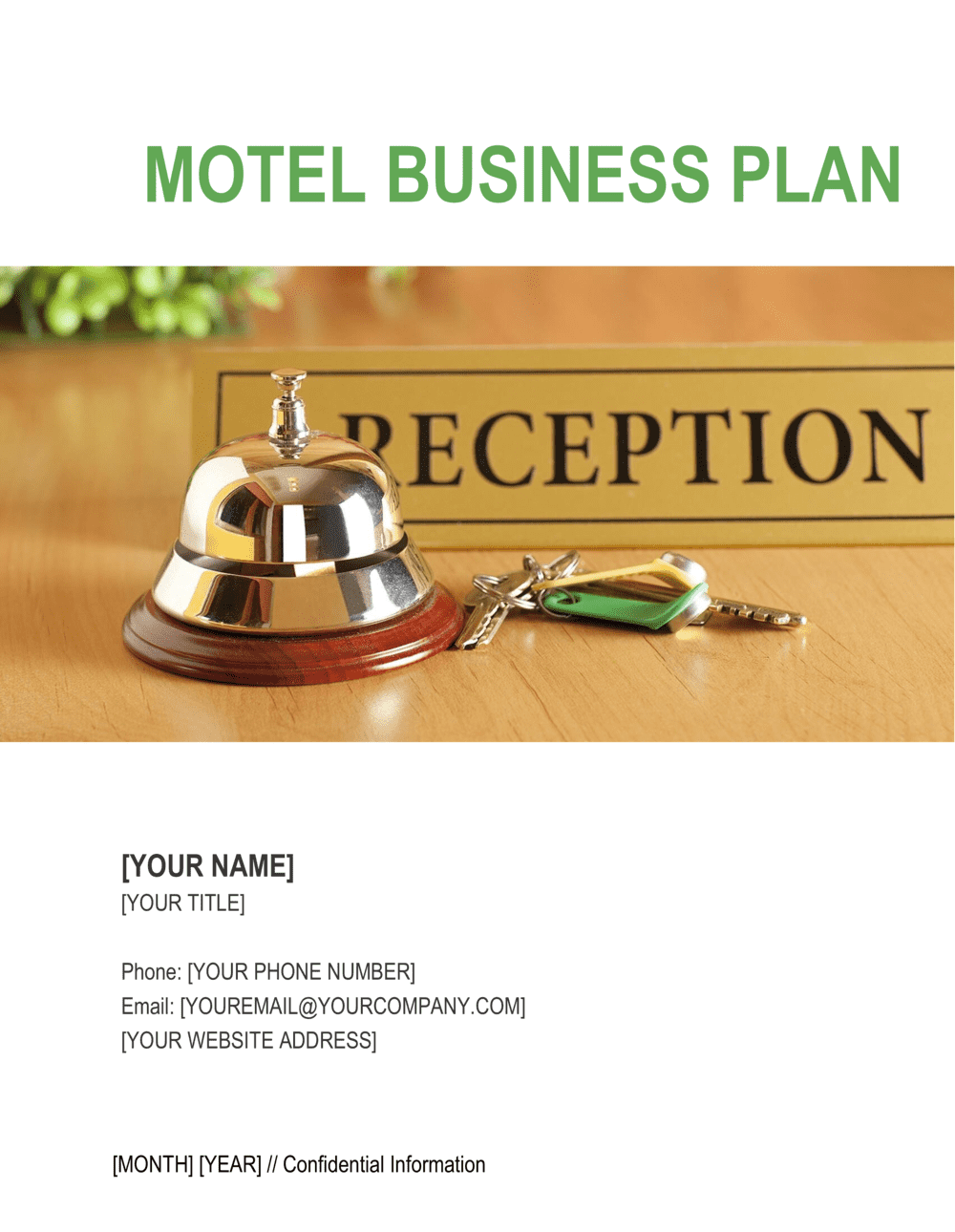
Motel Business Plan Template

Free Word download β€’ Edit online β€’ Save & share with Drive β€’ Export to PDF

30 pagesβ€’2h 35m – 3h 25m to fillβ€’Difficulty: Expert
Learn more ↓
FreeMotel Business Plan Template

At a glance

What it is
A Motel Business Plan is a structured document that outlines the ownership model, property concept, target guest profile, competitive positioning, operational procedures, staffing plan, and multi-year financial projections for a motel property. This free Word download gives you an investor- and lender-ready starting point you can edit online and export as PDF to share with banks, SBA lenders, or business partners.
When you need it
Use it when acquiring an existing motel, developing a new roadside lodging property, applying for a commercial real estate or SBA 7(a) loan, or seeking equity partners for a hospitality venture.
What's inside
Executive summary, property and concept overview, market and location analysis, competitive landscape, rooms and services description, marketing and distribution strategy, operations and staffing plan, and multi-year financial projections including RevPAR, occupancy rate, ADR, and cash flow.

What is a Motel Business Plan?

A Motel Business Plan is a structured document that maps the property concept, market opportunity, competitive positioning, operational model, staffing plan, and multi-year financial projections for a roadside or highway-adjacent lodging property. It anchors every revenue assumption to local submarket data β€” occupancy rate, ADR, and RevPAR benchmarked against the competitive set β€” and presents a department-level operating expense budget that lenders can underwrite against established hospitality benchmarks. Unlike a general business plan, a motel plan must address property-specific considerations: franchise flag decisions, OTA channel mix and commission costs, housekeeping labor ratios, and debt service coverage requirements that SBA and conventional lenders apply specifically to income-producing lodging real estate.

Why You Need This Document

Without a formal motel business plan, SBA lenders will not process a loan application, and conventional commercial real estate lenders have no basis to underwrite a debt service coverage ratio. Beyond financing, the process of building the plan forces you to test whether your projected occupancy rate is realistic against what comparable properties actually achieve, whether your rack rates will hold against OTA commission pressure, and whether your labor budget leaves enough gross operating profit to cover debt service in a below-average occupancy year. Operators who skip this step routinely discover in their first operating year that housekeeping costs alone exceed their original projections by 30–40%, or that OTA commissions have compressed margins to the point where DSCR falls below 1.0x. This template gives you a lender-ready, investor-credible starting point that cuts structural work in half β€” leaving your time for the market research and financial modeling that determines whether the deal actually works.

Which variant fits your situation?

If your situation is…Use this template
Planning a full-service hotel with restaurant and conference facilitiesHotel Business Plan
Developing a short-term rental or vacation property portfolioVacation Rental Business Plan
Launching a bed and breakfast with owner-occupied roomsBed and Breakfast Business Plan
Opening a campground or RV park alongside lodgingCampground Business Plan
Applying for an SBA loan and needing a one-page summaryOne-Page Business Plan
Expanding an existing motel into a multi-property groupBusiness Expansion Plan

Common mistakes to avoid

❌ Projecting first-year occupancy above the competitive set average

Why it matters: A new or newly acquired motel has no reputation, no repeat guests, and no OTA review history. Projecting 70% occupancy in Year 1 when the submarket average is 58% signals unrealistic assumptions and damages lender credibility.

Fix: Start Year 1 at 10–15 percentage points below the submarket average and show a ramp to the market average by Year 3. Use the STR competitive set data to anchor your baseline.

❌ Omitting the equity injection from the funding structure

Why it matters: SBA 7(a) loans for hospitality acquisitions require a minimum 10% equity contribution; conventional lenders typically require 25–35%. A plan that shows 100% debt financing is automatically declined.

Fix: Calculate the required equity injection based on your target lender's LTV policy and include it explicitly in the use-of-funds table with documentation of the source.

❌ Understating housekeeping and labor costs

Why it matters: Labor is the single largest controllable expense in motel operations, typically 30–40% of revenue. Underestimating it inflates GOP projections and creates a cash shortfall in the first operating year.

Fix: Model housekeeping at 30–45 minutes per room turnover at local market wages, then add front-desk, maintenance, and management labor separately. Benchmark the total against CBRE lodging cost data.

❌ Planning for near-total OTA distribution

Why it matters: Booking 90%+ of rooms through Expedia and Booking.com at 15–20% commission will compress margins to the point where debt service coverage ratios fall below lender minimums, even at healthy occupancy.

Fix: Build a direct booking strategy into the plan β€” a simple direct-booking website with a best-rate guarantee, a Google Business profile, and a corporate account outreach program β€” and project direct channel share reaching 25–30% by Year 2.

The 9 key sections, explained

Executive Summary

Property and Concept Overview

Market and Location Analysis

Competitive Analysis

Rooms, Services, and Amenities

Marketing and Distribution Strategy

Operations and Staffing Plan

Financial Projections

Funding Requirements and Use of Funds

How to fill it out

  1. 1

    Define the property concept and ownership structure

    Enter the motel name, legal entity (LLC, S-Corp, partnership), address or target market, room count, and whether the property is an acquisition, new build, or conversion. Clarify the flag status β€” branded or independent.

    πŸ’‘ Branded flags (Days Inn, Super 8, Econo Lodge) provide OTA visibility and a loyalty customer base but require franchise fees of 8–12% of room revenue β€” model both scenarios before committing.

  2. 2

    Research the local market and pull submarket data

    Gather traffic counts for the nearest highway interchange, annual visitor statistics from the local CVB or tourism board, and competitive set occupancy and ADR from a current STR report or OTA listings.

    πŸ’‘ A single STR Trend Report for your submarket costs $150–$300 and gives you 12 months of competitive set data that lenders consider authoritative β€” it is worth the cost before finalizing projections.

  3. 3

    Profile the competitive set

    List the four to six closest competitors with room count, brand, Google rating, and published rates. Identify one specific gap in the market your property fills β€” price tier, pet policy, extended-stay rates, or amenity.

    πŸ’‘ Check Booking.com and Expedia for real-time competitor rates on a midweek night and a weekend night in peak season β€” this takes 20 minutes and gives you defensible pricing data.

  4. 4

    Set room rates and build the revenue model

    Establish rack rates for each room type based on the competitive set. Then model three occupancy scenarios β€” conservative (50%), base (62%), and optimistic (72%) β€” and calculate RevPAR for each.

    πŸ’‘ Start with the conservative scenario for your lender presentation. If the project is viable at 50% occupancy, lenders will be far more comfortable with your projections.

  5. 5

    Build the operations and staffing budget

    Itemize all operating expenses by category: rooms (housekeeping, laundry, amenities), front desk labor, maintenance, utilities, insurance, property taxes, franchise fees, OTA commissions, and management fees.

    πŸ’‘ Industry benchmarks from CBRE or HVS show that well-run budget motels operate at 35–45% gross operating profit margin β€” if your model shows 60%+, recheck your labor and utility assumptions.

  6. 6

    Complete the three-statement financial model

    Build a monthly P&L for Year 1, then annual statements for Years 2–5. Derive the cash flow statement from the P&L. Calculate NOI and DSCR (target 1.25x minimum) for each year and enter them prominently for the lender.

    πŸ’‘ DSCR below 1.20x will cause most SBA lenders to decline β€” if your base case is below that threshold, adjust the capital structure (larger equity injection, longer amortization) before submitting.

  7. 7

    Document the funding ask with a use-of-funds table

    Enter the total project cost broken into acquisition, renovation, FF&E (furniture, fixtures, and equipment), pre-opening costs, and working capital reserves. State the loan amount, equity injection, and proposed loan terms.

    πŸ’‘ Include a 6-month working capital reserve in the use-of-funds table β€” lenders view this as a sign that the borrower understands the ramp-up period and reduces perceived risk.

  8. 8

    Write the executive summary last

    Pull the property concept, market opportunity, top financial metric (Year 2 RevPAR or GOP margin), and funding ask into a tight 1–2 page summary. Write it after every other section is complete.

    πŸ’‘ Lead the executive summary with the single strongest demand driver for the location β€” a highway interchange with 40,000 daily vehicles, proximity to a regional employer, or a tourism destination β€” before discussing the property itself.

Frequently asked questions

What is a motel business plan?

A motel business plan is a structured document that defines the property concept, ownership model, market opportunity, competitive positioning, operations approach, staffing plan, and multi-year financial projections for a motel property. It serves as the primary document for securing SBA or conventional financing, attracting equity partners, and guiding day-to-day operational decisions for the first three to five years.

What sections should a motel business plan include?

A complete motel business plan covers nine core sections: executive summary, property and concept overview, market and location analysis, competitive analysis, rooms and services description, marketing and distribution strategy, operations and staffing plan, financial projections (P&L, cash flow, balance sheet), and funding requirements with use of funds. Financial projections should include RevPAR, ADR, occupancy rate, GOP margin, NOI, and DSCR assumptions.

Do I need a business plan to buy a motel?

Yes β€” any SBA 7(a) or SBA 504 loan application for a hospitality property requires a formal business plan with financial projections. Conventional commercial real estate lenders also require it for properties where the borrower is an owner-operator rather than a passive investor. Even if you are paying cash, a business plan forces you to stress-test occupancy assumptions and operating costs before committing capital.

What financial metrics do motel lenders focus on?

Lenders underwriting motel loans focus primarily on DSCR (debt service coverage ratio β€” minimum 1.20–1.25x), NOI, occupancy rate benchmarked against the competitive set, ADR relative to comparable properties, and the borrower's equity injection (typically 10–35% of total project cost). RevPAR trending above the competitive set average significantly strengthens an application.

What is a realistic occupancy rate to project for a motel?

For a new or recently acquired motel with no established reputation, a conservative Year 1 projection of 48–55% occupancy is defensible with lenders. By Year 2–3, a well-run property in a stable market should approach the submarket average β€” typically 58–65% for budget and mid-scale roadside motels. Use the latest STR submarket report to anchor your assumptions rather than national averages.

Should my motel be branded (flagged) or independent?

A branded flag provides immediate OTA visibility, loyalty program access, and a recognizable booking channel β€” valuable for a new operator with no existing reputation. The cost is a franchise fee of 8–12% of room revenue plus mandatory property improvement requirements. An independent motel retains full pricing flexibility and avoids fees but must invest more in direct marketing and OTA presence to build occupancy. Model both scenarios in your plan before deciding.

How do I estimate operating expenses for a motel business plan?

Start with industry benchmarks: rooms expense (housekeeping, laundry, amenities) at 25–30% of room revenue, front-desk and admin labor at 10–15%, maintenance at 4–6%, utilities at 5–8%, sales and marketing at 3–5%, property taxes and insurance at 6–10%, and any franchise or management fees. CBRE's annual Trends in the Hotel Industry report publishes department-level benchmarks by property type and scale that are widely accepted by lenders.

What is the difference between a motel business plan and a hotel business plan?

The core structure is identical, but a motel business plan focuses on roadside or highway-adjacent properties with exterior-corridor room access, limited food and beverage operations, and a budget or mid-scale price tier. A hotel business plan typically addresses full-service properties with interior corridors, restaurant and meeting space revenue streams, and a broader range of ADR tiers. The financial model for a motel is simpler β€” fewer revenue lines β€” but lenders scrutinize RevPAR and DSCR equally for both.

How long does it take to write a motel business plan?

Expect 20–40 hours over two to three weeks. The financial model β€” building RevPAR-based revenue projections and a department-level operating expense budget β€” accounts for roughly half that time. Gathering local submarket data (STR report, CVB visitor statistics, competitive set rates) takes another 4–6 hours. Using a structured template reduces the formatting and structural work by roughly 50%, leaving your time for the market research and financial modeling that requires original input.

How this compares to alternatives

vs Hotel Business Plan

A hotel business plan covers full-service or select-service properties with interior corridors, food and beverage operations, meeting space, and broader ADR ranges. A motel business plan focuses on exterior-corridor roadside properties with limited amenities and a simplified operating model. The financial structure is similar, but a hotel plan requires additional revenue line items for F&B, meeting room rental, and a larger staffing budget.

vs Bed and Breakfast Business Plan

A bed and breakfast plan typically covers a small, owner-occupied property of 4–12 rooms with a personal hospitality focus and included breakfast service. A motel plan covers a larger commercial property with professional staffing, franchise considerations, and institutional financing requirements. The B&B plan is simpler financially but requires more narrative on owner lifestyle and guest experience.

vs Restaurant Business Plan

A restaurant business plan models food and beverage revenue, food cost percentage, table turns, and kitchen staffing β€” all of which are secondary or absent in a motel plan. If a motel property includes a restaurant or breakfast service, a separate F&B section using restaurant plan conventions should be appended rather than blended into the rooms revenue model.

vs One-Page Business Plan

A one-page business plan is a rapid-alignment tool for internal planning or early-stage concept validation. It is insufficient for SBA loan applications, commercial real estate financing, or franchisor approval β€” all of which require a full plan with financial projections. Use the one-page version for initial concept testing, then build the full motel plan before approaching any lender.

Industry-specific considerations

Budget and Mid-Scale Lodging

Highway-interchange locations, high price sensitivity, OTA-dominant channel mix, and lean staffing ratios of one front-desk agent per 40–60 rooms.

Tourism and Leisure Destinations

Pronounced seasonal demand peaks, drive-market guest profiles, and ancillary revenue from local attraction partnerships and extended-stay discounts in shoulder season.

Extended-Stay and Workforce Housing

Weekly and monthly rate structures, higher in-room kitchen amenity requirements, lower housekeeping frequency (every 7 days), and corporate account relationships with construction and energy companies.

Franchise and Branded Lodging

Franchise disclosure document (FDD) review required before plan finalization, mandatory PIP (property improvement plan) costs factored into use of funds, and loyalty program contribution fees modeled separately.

Template vs pro β€” what fits your needs?

PathBest forCostTime
Use the templateFirst-time motel buyers and owner-operators applying for SBA loans up to $2M on straightforward acquisitionsFree2–3 weeks (20–40 hours)
Template + professional reviewAcquisitions above $2M, properties requiring significant renovation, or first-time borrowers working with SBA-preferred lenders$500–$2,500 for a hospitality consultant or CPA review of the financial model3–4 weeks
Custom draftedMulti-property portfolios, branded flag conversions, new-build developments, or institutional equity raises$3,000–$8,000 for a hospitality business plan writer or HVS-style feasibility study4–8 weeks

Glossary

RevPAR
Revenue Per Available Room β€” calculated as ADR multiplied by occupancy rate; the primary performance metric for lodging properties.
ADR (Average Daily Rate)
The average rental income earned per occupied room per night, calculated by dividing total room revenue by the number of rooms sold.
Occupancy Rate
The percentage of available room nights sold in a given period, calculated as rooms sold divided by rooms available.
GOP (Gross Operating Profit)
Total revenue minus operating expenses before debt service, depreciation, and income taxes β€” the standard profitability measure for lodging operations.
NOI (Net Operating Income)
Gross operating profit minus fixed charges such as property taxes, insurance, and management fees, used by lenders to underwrite commercial lodging loans.
STR Report
A benchmarking report from CoStar/STR that compares a property's ADR, occupancy, and RevPAR against a defined competitive set.
Competitive Set
The group of comparable lodging properties β€” matched by location, room count, and price tier β€” used to benchmark a motel's performance.
Flag
A hotel or motel brand affiliation (e.g., Days Inn, Super 8, Econo Lodge) that grants access to a reservation system and brand standards in exchange for franchise fees.
Cap Rate
Capitalization rate β€” NOI divided by property value; the standard metric used by lenders and investors to value income-producing lodging real estate.
Channel Mix
The distribution of room bookings across sales channels β€” direct website, OTAs (Expedia, Booking.com), phone, walk-in, and corporate accounts.

Part of your Business Operating System

This document is one of 3,000+ business & legal templates included in Business in a Box.

  • Fill-in-the-blanks β€” ready in minutes
  • 100% customizable Word document
  • Compatible with all office suites
  • Export to PDF and share electronically

Create your document in 3 simple steps.

From template to signed document β€” all inside one Business Operating System.
1
Download or open template

Access over 3,000+ business and legal templates for any business task, project or initiative.

2
Edit and fill in the blanks with AI

Customize your ready-made business document template and save it in the cloud.

3
Save, Share, Send, Sign

Share your files and folders with your team. Create a space of seamless collaboration.

Save time, save money, and create top-quality documents.

β˜…β˜…β˜…β˜…β˜…

"Fantastic value! I'm not sure how I'd do without it. It's worth its weight in gold and paid back for itself many times."

Managing Director Β· Mall Farm
Robert Whalley
Managing Director, Mall Farm Proprietary Limited
β˜…β˜…β˜…β˜…β˜…

"I have been using Business in a Box for years. It has been the most useful source of templates I have encountered. I recommend it to anyone."

Business Owner Β· 4+ years
Dr Michael John Freestone
Business Owner
β˜…β˜…β˜…β˜…β˜…

"It has been a life saver so many times I have lost count. Business in a Box has saved me so much time and as you know, time is money."

Owner Β· Upstate Web
David G. Moore Jr.
Owner, Upstate Web

Run your business with a system β€” not scattered tools

Stop downloading documents. Start operating with clarity. Business in a Box gives you the Business Operating System used by over 250,000 companies worldwide to structure, run, and grow their business.

Start freeΒ Β·Β No credit card required