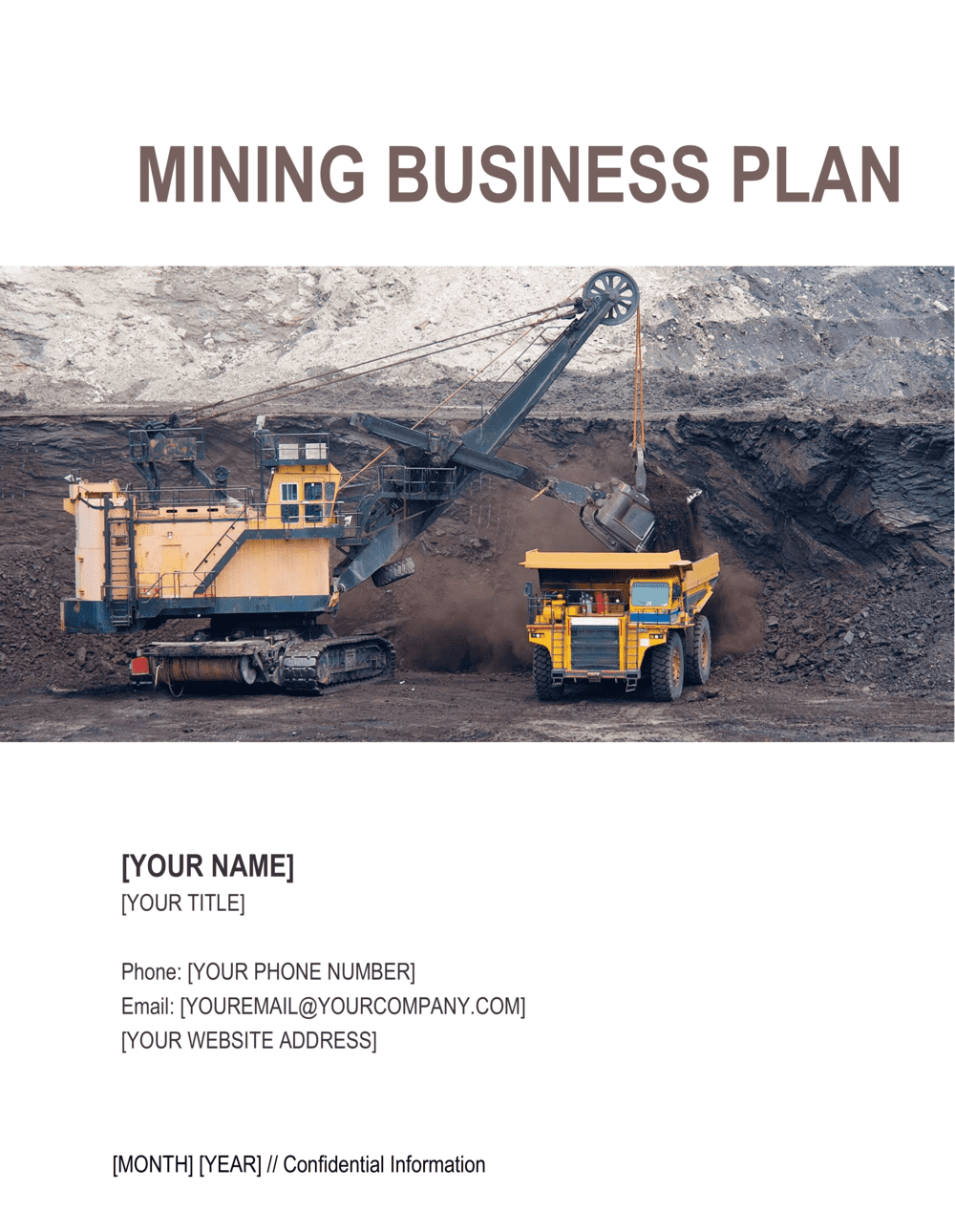
Mining Business Plan Template

Free Word download β€’ Edit online β€’ Save & share with Drive β€’ Export to PDF

25 pagesβ€’2h 15m – 3h to fillβ€’Difficulty: Expert
Learn more ↓
FreeMining Business Plan Template

At a glance

What it is
A Mining Business Plan is a detailed operational and financial document that outlines every material dimension of a proposed or operating mine β€” from geology and resource estimates to processing methods, environmental obligations, capital requirements, and reclamation commitments. This free Word download gives you a structured, investor-ready framework you can edit online and export as PDF to present to mining financiers, joint-venture partners, or regulatory bodies.
When you need it
Use it when raising project finance or equity for a new mine, applying for mining permits or environmental approvals, seeking a joint-venture partner, or transitioning a mineral exploration project into a development-stage operation.
What's inside
Executive summary, company and project overview, geology and resource estimate, mining method and production schedule, processing and metallurgy, environmental and social impact management, capital and operating cost estimates, market and commodity analysis, financial projections, and reclamation and closure plan.

What is a Mining Business Plan?

A Mining Business Plan is a comprehensive operational and financial document that organizes every material dimension of a proposed or active extractive project into a single investor-ready package. Unlike a general business plan, it is built on technically grounded inputs β€” a qualified-person resource estimate, a mine design and production schedule, a metallurgical processing flowsheet, environmental permit status, and a life-of-mine financial model producing NPV, IRR, and payback period at multiple commodity price scenarios. It is the foundation document for raising project equity or debt, securing joint-venture partners, and demonstrating technical and environmental credibility to permitting authorities.

Why You Need This Document

Without a structured mining business plan, capital conversations stall at the first technical question, permit applications lack the financial assurance regulators require, and potential partners have no consistent document to review. Mining investors β€” whether private equity funds, streaming companies, or strategic partners β€” expect to see resource estimates, engineering cost studies, and after-tax financial returns presented together in a coherent narrative. A plan that omits closure costs, uses an undiscounted commodity price, or presents an unattributed resource will be dismissed without a follow-up meeting. This template gives you the proven structure to consolidate your geological, engineering, and financial work into the document format that mining capital markets actually use β€” saving weeks of drafting time and reducing the risk of a credibility-damaging gap in your presentation.

Which variant fits your situation?

If your situation is…Use this template
Early-stage mineral exploration with no defined resource yetMineral Exploration Business Plan
Open-pit metal mine with bulk-tonnage processingMining Business Plan (Open-Pit)
Underground hard-rock mine with selective mining methodsMining Business Plan (Underground)
Quarry or aggregate extraction for construction materialsQuarry Business Plan
Coal or thermal-energy minerals projectCoal Mining Business Plan
One-page concept summary for an initial partner conversationOne-Page Business Plan
Full environmental and social impact study required separatelyEnvironmental Impact Assessment Report

Common mistakes to avoid

❌ Unattributed resource estimates

Why it matters: Mining capital markets require resource figures to be disclosed under NI 43-101 or JORC by a named qualified person. Unattributed numbers are dismissed entirely by institutional investors and lenders.

Fix: Engage a registered qualified person or competent person to author or sign off on the resource estimate section before the plan is circulated to any external party.

❌ Single-point commodity price assumption with no sensitivity analysis

Why it matters: Commodity prices are cyclical and volatile β€” a model built on one price input collapses in credibility the moment spot moves. Sophisticated mining investors immediately stress-test the price assumption.

Fix: Present base, upside, and downside price cases in a sensitivity matrix, and use a long-term consensus price from at least two independent research sources as your base.

❌ Understating the environmental permitting timeline

Why it matters: Environmental approvals for new mines typically take 2–7 years in jurisdictions with rigorous review processes. Treating permitting as a 6-month line item causes critical-path failures and investor distrust.

Fix: Research the actual permitting pathway and historical approval timelines for comparable projects in the same jurisdiction, and build the realistic timeline into your project schedule and financing plan.

❌ No after-tax financial model

Why it matters: Resource taxes, royalties, and depletion allowances can reduce pre-tax NPV by 20–40% depending on jurisdiction. Presenting only pre-tax returns tells experienced mining financiers that the economics haven't been properly validated.

Fix: Model the applicable royalty regime, corporate tax rate, and any resource-specific levies for the project jurisdiction, and present both pre-tax and after-tax NPV and IRR.

❌ Capex estimate with no accuracy class stated

Why it matters: A PEA-level capex estimate (Β±35%) presented without qualification alongside a feasibility-level NPV creates a false precision that independent engineers will flag immediately.

Fix: State the estimate accuracy class explicitly beside every capex figure and calibrate contingency to the estimate stage β€” 15% for feasibility, 25–30% for PFS, 30–50% for PEA.

❌ Omitting closure cost from the financial model cash flows

Why it matters: Reclamation and closure costs of $10M–$100M+ are a real cash outflow that, if excluded, overstates project NPV and IRR and understates total capital requirements.

Fix: Incorporate closure cost as a discounted lump-sum cash outflow in the final year of the LOM model and include progressive reclamation costs in the annual opex schedule.

The 10 key sections, explained

Executive Summary

Company and Project Overview

Geology and Resource Estimate

Mining Method and Production Schedule

Processing and Metallurgy

Environmental and Social Impact Management

Capital and Operating Cost Estimates

Market and Commodity Analysis

Financial Projections and Returns

Reclamation and Closure Plan

How to fill it out

  1. 1

    Define the company structure and tenure details

    Enter the legal entity name, jurisdiction of incorporation, project name, mineral tenure numbers, area in hectares, and the ownership percentage held. Confirm tenure status and next renewal dates.

    πŸ’‘ Pull tenure details directly from the relevant mining registry β€” errors in claim numbers or boundaries discovered during lender due diligence cause costly delays.

  2. 2

    Populate the geology and resource section with a qualified person's estimate

    Enter the deposit type, drilling summary, and resource classification table (measured, indicated, inferred) with tonnage, grade, and contained metal. Name the qualified person and the reporting standard used.

    πŸ’‘ If your resource is inferred only, acknowledge the higher geological uncertainty and explain the infill drilling program planned to upgrade the classification before development.

  3. 3

    Select and justify the mining method

    Choose the extraction method based on deposit geometry, depth, and grade distribution. Provide the strip ratio (open pit) or dilution estimate (underground) and build an annual production schedule tied to the reserve.

    πŸ’‘ A pit-optimization run using Lerchs-Grossmann or equivalent software is expected by most technical reviewers before committing to an open-pit production schedule.

  4. 4

    Complete the processing and metallurgy section

    Describe the flowsheet, nameplate capacity, and metallurgical recovery rates. Reference the test work program and number of composites tested. State the product form and destination.

    πŸ’‘ Include a variability range for metallurgical recovery β€” base, upside, and downside cases β€” rather than a single point estimate. This demonstrates technical rigor and protects against downside claims later.

  5. 5

    Estimate capex and opex with a clear accuracy statement

    Break capex into major components with individual subtotals and a contingency line. State the estimate accuracy class (e.g., Β±25% for PFS, Β±10% for feasibility). Express opex as cost per tonne milled and all-in sustaining cost per unit produced.

    πŸ’‘ Reconcile your opex estimate against published cost benchmarks for comparable operations in the same jurisdiction β€” unexplained deviations raise red flags with independent engineers.

  6. 6

    Build the commodity market section with a defensible price assumption

    Present a 5-year price chart, cite the consensus long-term price from at least two independent sources, and state the base-case price used in the financial model. Include a price sensitivity table.

    πŸ’‘ Use a price assumption 10–15% below the current spot price as your base case when the commodity is near a cyclical high β€” conservative inputs signal financial discipline.

  7. 7

    Model the three-statement financials for the life of mine

    Build a monthly P&L, cash flow, and balance sheet for Year 1, then annually through LOM. Calculate pre-tax and after-tax NPV (at 5%, 8%, and 10% discount rates) and IRR. Include a sensitivity matrix varying price and capex.

    πŸ’‘ State all key model assumptions β€” discount rate, tax rate, royalty rate, inflation, and exchange rate β€” in a dedicated assumptions table so reviewers can verify inputs without reverse-engineering the model.

  8. 8

    Draft the reclamation and closure plan with a bonded cost estimate

    Estimate total closure cost, state the regulatory bond requirement and form, and incorporate progressive reclamation activities and costs into the LOM cash flow model.

    πŸ’‘ Contact the relevant regulatory body early to confirm the bond quantum required before finalizing the financial model β€” surprise bond increases can shift project economics materially.

Frequently asked questions

What is a mining business plan?

A mining business plan is a structured document that covers every material aspect of a proposed or operating mine β€” geology, resource estimate, mining method, processing, environmental and social obligations, capital and operating costs, commodity market analysis, financial projections, and reclamation. It serves as the primary document for raising project finance, securing joint-venture partners, and obtaining regulatory approvals.

What sections should a mining business plan include?

A complete mining business plan covers ten core areas: executive summary, company and project overview, geology and resource estimate, mining method and production schedule, processing and metallurgy, environmental and social impact management, capital and operating cost estimates, commodity market analysis, financial projections with NPV and IRR, and a reclamation and closure plan. Each section is scrutinized by different reviewers β€” geologists, engineers, financiers, and regulators β€” so depth and accuracy matter throughout.

How is a mining business plan different from a standard business plan?

A standard business plan focuses on market sizing, go-to-market strategy, and revenue growth. A mining business plan replaces those sections with technically specific content: a qualified-person resource estimate, a mine design and production schedule, a metallurgical processing flowsheet, an environmental impact assessment, and a life-of-mine financial model. Mining-specific financial metrics β€” NPV at multiple discount rates, IRR, AISC, and payback period β€” replace the ARR and CAC metrics used in technology plans.

Do I need a qualified person to complete a mining business plan?

For any plan that will be shown to investors or regulators, a qualified person (QP under NI 43-101) or competent person (CP under JORC) must author or sign off on the resource and reserve estimates. You can draft the business and financial sections yourself, but resource disclosures without QP attribution are not accepted in capital markets and are treated as speculative by institutional lenders.

What financial metrics do mining investors look for?

Mining equity investors focus on after-tax NPV (typically discounted at 5–10%), IRR versus the project's risk profile (a 25%+ IRR is generally considered attractive for a greenfield mine), payback period (under 4 years is preferred), and all-in sustaining cost as a percentage of the commodity price. They also review the sensitivity of these metrics to commodity price and capex overrun scenarios.

How detailed should the capex estimate be at the business plan stage?

The required detail depends on the project stage. A preliminary economic assessment (PEA) supports a Β±35% accuracy estimate built from factored costs. A prefeasibility study (PFS) targets Β±25%, and a full feasibility study targets Β±10–15% based on detailed engineering. Always state the accuracy class explicitly alongside any capex figure and set contingency accordingly β€” misrepresenting estimate accuracy is a common reason lenders decline mining project financing.

What commodity price should I use in my financial model?

Use the long-term consensus price from at least two independent sources β€” bank research desks, commodity forecasters, or government agencies β€” rather than the current spot price. If the commodity is near a cyclical high, apply a 10–15% discount to spot as your base case. Present a sensitivity table showing NPV and IRR at spot, base, and downside prices so reviewers can stress-test the economics themselves.

How long does it take to write a mining business plan?

Drafting the narrative sections using a structured template takes 2–4 weeks for a project team with the underlying technical data available. The financial model alone typically requires 20–40 hours to build from scratch. Completing the resource estimate, environmental baseline, and metallurgical test work that feeds the plan typically takes months to years of fieldwork β€” the plan consolidates that work rather than replacing it.

Is a mining business plan the same as a feasibility study?

No. A feasibility study is a detailed technical and economic study β€” often running hundreds of pages β€” that establishes the basis for a final investment decision. A mining business plan is a capital-raising and stakeholder-facing summary document that draws on the feasibility study (or PEA/PFS) for its key inputs. You typically write the business plan after the technical study is complete, synthesizing its findings into a format accessible to non-technical investors and regulators.

How this compares to alternatives

vs Standard Business Plan

A standard business plan suits businesses that sell products or services in a competitive market. A mining business plan replaces market-sizing and go-to-market sections with geologically grounded resource estimates, engineering cost studies, environmental permits, and life-of-mine financial models. Use the standard plan for a mining services or equipment business; use the mining plan for any extractive project.

vs One-Page Business Plan

A one-page plan is a rapid-alignment tool for internal teams or early-stage concept testing. It lacks the resource estimates, cost studies, and financial depth that regulators and mining investors require. Use it to align founding partners on the project thesis, then build the full mining plan before any capital raise or permit application.

vs Financial Projections Template

A financial projections template models revenue and expenses but does not cover geology, mining method, processing, environmental management, or reclamation. Mining financiers evaluate the financial model only in context of the technical sections that justify its inputs β€” standalone projections without a supporting mining plan carry no credibility in the sector.

vs Environmental Impact Assessment Report

An environmental impact assessment is a standalone regulatory submission covering baseline environment, predicted impacts, and mitigation measures in exhaustive detail. The mining business plan summarizes environmental status and key risks for investors and partners. Both documents are typically required β€” the EIA for regulators, the business plan for capital markets β€” and they must be internally consistent.

Industry-specific considerations

Precious Metals Mining

AISC per ounce is the primary cost benchmark; gold and silver price sensitivity tables are expected in every financial model; streaming and royalty financing structures are common alternatives to equity.

Base Metals and Industrial Minerals

Offtake agreements with smelters or end-users are typically required before project financing is committed; concentrate quality and payable metals calculations are critical to revenue modeling.

Coal and Energy Minerals

Thermal versus metallurgical coal distinction drives pricing and market access; ESG screening by institutional lenders has reduced available capital, making community and environmental sections disproportionately important.

Quarry and Aggregate Operations

Market analysis focuses on regional construction activity and competing quarry locations rather than commodity exchanges; permit proximity to urban markets is a key competitive differentiator.

Template vs pro β€” what fits your needs?

PathBest forCostTime
Use the templateEarly-stage project teams assembling a capital-raising summary from existing technical reports and financial model workFree2–4 weeks (40–80 hours)
Template + professional reviewProjects at PEA or PFS stage seeking seed or Series A investment up to $10M from sophisticated mining investors$2,000–$8,000 for review by a mining engineer or financial advisor4–6 weeks
Custom draftedFeasibility-stage projects raising project finance above $25M, requiring full NI 43-101 or JORC compliance and independent engineer sign-off$15,000–$75,000+ for a professional technical report and business plan package8–20 weeks

Glossary

Mineral Resource Estimate
A quantified inventory of mineralized material β€” classified as inferred, indicated, or measured β€” based on geological sampling and modeling.
Mineral Reserve
The economically mineable portion of a measured or indicated resource, accounting for mining, processing, and economic parameters.
Capex (Capital Expenditure)
One-time upfront costs to build or acquire mine infrastructure β€” including earthworks, processing plant, tailings facility, and access roads.
Opex (Operating Expenditure)
Ongoing per-unit costs to mine, process, and sell the commodity β€” typically expressed as cost per tonne mined or cost per ounce produced.
Strip Ratio
In open-pit mining, the volume of waste rock that must be moved to expose one unit of ore β€” a key driver of opex and mine life economics.
Metallurgical Recovery
The percentage of target metal or mineral extracted from the ore during processing β€” a critical efficiency metric directly affecting revenue.
Tailings
The slurried waste material remaining after ore processing, requiring engineered containment and long-term environmental management.
Net Smelter Return (NSR)
Revenue received by the mine operator after deducting smelting, refining, and transportation charges from gross metal sales.
Reclamation Bond
Financial assurance β€” cash, surety bond, or letter of credit β€” posted with regulators to guarantee site rehabilitation upon mine closure.
NI 43-101 / JORC
Canadian (NI 43-101) and Australian/international (JORC) standards governing public disclosure of mineral resource and reserve estimates.
Life of Mine (LOM)
The projected operational lifespan of the mine from first production to final extraction, based on the proven and probable reserve estimate.
AISC (All-In Sustaining Cost)
A gold-industry cost metric that includes opex, sustaining capex, royalties, and corporate overhead β€” enabling apples-to-apples cost comparison across mines.

Part of your Business Operating System

This document is one of 3,000+ business & legal templates included in Business in a Box.

  • Fill-in-the-blanks β€” ready in minutes
  • 100% customizable Word document
  • Compatible with all office suites
  • Export to PDF and share electronically

Create your document in 3 simple steps.

From template to signed document β€” all inside one Business Operating System.
1
Download or open template

Access over 3,000+ business and legal templates for any business task, project or initiative.

2
Edit and fill in the blanks with AI

Customize your ready-made business document template and save it in the cloud.

3
Save, Share, Send, Sign

Share your files and folders with your team. Create a space of seamless collaboration.

Save time, save money, and create top-quality documents.

β˜…β˜…β˜…β˜…β˜…

"Fantastic value! I'm not sure how I'd do without it. It's worth its weight in gold and paid back for itself many times."

Managing Director Β· Mall Farm
Robert Whalley
Managing Director, Mall Farm Proprietary Limited
β˜…β˜…β˜…β˜…β˜…

"I have been using Business in a Box for years. It has been the most useful source of templates I have encountered. I recommend it to anyone."

Business Owner Β· 4+ years
Dr Michael John Freestone
Business Owner
β˜…β˜…β˜…β˜…β˜…

"It has been a life saver so many times I have lost count. Business in a Box has saved me so much time and as you know, time is money."

Owner Β· Upstate Web
David G. Moore Jr.
Owner, Upstate Web

Run your business with a system β€” not scattered tools

Stop downloading documents. Start operating with clarity. Business in a Box gives you the Business Operating System used by over 250,000 companies worldwide to structure, run, and grow their business.

Free Forever PlanΒ Β·Β No credit card required