How to write an Executive Summary

Free to read β€’ Save or share with one click

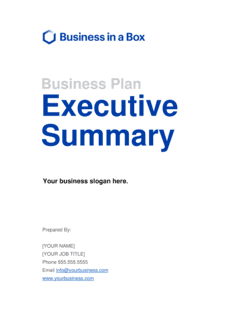
FreeHow to write an Executive Summary Template

At a glance

What it is
An Executive Summary is a concise, standalone overview of a longer document β€” a business plan, proposal, report, or feasibility study β€” that lets a busy reader understand the core findings, recommendations, and required actions without reading the full document. This free Word download gives you a structured, reader-ready template you can edit online and export as PDF for investors, executives, clients, or lenders.
When you need it
Use it whenever you submit a business plan, project proposal, research report, or strategic recommendation to an audience that will decide whether to read further, approve funding, or take action based on a short brief.
What's inside
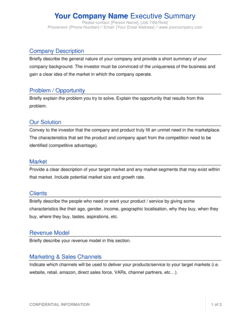
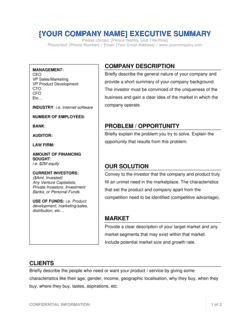
Purpose statement, company or project overview, problem and proposed solution, key findings or highlights, financial snapshot, call to action, and a concise conclusion β€” all structured to be read in under five minutes.

What is an Executive Summary?

An Executive Summary is a concise, standalone overview of a longer document β€” a business plan, project proposal, research report, or feasibility study β€” that gives a busy decision-maker everything they need to understand the core recommendation and act on it without reading the full text. It typically runs one to two pages, appears at the front of the document, and covers the problem being addressed, the proposed solution, the key supporting evidence, a financial snapshot, and a specific call to action. Unlike an abstract, which describes what a document contains, an executive summary delivers the conclusions directly β€” replacing the need to read the underlying document for anyone who needs only to decide, not to study.

Why You Need This Document

Without a well-structured executive summary, even the strongest business plan, proposal, or report loses its impact at the moment that matters most β€” when a decision-maker encounters it for the first time. Investors who open a 30-page plan and find no summary skim the financials and move on. Lenders return documents with missing summaries as incomplete. Internal approvers table proposals that do not make the ask legible in the first two pages. Beyond routing around these gatekeeping moments, a clear executive summary forces the author to identify their single strongest argument before the meeting β€” a discipline that sharpens every other section of the document. This template gives you the structure to write a summary that earns the full read, in under three hours, once your underlying document is complete.

Which variant fits your situation?

If your situation is…Use this template
Summarizing a full business plan for investors or lendersExecutive Summary for Business Plan
Opening a project proposal submitted for internal approvalProject Proposal Executive Summary
Prefacing a research or market analysis reportResearch Report Executive Summary
Summarizing a grant application for a nonprofit funderGrant Proposal Executive Summary
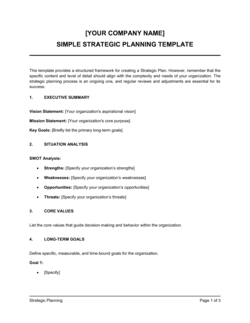
Condensing a strategic plan for board-level reviewStrategic Plan Executive Summary
Introducing a new product launch plan for leadership sign-offProduct Launch Executive Summary
Summarizing a feasibility study for a capital investment decisionFeasibility Study Executive Summary

Common mistakes to avoid

❌ Writing the executive summary first

Why it matters: A summary written before the body document will contradict specific figures and conclusions added later, making the whole package look uncoordinated and unreliable.

Fix: Complete every section of the underlying document first, then write the summary as the final step before submission.

❌ Exceeding two pages

Why it matters: Decision-makers who receive a four-page summary skim or skip it β€” negating its entire purpose. Length signals the author could not prioritize.

Fix: Limit the summary to one to two pages. Move supporting detail to labeled appendices in the main document and reference them by page number.

❌ Burying the recommendation

Why it matters: Readers who cannot find the core ask within the first paragraph often stop reading and ask the author to clarify β€” adding a round-trip delay to your approval cycle.

Fix: State the recommendation or proposed action in the opening paragraph, before any background or context.

❌ Using vague financial figures without time horizons or currencies

Why it matters: A figure like 'projected savings of $200K' is uninterpretable without knowing whether it is annual, cumulative, or one-time, and in which currency.

Fix: Attach a time horizon and currency to every financial figure: '$200K USD in annual operating savings beginning Year 2.'

❌ Copying the table of contents instead of summarizing findings

Why it matters: A summary that says 'Section 3 covers market analysis' tells the reader nothing they could not learn from the document itself, and fails to make the case for the recommendation.

Fix: Summarize conclusions and evidence, not structure. Replace 'Section 3 covers market analysis' with the single most important market finding and its implication.

❌ No specific call to action

Why it matters: Endings like 'please review at your earliest convenience' produce ambiguous responses and allow decision-makers to defer indefinitely without accountability.

Fix: Close with a named decision, a named decision-maker, and a specific date: 'We request budget approval from the CFO by June 15, 2026 to proceed to Phase 1.'

The 9 key sections, explained

Purpose and scope statement

Company or project overview

Problem or opportunity statement

Proposed solution or recommendation

Key findings or highlights

Financial snapshot

Implementation timeline

Call to action and next steps

Contact information and document reference

How to fill it out

  1. 1

    Write the full document first

    Complete the business plan, report, or proposal in full before writing a single word of the executive summary. The summary is a distillation β€” you cannot distill what does not yet exist.

    πŸ’‘ Set the executive summary aside as a blank page while you draft the body. Returning to it last ensures accuracy and prevents contradictions.

  2. 2

    Identify the three to five most compelling findings

    Re-read the full document and mark every data point, conclusion, or insight that directly supports your recommendation. Then cut to the strongest three to five β€” the ones that, if the reader believed nothing else, would justify approval.

    πŸ’‘ If two findings make the same point, keep the one with the stronger number or more credible source.

  3. 3

    Write the problem and solution statements

    Draft a one-paragraph problem statement that quantifies the challenge, then a one-paragraph solution statement that describes your approach in plain language. These two paragraphs are the core of the summary.

    πŸ’‘ Read the problem statement aloud. If it sounds like it could apply to any company in any industry, make it more specific.

  4. 4

    Build the financial snapshot

    Extract the four to six headline financial figures from your model β€” investment required, projected revenue or savings, ROI, and funding ask. Format them as a brief table or a bulleted list, not prose.

    πŸ’‘ State the currency and time horizon for every figure. '$500K' means nothing without knowing whether it is annual revenue or a one-time cost.

  5. 5

    Draft the implementation timeline

    Summarize major phases and key milestones in two to four lines. Include start and end months for each phase and one concrete deliverable per phase.

    πŸ’‘ Use calendar months and years, not relative terms like 'Month 6.' Relative dates become meaningless as the document circulates over time.

  6. 6

    Write a specific call to action

    Close with the single action you need the reader to take, who needs to take it, and by when. If you need a budget approval, say so. If you need a meeting, name a date.

    πŸ’‘ Test your call to action by asking: could the reader complete this action today, without asking a clarifying question? If not, make it more specific.

  7. 7

    Edit to one to two pages

    A complete executive summary for most documents runs one to two pages β€” never more than three. Cut every sentence that does not introduce a new fact or advance the recommendation.

    πŸ’‘ If you cannot get below two pages, remove any section that appears in more detail in the body and replace it with a one-sentence reference: 'Full analysis on page X.'

  8. 8

    Match tone and terminology to your audience

    Investors read for market size and ROI. Lenders read for cash flow and repayment. Executives read for risk and resource requirements. Review the summary once with your specific reader in mind and adjust the emphasis accordingly.

    πŸ’‘ Give a draft to one person who matches your target reader profile and time them. If they do not grasp the core recommendation within three minutes, revise.

Frequently asked questions

What is an executive summary?

An executive summary is a concise, standalone overview of a longer document β€” such as a business plan, proposal, or report β€” that communicates the key findings, recommendations, and required decisions without requiring the reader to review the full text. It typically runs one to two pages and is positioned at the front of the document. Its purpose is to let a busy decision-maker understand the core argument and act on it quickly.

How long should an executive summary be?

One to two pages is the standard for most business documents. For a 20-to-30-page business plan or project proposal, one page is often sufficient. For a 100-page research report or feasibility study, two pages is acceptable. Anything beyond three pages defeats the purpose β€” if your summary requires more than three pages, the underlying document likely needs restructuring, not a longer summary.

What is the difference between an executive summary and an abstract?

An abstract describes what a document contains β€” its topic, method, and scope. An executive summary replaces the need to read the full document by conveying the conclusions, recommendations, and key data directly. Abstracts are common in academic and scientific writing; executive summaries are standard in business, government, and consulting contexts where the reader needs to make a decision, not conduct further research.

Should the executive summary be written first or last?

Always last. The executive summary is a distillation of a finished document β€” writing it before the body is complete guarantees that specific figures, conclusions, or section references will be inaccurate by the time you finish. Treat it as the final editing step, not the starting point.

What should every executive summary include?

At minimum: a purpose statement identifying what the document is and what decision it supports, a brief company or project overview, a quantified problem or opportunity statement, the proposed solution or recommendation, three to five key findings or data points, a financial snapshot, a high-level implementation timeline, and a specific call to action. Missing any of these leaves the reader without information they need to act.

How is an executive summary different from a business plan?

A business plan is a 20-to-35-page document covering market analysis, competitive positioning, operations, management, and full financial projections. An executive summary is a one-to-two-page overview of that plan, written for a reader who will decide whether the full plan merits their time. The executive summary does not replace the business plan β€” it precedes it and drives the decision to read further.

Can I use an executive summary template for any type of document?

Yes, with minor adaptation. The core structure β€” problem, solution, key findings, financials, timeline, call to action β€” applies to business plans, project proposals, research reports, feasibility studies, grant applications, and strategic plans. The emphasis shifts by audience: investors focus on market size and ROI, lenders on cash flow and repayment, executives on risk and resources. Adjust the financial snapshot and call to action sections to match your specific reader.

How do I make my executive summary stand out to investors?

Lead with the single most compelling proof point β€” a traction metric, a market size number, or a customer outcome β€” before any background context. State the funding ask and its specific use in the first or second paragraph. Keep financial figures to four or five headlines with clear time horizons. Investors read hundreds of summaries; the ones that earn a follow-up make the recommendation immediately legible and support it with one undeniable number.

What is the right reading time for an executive summary?

Three to five minutes is the target for a one-to-two-page summary at a normal reading pace. If a test reader takes longer, the summary is either too long, too dense, or structured in a way that buries the main point. Use short paragraphs, one to two sentences each, and bullet points for findings and financial figures to keep the document scannable.

How this compares to alternatives

vs Business Plan

A business plan is a 20-to-35-page document covering market analysis, competitive positioning, operations, and full financial projections. An executive summary is a one-to-two-page distillation of that plan, written to support a single decision. The executive summary does not replace the business plan β€” it precedes it. You need the full plan before you can write a credible summary.

vs One-Page Business Plan

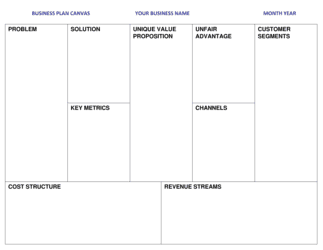
A one-page business plan is an internal alignment tool that maps the business model β€” customer segments, value propositions, channels, and revenue streams β€” on a single canvas. An executive summary is an external-facing document that summarizes a completed plan or proposal for a decision-maker. They serve different audiences and different moments in the planning process.

vs Project Proposal

A project proposal is the full document β€” scope, objectives, methodology, budget, and team β€” submitted for approval. An executive summary is the one-to-two-page overview that opens the proposal and allows the approver to grasp the recommendation without reading all 15 pages. Every substantial proposal should include both.

vs Elevator Pitch

An elevator pitch is a 60-to-90-second verbal or slide-based summary designed for an unscheduled first impression. An executive summary is a written, structured document submitted as part of a formal package. The pitch generates curiosity; the executive summary provides enough detail to support a yes-or-no decision.

Industry-specific considerations

Technology / SaaS

Investor-facing summaries emphasize MRR, churn rate, CAC payback, and the product's technical differentiation in plain language for non-technical readers.

Professional Services

Consulting and advisory firms use executive summaries to present findings and recommendations to client leadership, where the call to action is typically a decision to implement a specific strategy.

Healthcare / MedTech

Regulatory submissions, grant applications, and clinical study reports require summaries that lead with safety outcomes, patient population size, and compliance pathway status.

Nonprofit

Funder-facing summaries emphasize program impact metrics, cost per beneficiary, and alignment with the funder's stated priorities rather than financial ROI.

Template vs pro β€” what fits your needs?

PathBest forCostTime
Use the templateFounders, project managers, and business owners drafting summaries for internal approvals, loan applications, or standard investor outreachFree1–3 hours once the underlying document is complete
Template + professional reviewHigh-stakes proposals β€” Series A fundraising, government contracts, or board presentations β€” where a second expert reader adds material value$200–$800 for a business writing or communications consultant review1–2 additional days
Custom draftedComplex institutional submissions β€” private equity deals, large government grants, or major consulting deliverables β€” where the summary is a primary selling document$1,000–$5,000 for a professional business writer or communications firm3–7 days

Glossary

Executive Summary
A short, self-contained overview of a longer document that communicates the key points, findings, and recommended actions without requiring the reader to review the full text.
Problem Statement
A concise description of the specific challenge, gap, or opportunity the document addresses β€” typically the first substantive paragraph of the summary.
Value Proposition
A single sentence or short paragraph explaining the specific benefit the proposed solution or product delivers to the target audience.
Call to Action
An explicit statement of what you want the reader to do next β€” approve funding, schedule a meeting, sign a contract, or proceed to the next stage.
Key Findings
The most important data points, conclusions, or results from the underlying document, selected because they directly support the recommendation.
Financial Snapshot
A brief summary of the most relevant financial figures β€” revenue, cost, ROI, funding ask, or projected savings β€” presented without the full supporting model.
Recommendation
A clear, specific action the author proposes the reader take, derived directly from the findings and framed in terms of benefit to the reader.
Scope
A brief definition of what the underlying document covers and what it excludes, preventing the reader from drawing conclusions beyond the evidence presented.
Abstract vs. Executive Summary
An abstract describes what a document contains; an executive summary replaces the need to read it by conveying conclusions and recommendations directly.
Stakeholder
Any individual or group with a vested interest in the outcome of the plan, project, or report β€” including decision-makers, funders, affected teams, and end users.

Part of your Business Operating System

This document is one of 3,000+ business & legal templates included in Business in a Box.

  • Fill-in-the-blanks β€” ready in minutes
  • Compatible with all office suites
  • Export to PDF and share electronically

Create your document in 3 simple steps.

From template to signed document β€” all inside one Business Operating System.
1
Download or open template

Access over 3,000+ business and legal templates for any business task, project or initiative.

2
Edit and fill in the blanks with AI

Customize your ready-made business document template and save it in the cloud.

3
Save, Share, Send, Sign

Share your files and folders with your team. Create a space of seamless collaboration.

Save time, save money, and create top-quality documents.

β˜…β˜…β˜…β˜…β˜…

"Fantastic value! I'm not sure how I'd do without it. It's worth its weight in gold and paid back for itself many times."

Managing Director Β· Mall Farm
Robert Whalley
Managing Director, Mall Farm Proprietary Limited
β˜…β˜…β˜…β˜…β˜…

"I have been using Business in a Box for years. It has been the most useful source of templates I have encountered. I recommend it to anyone."

Business Owner Β· 4+ years
Dr Michael John Freestone
Business Owner
β˜…β˜…β˜…β˜…β˜…

"It has been a life saver so many times I have lost count. Business in a Box has saved me so much time and as you know, time is money."

Owner Β· Upstate Web
David G. Moore Jr.
Owner, Upstate Web

Run your business with a system β€” not scattered tools

Stop downloading documents. Start operating with clarity. Business in a Box gives you the Business Operating System used by over 250,000 companies worldwide to structure, run, and grow their business.

Free Forever PlanΒ Β·Β No credit card required