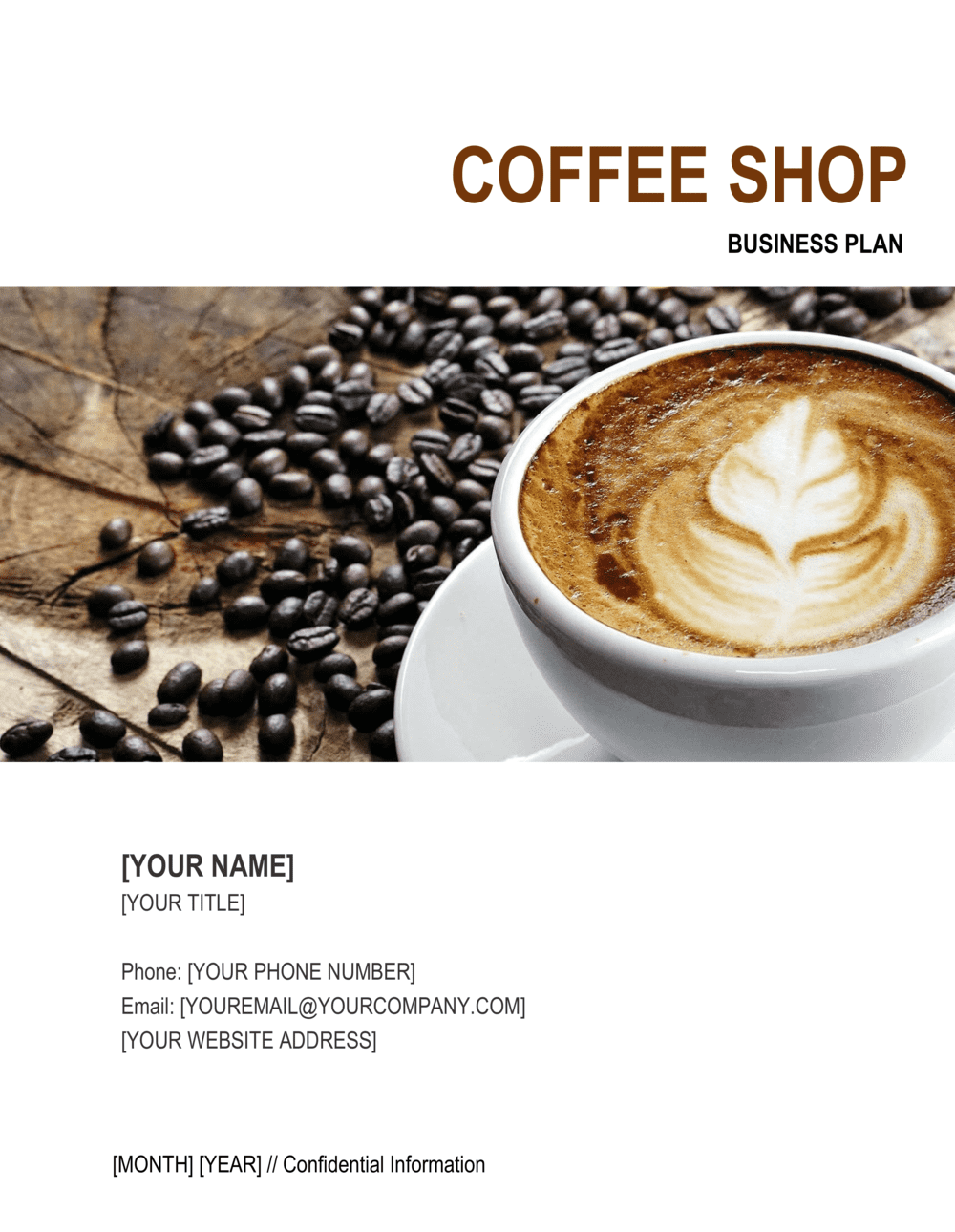
Coffee Shop Business Plan Template

Free Word download • Edit online • Save & share with Drive • Export to PDF

38 pages3h 5m – 4h 10m to fillDifficulty: Expert
Learn more ↓
FreeCoffee Shop Business Plan Template

At a glance

What it is
A Coffee Shop Business Plan is a structured document that maps your café concept, target market, location strategy, menu, sourcing, equipment, staffing, licensing requirements, and 3-year financial projections into a single investor- and lender-ready file. This free Word download gives you a fully editable starting point you can customize online and export as PDF to share with banks, SBA lenders, or potential investors.
When you need it
Use it when applying for an SBA loan or bank financing, pitching angel investors or partners, or preparing to sign a commercial lease and need proof of a viable operating model before committing capital.
What's inside
Executive summary, concept and brand overview, market and competitive analysis, menu and sourcing strategy, location and build-out plan, equipment list, staffing model, licensing checklist, and financial projections including a monthly P&L, cash flow statement, and break-even analysis.

What is a Coffee Shop Business Plan?

A Coffee Shop Business Plan is a structured document that translates a café concept into a bankable, operational blueprint — covering brand positioning, local market analysis, menu and sourcing strategy, location build-out, equipment requirements, staffing model, licensing checklist, and three-year financial projections. Unlike a general business plan, it is built around café-specific metrics: daily cover counts by daypart, average ticket size, food cost percentage, barista-to-cover ratios, and espresso equipment throughput. This free Word download gives you a fully editable, investor- and lender-ready starting point you can complete online and export as PDF for banks, SBA lenders, or potential partners.

Why You Need This Document

Without a written coffee shop business plan, SBA loan applications are declined before underwriting begins, commercial landlords dismiss lease inquiries from operators who cannot demonstrate financial viability, and build-out budgets spiral because no one modeled the full capital stack in advance. The cost of skipping it is concrete: a failed health inspection caused by a floor plan nobody reviewed with the health authority before build-out delays opening by weeks and burns the working capital reserve meant to cover the ramp-up period. A completed plan forces you to stress-test your daily cover projections, food cost assumptions, and permit timeline before you sign a lease or spend a dollar on construction — turning foreseeable operational surprises into decisions you can plan for. This template gives you the section structure, sample language, and financial framework to complete that work in two to three weeks rather than starting from a blank document.

Which variant fits your situation?

If your situation is…Use this template
Opening a standalone brick-and-mortar caféCoffee Shop Business Plan
Launching a mobile coffee cart or kioskFood Truck Business Plan
Starting a coffee roasting or wholesale operationSmall Business Plan
Opening a full-service restaurant with a coffee barRestaurant Business Plan
Quick internal concept validation before full planningOne-Page Business Plan
Applying for an SBA 7(a) loan above $350KBank Loan Business Plan
Raising equity from angel investors or a silent partnerInvestor Business Plan

Common mistakes to avoid

❌ Using national coffee market statistics instead of local data

Why it matters: A $50B industry figure says nothing about demand at a specific intersection. Lenders who see this know the founder has not done ground-level market research.

Fix: Replace national statistics with trade-area data: pedestrian counts, competitor revenue estimates, and demographic data from the US Census or a local economic development office.

❌ Projecting revenue from targets rather than from cover counts

Why it matters: A top-down revenue target has no operational basis and falls apart the moment a lender asks 'how many customers per day does that imply?'

Fix: Model daily covers by daypart at conservative, base, and optimistic scenarios. Let the revenue line emerge from the operational model, not the other way around.

❌ Underestimating build-out costs and timeline

Why it matters: Construction overruns are the single most common reason new cafés burn through working capital before opening day, leaving no cushion for the slow ramp-up period.

Fix: Obtain at least one written contractor estimate and add a 15% contingency. Add four to eight weeks to any contractor-provided timeline.

❌ Ignoring the health department during the design phase

Why it matters: A floor plan that fails health inspection requires expensive rework — moving sinks, adding ventilation, or replacing surfaces — after the build-out has already begun.

Fix: Schedule a pre-application meeting with the local health authority before finalizing the floor plan. Most jurisdictions offer this at no cost.

❌ Building a menu that exceeds opening-day staffing capacity

Why it matters: A 35-item menu at a two-barista counter produces 5-minute ticket times during the morning rush, generating negative first-impression reviews that persist.

Fix: Limit the opening menu to 15–20 items maximum. Expand after the team has hit consistent sub-3-minute ticket times for 30 consecutive operating days.

❌ Omitting a working capital reserve from the funding ask

Why it matters: Most cafés take 8–12 weeks to reach projected revenue. Without a cash reserve covering at least 90 days of fixed costs, a slower-than-expected ramp triggers missed rent and payroll.

Fix: Include a minimum of 90 days of fixed operating costs as a working capital line in the use-of-funds table, separate from build-out and equipment.

The 10 key sections, explained

Executive Summary

Concept and Brand Overview

Market and Competitive Analysis

Menu and Sourcing Strategy

Location and Build-Out Plan

Equipment List and Capital Requirements

Staffing Model and Organizational Structure

Licensing, Permits, and Compliance

Financial Projections

Growth Strategy and Milestones

How to fill it out

  1. 1

    Define your concept and brand positioning

    Write one sentence that names your format, specialty, and the specific customer gap you fill. Use this statement to anchor every other section — menu, location, and staffing decisions should all connect back to it.

    💡 Validate the positioning with 10 conversations with people in your target demographic before committing it to the plan.

  2. 2

    Walk the trade area and count competitors

    Visit every café within a half-mile of your target location on a Tuesday and a Saturday. Count customers, note average ticket, observe peak hours, and identify the gap your concept fills.

    💡 Foot traffic count apps (Placer.ai, Dwell) provide third-party pedestrian data that lenders find more credible than personal observation alone.

  3. 3

    Build the menu and calculate food cost

    List every item with its recipe cost and selling price. Calculate the food cost percentage for each item and the blended average across the full menu. Adjust pricing or ingredients until the blended target is 28–35%.

    💡 Include a seasonal variation column — bean and dairy costs fluctuate 10–20% annually. Build the conservative cost assumption into your Year 1 model.

  4. 4

    Get a contractor quote for the build-out

    Engage at least one licensed contractor to provide a written estimate for construction, plumbing, and electrical work. Use that figure — not an industry average — in your capital requirements section.

    💡 Ask the contractor to break the estimate into fixed structural work and movable fixtures. Lenders want to see which costs are unavoidable and which can be phased if funding falls short.

  5. 5

    Model financial projections from daily covers up

    Start with a realistic daily cover estimate by daypart (morning rush, midday, afternoon), multiply by average ticket and operating days, and build the P&L from that revenue line. Never start from a target revenue number and work backward.

    💡 Run the model at 60% of projected covers for the first 90 days. Most cafés take 6–12 weeks to build their customer base; a conservative ramp protects your cash runway.

  6. 6

    Itemize the licensing and permit timeline

    Research every required permit with your city and county health authority. List each permit, cost, processing time, and responsible party. Add the total processing time to your pre-opening timeline.

    💡 Call the local health department before finalizing the floor plan — a single sink placement can determine whether a layout passes inspection without revision.

  7. 7

    State the funding ask with a specific use-of-funds table

    List the total capital needed broken into at least four buckets: build-out, equipment, pre-opening costs (permits, deposits, marketing), and working capital reserve for the first 90 days.

    💡 Include a 10–15% contingency line in the build-out budget. Lenders expect it; omitting it signals inexperience with construction projects.

  8. 8

    Write the executive summary last

    Pull the single most compelling data point from each section — market gap, projected revenue, break-even, team credentials — and compress them into one to two pages.

    💡 If an SBA lender reads only two things, it will be the executive summary and the financial projections. Make sure both tell a consistent story.

Frequently asked questions

What should a coffee shop business plan include?

A complete coffee shop business plan covers ten areas: executive summary, concept and brand overview, market and competitive analysis, menu and sourcing strategy, location and build-out plan, equipment list, staffing model, licensing and permits, financial projections (monthly P&L, cash flow, and break-even analysis), and a growth strategy with milestones. Most SBA lenders and bank loan officers require all of these sections before approving financing.

How much does it cost to open a coffee shop?

Startup costs vary widely by format and location. A kiosk or cart typically runs $25,000–$75,000. A small sit-down café in a leased space runs $80,000–$250,000, with the majority going to build-out and equipment. A drive-through or larger café can exceed $350,000. Your business plan should itemize every cost bucket — build-out, equipment, pre-opening expenses, and a 90-day working capital reserve.

Do I need a business plan to get an SBA loan for a coffee shop?

Yes. SBA lenders require a formal business plan for any loan application, typically including a description of the business, a market analysis, an operations plan, management bios, and at least three years of financial projections. For SBA 7(a) loans above $150,000, lenders also expect a personal financial statement and a detailed use-of-funds breakdown. A completed template satisfies most of these requirements out of the box.

How much revenue does an average coffee shop make?

A small independent café doing 150–200 covers per day at an average ticket of $7–$9 typically generates $380,000–$650,000 in annual revenue. Profitability depends heavily on rent as a percentage of revenue — industry benchmarks suggest rent should not exceed 8–10% of gross sales. Your business plan should model revenue from actual daily cover estimates tied to your specific location, not industry averages.

What is a good food cost percentage for a coffee shop?

Most well-run cafés target a blended food and beverage cost of 28–35% of revenue. Espresso drinks typically run 18–22% food cost; baked goods purchased from a wholesale bakery run 35–45%. Blending high-margin drinks with moderate-margin food items should produce a combined cost below 32%. Your business plan should calculate this item by item before finalizing the menu and pricing.

What licenses and permits does a coffee shop need?

Requirements vary by jurisdiction but typically include a general business license, a food handler or food service permit for all staff, a health department inspection and operating permit, a seller's permit for sales tax collection, a signage permit, and a certificate of occupancy after build-out. Some locations also require a music license (ASCAP/BMI) if you play recorded music. Your plan should list every permit with cost, processing time, and application source.

How long does it take to write a coffee shop business plan?

First-time café owners typically spend 20–40 hours over two to three weeks completing a full plan. The financial model — building daily cover projections, food cost calculations, and a three-statement P&L — accounts for roughly half that time. Using a structured template reduces the formatting and structural work by about 60%, leaving your time for the market research and financial modeling that require original thinking.

What financial projections should a coffee shop business plan include?

At minimum: a monthly P&L for Year 1 (modeled from daily cover counts and average ticket), an annual P&L for Years 2 and 3, a monthly cash flow statement for Year 1, and a break-even analysis showing the minimum daily covers required to cover fixed costs. Lenders also expect a use-of-funds table showing how the loan proceeds are allocated across build-out, equipment, pre-opening costs, and working capital.

Can I use this template for a franchise coffee shop application?

Yes, with modifications. Most franchisors require a business plan as part of the territory or location approval process. You will need to replace the concept, menu, and sourcing sections with the franchisor's approved standards, but the financial projections, location analysis, and staffing model sections translate directly. Check the franchisor's FDD (Franchise Disclosure Document) for any format-specific requirements.

How this compares to alternatives

vs Restaurant Business Plan

A restaurant business plan covers full kitchen operations, multi-course menus, front-of-house staffing, and liquor licensing. A coffee shop plan focuses on espresso equipment, beverage throughput, barista staffing ratios, and a tighter food cost model. Use the restaurant template if food revenue will exceed 40% of total sales or if you are operating a full commercial kitchen.

vs Food Truck Business Plan

A food truck plan addresses vehicle purchase, commissary kitchen requirements, event permitting, and route-based revenue modeling. A coffee shop plan covers fixed-location build-out, commercial lease terms, and interior equipment installation. Use the food truck template for mobile carts, kiosks, or event-based espresso service without a permanent location.

vs General Business Plan

A general business plan template provides a universal structure applicable to any industry. A coffee shop plan replaces generic sections with café-specific content — daypart revenue modeling, equipment specifications, health permit timelines, and food cost benchmarks. If your business is a café, the specialized template saves significant customization time and delivers more credible industry-specific benchmarks.

vs One-Page Business Plan

A one-page plan is a rapid-alignment tool for testing a concept or presenting an idea to a potential partner. It lacks the financial depth, equipment detail, and regulatory checklist that SBA lenders and commercial landlords require. Use the one-page version for early concept validation, then build the full coffee shop plan before any capital conversation.

Industry-specific considerations

Food and Beverage

Café-specific metrics — covers per day, average ticket, food cost percentage, and daypart revenue split — are built into the financial model sections.

Retail

Brick-and-mortar location analysis, lease negotiation context, and foot traffic data sourcing are covered in the location and build-out section.

Franchise

The template's structure maps to standard franchisor documentation requirements, with sections for approved concept, equipment, and initial investment disclosure.

Professional Services

Consultants and workspace operators adding a café or coffee service line can use the menu, equipment, and staffing sections as a standalone revenue model addendum.

Template vs pro — what fits your needs?

PathBest forCostTime
Use the templateFirst-time café owners applying for SBA loans under $350K or negotiating a first commercial leaseFree2–3 weeks (20–40 hours)
Template + professional reviewFounders raising equity, applying for loans above $350K, or entering a competitive lease negotiation$500–$2,000 for a restaurant consultant or SBDC advisor session3–4 weeks
Custom draftedMulti-unit concepts, franchise development, or institutional lenders requiring audited financial projections$3,000–$8,000 for a specialized hospitality business plan writer4–8 weeks

Glossary

Average Ticket
The average dollar amount spent per customer transaction, calculated as total revenue divided by number of transactions in a period.
Covers per Day
The number of customer visits served in a single operating day — a primary throughput metric for café capacity planning.
Food Cost Percentage
Cost of ingredients and supplies divided by food and beverage revenue, expressed as a percentage; the industry target for cafés is typically 28–35%.
Build-Out Cost
Total capital required to renovate and equip a raw commercial space to a café's operating standard, including construction, plumbing, electrical, and fixtures.
Break-Even Point
The monthly revenue level at which total costs — fixed and variable — exactly equal income, resulting in zero profit or loss.
Third-Wave Coffee
A movement treating coffee as an artisanal product with emphasis on single-origin beans, transparent sourcing, precise brewing methods, and direct trade relationships.
SBA 7(a) Loan
A US Small Business Administration loan program that partially guarantees financing for small businesses, commonly used to fund café build-outs and working capital.
Net Lease
A commercial lease structure in which the tenant pays base rent plus a share of property taxes, insurance, and maintenance costs — common for retail café locations.
Throughput
The rate at which a café can serve customers during peak periods, constrained by counter space, barista headcount, and equipment capacity.
Direct Trade
A sourcing model in which a coffee business purchases beans directly from growers, bypassing commodity brokers to improve quality control and farmer margins.
Labor Cost Percentage
Total wages and payroll taxes divided by revenue; café industry benchmarks typically target 30–35% of gross revenue.

Part of your Business Operating System

This document is one of 3,000+ business & legal templates included in Business in a Box.

  • Fill-in-the-blanks — ready in minutes
  • 100% customizable Word document
  • Compatible with all office suites
  • Export to PDF and share electronically

Create your document in 3 simple steps.

From template to signed document — all inside one Business Operating System.
1
Download or open template

Access over 3,000+ business and legal templates for any business task, project or initiative.

2
Edit and fill in the blanks with AI

Customize your ready-made business document template and save it in the cloud.

3
Save, Share, Send, Sign

Share your files and folders with your team. Create a space of seamless collaboration.

Save time, save money, and create top-quality documents.

★★★★★

"Fantastic value! I'm not sure how I'd do without it. It's worth its weight in gold and paid back for itself many times."

Managing Director · Mall Farm
Robert Whalley
Managing Director, Mall Farm Proprietary Limited
★★★★★

"I have been using Business in a Box for years. It has been the most useful source of templates I have encountered. I recommend it to anyone."

Business Owner · 4+ years
Dr Michael John Freestone
Business Owner
★★★★★

"It has been a life saver so many times I have lost count. Business in a Box has saved me so much time and as you know, time is money."

Owner · Upstate Web
David G. Moore Jr.
Owner, Upstate Web

Run your business with a system — not scattered tools

Stop downloading documents. Start operating with clarity. Business in a Box gives you the Business Operating System used by over 250,000 companies worldwide to structure, run, and grow their business.

Free Forever Plan · No credit card required