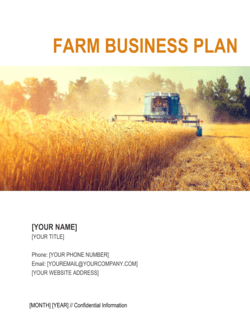
Farm Business Plan Template

Free Word download β€’ Edit online β€’ Save & share with Drive β€’ Export to PDF

31 pagesβ€’2h 35m – 3h 30m to fillβ€’Difficulty: Expert
Learn more ↓
FreeFarm Business Plan Template

At a glance

What it is
A Farm Business Plan is a structured document that maps an agricultural operation's land base, crop and livestock mix, equipment inventory, labor model, environmental practices, regulatory obligations, and 3–5 year financial projections into a single plan. This free Word download gives you a farmer-ready starting point you can edit online and export as PDF to present to lenders, USDA programs, or farm succession advisors.
When you need it
Use it when applying for a farm loan or FSA operating loan, enrolling in USDA conservation or commodity programs, onboarding a farm manager, or planning a new enterprise β€” row crops, livestock, specialty produce, or agritourism.
What's inside
Executive summary, farm description and land inventory, production plan, equipment and infrastructure, marketing and sales strategy, labor plan, environmental and regulatory compliance, and a full financial section including projected P&L, cash flow, and balance sheet with sensitivity analysis.

What is a Farm Business Plan?

A Farm Business Plan is a structured document that maps an agricultural operation's land base, production enterprises, equipment inventory, labor model, marketing strategy, environmental compliance obligations, and 3–5 year financial projections into a single plan. Unlike a general business plan, it incorporates elements specific to farming: FSA farm numbers and APH yield history, enterprise budgets per acre or per head, commodity price risk management, USDA program enrollment, and permit documentation. Lenders, USDA program offices, and farm succession advisors all rely on this document to assess operational viability and repayment capacity.

Why You Need This Document

Without a written farm business plan, FSA loan applications stall at the county office, commercial ag lenders request repeated document revisions, and USDA conservation program payments go unclaimed because enrollment paperwork is never organized in one place. A missing debt service coverage ratio calculation alone can delay a loan closing by weeks. Beyond financing, a completed plan forces you to stress-test your commodity price assumptions, confirm that land tenure is secured for the loan term, and identify labor gaps before planting season β€” not after. This template gives you the structure FSA county offices and commercial ag underwriters expect, so you spend your time on the farm-specific content that actually requires your knowledge rather than building a document format from scratch.

Which variant fits your situation?

If your situation is…Use this template
Row crop operation (corn, soybeans, wheat) seeking an FSA loanFarm Business Plan
Raising cattle, hogs, or poultry with a CAFO or permit requirementLivestock Farm Business Plan
Growing organic or specialty produce for direct-to-consumer marketsSpecialty Crop Farm Business Plan
Adding agritourism, farm stays, or a farm store to an existing operationAgritourism Business Plan
Transitioning conventional acres to certified organic productionOrganic Farm Transition Plan
Early ideation or internal alignment before writing the full planOne-Page Business Plan
Aquaculture, fish farming, or shellfish operationAquaculture Business Plan

Common mistakes to avoid

❌ Using county average yields instead of farm APH records

Why it matters: County averages often exceed the farm's actual production history. A lender who pulls APH records and finds a 15 bu/acre gap in corn yield will recalculate revenue projections downward and may reduce the loan amount or deny the application.

Fix: Request your 10-year APH yield history from your crop insurance agent and use the 5-year Olympic average (drop high and low, average the rest) as your production baseline in the plan.

❌ Omitting operator labor from the cost structure

Why it matters: A plan that shows profitability only because the operator works for free misleads lenders about true breakeven and makes the business appear non-viable if the operator ever needs to be replaced by a hired manager.

Fix: Assign the operator a market-rate labor cost β€” typically $18–$28/hour for farm operations β€” and include it as a cash or opportunity cost in the enterprise budgets.

❌ No commodity price risk management strategy

Why it matters: Presenting projected revenue at today's spot price with no hedging plan exposes the entire financial model to a single variable. Lenders know commodity prices can drop 25–30% in a single marketing year.

Fix: Document a specific marketing plan for each commodity: percentage pre-sold via forward contracts, storage strategy, and target price floors. Attach any contracts already executed.

❌ Leaving the environmental and regulatory section blank

Why it matters: FSA loan officers and USDA program staff verify permit status and nutrient management plan compliance independently. Missing documentation can delay closings by 30–60 days or trigger a compliance hold.

Fix: Contact your state department of agriculture and local NRCS office to collect copies of all active permits, plans, and contract numbers before completing this section.

❌ Omitting debt service coverage ratio from the financial projections

Why it matters: FSA and commercial ag lenders require a minimum DSCR of 1.10–1.25. Submitting financials without a DSCR calculation forces the underwriter to recalculate it β€” and signals the applicant does not understand the lending criteria.

Fix: Calculate DSCR for each projection year: (net farm income + depreciation + interest) Γ· (principal + interest payments). Present it as a labeled line in the financial summary.

❌ No succession or continuity section for operators over 55

Why it matters: A farm loan with a 20-year amortization on an operation where the sole operator has no succession plan is a repayment risk. Lenders and program agencies both assess long-term viability.

Fix: Include at least two sentences describing the transition plan β€” whether that is a family transfer, a hired manager arrangement, or a sale β€” and the timeline for each step.

The 10 key sections, explained

Executive Summary

Farm Description and Land Inventory

Production Plan

Equipment and Infrastructure

Marketing and Sales Strategy

Labor Plan

Environmental and Regulatory Compliance

Management Team and Succession

Financial Projections

Funding Requirements and Government Programs

How to fill it out

  1. 1

    Complete the farm description and land inventory

    List every tract by FSA farm number, acres, ownership status (owned vs. rented), cash rent rate, and lease expiration date. Note soil productivity index and primary water source for each tract.

    πŸ’‘ Pull your FSA farm records from your local Farm Service Agency office β€” they contain official acreage, yield history, and program enrollment data you can reference directly.

  2. 2

    Build the production plan by enterprise

    Create a separate enterprise budget for each crop or livestock type: planned acres or animal units, expected yield or production, estimated input costs per acre or per head, and projected gross revenue.

    πŸ’‘ Use your actual 5-year APH (Actual Production History) yield records from your crop insurance agent as the production baseline β€” they are more credible to lenders than county averages.

  3. 3

    Inventory equipment with values and debt balances

    List each piece of major equipment with its model year, current market value (use NADA or auction comparables), and any outstanding loan balance. Calculate net equity for each item.

    πŸ’‘ If a machine is more than 15 years old and approaching major repair, note the expected service life remaining β€” lenders factor replacement timing into cash flow projections.

  4. 4

    Document the marketing strategy for each enterprise

    State specifically how and when each commodity or product will be sold β€” elevator contract, cooperative, farmers market, direct-to-processor, or CSA subscription. Include any forward contracts already booked for the plan year.

    πŸ’‘ Attach copies of signed forward contracts or marketing agreements to the plan's appendix β€” they convert projected revenue into documented revenue in the lender's eyes.

  5. 5

    Calculate total labor costs including operator labor

    Assign an hourly rate to operator and unpaid family labor based on local hired-labor market rates, even if no cash changes hands. Add all hired and seasonal labor wages and benefits.

    πŸ’‘ Including operator labor at a market rate makes the farm's true profitability transparent and demonstrates to lenders that the operation can survive a hired-manager transition.

  6. 6

    List all permits, conservation plans, and program enrollments

    Record every active permit (CAFO, water withdrawal, pesticide applicator license), nutrient management plan, and USDA program contract number with expiration or renewal dates.

    πŸ’‘ Contact your local USDA Service Center to get a printout of all active FSA and NRCS contracts β€” this takes 15 minutes and prevents gaps in the compliance section.

  7. 7

    Build the three-statement financial model

    Model the P&L, cash flow statement, and balance sheet for Years 1–3, with Year 1 broken out monthly. Calculate debt service coverage ratio (net farm income + depreciation) Γ· total annual debt service for each year.

    πŸ’‘ Run a sensitivity case at 80% of projected commodity prices β€” if the DSCR drops below 1.0 in that scenario, adjust the plan's debt structure or cost base before submitting to a lender.

  8. 8

    Write the executive summary last

    Pull the key metrics from each completed section β€” total acres, primary enterprises, Year 1 net farm income, DSCR, and funding request β€” and compress them into 1–2 pages.

    πŸ’‘ State the specific USDA programs you are enrolled in or applying for in the executive summary β€” FSA loan officers use this to route the application to the correct program specialist.

Frequently asked questions

What is a farm business plan?

A farm business plan is a structured document that describes an agricultural operation's land base, production enterprises, equipment, labor, marketing strategy, environmental compliance, and 3–5 year financial projections. It functions as both an internal management tool and an external document required by FSA loan programs, commercial ag lenders, and USDA conservation payment applications.

Do I need a business plan to get an FSA farm loan?

Yes. The USDA Farm Service Agency requires a written farm business plan for most loan programs, including Direct Operating Loans, Direct Farm Ownership Loans, and Beginning Farmer loans. The plan must include production history or projections, a cash flow statement, a balance sheet, and documentation of any existing USDA program enrollment. Incomplete plans are the most common reason FSA applications stall at the county office level.

How long should a farm business plan be?

For an FSA loan or commercial ag lender, a plan of 15–25 pages plus a financial model appendix is typical. Beginning farmer plans tend to run longer because production history must be replaced with detailed projections and references. Internal operating plans used for family decision-making can be shorter, but any plan submitted to a lender or USDA program office should include all ten core sections.

What financial projections does a farm business plan need?

At minimum: a projected income statement (P&L) by enterprise, a monthly cash flow statement for Year 1, an annual cash flow for Years 2–3, a projected balance sheet at the end of each year, and a debt service coverage ratio calculation. Lenders also expect a breakeven commodity price analysis and a sensitivity case at 80% of projected prices. Enterprise budgets supporting the income statement should be included in an appendix.

What USDA programs should I document in my farm business plan?

Document all active enrollments: ARC-CO or PLC commodity program elections, EQIP or CSP conservation contracts with annual payment amounts, crop insurance policies with coverage levels, and any FSA loan program participation. These program payments are part of your farm's income base and improve repayment capacity calculations. FSA loan officers expect to see them referenced explicitly.

How do I handle commodity price risk in a farm business plan?

Present a specific marketing plan for each commodity rather than assuming a single price. Document what percentage will be sold via forward contracts, what will go to storage, and what floor price you are targeting. Attach any contracts already executed as an appendix. Then run a sensitivity analysis showing net farm income and DSCR if prices come in 20% below your base projection β€” this demonstrates to lenders that you have stress-tested the plan.

Can I write a farm business plan myself, or do I need a consultant?

Most farm operators can complete a plan using a structured template, especially for FSA operating loans and smaller commercial credit lines. Consider engaging an agricultural lender, farm management consultant, or your local USDA Farm Business Management program when the loan exceeds $500K, the operation involves multiple complex enterprises, or the financial model requires a full three-statement build. Many land-grant university extension services offer free farm business planning assistance.

How does a farm business plan differ from a standard business plan?

A farm business plan includes agricultural-specific elements that a generic business plan omits: land tenure and lease documentation, FSA farm numbers and APH yield history, enterprise budgets per acre or per head, commodity marketing and hedging strategy, CAFO or nutrient management permit status, USDA program enrollment, and a breakeven yield or price analysis. The financial section must also account for the seasonal cash flow pattern of farming β€” large input expenses in spring, revenue concentrated at harvest.

How often should a farm business plan be updated?

Update it annually before each crop year, ideally after harvest when you have actual yield and price data to compare against projections. Update immediately whenever you add a new enterprise, purchase significant equipment, take on new land, or apply for a new loan or USDA program. A plan more than 18 months old with no updates is treated as stale by FSA county offices and will require a full revision before a loan application proceeds.

How this compares to alternatives

vs General Business Plan

A general business plan covers market analysis, competitive positioning, and financial projections for any business type. A farm business plan replaces generic market analysis with enterprise budgets per acre or per head, adds land tenure documentation, USDA program enrollment, and commodity price risk management β€” elements that FSA loan officers and ag lenders require and that a standard template does not address.

vs One-Page Business Plan

A one-page plan is a rapid-alignment tool for early ideation. It lacks the production detail, financial depth, and regulatory compliance documentation that FSA and commercial ag lenders require. Use it to organize your thinking before building the full farm plan, not as a substitute for it.

vs Strategic Plan

A strategic plan defines multi-year goals and initiatives for an existing business. A farm business plan serves both a strategic and a financing function β€” it must meet lender underwriting standards and USDA program requirements in addition to guiding internal decisions. Established operations typically use both documents, with the business plan driving capital access and the strategic plan guiding day-to-day priorities.

vs Financial Projections Template

A standalone financial forecast projects revenue, expenses, and cash flow but provides no context on land, production practices, labor, or compliance. FSA and commercial ag lenders evaluate the financial projections within the framework of the full plan β€” production assumptions, marketing strategy, and program enrollment all explain why the numbers are credible. A projection spreadsheet submitted alone is insufficient for most farm loan applications.

Industry-specific considerations

Row Crop Production

Corn, soybean, and wheat operations rely on ARC/PLC program payments, crop insurance, and basis contracts β€” all three must be documented in the financial projections.

Livestock and Dairy

Herd inventory valuation, feed cost as a percentage of gross revenue, CAFO permit status, and milk or cattle marketing agreements require dedicated sections beyond a standard crop plan.

Specialty Crops and Direct Marketing

CSA subscription counts, farmers market revenue by season, organic certification status, and GAP food-safety compliance add enterprise-specific complexity to the marketing and compliance sections.

Agritourism and Value-Added Agriculture

A blended operation adds non-farm revenue streams β€” event hosting, farm store, or on-farm processing β€” that require separate enterprise budgets and liability insurance documentation within the plan.

Template vs pro β€” what fits your needs?

PathBest forCostTime
Use the templateBeginning and established farmers applying for FSA operating loans, USDA programs, or commercial lines of credit up to $500KFree2–4 weeks (30–60 hours)
Template + professional reviewLarger commercial loans, multi-enterprise operations, or first-time FSA applicants who want a county office review before submission$500–$2,000 for a farm management consultant or extension farm business advisor3–5 weeks
Custom draftedFarm acquisitions over $1M, complex livestock or specialty crop operations, or farm succession transactions requiring appraisal and legal coordination$2,500–$8,000 for an agricultural lender-referred farm management consultant4–8 weeks

Glossary

FSA (Farm Service Agency)
The USDA agency that administers farm loans, disaster assistance, conservation programs, and commodity price-support payments to eligible producers.
Operating Loan
A short-term line of credit used to finance annual production costs β€” seed, fertilizer, fuel, and labor β€” repaid after harvest or livestock sale.
Farm Enterprise
A distinct income-generating activity within a farm operation, such as corn production, cow-calf cattle, or direct-market vegetables, each tracked with its own revenue and cost center.
Gross Margin (per Acre / per Head)
Revenue from a single acre or animal unit minus the direct variable costs attributable to that unit, before fixed overhead.
Cash Rent
A fixed annual payment per acre made by a tenant farmer to a landowner, regardless of crop yield or commodity price.
CAFO (Concentrated Animal Feeding Operation)
An EPA-regulated livestock facility that confines animals for 45+ days per year and meets specific size thresholds, requiring a permit for manure management.
Conservation Easement
A voluntary legal agreement restricting development on farmland in exchange for a tax benefit or payment, often administered through USDA NRCS programs.
Breakeven Yield
The minimum crop yield per acre needed to cover all variable and fixed production costs at a given commodity price.
Working Capital
Current assets minus current liabilities β€” the short-term financial buffer that allows a farm to cover operating expenses between planting and harvest.
AUM (Animal Unit Month)
A standard measure of grazing consumption equal to the forage needed by one 1,000-pound cow for one month, used to size pasture capacity.
NRCS (Natural Resources Conservation Service)
The USDA agency that delivers financial and technical assistance for conservation practices including cover crops, wetland restoration, and irrigation efficiency.

Part of your Business Operating System

This document is one of 3,000+ business & legal templates included in Business in a Box.

  • Fill-in-the-blanks β€” ready in minutes
  • 100% customizable Word document
  • Compatible with all office suites
  • Export to PDF and share electronically

Create your document in 3 simple steps.

From template to signed document β€” all inside one Business Operating System.
1
Download or open template

Access over 3,000+ business and legal templates for any business task, project or initiative.

2
Edit and fill in the blanks with AI

Customize your ready-made business document template and save it in the cloud.

3
Save, Share, Send, Sign

Share your files and folders with your team. Create a space of seamless collaboration.

Save time, save money, and create top-quality documents.

β˜…β˜…β˜…β˜…β˜…

"Fantastic value! I'm not sure how I'd do without it. It's worth its weight in gold and paid back for itself many times."

Managing Director Β· Mall Farm
Robert Whalley
Managing Director, Mall Farm Proprietary Limited
β˜…β˜…β˜…β˜…β˜…

"I have been using Business in a Box for years. It has been the most useful source of templates I have encountered. I recommend it to anyone."

Business Owner Β· 4+ years
Dr Michael John Freestone
Business Owner
β˜…β˜…β˜…β˜…β˜…

"It has been a life saver so many times I have lost count. Business in a Box has saved me so much time and as you know, time is money."

Owner Β· Upstate Web
David G. Moore Jr.
Owner, Upstate Web

Run your business with a system β€” not scattered tools

Stop downloading documents. Start operating with clarity. Business in a Box gives you the Business Operating System used by over 250,000 companies worldwide to structure, run, and grow their business.

Start freeΒ Β·Β No credit card required