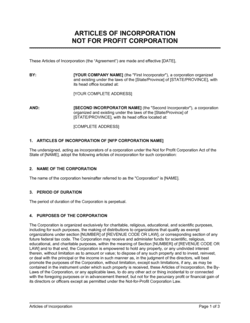
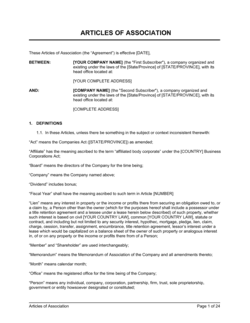
Articles of Incorporation Template

Free Word download • Edit online • Save & share with Drive • Export to PDF

3 pages25–30 min to fillDifficulty: StandardSignature requiredLegal review recommended
Learn more ↓
FreeArticles of Incorporation Template

At a glance

What it is
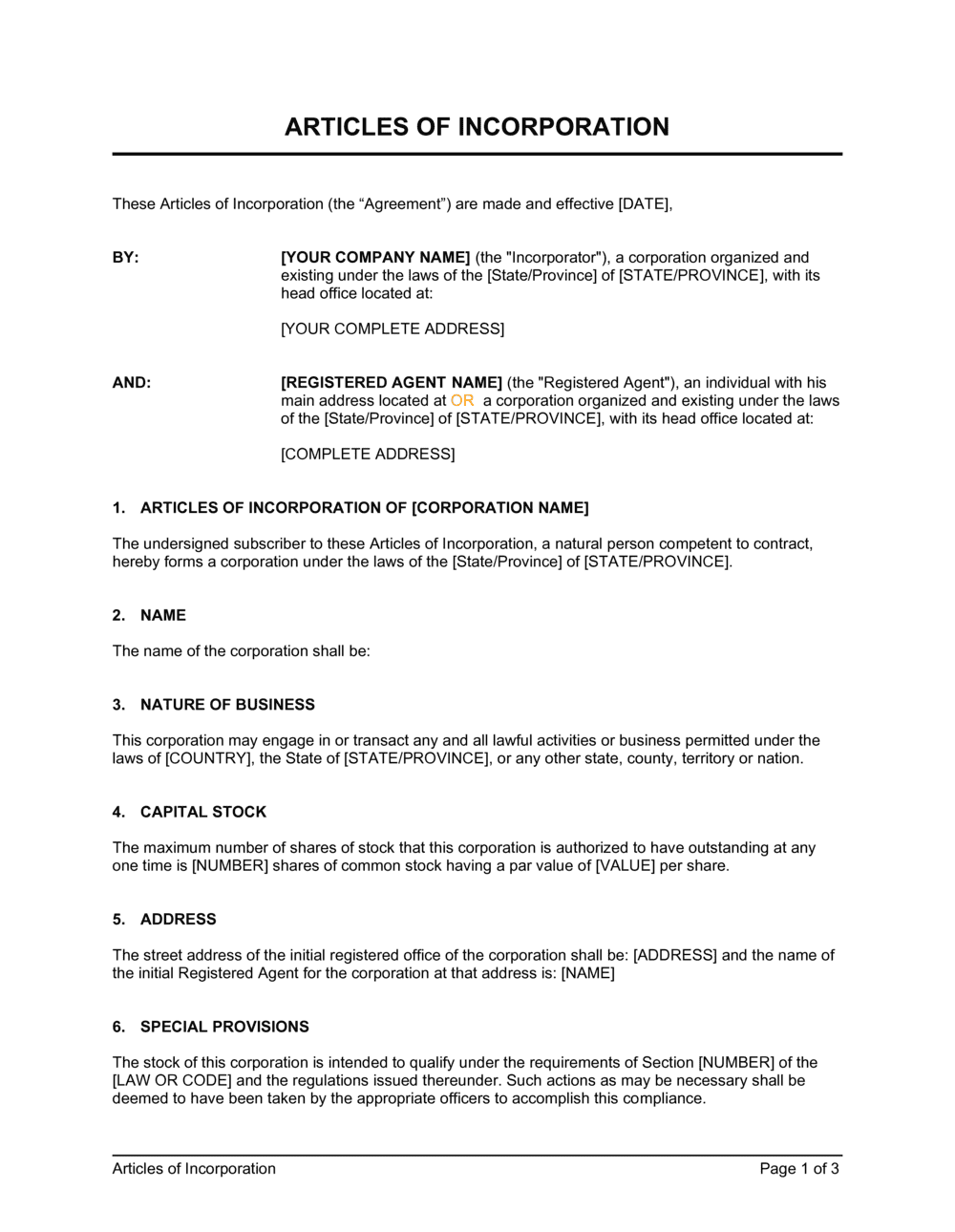
Articles of Incorporation is the foundational legal document filed with a state, provincial, or national government authority to formally create a corporation. This free Word download gives you a structured, government-ready starting point you can edit online and export as PDF before filing with the relevant corporate registry.
When you need it
Use it when you are ready to legally form a corporation — whether a C-corp, S-corp, or equivalent — to establish limited liability, issue shares, and separate personal assets from business obligations. It must be filed before the entity can enter contracts, open business bank accounts, or issue equity.
What's inside
Corporate name and registered office, statement of purpose, authorized share structure and classes, incorporator details, initial board of directors, liability limitations, and any special provisions governing the corporation's internal affairs.

What is Articles of Incorporation?

Articles of Incorporation — also called a corporate charter or certificate of incorporation — is the foundational legal document filed with a state, provincial, or national government authority to formally create a corporation as a distinct legal entity. Once accepted and stamped by the relevant corporate registry, the corporation exists independently of its founders: it can enter contracts, hold assets, incur debts, sue and be sued, and issue equity to employees and investors. The document establishes the corporation's legal name, registered agent and office, authorized share structure, initial directors, and the scope of its legal purpose — all in a format the government requires before it will recognize the entity's existence.

Why You Need This Document

Operating as an unincorporated business exposes every owner to unlimited personal liability — creditors, judgment holders, and tax authorities can reach personal bank accounts, vehicles, and real estate. Filing articles of incorporation draws a legal line between you and the business: shareholders typically risk only the capital they invested, not their personal assets. Beyond liability, a corporation is the only entity form that can issue stock options under a qualified equity plan, satisfy the requirements of most venture capital term sheets, and open the door to certain federal and state tax elections. Without filed articles, your business cannot open a dedicated corporate bank account in many jurisdictions, cannot issue equity to compensate employees, and has no legal standing to enter certain commercial contracts. This template gives you a state-ready starting point that covers every required clause — so the first document your corporation files is complete, accurate, and legally sound from day one.

Which variant fits your situation?

If your situation is…Use this template
Forming a standard for-profit corporation in a US stateArticles of Incorporation (For-Profit)
Forming a tax-exempt charitable organizationArticles of Incorporation (Nonprofit)
Establishing a corporation in a Canadian provinceArticles of Incorporation (Canada)
Registering a company in England and WalesMemorandum and Articles of Association (UK)
Creating a limited liability company instead of a corporationLLC Operating Agreement
Governing internal affairs after incorporationCorporate Bylaws
Electing S-corporation tax status after filingIRS Form 2553 Cover Letter

Common mistakes to avoid

❌ Filing without confirming name availability

Why it matters: A rejected filing due to a name conflict delays your formation date, potentially costs an expedite fee to refile, and may allow another entity to register the name you wanted in the interim.

Fix: Run the secretary of state's online name search before drafting and pay for a name reservation to hold it while you prepare the filing.

❌ Authorizing too few shares at formation

Why it matters: Corporations that authorize only 100 or 1,000 shares quickly run out of equity capacity when issuing founder grants, option pools, and investor preferred stock — requiring an amendment that costs $50–$200 and delays transactions.

Fix: Authorize at least 10,000,000 shares at formation. In Delaware, the filing fee is the same up to a calculated authorized capital threshold, so there is no incremental cost to authorizing more shares.

❌ Using a narrowly specific purpose clause

Why it matters: A purpose clause that names a specific product or market locks the corporation into that description — if the business pivots, the articles require a formal amendment filing before the new activity is technically authorized.

Fix: Use the broadest permissible purpose language: 'to engage in any lawful act or activity' for the applicable state corporation law.

❌ Skipping the organizational meeting after filing

Why it matters: Without bylaws, appointed officers, and issued shares, the corporation exists on paper but has no governance structure — banks will refuse to open accounts, and investors will flag the gap during due diligence.

Fix: Schedule the organizational meeting within one week of receiving the certificate of incorporation and complete all four items: adopt bylaws, appoint officers, authorize a bank account, and issue founder shares.

❌ Conflating articles of incorporation with corporate bylaws

Why it matters: Founders who include detailed governance rules — board meeting procedures, quorum requirements, officer duties — in the articles make every governance change a public filing rather than an internal board resolution.

Fix: Keep the articles minimal and public; place all operational governance in the bylaws, which are an internal document adopted by the board and not filed with the state.

❌ Failing to update the registered agent after personnel changes

Why it matters: If the registered agent moves, resigns, or is no longer available and the state record is not updated, the corporation can miss service of a lawsuit and have a default judgment entered against it.

Fix: File a registered agent update with the secretary of state within 30 days of any change. Most commercial registered agents send automatic renewal reminders that prompt this update.

The 10 key clauses, explained

Corporate Name

In plain language: States the full legal name of the corporation, which must be unique in the filing jurisdiction and include a required designator such as 'Inc.', 'Corp.', or 'Incorporated'.

Sample language
The name of the corporation is [FULL CORPORATE NAME], Inc.

Common mistake: Filing without first confirming name availability through the state's corporate registry search — the filing is rejected, delaying the formation date and potentially losing the name to another filer.

Registered Agent and Registered Office

In plain language: Identifies the person or professional service authorized to receive legal notices, lawsuits, and government correspondence on behalf of the corporation, along with a physical street address in the state of incorporation.

Sample language
The name of the registered agent is [REGISTERED AGENT NAME]. The registered office is located at [STREET ADDRESS], [CITY], [STATE] [ZIP CODE].

Common mistake: Using a P.O. box as the registered office address — virtually every jurisdiction requires a physical street address, and filings with a P.O. box are rejected.

Statement of Purpose

In plain language: Declares the business activities the corporation is authorized to conduct. Most general-purpose corporations use an all-encompassing clause to avoid inadvertently restricting future activities.

Sample language
The purpose of the corporation is to engage in any lawful act or activity for which corporations may be organized under the [STATE] General Corporation Law.

Common mistake: Writing a narrowly specific purpose clause tied to the current product or service. If the business pivots, the articles must be amended — an additional cost and filing delay.

Authorized Share Structure

In plain language: Sets the total number of shares the corporation may issue, the classes of stock (common and preferred), and the par value per share. This clause determines the corporation's equity capacity.

Sample language
The total number of shares of stock that the corporation is authorized to issue is [NUMBER] shares of Common Stock, par value $[PAR VALUE] per share, and [NUMBER] shares of Preferred Stock, par value $[PAR VALUE] per share.

Common mistake: Authorizing too few shares — founders who authorize only 1,000 shares find they cannot grant equity to employees or investors without a costly amendment to increase the authorized share count.

Classes and Rights of Stock

In plain language: Describes the voting rights, dividend preferences, and liquidation priorities attached to each class of stock, distinguishing common stock held by founders from preferred stock typically issued to investors.

Sample language
Each share of Common Stock shall be entitled to one vote on all matters submitted to stockholders. Preferred Stock may be issued in one or more series with such rights and preferences as determined by the Board of Directors.

Common mistake: Leaving preferred stock rights entirely to the board without any parameters in the articles — in some jurisdictions this creates ambiguity about board authority that complicates later financing rounds.

Incorporator Information

In plain language: Identifies the person signing and submitting the articles, along with their mailing address. The incorporator's authority over the corporation ends once the initial board of directors is seated.

Sample language
The name and mailing address of the incorporator is: [INCORPORATOR NAME], [ADDRESS], [CITY], [STATE] [ZIP CODE].

Common mistake: Listing the incorporator as a permanent director or officer in the articles — the incorporator role is administrative only, and conflating it with governance roles creates confusion in the corporate record.

Initial Board of Directors

In plain language: Names the first directors of the corporation who will serve until the initial shareholder meeting or until their successors are elected. Some states make this clause optional; others require it.

Sample language
The names and addresses of the persons who are to serve as directors until the first annual meeting of stockholders or until their successors are elected and qualified are: [DIRECTOR NAME], [ADDRESS].

Common mistake: Omitting this clause in states that require it, causing the filing to be returned, or listing directors by first name only without addresses — which fails validation in most jurisdictions.

Director and Officer Liability Limitation

In plain language: Limits the personal monetary liability of directors to the corporation and its stockholders for breaches of fiduciary duty, to the fullest extent permitted by applicable law — a standard protective provision.

Sample language
To the fullest extent permitted by [STATE] law, a director of the corporation shall not be personally liable to the corporation or its stockholders for monetary damages for breach of fiduciary duty as a director.

Common mistake: Omitting the liability limitation clause entirely. Without it, directors of early-stage companies may decline to serve due to personal liability exposure, and the company cannot provide indemnification at the articles level.

Indemnification of Directors and Officers

In plain language: Authorizes the corporation to indemnify its directors, officers, and agents against legal costs and judgments arising from actions taken in their official capacity, consistent with applicable law.

Sample language
The corporation shall indemnify and hold harmless each person who was or is made a party to any action, suit, or proceeding by reason of being or having been a director or officer of the corporation, to the fullest extent permitted by [STATE] law.

Common mistake: Drafting indemnification language that exceeds the statutory maximum in the governing state — excess indemnification provisions are void and can call the validity of surrounding clauses into question.

Amendment Procedure

In plain language: States the process and voting threshold required to amend the articles of incorporation after filing — typically approval by a majority or supermajority of shareholders plus a state filing.

Sample language
The corporation reserves the right to amend, alter, change, or repeal any provision contained in these Articles, in the manner now or hereafter prescribed by [STATE] statute, and all rights conferred upon stockholders are granted subject to this reservation.

Common mistake: Omitting the amendment reservation clause. Without it, courts in some states treat the articles as a fixed instrument, making future amendments procedurally more complex than the statute would otherwise require.

How to fill it out

  1. 1

    Choose your state of incorporation

    Decide whether to incorporate in your home state or a business-friendly jurisdiction like Delaware, Nevada, or Wyoming. Delaware is the default choice for venture-backed startups due to its predictable corporate law and experienced courts.

    💡 If your business operates in a single state and is not raising venture capital, incorporating locally avoids the cost and paperwork of a dual-state registration.

  2. 2

    Confirm corporate name availability

    Run a name search on the secretary of state's online database before drafting. The name must include a required designator ('Inc.', 'Corp.', 'Corporation', or 'Incorporated') and must be distinguishable from all existing registered entities.

    💡 Reserve the name online for a small fee ($10–$50 in most states) while you prepare the filing — reservations typically hold for 60–120 days.

  3. 3

    Designate a registered agent

    Enter a registered agent with a physical street address in the state of incorporation who is available during business hours to accept legal service. You may serve as your own registered agent, or hire a commercial service for $50–$300 per year.

    💡 Using a commercial registered agent keeps your home address off the public record and ensures you never miss a critical legal notice due to being unavailable.

  4. 4

    Define your authorized share structure

    Enter the total number of authorized shares and par value. For startups, a common structure is 10,000,000 shares of common stock at $0.0001 par value. Add a preferred stock class if you anticipate institutional investment.

    💡 Authorizing at least 10 million shares gives you flexibility to issue founder shares, option pools, and investor shares without immediate amendment — Delaware's filing fee is the same up to certain share thresholds.

  5. 5

    Name the incorporator and initial directors

    Enter the incorporator's full legal name and mailing address. If your state requires initial directors in the articles, list each director's full name and address. Directors named here serve until the first shareholder meeting.

    💡 The incorporator should sign and date the document after all fields are complete — do not leave signature blocks blank before reviewing the full document.

  6. 6

    Review liability limitation and indemnification language

    Confirm the liability limitation and indemnification clauses reference the correct state law. If your template was drafted for Delaware and you are filing in California, update the statutory references throughout.

    💡 A 30-minute review by a local attorney ($150–$300) to confirm state-specific statutory references is the highest-ROI legal spend for a first-time incorporator.

  7. 7

    File with the secretary of state and pay the filing fee

    Submit the signed articles online or by mail to the secretary of state's office along with the applicable filing fee — ranging from $50 in Kentucky to $90 in Delaware to $100+ in California. Processing times run from same-day (expedited) to 10 business days (standard).

    💡 Pay for expedited processing ($50–$100 extra in most states) if you have a time-sensitive contract signing, bank account opening, or fundraise dependent on the existence of the entity.

  8. 8

    Adopt bylaws and issue founder shares immediately after filing

    Once the certificate of incorporation is returned, hold an organizational meeting to adopt corporate bylaws, appoint officers, authorize a bank account, and issue founder shares — ideally on the same day or within the first week.

    💡 Issue founder shares at the lowest defensible valuation immediately after filing. Delaying share issuance while the company grows creates a higher fair market value and a larger tax liability for founders at issuance.

Frequently asked questions

What are articles of incorporation?

Articles of incorporation are the foundational legal document filed with a state, provincial, or national government authority to formally create a corporation. They establish the corporation's legal name, registered agent, authorized share structure, and basic governance framework. Once the government authority accepts the filing and issues a certificate of incorporation, the entity legally exists as a separate legal person — capable of entering contracts, owning property, and incurring liabilities independent of its owners.

What is the difference between articles of incorporation and bylaws?

Articles of incorporation are a public document filed with the government that brings the corporation into legal existence — they set the foundational parameters of the entity. Bylaws are a private internal document adopted by the board of directors after filing that governs day-to-day operations: meeting procedures, officer roles, voting thresholds, and record-keeping requirements. Changes to the articles require a state filing; bylaw amendments are handled internally by the board or shareholders and are never filed with the government.

Do I need articles of incorporation to start a business?

You need articles of incorporation only if you want your business to operate as a corporation. Sole proprietorships, partnerships, and limited liability companies use different formation documents — or none at all. However, if you want limited personal liability, the ability to issue stock, or access to corporate tax elections like S-corp status, filing articles of incorporation is the required first step.

Which state should I incorporate in?

Delaware is the most common choice for startups expecting venture capital investment because of its well-developed corporate law, experienced Court of Chancery, and investor familiarity. Nevada and Wyoming offer similar flexibility and tax advantages. For businesses that operate primarily in one state and are not raising outside capital, incorporating locally avoids the cost and administrative burden of registering as a foreign corporation in your home state.

How long does it take to file articles of incorporation?

Standard processing times range from 1 business day (Delaware standard) to 10–15 business days in states with higher filing volumes like California. Most states offer expedited processing for an additional fee of $50–$250, reducing turnaround to same-day or 24 hours. Online filing is available in virtually every US state and most Canadian provinces and is significantly faster than mail submissions.

What is the filing fee for articles of incorporation?

Filing fees vary by jurisdiction: Delaware charges $90 for a standard certificate, California charges $100 plus a $25 handling fee, New York charges $125 for a basic filing, and most other states fall in the $50–$150 range. Some states base fees on the number of authorized shares or the stated authorized capital, so authorizing a very large number of shares in those jurisdictions can increase the filing cost.

Can I file articles of incorporation without a lawyer?

Yes — for a straightforward domestic for-profit corporation with a standard share structure, a high-quality template and careful attention to state-specific requirements is sufficient. Engage a lawyer when forming a nonprofit seeking tax-exempt status, when the share structure includes multiple classes of preferred stock with complex rights, when the corporation will operate in a regulated industry, or when the founders have different equity expectations that need to be locked in at formation.

What happens after articles of incorporation are filed?

After the government issues a certificate of incorporation, you must hold an organizational meeting to adopt corporate bylaws, appoint initial officers, authorize a corporate bank account, and issue founder shares. You should also obtain a federal Employer Identification Number (EIN) from the IRS, register for any applicable state taxes, and file for foreign qualification in any state where the company will conduct business but did not incorporate.

What is the difference between a C-corp and an S-corp?

Both are corporations formed by filing articles of incorporation. The distinction is a federal tax election, not a state corporate law one. A C-corporation is taxed as a separate entity; an S-corporation passes income and losses through to shareholders, avoiding entity-level tax. To elect S-corp status, the corporation files IRS Form 2553 after formation — articles of incorporation are identical for both, and an S-election can be revoked later if the company grows beyond the eligibility limits (100 shareholders, one class of stock, US residents only).

How this compares to alternatives

vs LLC Operating Agreement

An LLC operating agreement governs a limited liability company — a flexible pass-through entity without share classes, boards, or corporate formalities. Articles of incorporation create a corporation, which is required for equity investment, stock option plans, and certain regulated industries. LLCs are simpler to maintain; corporations are preferred when issuing equity to employees or raising venture capital.

vs Corporate Bylaws

Articles of incorporation are the public founding document filed with the state — they establish existence. Bylaws are the private internal rulebook adopted after filing — they govern operations. Both are required for a properly organized corporation, but only the articles are a government filing. Changes to the articles cost money and are public; bylaw amendments are internal and private.

vs Partnership Agreement

A partnership agreement governs a general or limited partnership, where owners have direct liability exposure (general partners) or limited liability tied to non-management (limited partners). Articles of incorporation create a corporation where all shareholders enjoy full limited liability regardless of involvement. Corporations are more complex to maintain but provide cleaner liability protection and easier equity transferability.

vs Shareholder Agreement

Articles of incorporation establish the corporation's legal existence and authorized share structure with the state. A shareholder agreement is a private contract among the actual shareholders that governs transfer restrictions, buy-sell triggers, drag-along and tag-along rights, and dividend policy. Both documents are needed for a fully governed corporation — the articles come first, the shareholder agreement follows.

Industry-specific considerations

Technology / SaaS

Delaware C-corp formation is effectively required for venture capital investment; the authorized share structure must accommodate a standard 10–15% option pool and multiple series of preferred stock from the outset.

Healthcare

Many states restrict non-physician ownership of medical corporations through professional corporation statutes, requiring a specialized articles form and specific purpose language tied to licensed healthcare activities.

Nonprofit / Social Sector

Nonprofit articles of incorporation must include a specific exempt-purpose clause and an asset-distribution restriction to qualify for IRS 501(c)(3) status — standard for-profit articles are insufficient.

Financial Services

Registered investment advisers, broker-dealers, and insurance companies face state and federal licensing requirements that depend on the corporate form being established correctly before the license application is submitted.

Real Estate

Real estate holding corporations often require property-specific purpose language and must be coordinated with title company requirements for the corporation to appear on deeds and title insurance policies.

Professional Services

Lawyers, accountants, architects, and engineers in most states must form a professional corporation (PC) or professional association (PA) with a licensed-professional ownership requirement stated in the articles.

Jurisdictional notes

United States

Each state has its own corporate statute and filing requirements. Delaware is the most popular jurisdiction for venture-backed companies due to the General Corporation Law and the Court of Chancery. California imposes additional disclosure requirements and higher filing fees; corporations formed elsewhere but headquartered in California must also register as foreign corporations and comply with California securities law on share issuances. S-corp elections are made federally via IRS Form 2553 after state filing.

Canada

Canadian corporations can incorporate federally under the Canada Business Corporations Act (CBCA) or provincially under each province's business corporations act. Federal incorporation gives the right to carry on business under the same corporate name in all provinces. Quebec requires that articles and all corporate communications be in French for provincially incorporated entities. Director residency requirements apply federally and in most provinces — typically 25% of directors must be Canadian residents.

United Kingdom

In England and Wales, the equivalent document is the Memorandum and Articles of Association filed with Companies House under the Companies Act 2006. The memorandum is now a minimal one-page document; the articles govern internal affairs and default to the Model Articles if not customized. Scotland and Northern Ireland use the same framework. Filing fees are £12 for online incorporation, and same-day registration is available for £100. A company number and certificate of incorporation are issued electronically.

European Union

EU member states each maintain separate company law, though the Societas Europaea (SE) form allows a pan-European public company structure. Most common forms — French SAS, German GmbH, Dutch BV, Spanish SL — have their own founding document requirements and minimum capital rules. The 2019 EU Company Law Directive requires all member states to allow fully online incorporation for private limited companies. Minimum share capital requirements vary from €1 (France, Germany for UG) to €60,000 (Belgian NV/SA). GDPR compliance for data held in the corporate record should be considered at formation.

Template vs lawyer — what fits your deal?

PathBest forCostTime
Use the templateSingle-founder or small-team for-profit corporations with a standard share structure in a domestic jurisdictionFree (plus state filing fee of $50–$150)1–2 hours to complete; 1–10 business days for state processing
Template + legal reviewMulti-founder startups with equity splits, corporations in regulated industries, or any filing in California, New York, or Canada$300–$750 for a one-hour attorney review2–5 days
Custom draftedNonprofit corporations seeking 501(c)(3) status, professional corporations, or entities with complex multi-class share structures for an imminent funding round$1,000–$3,500+1–3 weeks

Glossary

Articles of Incorporation
The public charter document filed with a government authority that legally brings a corporation into existence.
Registered Agent
A person or entity designated to receive official legal and government correspondence on behalf of the corporation at a specific address.
Authorized Shares
The maximum number of shares a corporation is permitted to issue under its articles, across all classes of stock.
Par Value
A nominal minimum price per share stated in the articles, used historically for legal capital calculations — often set at $0.0001 for flexibility.
Incorporator
The person who signs and files the articles of incorporation; they have authority over initial organizational actions before directors take over.
Corporate Charter
Another name for the articles of incorporation — the foundational government-issued document defining the corporation's existence and basic powers.
Registered Office
The official address of the corporation in its jurisdiction of incorporation, where legal notices and service of process are delivered.
Statement of Purpose
A clause describing the business activities the corporation is authorized to conduct — often written broadly as 'any lawful purpose' to avoid restrictions.
Bylaws
A separate internal governance document that details the rules for running the corporation — board meetings, officer roles, and voting procedures — and which is adopted after the articles are filed.
Certificate of Incorporation
The government-issued confirmation document returned after articles are filed and approved, proving the corporation legally exists.
Domestic vs. Foreign Corporation
A corporation is 'domestic' in its state of incorporation and 'foreign' in every other state where it operates, requiring a separate foreign qualification filing.

Part of your Business Operating System

This document is one of 3,000+ business & legal templates included in Business in a Box.

  • Fill-in-the-blanks — ready in minutes
  • 100% customizable Word document
  • Compatible with all office suites
  • Export to PDF and share electronically

Create your document in 3 simple steps.

From template to signed document — all inside one Business Operating System.
1
Download or open template

Access over 3,000+ business and legal templates for any business task, project or initiative.

2
Edit and fill in the blanks with AI

Customize your ready-made business document template and save it in the cloud.

3
Save, Share, Send, Sign

Share your files and folders with your team. Create a space of seamless collaboration.

Save time, save money, and create top-quality documents.

★★★★★

"Fantastic value! I'm not sure how I'd do without it. It's worth its weight in gold and paid back for itself many times."

Managing Director · Mall Farm
Robert Whalley
Managing Director, Mall Farm Proprietary Limited
★★★★★

"I have been using Business in a Box for years. It has been the most useful source of templates I have encountered. I recommend it to anyone."

Business Owner · 4+ years
Dr Michael John Freestone
Business Owner
★★★★★

"It has been a life saver so many times I have lost count. Business in a Box has saved me so much time and as you know, time is money."

Owner · Upstate Web
David G. Moore Jr.
Owner, Upstate Web

Run your business with a system — not scattered tools

Stop downloading documents. Start operating with clarity. Business in a Box gives you the Business Operating System used by over 250,000 companies worldwide to structure, run, and grow their business.

Start free · No credit card required