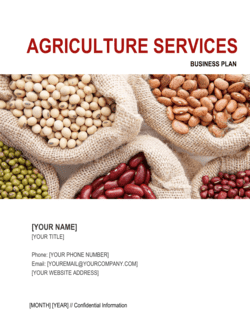
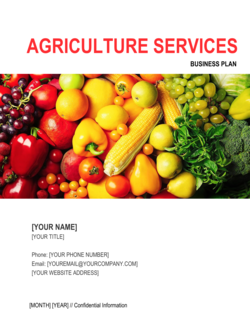
Agriculture Services Business Plan Template

Free Word download β€’ Edit online β€’ Save & share with Drive β€’ Export to PDF

29 pagesβ€’2h 30m – 3h 20m to fillβ€’Difficulty: Expert
Learn more ↓
FreeAgriculture Services Business Plan Template

At a glance

What it is
An Agriculture Services Business Plan is a structured document that defines the strategy, market positioning, service offerings, operational model, and financial projections for a company providing agricultural support services β€” such as crop consulting, soil testing, irrigation installation, pest management, or equipment hire. This free Word download gives you an investor- and lender-ready framework you can edit online and export as PDF.
When you need it
Use it when launching a new agriculture services venture, applying for an agricultural loan or USDA grant, onboarding investors or business partners, or formalizing an existing operation that has been running without a written strategic plan.
What's inside
Executive summary, company overview, market and industry analysis, service descriptions, marketing and sales strategy, operations plan, management team profiles, and three-to-five year financial projections including revenue forecasts, cost structure, and funding requirements.

What is an Agriculture Services Business Plan?

An Agriculture Services Business Plan is a structured planning document that maps the strategy, market opportunity, service offerings, operational model, and financial projections for a company that provides fee-based support services to farmers, growers, and agribusinesses. Unlike a farming business plan focused on crop or livestock production, this document describes a service business β€” crop consulting, soil testing, custom application, irrigation contracting, precision agriculture, or equipment hire β€” that earns revenue by serving producers rather than producing commodities. It includes a market and industry analysis grounded in regional agricultural data, a service-by-service description with pricing, a seasonal operations schedule tied to the local crop calendar, and a three-to-five year financial model built from per-acre or per-contract unit economics.

Why You Need This Document

USDA Farm Service Agency lenders, SBA loan officers, and agricultural credit associations all require a formal written business plan before approving financing β€” a verbal summary or a pitch deck is not sufficient. Without a plan that models seasonal cash flow honestly, most agriculture services startups discover mid-season liquidity gaps only after they have already committed to equipment purchases and labor contracts. A written plan forces you to quantify local demand using actual county-level farm data, price your services against real input and labor costs, and identify the working capital need that sits between your first spring service delivery and your first payment collection. This template gives you the structure to complete that analysis in a format lenders recognize, so you spend your time on the numbers that matter rather than the formatting that surrounds them.

Which variant fits your situation?

If your situation is…Use this template
Starting a crop scouting or agronomic consulting firmAgriculture Services Business Plan
Planning a livestock or animal husbandry service operationLivestock Farming Business Plan
Launching a general farming or crop production enterpriseFarming Business Plan
Opening a farm supply retail or equipment dealershipRetail Business Plan
Seeking early-stage ideation or internal team alignmentOne-Page Business Plan
Applying for a USDA or rural development grantGrant Proposal
Expanding an existing agriculture services business into new regionsBusiness Expansion Plan

Common mistakes to avoid

❌ Ignoring seasonal cash flow in the financial model

Why it matters: Agriculture services revenue is concentrated in planting and harvest windows. A flat monthly revenue model will show false mid-season profitability and hide the working capital need that causes most ag service startups to stall.

Fix: Build a month-by-month cash flow model that assigns revenue to the actual months services are delivered and expenses to when they are incurred β€” fuel, labor, and inputs often precede invoicing by 30–60 days.

❌ Using national TAM data without local validation

Why it matters: A $40B national agriculture services market figure is irrelevant to a lender evaluating a two-county service operation. It signals the founder has not done the local homework.

Fix: Pull USDA NASS county-level farm counts and acreage data and build a bottom-up SAM: number of target farms Γ— average acres Γ— your service fee per acre.

❌ Omitting equipment depreciation and maintenance costs

Why it matters: Tractors, sprayers, soil sampling equipment, and GPS hardware depreciate quickly and require annual maintenance budgets. Leaving these out overstates gross margin and makes the plan financially unrealistic.

Fix: Use IRS Section 179 or MACRS depreciation schedules for each major equipment asset and include an annual maintenance reserve of 5–8% of equipment value in your operating expense line.

❌ Requesting a lump-sum loan with no itemized use of funds

Why it matters: USDA FSA, SBA, and most agricultural lenders require a specific breakdown of how borrowed capital will be deployed. A vague 'working capital and equipment' description triggers immediate requests for more information and delays approval.

Fix: Itemize every planned expenditure, attach vendor quotes for equipment over $5,000, and show the expected date of each disbursement in a draw schedule tied to operational milestones.

The 9 key sections, explained

Executive Summary

Company Overview

Market and Industry Analysis

Services Description

Marketing and Sales Strategy

Operations Plan

Management Team

Financial Projections

Funding Requirements and Use of Funds

How to fill it out

  1. 1

    Complete the company overview and mission statement

    Enter your legal entity name, registration state, founding date, service territory, and a one-sentence mission statement. This anchors every other section of the plan.

    πŸ’‘ Use the exact registered business name β€” lenders cross-reference the plan against your Articles of Organization or Incorporation.

  2. 2

    Research and document regional market demand

    Pull county-level agricultural census data from the USDA NASS to quantify the number of farms, total acreage, and crop types in your service territory. Use this to build a bottom-up SAM estimate.

    πŸ’‘ County extension office annual reports and state department of agriculture data are free, credible, and local β€” far more persuasive to a regional lender than a national market report.

  3. 3

    Define and price each service clearly

    List every service you offer, write a two-sentence plain-language description of what it does for the customer, and state your pricing model β€” per acre, per hour, per application, or per season.

    πŸ’‘ If you offer variable pricing based on acreage tiers, show the price table in a Schedule A appendix rather than embedding every tier in the body.

  4. 4

    Map your sales and acquisition strategy

    Identify your top two or three customer acquisition channels and assign a realistic cost and timeline to each. Tie channel assumptions directly to the customer count in your Year 1 revenue projection.

    πŸ’‘ Co-op and grain elevator relationships are the highest-conversion referral channel for most agriculture service businesses β€” prioritize them in the plan if they apply to your territory.

  5. 5

    Build the operations schedule around your crop calendar

    Create a month-by-month service delivery calendar that maps your capacity (staff hours and equipment availability) against the planting, growing, and harvest windows in your territory.

    πŸ’‘ Build a 10–15% buffer into your capacity model to account for weather delays, equipment downtime, and emergency service calls from existing clients.

  6. 6

    Construct financial projections from unit economics up

    Start with acres under contract Γ— service fee per acre = gross revenue. Then subtract direct costs (labor, inputs, fuel, equipment depreciation) to arrive at gross margin. Add fixed overhead to derive net income.

    πŸ’‘ Model at least two scenarios β€” a base case and a 75%-of-plan downside β€” and show both to lenders. It demonstrates financial literacy and reduces perceived risk.

  7. 7

    Specify the funding ask with an itemized use of funds

    List every major expenditure the loan or investment will cover β€” equipment make and model with price quote, working capital target, and any marketing or hiring budget. Include expected repayment or return timeline.

    πŸ’‘ Attach vendor quotes for major equipment purchases as an appendix. It converts your funding request from an estimate into a documented, credible ask.

  8. 8

    Write the executive summary last

    Compress the plan into 1–2 pages by pulling the single most compelling data point from each section β€” market opportunity, traction, team credential, and financial milestone.

    πŸ’‘ USDA and SBA loan officers read the executive summary and financial projections first. If those two sections are not self-explanatory, the rest of the plan will not get a fair read.

Frequently asked questions

What is an agriculture services business plan?

An agriculture services business plan is a structured document that outlines the strategy, market opportunity, service offerings, operations model, and financial projections for a company that provides support services to farmers and agribusinesses β€” such as crop consulting, soil testing, irrigation, pest management, or equipment hire. It functions as both an internal roadmap and an external document for securing loans, grants, or investor capital.

Who needs an agriculture services business plan?

Anyone launching or growing a fee-based agricultural services company needs a formal plan. This includes crop consultants, agronomists, custom applicators, irrigation contractors, and farm equipment service providers. It is also required by USDA FSA and SBA lenders, most agricultural credit associations, and grant programs administered by state departments of agriculture.

What financial projections should an agriculture services business plan include?

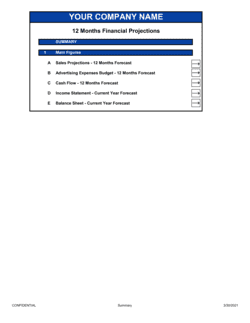
The plan should include a monthly P&L for Year 1, annual P&L for Years 2–5, a cash flow statement that reflects seasonal revenue and expense timing, a projected balance sheet, and a unit-economics summary showing gross margin per acre or per service contract. A sensitivity analysis showing revenue at 75% of plan strengthens credibility with agricultural lenders.

How do I estimate market size for a local agriculture services business?

Use USDA National Agricultural Statistics Service (NASS) county-level data to identify the number of farms, total acreage, and primary crops in your service territory. Multiply the number of target farms by average serviced acres and your fee per acre to build a bottom-up SAM. Cross-check that figure against any available industry benchmarks for your service category.

What funding sources are available for agriculture services businesses?

Common sources include USDA Farm Service Agency operating and ownership loans, SBA 7(a) loans for small agribusinesses, agricultural credit associations, USDA Rural Development business grants, state-level agricultural development grants, and private equity or angel investment for technology-enabled ag service companies. Each source has specific documentation requirements β€” FSA and SBA both require a formal written business plan.

How long should an agriculture services business plan be?

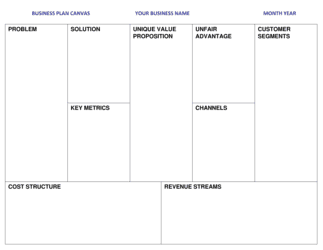
A complete plan suitable for a lender or grant application typically runs 20–30 pages plus a financial model appendix. Internal operating plans can be shorter. A one-page canvas is useful for early ideation but is not sufficient for USDA FSA, SBA, or agricultural credit association applications, which require full financial statements and a detailed operations section.

How should I handle seasonality in the financial projections?

Assign revenue to the specific months when services are actually delivered β€” not evenly across the year. Build a crop calendar for your territory and map your service delivery windows onto it. Model direct expenses (labor, fuel, inputs) in the month they are incurred, which typically precedes invoicing by 30–60 days. This reveals the working capital requirement that flat monthly models consistently understate.

Do I need a consultant to write an agriculture services business plan?

For most USDA FSA or SBA loan applications and agricultural credit associations, a well-completed template is sufficient. Consider hiring an agricultural business consultant ($1,500–$5,000) when the loan exceeds $500K, the operation involves complex multi-service or multi-site structures, or when the financial model requires detailed equipment depreciation schedules and working capital analysis beyond your accounting background.

What makes an agriculture services business plan stand out to lenders?

Lenders respond to three things: local market evidence (county-level farm data, not national statistics), a seasonal cash flow model that honestly reflects mid-season liquidity gaps, and an itemized use-of-funds schedule with vendor quotes for major equipment. Plans that demonstrate the founder understands the operating rhythm of the territory they intend to serve consistently outperform generic plans with better prose but weaker numbers.

How this compares to alternatives

vs Farming Business Plan

A farming business plan focuses on a crop or livestock production operation β€” land, yields, commodity prices, and production costs. An agriculture services business plan covers a fee-for-service company that supports producers without necessarily owning or farming land. The revenue model, cost structure, and customer relationship are fundamentally different.

vs Livestock Farming Business Plan

A livestock farming business plan is built around animal husbandry β€” breed selection, feed conversion, herd health, and meat or dairy commodity pricing. An agriculture services plan describes a service business that may support livestock producers but earns revenue from service contracts rather than commodity sales.

vs One-Page Business Plan

A one-page plan is a rapid-alignment tool useful for early ideation or internal team discussions. It lacks the market evidence, financial depth, and operational detail required by USDA FSA, SBA, or agricultural credit association lenders. Use the one-pager to validate the concept, then build the full agriculture services plan before any capital application.

vs General Business Plan

A general business plan template provides a universal structure applicable to any industry. An agriculture services business plan adds sector-specific sections β€” crop calendar operations scheduling, seasonal cash flow modeling, USDA funding pathways, and per-acre unit economics β€” that generic templates omit. For any lender familiar with ag lending, the industry-specific version is more credible.

Industry-specific considerations

Crop Production and Consulting

Agronomic service businesses model revenue per acre scouted or per field assessment, with seasonal concentration in spring planting and fall harvest windows.

Precision Agriculture and AgTech

Technology-enabled service providers add SaaS or data subscription revenue streams alongside field services, requiring a hybrid unit-economics model covering both recurring software fees and per-acre service fees.

Irrigation and Water Management

Capital-intensive equipment installs require a project-based revenue model with clear milestone billing, plus a recurring maintenance and monitoring service component that smooths seasonal revenue.

Custom Application and Pest Management

Custom applicators carry significant equipment, liability, and input-cost exposure and must model EPA and state pesticide licensing costs alongside standard operating expenses.

Template vs pro β€” what fits your needs?

PathBest forCostTime
Use the templateEntrepreneurs launching or formalizing an agriculture services business seeking USDA FSA loans, SBA loans, or agricultural credit association financing under $500KFree2–4 weeks (30–60 hours)
Template + professional reviewOperators seeking loans between $500K and $2M, multi-service businesses, or those applying for competitive state or federal grant programs$500–$2,000 for an agricultural extension specialist or business advisor review3–5 weeks
Custom draftedLarge-scale or multi-county agriculture service businesses, AgTech ventures seeking equity investment, or operations with complex equipment financing and multi-site structures$3,000–$8,000 for a professional agricultural business plan writer4–8 weeks

Glossary

Agribusiness
The commercial sector encompassing farming, farm supply, food processing, distribution, and the services that support each of those activities.
Crop Consulting
A fee-based agronomic service in which a certified professional assesses crop health, soil conditions, and input requirements to advise farmers on yield optimization.
Precision Agriculture
The use of GPS mapping, remote sensing, variable-rate technology, and data analytics to manage field variability and improve input efficiency at a site-specific level.
Integrated Pest Management (IPM)
A science-based approach to controlling pests that combines biological, cultural, physical, and chemical tools to minimize economic and environmental harm.
Service Territory
The defined geographic area β€” typically measured in county or radius terms β€” within which an agriculture services provider operates and markets its offerings.
Serviceable Addressable Market (SAM)
The portion of the total agriculture services market that a specific company can realistically reach given its geography, service mix, and capacity.
Gross Margin per Acre
Revenue per acre serviced minus direct variable costs (labor, inputs, fuel), used as a unit-economics benchmark for field-based agriculture service businesses.
USDA Farm Service Agency (FSA)
The US federal agency that administers farm loans, commodity programs, and disaster assistance β€” a common funding source reviewed in agriculture business plans.
Seasonal Cash Flow
The predictable fluctuation in revenue and expenses driven by planting, growing, and harvest cycles, requiring deliberate planning to avoid liquidity shortfalls.
Input Costs
The direct expenses required to deliver an agricultural service, including seed, fertilizer, pesticides, fuel, water, and labor tied to service delivery.

Part of your Business Operating System

This document is one of 3,000+ business & legal templates included in Business in a Box.

  • Fill-in-the-blanks β€” ready in minutes
  • 100% customizable Word document
  • Compatible with all office suites
  • Export to PDF and share electronically

Create your document in 3 simple steps.

From template to signed document β€” all inside one Business Operating System.
1
Download or open template

Access over 3,000+ business and legal templates for any business task, project or initiative.

2
Edit and fill in the blanks with AI

Customize your ready-made business document template and save it in the cloud.

3
Save, Share, Send, Sign

Share your files and folders with your team. Create a space of seamless collaboration.

Save time, save money, and create top-quality documents.

β˜…β˜…β˜…β˜…β˜…

"Fantastic value! I'm not sure how I'd do without it. It's worth its weight in gold and paid back for itself many times."

Managing Director Β· Mall Farm
Robert Whalley
Managing Director, Mall Farm Proprietary Limited
β˜…β˜…β˜…β˜…β˜…

"I have been using Business in a Box for years. It has been the most useful source of templates I have encountered. I recommend it to anyone."

Business Owner Β· 4+ years
Dr Michael John Freestone
Business Owner
β˜…β˜…β˜…β˜…β˜…

"It has been a life saver so many times I have lost count. Business in a Box has saved me so much time and as you know, time is money."

Owner Β· Upstate Web
David G. Moore Jr.
Owner, Upstate Web

Run your business with a system β€” not scattered tools

Stop downloading documents. Start operating with clarity. Business in a Box gives you the Business Operating System used by over 250,000 companies worldwide to structure, run, and grow their business.

Free Forever PlanΒ Β·Β No credit card required