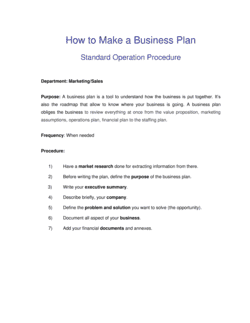
How to Write a Business Plan Guidebook

Free to read β€’ Save or share with one click

FreeHow to Write a Business Plan Guidebook Template

At a glance

What it is
A How To Write A Business Plan Guidebook is a structured Word document that walks founders, owners, and managers through every section of a business plan β€” explaining what to include, how to research it, and what mistakes to avoid. This free download gives you annotated section-by-section instructions you can edit online and share with a team or co-founder before drafting the actual plan.
When you need it
Use it before you begin writing a business plan β€” especially if you are doing it for the first time, working with a team that needs alignment on scope, or preparing for a capital raise where the plan will face investor scrutiny.
What's inside
Section-by-section writing instructions, annotated guidance on market sizing and financial projections, common mistakes to avoid in each section, and checklists that confirm your plan is investor- or lender-ready before submission.

What is a How To Write A Business Plan Guidebook?

A How To Write A Business Plan Guidebook is a structured instructional document that walks founders, owners, and managers through every section of a formal business plan β€” explaining what belongs in each section, how to research and frame it, and what errors to avoid. Unlike a blank business plan template, which provides structure without explanation, the guidebook annotates each section with writing criteria, example language with placeholders, and common mistakes tied to specific consequences. It functions as the preparation layer between knowing you need a business plan and actually writing one that holds up under investor or lender scrutiny.

Why You Need This Document

Starting a business plan without a guidebook is one of the most common reasons founders produce documents that look complete but fail in review β€” an executive summary written before the financials are done, a market sizing section built entirely from top-down estimates, a competitive analysis that claims no real competition exists. These errors are not the result of bad ideas; they are the result of not knowing what each section is actually supposed to accomplish. This guidebook closes that gap by giving you explicit, section-by-section instructions before you write a single word of the plan itself. The result is a business plan built in the right order, from the right inputs, with the internal consistency that investors and lenders require β€” and that your own team can actually execute against.

Which variant fits your situation?

If your situation is…Use this template
Need the actual plan document, not the writing guideBusiness Plan
Preparing a rapid one-page summary for early ideationOne-Page Business Plan
Writing a plan specifically for an investor pitchInvestor Business Plan
Applying for an SBA or bank loanBank Loan Business Plan
Planning a restaurant or food-service conceptRestaurant Business Plan
Building the financial model to accompany the planFinancial Projections (12 Months)
Summarizing strategy for an internal leadership audienceStrategic Planning Template

Common mistakes to avoid

❌ Using the guidebook as a substitute for the actual plan

Why it matters: A guidebook explains what to write; it is not itself a business plan. Submitting annotated instructions to an investor or lender instead of a completed plan signals that the founder is not ready.

Fix: Use this guidebook to prepare, then complete the Business Plan template as your deliverable. The two documents work in sequence, not interchangeably.

❌ Skipping the competitive analysis because the market feels uncontested

Why it matters: Every problem has an existing workaround β€” a spreadsheet, a manual process, or an incumbent product. Omitting this section causes investors to question the founder's market awareness.

Fix: Identify at least four alternatives including the status quo and write a specific paragraph on why your solution wins against each.

❌ Building financial projections backward from a target

Why it matters: Starting from a desired revenue number and finding assumptions to justify it produces a model that falls apart under any scrutiny β€” investors test assumptions, not conclusions.

Fix: Build from unit economics up: number of customers Γ— average contract value, with explicit conversion rate and churn assumptions driving each year's output.

❌ Writing team bios as career summaries rather than credibility proof

Why it matters: A five-paragraph bio that lists every role a founder has held buries the one achievement that actually matters and makes the team look less capable, not more.

Fix: Lead each bio with the single most relevant, quantified accomplishment. Cut anything that does not directly support the thesis that this team can execute this specific plan.

❌ Treating the guidebook as a one-time read before writing

Why it matters: Founders who read the guidebook once and then write from memory skip the nuance in each section's instructions β€” particularly around market sizing and financial modeling β€” and reproduce the same structural errors the guidebook is designed to prevent.

Fix: Keep the guidebook open alongside the plan template and work through each section's instructions while drafting that section, not before.

❌ Ignoring the use-of-funds section because the raise amount feels self-explanatory

Why it matters: A capital ask with no allocation breakdown tells investors you have not thought through execution β€” or that you are obscuring how the money will actually be spent.

Fix: Break the ask into at least four buckets (product, sales and marketing, operations, G&A) with a percentage and dollar amount for each, tied to a specific deliverable or milestone.

The 10 key sections, explained

How to use this guidebook

Defining your business concept

Conducting market analysis

Analyzing the competitive landscape

Describing products and services

Building the marketing and sales strategy

Writing the operations plan

Presenting the management team

Building financial projections

Writing the executive summary

How to fill it out

  1. 1

    Read the full guidebook before writing anything

    Work through every section of the guidebook before opening the blank business plan template. Understanding what each section requires prevents you from writing the wrong things in the wrong order.

    πŸ’‘ Flag the three sections you find most uncertain β€” those are where you need the most research time, not the most writing time.

  2. 2

    Define your business concept in one paragraph

    Write a single paragraph identifying the problem, your solution, the target customer, and the business model. Use this paragraph to test whether you can explain the business clearly before building a 30-page plan around it.

    πŸ’‘ If the concept paragraph takes more than five minutes to write and still feels vague, the business model needs more definition before the plan does.

  3. 3

    Complete the market analysis with two independent sources

    Research TAM using at least two credible sources β€” an industry report, a trade association, or government data. Then build a bottom-up estimate by counting reachable customers and multiplying by average contract value.

    πŸ’‘ If your top-down and bottom-up estimates differ by more than 50%, revisit your assumptions β€” the gap usually signals a flawed customer count or an unrealistic ACV.

  4. 4

    Map competitors and write your differentiation statement

    List at least four alternatives β€” including the status quo β€” with their pricing and key weakness. Then write one specific paragraph on what makes your solution win and why that advantage is defensible.

    πŸ’‘ Use a simple 2Γ—2 positioning matrix to visualize competitive space β€” it forces you to pick meaningful axes and immediately reveals white space or crowding.

  5. 5

    Build the financial model from unit economics

    Start with your unit economics β€” CAC, LTV, gross margin β€” then build up to monthly P&L, cash flow, and balance sheet for Year 1, and annual for Years 2–5. Never start from a revenue target.

    πŸ’‘ Include a sensitivity table at 70% and 130% of your base-case revenue. Investors will stress-test immediately; having the analysis ready signals credibility.

  6. 6

    State the funding ask with specific milestones

    Enter the total capital amount, the instrument (equity, debt, or convertible note), and the precise milestones the capital funds β€” not just a time horizon.

    πŸ’‘ Each spending bucket (product, sales, G&A) should map to a measurable output: '25% to product development = launch of Feature X by Month 6.'

  7. 7

    Write the executive summary last

    Pull the single most compelling data point from each completed section and compress them into 1–2 pages. The summary is a trailer β€” it should make the reader want to read the full document.

    πŸ’‘ If the executive summary runs longer than two pages, cut it. Investors read the summary and financials first; everything else is due diligence.

  8. 8

    Run the completed plan through the readiness checklist

    Use the guidebook's final checklist to verify internal consistency β€” revenue in the P&L must match receipts in the cash flow, and ending cash must match the balance sheet.

    πŸ’‘ Have someone who has not read the plan review the financial model for arithmetic errors. A single formula mistake can end a funding conversation before it starts.

Frequently asked questions

What is a business plan guidebook?

A business plan guidebook is a structured instructional document that walks you through every section of a business plan β€” explaining what to include, how to research it, and what to avoid. Unlike a blank business plan template, a guidebook provides annotated writing instructions and criteria for each section, so you understand the purpose of what you are writing before you write it.

How is a guidebook different from a business plan template?

A business plan template is the deliverable β€” the document you fill in and submit to investors, lenders, or your board. A guidebook is the instruction manual that prepares you to complete that template correctly. The two are designed to be used together: work through the guidebook first, then write the plan. Using a template without the guidebook often produces superficially complete plans with structural gaps that reviewers catch immediately.

Who should use a business plan guidebook?

First-time founders preparing for a capital raise, small business owners applying for an SBA or bank loan, accelerator participants required to submit a formal plan, and business plan consultants onboarding new clients all benefit from a guidebook. It is also commonly used in MBA and entrepreneurship programs to align student teams on planning standards before they begin writing.

What sections does a complete business plan need?

A complete business plan typically covers ten sections: executive summary, company overview, market analysis, competitive analysis, products and services, marketing and sales strategy, operations plan, management team, financial projections (P&L, cash flow, and balance sheet), and funding requirements with use of funds. The guidebook provides writing instructions for each of these sections in the order they should be drafted.

Do I need to complete the guidebook before writing my business plan?

Yes β€” that is the intended workflow. The guidebook is designed to be read section by section while the corresponding section of the plan is being drafted. Working through the instructions before writing each section prevents the most common structural errors β€” vague market sizing, missing competitive analysis, and backward financial modeling β€” that cause plans to fail investor or lender review.

How long does it take to write a business plan using the guidebook?

First-time founders using the guidebook typically complete a full business plan in 2–4 weeks, spending 40–80 hours total. The financial model alone takes 8–15 hours when built correctly from unit economics. The guidebook reduces the time spent on structure and format, leaving more time for the market research and financial modeling that require original thinking.

Can I use this guidebook for a nonprofit business plan?

Yes, with some adaptation. Nonprofit plans replace the profit-focused financial projections with program budgets, funding source diversification, and impact metrics. The market analysis and competitive sections translate directly β€” nonprofits compete for donor attention and program participants just as for-profits compete for customers. The guidebook flags the sections most relevant to nonprofit audiences.

Do I need a consultant to use this guidebook effectively?

For most early-stage founders and small business owners, the guidebook plus the Business Plan template is sufficient without a consultant. Consider hiring a business plan consultant ($1,500–$10,000) when the plan is for a raise above $500K, the financial model involves complex multi-product unit economics, or the audience is a sophisticated institutional lender with specific formatting requirements.

What is the most important section of a business plan?

The executive summary is the section most investors and lenders read first β€” and sometimes exclusively. However, the financial projections section is the most scrutinized during due diligence. Both sections depend on every other section being completed accurately first: the summary synthesizes the plan, and the projections must be consistent with the market analysis, competitive positioning, and go-to-market strategy described in the body of the document.

How this compares to alternatives

vs Business Plan Template

The Business Plan template is the deliverable β€” the structured document you complete and submit to investors, lenders, or your board. The guidebook is the preparation document that explains how to complete each section correctly. Use the guidebook first, then fill out the template. Neither replaces the other.

vs One-Page Business Plan

A one-page business plan is a rapid-alignment tool for early ideation or internal team communication. It lacks the financial depth, market evidence, and competitive analysis required for capital raises. The guidebook prepares you for the full-length plan; the one-pager is a separate, lighter tool for a different purpose.

vs Strategic Planning Template

A strategic plan focuses on a 3–5 year internal operating roadmap for an existing business β€” goals, initiatives, KPIs, and resource allocation. A business plan is an external-facing capital document that adds market context, competitive positioning, and a capital structure. The guidebook specifically prepares you for the external-facing plan.

vs Financial Projections Template

A financial projections template is a standalone modeling tool covering P&L, cash flow, and balance sheet. The guidebook contextualizes those numbers with instructions on how to build them from unit economics up and how they fit within the broader narrative of a business plan. Use the projections template to build the model; use the guidebook to understand what it needs to show.

Industry-specific considerations

SaaS / Technology

The guidebook's financial modeling section emphasizes MRR/ARR build, churn assumptions, CAC payback periods, and cloud infrastructure cost structure β€” the metrics SaaS investors test first.

Retail / E-commerce

Guidance covers average order value, inventory turnover, customer repeat-purchase rate, and fulfillment cost per order as the core unit economics to model before building revenue projections.

Food and Beverage

The operations section instructions cover food cost as a percentage of revenue (target 28–35%), covers per day, table turn rates, and build-out cost amortization specific to brick-and-mortar food concepts.

Professional Services

The guidebook addresses billable utilization rate, average bill rate, revenue per employee, and client concentration risk β€” the four metrics lenders and investors examine in professional services plans.

Manufacturing

Instructions cover cost of goods sold breakdown by materials, labor, and overhead; capacity utilization curves; lead times; and the capex investment required to reach projected production volumes.

Healthcare / MedTech

Guidance flags the need to address regulatory pathway (FDA 510(k), CE mark), reimbursement codes, clinical validation timelines, and compliance costs as required components of plans in regulated healthcare markets.

Template vs pro β€” what fits your needs?

PathBest forCostTime
Use the templateFirst-time founders, small business owners, and students preparing plans for loans under $350K or early-stage fundraisingFree2–4 weeks to complete the accompanying business plan
Template + professional reviewFounders raising seed rounds up to $500K or applying for their first bank loan, who want a financial model or narrative reviewed by an advisor$500–$2,000 for a business advisor or accountant review session3–5 weeks
Custom draftedSeries A raises, institutional lenders, heavily regulated industries, or plans where financial model complexity exceeds founder capacity$3,000–$10,000 for a professional business plan writer4–8 weeks

Glossary

Executive Summary
A 1–2 page distillation of the entire business plan, written last but placed first β€” the section most readers review before deciding whether to continue.
TAM / SAM / SOM
Total Addressable Market, Serviceable Addressable Market, and Serviceable Obtainable Market β€” three nested estimates of how large your potential market is and how much of it you can realistically reach.
Unit Economics
Revenue and cost metrics measured at the level of a single customer or transaction, including customer acquisition cost, lifetime value, and gross margin per unit.
Pro Forma Financials
Forward-looking financial statements β€” P&L, cash flow, and balance sheet β€” built on stated assumptions rather than historical data.
Go-to-Market Strategy
The specific channels, tactics, and sequencing a business uses to acquire its first customers and grow revenue systematically.
Competitive Moat
A durable structural advantage β€” such as proprietary technology, network effects, or switching costs β€” that makes a market position difficult for competitors to replicate.
Burn Rate
The monthly net cash outflow of a startup or pre-revenue business; used to calculate how long existing capital will last before the company needs more funding.
Use of Funds
A breakdown of how capital raised will be deployed across spending categories β€” product development, sales, operations, and G&A β€” with dollar amounts and expected outcomes.
Value Proposition
A clear statement of the specific benefit a product or service delivers to a defined customer, and why that customer should choose it over alternatives.
Bottom-Up Forecast
A financial projection built from individual assumptions β€” number of customers, average deal size, conversion rates β€” rather than from a top-line revenue target worked backward.

Part of your Business Operating System

This document is one of 3,000+ business & legal templates included in Business in a Box.

  • Fill-in-the-blanks β€” ready in minutes
  • Compatible with all office suites
  • Export to PDF and share electronically

Create your document in 3 simple steps.

From template to signed document β€” all inside one Business Operating System.
1
Download or open template

Access over 3,000+ business and legal templates for any business task, project or initiative.

2
Edit and fill in the blanks with AI

Customize your ready-made business document template and save it in the cloud.

3
Save, Share, Send, Sign

Share your files and folders with your team. Create a space of seamless collaboration.

Save time, save money, and create top-quality documents.

β˜…β˜…β˜…β˜…β˜…

"Fantastic value! I'm not sure how I'd do without it. It's worth its weight in gold and paid back for itself many times."

Managing Director Β· Mall Farm
Robert Whalley
Managing Director, Mall Farm Proprietary Limited
β˜…β˜…β˜…β˜…β˜…

"I have been using Business in a Box for years. It has been the most useful source of templates I have encountered. I recommend it to anyone."

Business Owner Β· 4+ years
Dr Michael John Freestone
Business Owner
β˜…β˜…β˜…β˜…β˜…

"It has been a life saver so many times I have lost count. Business in a Box has saved me so much time and as you know, time is money."

Owner Β· Upstate Web
David G. Moore Jr.
Owner, Upstate Web

Run your business with a system β€” not scattered tools

Stop downloading documents. Start operating with clarity. Business in a Box gives you the Business Operating System used by over 250,000 companies worldwide to structure, run, and grow their business.

Free Forever PlanΒ Β·Β No credit card required