Competitive Analysis Report Template

Free Word download β€’ Edit online β€’ Save & share with Drive β€’ Export to PDF

14 pagesβ€’30–40 min to fillβ€’Difficulty: Complex
Learn more ↓
FreeCompetitive Analysis Report Template

At a glance

What it is
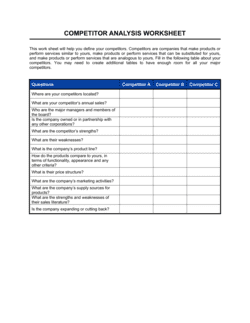
A Competitive Analysis Report is a structured document that identifies your key competitors, evaluates their products, pricing, positioning, and distribution, and maps your company's relative strengths and gaps against each. This free Word download gives you a ready-to-edit framework you can complete online and export as PDF to share with leadership, investors, or your product and marketing teams.
When you need it
Use it when entering a new market, launching a product, preparing a strategic plan, or responding to competitive pressure that has begun affecting win rates or pricing power. It is also a standard deliverable for investor due diligence and annual planning cycles.
What's inside
Executive summary, competitive landscape overview, individual competitor profiles, feature and pricing comparison matrix, SWOT analysis, market positioning map, strategic gap analysis, and actionable recommendations with prioritized next steps.

What is a Competitive Analysis Report?

A Competitive Analysis Report is a structured business document that identifies your key competitors, evaluates their products, pricing, positioning, and market reach, and maps your company's relative strengths and capability gaps against each one. It goes beyond a simple list of rivals β€” a complete report profiles each competitor consistently, benchmarks features and pricing in a side-by-side matrix, plots market positioning on meaningful dimensions, and translates findings into prioritized strategic actions. The result is a single reference document that product, marketing, sales, and leadership teams can all use to make decisions from a shared, evidence-based view of the competitive landscape.

Why You Need This Document

Without a documented competitive analysis, strategic decisions rely on assumptions that go untested until a competitor makes them wrong. Sales teams lose deals to rivals they cannot articulate a clear answer to. Product roadmaps over-invest in parity features while ignoring the gaps that actually drive customer churn. Marketing messaging sounds identical to three other companies in the same space. Investors and board members consistently ask for competitive context β€” a well-prepared report demonstrates market fluency and strategic rigor that ad hoc answers cannot. This template gives you a structured framework to gather, organize, and act on competitive intelligence so that your positioning decisions are grounded in evidence rather than instinct.

Which variant fits your situation?

If your situation is…Use this template
Quick internal alignment on two or three direct competitorsCompetitive Comparison Matrix
Evaluating a specific market before launching a new productMarket Analysis Report
Annual strategic planning with full internal and external auditSWOT Analysis
Investor pitch requiring competitive landscape slide supportPitch Deck / Business Plan
Sales enablement focused on head-to-head product comparisonsCompetitive Battlecard
Pricing strategy review driven by competitor pricing shiftsPricing Strategy Template
Ongoing quarterly tracking of competitor activity and newsCompetitive Intelligence Dashboard

Common mistakes to avoid

❌ Covering too many competitors at shallow depth

Why it matters: A report profiling fifteen competitors with two sentences each produces no actionable intelligence. Readers cannot extract differentiation strategy from surface-level descriptions.

Fix: Limit the report to three to six direct competitors and analyze each with enough depth to reveal specific pricing, feature, and positioning details.

❌ Using outdated data without flagging it

Why it matters: Competitor pricing, product features, and funding status change frequently β€” a report built on twelve-month-old data can lead to strategy decisions that are immediately wrong.

Fix: Record the collection date for every data point and add a report expiry note (typically 90 days for fast-moving markets) so readers know when to refresh.

❌ Biased self-scoring in the comparison matrix

Why it matters: Marking your product as superior on every dimension without evidence destroys the report's credibility with investors, boards, and cross-functional teams who know the real picture.

Fix: Have someone outside your product team β€” a customer, a sales rep, or a neutral colleague β€” audit the matrix scores before the report is finalized.

❌ Recommendations without owners or deadlines

Why it matters: Strategy documents with no assigned accountability consistently fail to drive action β€” the findings sit in a shared drive and the competitive gaps remain unaddressed.

Fix: Every recommendation must name a role (not a person, to survive org changes), a target date, and a measurable success criterion.

❌ Ignoring indirect competitors and substitutes

Why it matters: Buyers often choose a spreadsheet, a manual process, or a tangentially related tool over your product β€” excluding these alternatives leaves the most common loss reason unaddressed.

Fix: Add a section on indirect competitors and status-quo alternatives, even if brief, so the report captures the full set of options a buyer actually considers.

❌ No methodology or source documentation

Why it matters: A report with no documented sources cannot be updated, audited, or trusted β€” when a competitor profile is challenged in a leadership meeting, there is no way to defend or correct it.

Fix: Include a one-paragraph methodology section stating which sources were used, when data was collected, and how conflicting data points were resolved.

The 9 key sections, explained

Executive summary

Scope and methodology

Competitive landscape overview

Individual competitor profiles

Feature and pricing comparison matrix

Market positioning map

SWOT analysis

Strategic gap analysis

Recommendations and next steps

How to fill it out

  1. 1

    Define scope: select competitors and set research boundaries

    List three to six direct competitors and two to three indirect or emerging competitors. Document why each was included. Set the data collection date range so the report can be reliably updated.

    πŸ’‘ Prioritize competitors your sales team encounters most frequently in active deals β€” win/loss data is the most reliable indicator of who actually competes for your customers.

  2. 2

    Gather data from primary and secondary sources

    Use a mix of sources: competitor websites, product trials or demos, G2 and Capterra reviews, LinkedIn employee counts, Crunchbase funding data, and any available public filings. Record the source and date for each data point.

    πŸ’‘ Set up a Google Alert for each competitor's name before you start β€” news from the 30 days before your research window often surfaces pricing changes, product launches, or leadership moves you would otherwise miss.

  3. 3

    Complete one consistent profile for each competitor

    Fill in the same set of fields β€” founding year, headcount, funding, target segment, pricing, top products, distribution channels, and positioning β€” for every competitor. Mark fields as 'Not available' rather than leaving them blank.

    πŸ’‘ Trial a competitor's product or sign up for a free tier before writing the profile β€” firsthand observations catch positioning gaps that website copy hides.

  4. 4

    Build the feature and pricing comparison matrix

    List the ten to fifteen features or capabilities most important to your target buyer. Score each competitor honestly: Yes, Partial, or No. Add a notes column for nuance β€” a 'Yes' that requires a paid add-on is different from a native feature.

    πŸ’‘ Pull the feature list from real customer discovery calls or support tickets, not your internal roadmap β€” buyers define what matters, not your product team.

  5. 5

    Plot the market positioning map

    Select two dimensions that reflect real buyer decision criteria β€” price, feature breadth, target segment size, or implementation complexity. Plot each competitor and describe the quadrant dynamics in one paragraph.

    πŸ’‘ Ask three customers or prospects to validate the axes before you finalize the map β€” their vocabulary often surfaces better dimensions than internal assumptions.

  6. 6

    Complete the SWOT and gap analysis

    Write the SWOT with specific competitive references: each strength should call out a competitor weakness it exploits, and each threat should name the competitor or trend creating it. Then rank gaps by estimated impact on buying decisions.

    πŸ’‘ Limit the SWOT to three to four items per quadrant β€” ten weaknesses signal analysis paralysis, not thoroughness.

  7. 7

    Draft recommendations with owners and dates

    For each gap or threat identified, write one specific action, assign an owner by role, set a target completion date, and state the expected outcome. Prioritize using a simple High / Medium / Low framework.

    πŸ’‘ Limit the recommendations section to the top five actions β€” a list of fifteen dilutes focus and reduces the probability that any of them get executed.

  8. 8

    Write the executive summary last

    Compress the three most important findings and the single most urgent recommendation into half a page. The summary is written for a reader who will not read the rest of the report.

    πŸ’‘ If your summary requires more than one page to convey the key findings, the body of the report likely lacks focus β€” tighten the recommendations section first.

Frequently asked questions

What is a competitive analysis report?

A competitive analysis report is a structured business document that identifies your key competitors, evaluates their products, pricing, positioning, and market share, and maps your company's relative strengths and gaps against each. It provides the factual foundation for strategic decisions about product development, pricing, messaging, and market entry. A complete report typically covers three to six direct competitors and includes a feature comparison matrix, positioning map, SWOT analysis, and prioritized recommendations.

When should I conduct a competitive analysis?

The most common triggers are: entering a new market, launching or repositioning a product, preparing an annual strategic plan, experiencing a decline in win rates, or responding to investor due diligence requests. In fast-moving markets, a quarterly refresh of the key competitor profiles and comparison matrix is a reasonable cadence. A full report is typically warranted annually or whenever a major competitor makes a significant move.

How many competitors should I include in the report?

Three to six direct competitors is the standard range for a report that is both thorough and actionable. Including fifteen competitors sounds comprehensive but produces shallow profiles that cannot support strategic decisions. Supplement direct competitors with two to three indirect alternatives or emerging entrants to capture the full buyer decision set.

What is the difference between a competitive analysis and a market analysis?

A market analysis focuses on the overall market β€” size, growth rate, customer segments, and macro trends. A competitive analysis focuses specifically on the companies operating in that market β€” their products, pricing, positioning, and strategies. The two are complementary: a business plan or investor deck typically requires both, with the market analysis providing context and the competitive analysis providing differentiation evidence.

What sources should I use for competitor research?

Reliable sources include competitor websites and product documentation, free trials or product demos, customer review platforms like G2 and Capterra, Crunchbase and LinkedIn for funding and headcount data, LinkedIn job postings to infer product roadmap priorities, earnings calls and press releases for publicly traded companies, and your own sales team's win/loss notes. Primary sources β€” actual product usage and customer interviews β€” produce insights that secondary sources rarely surface.

How do I avoid bias in a competitive analysis?

The most reliable technique is to apply identical research methods and scoring criteria to every competitor, including your own product. Have someone outside your product or marketing team β€” a customer, a sales rep, or a board member β€” review the comparison matrix before the report is finalized. If you find your product scores highest on every dimension, treat that as a signal to revisit the scoring, not a validation of the results.

How often should a competitive analysis report be updated?

In most markets, a full refresh annually is a minimum. Fast-moving sectors β€” SaaS, fintech, consumer tech β€” warrant a quarterly update of competitor profiles and pricing. At minimum, update the report whenever a key competitor raises a significant funding round, launches a major product, changes pricing, or exits the market. Add an expiry date to every report so readers know when the data should no longer be relied upon.

Can I use a competitive analysis template, or do I need a consultant?

A well-structured template handles the format and framework for most companies. The value-add of a consultant is primary research β€” customer interviews, expert calls, and market access that internal teams cannot easily conduct. Consider hiring a consultant when the report will drive a material capital allocation decision, when the market is highly specialized, or when objectivity is critical for an investor audience. For internal strategy and annual planning, a thorough template completed with honest primary research is typically sufficient.

What makes a competitive analysis report useful versus ignored?

Reports that get used share three traits: they are specific enough to drive a decision (feature X is missing; price is 20% above competitors in the SMB segment), they include prioritized recommendations with named owners and deadlines, and they are short enough to be read by a busy executive. Reports that are ignored tend to be either too shallow to support decisions or so exhaustive that no one reads past the executive summary.

How this compares to alternatives

vs SWOT Analysis

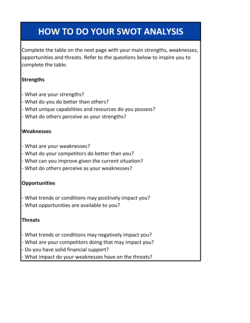
A SWOT analysis is an internal strategic audit covering your own strengths, weaknesses, opportunities, and threats. A competitive analysis report focuses outward β€” profiling specific rivals in detail and benchmarking your capabilities against theirs. A complete competitive analysis typically includes a SWOT section, making the two documents complementary rather than interchangeable.

vs Market Analysis Report

A market analysis characterizes the overall market β€” size, growth trajectory, customer segments, and macro trends. A competitive analysis focuses specifically on the companies operating within that market and how they position against each other. For investor pitches and strategic planning, both documents are typically required: the market analysis establishes the opportunity; the competitive analysis demonstrates why you can win it.

vs Competitive Battlecard

A battlecard is a one-page sales enablement tool summarizing how to win against a single competitor in an active sales conversation. A competitive analysis report is the strategic research foundation that battlecards are built from. The report is written for leadership, product, and marketing audiences; the battlecard is written for a sales rep with five minutes before a call.

vs Marketing Plan

A marketing plan defines how you will acquire and retain customers β€” channels, messaging, budget, and campaigns. A competitive analysis report informs the messaging and positioning choices in a marketing plan by documenting what rivals are saying and where gaps exist. The competitive analysis is an input to the marketing plan, not a substitute for it.

Industry-specific considerations

SaaS / Technology

Feature-by-feature comparison matrices, pricing tier benchmarking, integration ecosystem mapping, and NPS and G2 review score tracking against key rivals.

Retail / E-commerce

Price point and promotional cadence benchmarking, assortment breadth comparison, shipping speed and returns policy analysis, and channel distribution mapping.

Professional Services

Service scope and specialization mapping, rate benchmarking by tier and geography, client portfolio and industry concentration comparison, and talent and credential differentiation.

Healthcare / MedTech

Regulatory clearance status comparison (FDA 510(k), CE mark), clinical evidence benchmarking, payer reimbursement coverage, and distribution channel and GPO contract analysis.

Financial Services

Fee structure and rate benchmarking, product breadth comparison across lending or investment categories, regulatory licensing status, and digital channel and UX differentiation.

Manufacturing

Product specification and certification comparison, lead time and MOQ benchmarking, geographic distribution coverage, and after-sales service and warranty policy analysis.

Template vs pro β€” what fits your needs?

PathBest forCostTime
Use the templateInternal strategy teams, product and marketing managers, and founders preparing for annual planning or investor conversationsFree4–12 hours depending on number of competitors and data availability
Template + professional reviewReports supporting a major pricing decision, product pivot, or Series A fundraising round$500–$2,000 for a strategy advisor or market research review1–2 weeks
Custom draftedInstitutional investor due diligence, M&A target evaluation, or entry into a highly specialized or regulated market$3,000–$15,000 for a market research firm or strategy consultant3–6 weeks

Glossary

Direct Competitor
A company offering the same or substantially similar product or service to the same target customer segment.
Indirect Competitor
A company that solves the same customer problem through a different product category or delivery method.
Competitive Moat
A durable structural advantage β€” network effects, proprietary data, switching costs, or brand β€” that makes a market position difficult for rivals to replicate.
Positioning Statement
A concise internal declaration of how a company differentiates its offering for a specific target audience relative to alternatives.
Win/Loss Rate
The percentage of competitive deals won versus lost, used to measure how effectively a company converts opportunities against rivals.
Feature Parity
A state where two or more competing products offer the same core capabilities, forcing competition to shift to price, service, or brand.
Market Share
A competitor's portion of total industry revenue or unit sales within a defined market and time period.
White Space
An unmet or underserved customer need that no current competitor addresses adequately, representing a potential growth opportunity.
Battlecard
A one-page sales reference document summarizing how to position against a specific competitor during an active sales conversation.
SWOT Analysis
A structured evaluation of internal Strengths and Weaknesses alongside external Opportunities and Threats facing an organization.
Price Anchoring
A competitor's strategy of establishing a reference price point that influences how customers perceive the value of all other offerings in the market.

Part of your Business Operating System

This document is one of 3,000+ business & legal templates included in Business in a Box.

  • Fill-in-the-blanks β€” ready in minutes
  • 100% customizable Word document
  • Compatible with all office suites
  • Export to PDF and share electronically

Create your document in 3 simple steps.

From template to signed document β€” all inside one Business Operating System.
1
Download or open template

Access over 3,000+ business and legal templates for any business task, project or initiative.

2
Edit and fill in the blanks with AI

Customize your ready-made business document template and save it in the cloud.

3
Save, Share, Send, Sign

Share your files and folders with your team. Create a space of seamless collaboration.

Save time, save money, and create top-quality documents.

β˜…β˜…β˜…β˜…β˜…

"Fantastic value! I'm not sure how I'd do without it. It's worth its weight in gold and paid back for itself many times."

Managing Director Β· Mall Farm
Robert Whalley
Managing Director, Mall Farm Proprietary Limited
β˜…β˜…β˜…β˜…β˜…

"I have been using Business in a Box for years. It has been the most useful source of templates I have encountered. I recommend it to anyone."

Business Owner Β· 4+ years
Dr Michael John Freestone
Business Owner
β˜…β˜…β˜…β˜…β˜…

"It has been a life saver so many times I have lost count. Business in a Box has saved me so much time and as you know, time is money."

Owner Β· Upstate Web
David G. Moore Jr.
Owner, Upstate Web

Run your business with a system β€” not scattered tools

Stop downloading documents. Start operating with clarity. Business in a Box gives you the Business Operating System used by over 250,000 companies worldwide to structure, run, and grow their business.

Start freeΒ Β·Β No credit card required