Feasibility Study Template

Free Word download β€’ Edit online β€’ Save & share with Drive β€’ Export to PDF

3 pagesβ€’20–30 min to fillβ€’Difficulty: Standard
Learn more ↓
FreeFeasibility Study Template

At a glance

What it is
A Feasibility Study is a structured analytical document that evaluates whether a proposed project, product, or business venture is viable before committing significant capital or resources. This free Word download gives you a ready-to-edit framework covering market, technical, operational, financial, and risk dimensions β€” export as PDF and share with decision-makers or investors in a single, professional report.
When you need it
Use it before approving a new product launch, capital project, market expansion, acquisition, or any initiative where the cost of failure exceeds the cost of analysis. It converts a promising idea into an evidence-based go/no-go recommendation.
What's inside
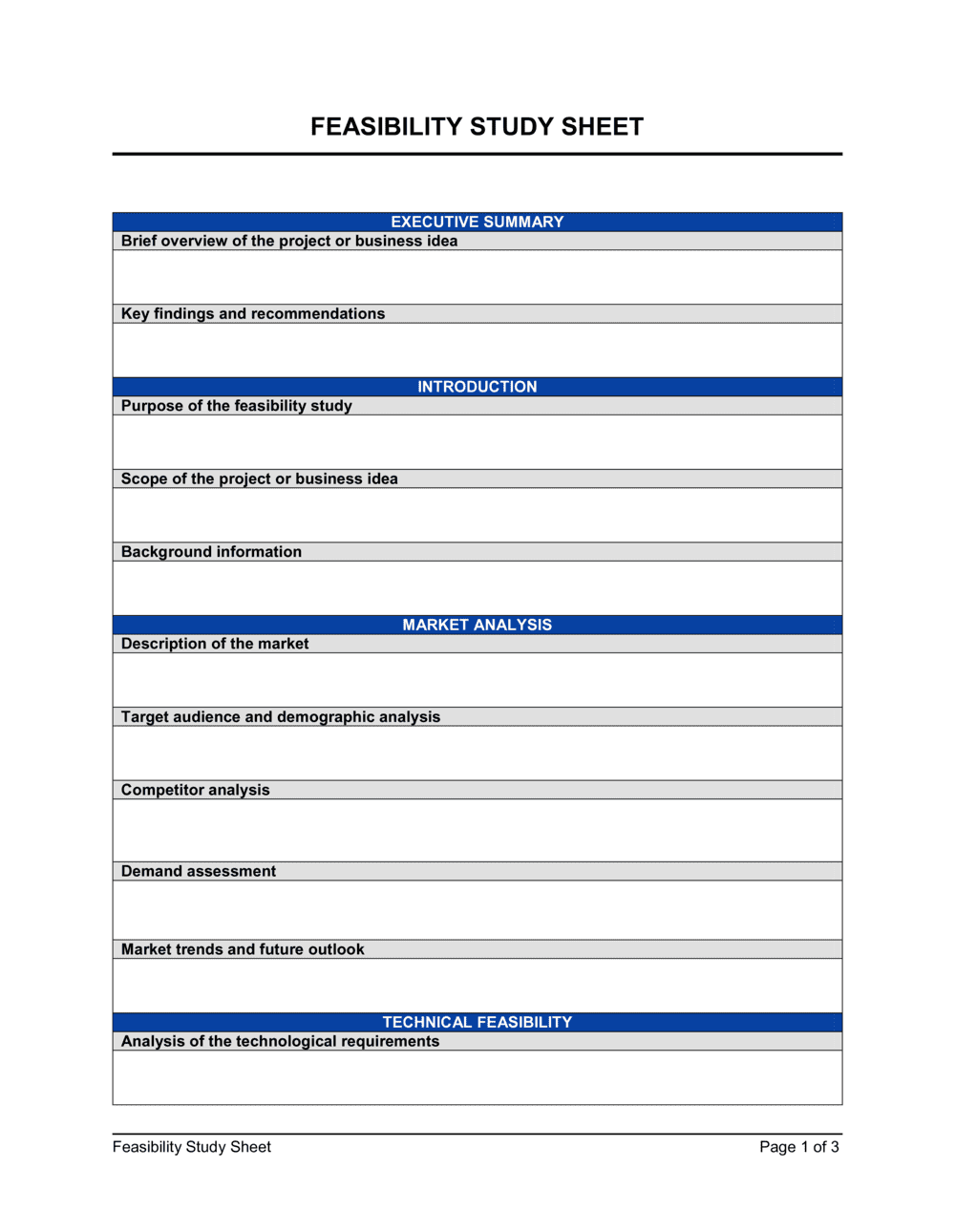
Executive summary with a clear recommendation, market and demand analysis, technical and operational assessment, financial projections with NPV and payback period, risk register, and a final viability conclusion with defined decision criteria.

What is a Feasibility Study?

A Feasibility Study is a structured analytical document that evaluates whether a proposed project, product, or business venture is viable before significant time, money, or resources are committed. It investigates five core dimensions β€” market demand, technical requirements, operational capacity, financial returns, and risk β€” and synthesizes the findings into a clear go, no-go, or conditional-go recommendation. Unlike a business plan, which assumes viability and focuses on execution, a feasibility study explicitly tests whether the opportunity is worth pursuing at all, giving decision-makers the evidence they need to approve, defer, or abandon an initiative with confidence.

Why You Need This Document

Without a formal feasibility study, organizations commit capital to projects based on optimism rather than evidence β€” and the consequences are measurable. Projects that skip structured feasibility analysis are significantly more likely to exceed budget, miss adoption targets, or be abandoned mid-execution after sunk costs have accumulated. A feasibility study forces the critical questions β€” Is there real market demand? Can we build it? Can we sustain it? Does it meet our return threshold? β€” before those questions become expensive to answer. For any initiative with meaningful capital exposure, board oversight, or external financing requirements, a documented feasibility study is not optional; it is the foundation on which every subsequent decision rests. This template gives you the structure to conduct a rigorous study in days rather than weeks, and to present the outcome in a format that earns trust from the stakeholders who control the budget.

Which variant fits your situation?

If your situation is…Use this template
Evaluating a new product concept before development beginsProduct Feasibility Study
Assessing viability of a capital construction or infrastructure projectProject Feasibility Study
Analyzing entry into a new geographic or demographic marketMarket Feasibility Study
Deciding whether to build internal capability or outsource a functionMake-or-Buy Analysis
Turning a positive feasibility outcome into a full funding documentBusiness Plan
Identifying strategic options before a feasibility study is scopedSWOT Analysis
Presenting feasibility findings to investors in slide formatPitch Deck

Common mistakes to avoid

❌ Writing the executive summary first

Why it matters: The summary will not accurately reflect the analysis and the recommendation will often contradict findings elsewhere in the document, undermining credibility.

Fix: Complete every analytical section first, then distill the executive summary from the finished findings β€” it should take no more than 90 minutes to write at that point.

❌ Single-scenario financial projections

Why it matters: A base-case-only model gives decision-makers no information about downside exposure, and any experienced reviewer will immediately ask for sensitivity analysis.

Fix: Always include at least a 70%-of-plan downside scenario alongside the base case, and state explicitly whether the project still meets the hurdle rate under that scenario.

❌ Declaring technical feasibility based on vendor assurances

Why it matters: Vendors have an incentive to overstate capability β€” building a go decision on unvalidated vendor claims has derailed projects at every scale.

Fix: Require a proof-of-concept, pilot result, or independent technical assessment before recording a technology gap as resolved in the study.

❌ No risk register with assigned owners

Why it matters: A list of risks without owners or mitigation actions tells decision-makers what could go wrong but gives them no confidence the organization will manage it.

Fix: Assign a named role to every high-rated risk and define a specific, time-bound mitigation action β€” not a generic 'monitor this risk' entry.

❌ Omitting steady-state operational costs

Why it matters: Studies that only model launch costs routinely underestimate total cost of ownership by 30–50%, producing a financial case that collapses within 12 months of go-live.

Fix: Model Year 2 and Year 3 operating costs explicitly, including support headcount, maintenance, licensing, and customer success overhead.

❌ Ending with findings instead of a recommendation

Why it matters: A study that summarizes results without stating a clear go/no-go forces stakeholders to draw their own conclusions from partial information, often producing disagreement or decision paralysis.

Fix: State the recommendation explicitly in both the executive summary and the conclusion section, with defined conditions if a conditional go is warranted.

The 10 key sections, explained

Executive Summary and Recommendation

Project Description and Scope

Market and Demand Analysis

Competitive and Environmental Analysis

Technical Feasibility

Operational Feasibility

Financial Analysis

Risk Assessment and Mitigation

Implementation Roadmap

Conclusion and Decision Criteria

How to fill it out

  1. 1

    Define the project scope and study boundaries

    Before any analysis begins, write a precise description of what is being evaluated, why it is being studied now, and what is explicitly out of scope. A well-bounded scope prevents the study from expanding mid-analysis.

    πŸ’‘ Get sign-off on the scope statement from the primary decision-maker before proceeding β€” rescoping midway costs more time than the original scoping conversation.

  2. 2

    Build the market and demand analysis

    Research market size using at least two independent sources, then build a bottom-up demand estimate by counting reachable customers and multiplying by expected revenue per customer. The two figures should land within 30% of each other.

    πŸ’‘ Primary research β€” even 10–15 customer interviews β€” is more defensible than published market reports alone and often surfaces demand drivers the desk research misses.

  3. 3

    Assess technical and operational requirements

    Inventory the technology, skills, infrastructure, and process changes the project requires. For each capability gap, specify whether it will be built internally, purchased, or sourced from a partner, and by what date.

    πŸ’‘ For technology gaps, require a proof-of-concept or vendor demonstration before marking the gap as resolved β€” vendor claims alone are not sufficient evidence.

  4. 4

    Build the financial model

    Estimate capital expenditure, Year 1–5 operating costs, and projected revenue from the bottom up. Calculate NPV, IRR, and payback period. Then run a sensitivity analysis testing revenue at 70%, 85%, and 115% of the base case.

    πŸ’‘ Use your organization's established hurdle rate as the discount rate for NPV β€” if one does not exist, 10–12% is a common default for mid-market projects.

  5. 5

    Complete the risk register

    Identify at least six risks across market, technical, operational, financial, and regulatory categories. Rate each by likelihood and impact on a 3Γ—3 matrix, assign an owner, and define a specific mitigation action for every high-rated item.

    πŸ’‘ A risk that has no feasible mitigation action is a signal to reconsider the go recommendation β€” flag it explicitly rather than downgrading its rating.

  6. 6

    Draft the implementation roadmap (go scenario only)

    If the financial analysis supports proceeding, outline the phases, milestones, resources, and timeline from approval to launch. Tie each phase to a funding release and a measurable milestone.

    πŸ’‘ Keep the roadmap at phase level, not task level β€” detailed project plans belong in a subsequent project charter, not a feasibility study.

  7. 7

    Write the conclusion and decision criteria

    State the recommendation explicitly β€” go, no-go, or conditional go β€” and list the two to four specific conditions that must be satisfied before the organization proceeds. Name the decision owner and set a deadline.

    πŸ’‘ A conditional go with clearly defined conditions is often more useful than a binary decision β€” it moves the project forward while protecting against the most material risks.

  8. 8

    Write the executive summary last

    Pull the single most compelling or disqualifying finding from each section and compress them into one to two pages. State the recommendation in the first paragraph so busy executives do not have to read to the end.

    πŸ’‘ If a decision-maker can read only the executive summary and still understand the recommendation and its key conditions, the summary is doing its job.

Frequently asked questions

What is a feasibility study?

A feasibility study is a structured analytical document that evaluates whether a proposed project, product, or business venture is viable before significant resources are committed. It examines market demand, technical requirements, operational capacity, financial returns, and key risks β€” and concludes with a clear go, no-go, or conditional-go recommendation. It is distinct from a business plan in that it explicitly tests viability rather than assuming it.

What are the five types of feasibility analysis?

The five standard dimensions are market feasibility (is there sufficient demand?), technical feasibility (can it be built or sourced?), operational feasibility (can the organization sustain it?), financial feasibility (does it generate an acceptable return?), and risk feasibility (are the risks manageable?). A thorough study addresses all five β€” omitting any one of them leaves a material blind spot that decision-makers will immediately notice.

Who typically conducts a feasibility study?

In larger organizations, feasibility studies are typically led by a project manager, strategy team, or business analyst, with input from finance, operations, and the relevant technical functions. In smaller businesses and startups, the founder or a senior manager often leads the study, sometimes supported by an external consultant for the financial modeling or market research components.

How long should a feasibility study be?

For most project or product evaluations, 15–30 pages plus a financial model appendix is the accepted range. Simple internal projects may justify a shorter 8–12 page study. Complex capital projects, acquisitions, or market entries with significant regulatory dimensions may run 40–60 pages. Length should be driven by the complexity of the decision, not by the desire to appear thorough.

What is the difference between a feasibility study and a business plan?

A feasibility study asks and answers the question: should we do this? A business plan assumes the answer is yes and describes how. Feasibility studies are used to make the go/no-go investment decision; business plans are used to execute and raise capital once that decision is made. A well-founded business plan is typically built from the market and financial findings of a prior feasibility study.

What financial metrics belong in a feasibility study?

At minimum: total capital investment, Year 1–5 projected revenue and operating costs, NPV at the organization's hurdle rate, IRR, and payback period. A sensitivity analysis testing the base case at 70% and 115% of projected revenue is essential. For capital-intensive projects, also include a break-even analysis and a cash flow timeline showing when the project becomes self-funding.

How is a feasibility study different from a cost-benefit analysis?

A cost-benefit analysis (CBA) is a single financial tool that compares total projected costs against total projected benefits to produce a net value. A feasibility study is a broader document that includes a CBA within its financial section but also evaluates market demand, technical viability, operational capacity, and risk β€” all of which can disqualify a project regardless of how favorable the financial numbers appear.

When should I hire a consultant to conduct a feasibility study?

Engage an external consultant when the decision involves capital expenditure above $1M, when the project enters a market or technology domain outside the team's direct experience, when the study will be reviewed by external lenders or investors who expect independent validation, or when internal politics make it difficult to produce an objective recommendation. For straightforward internal projects, a well-structured template completed by the project team is typically sufficient.

What makes a feasibility study recommendation credible?

Four factors drive credibility: market demand supported by both top-down and bottom-up evidence, financial projections built from unit economics rather than top-line assumptions, technical and operational gaps with concrete resolution paths and timelines, and a risk register with named owners and specific mitigation actions. A recommendation unsupported by any one of these will face immediate challenge from any experienced decision-maker or investor.

How this compares to alternatives

vs Business Plan

A business plan assumes viability and describes how to execute β€” it is built for raising capital and guiding operations. A feasibility study asks whether the venture should happen at all and is completed before the business plan is written. Use the feasibility study to make the go/no-go decision, then use the business plan to execute and fund it.

vs SWOT Analysis

A SWOT analysis is a high-level strategic framing tool that identifies strengths, weaknesses, opportunities, and threats β€” typically completed in one to two hours with limited quantitative backing. A feasibility study is a weeks-long investigation with financial modeling, market research, and a risk register. Use a SWOT to scope and prioritize; use a feasibility study to validate and decide.

vs Project Charter

A project charter formally authorizes a project and assigns a project manager β€” it assumes the decision to proceed has already been made. A feasibility study produces the evidence that supports or refutes that decision. The feasibility study comes first; the project charter is issued after a go decision is reached.

vs Financial Projections

A financial projections template models revenue, expenses, and cash flow in detail but does not evaluate market demand, technical viability, or operational readiness. A feasibility study incorporates financial projections as one of five analytical dimensions and contextualizes the numbers with the evidence that makes them credible or calls them into question.

Industry-specific considerations

Real estate and construction

Site acquisition decisions, zoning and permitting risk assessment, demand absorption modeling, and construction cost versus projected rental or sale yield.

Technology and SaaS

Build-vs-buy-vs-partner analysis, technical architecture validation, CAC and LTV modeling for new product lines, and competitive moat assessment.

Healthcare and life sciences

Regulatory pathway timeline and cost (FDA, CE mark), reimbursement code eligibility, clinical validation requirements, and payor adoption risk.

Manufacturing and infrastructure

Capex and capacity modeling, supply chain dependency analysis, environmental compliance cost, and break-even volume at different utilization rates.

Template vs pro β€” what fits your needs?

PathBest forCostTime
Use the templateInternal project approvals, early-stage venture validation, and decisions involving capital under $250KFree1–3 weeks (20–50 hours)
Template + professional reviewCapital projects between $250K and $2M, new market entries, or studies that will be reviewed by a board or lender$500–$3,000 for a financial model review or market research support3–5 weeks
Custom draftedInvestments above $2M, acquisitions, regulated industries, or studies commissioned by external lenders and institutional investors$5,000–$25,000+ for an independent consultant or advisory firm4–12 weeks

Glossary

Feasibility Study
A structured investigation that determines whether a proposed venture or project is technically possible, operationally practical, and financially worthwhile.
Go/No-Go Decision
A formal checkpoint at which stakeholders decide, based on study findings, whether to proceed, pause, or abandon a proposed initiative.
Net Present Value (NPV)
The sum of all projected future cash flows discounted back to today's value β€” a positive NPV indicates the project is expected to generate more value than it costs.
Payback Period
The time required for cumulative net cash inflows to recover the initial investment, expressed in months or years.
Internal Rate of Return (IRR)
The discount rate at which a project's NPV equals zero β€” used to compare a project's expected return against a required hurdle rate.
Risk Register
A structured log of identified risks, each rated by likelihood and impact, with assigned owners and defined mitigation actions.
Technical Feasibility
An assessment of whether the required technology, skills, and infrastructure exist or can be realistically acquired to deliver the proposed solution.
Operational Feasibility
An evaluation of whether the organization has β€” or can develop β€” the processes, people, and systems needed to run the proposed venture on an ongoing basis.
Market Demand Analysis
Research quantifying the size of the target market, customer willingness to pay, and the competitive intensity of the space the project would enter.
Sensitivity Analysis
A technique that tests how the financial outcome changes when key assumptions β€” revenue, cost, or timing β€” vary by a defined percentage above or below the base case.
Critical Success Factors
The specific conditions that must be true for the project to succeed β€” used to frame the final recommendation and decision criteria.
Hurdle Rate
The minimum acceptable rate of return a project must meet or exceed for the organization to justify investment, typically set equal to the weighted average cost of capital.

Part of your Business Operating System

This document is one of 3,000+ business & legal templates included in Business in a Box.

  • Fill-in-the-blanks β€” ready in minutes
  • 100% customizable Word document
  • Compatible with all office suites
  • Export to PDF and share electronically

Create your document in 3 simple steps.

From template to signed document β€” all inside one Business Operating System.
1
Download or open template

Access over 3,000+ business and legal templates for any business task, project or initiative.

2
Edit and fill in the blanks with AI

Customize your ready-made business document template and save it in the cloud.

3
Save, Share, Send, Sign

Share your files and folders with your team. Create a space of seamless collaboration.

Save time, save money, and create top-quality documents.

β˜…β˜…β˜…β˜…β˜…

"Fantastic value! I'm not sure how I'd do without it. It's worth its weight in gold and paid back for itself many times."

Managing Director Β· Mall Farm
Robert Whalley
Managing Director, Mall Farm Proprietary Limited
β˜…β˜…β˜…β˜…β˜…

"I have been using Business in a Box for years. It has been the most useful source of templates I have encountered. I recommend it to anyone."

Business Owner Β· 4+ years
Dr Michael John Freestone
Business Owner
β˜…β˜…β˜…β˜…β˜…

"It has been a life saver so many times I have lost count. Business in a Box has saved me so much time and as you know, time is money."

Owner Β· Upstate Web
David G. Moore Jr.
Owner, Upstate Web

Run your business with a system β€” not scattered tools

Stop downloading documents. Start operating with clarity. Business in a Box gives you the Business Operating System used by over 250,000 companies worldwide to structure, run, and grow their business.

Start freeΒ Β·Β No credit card required