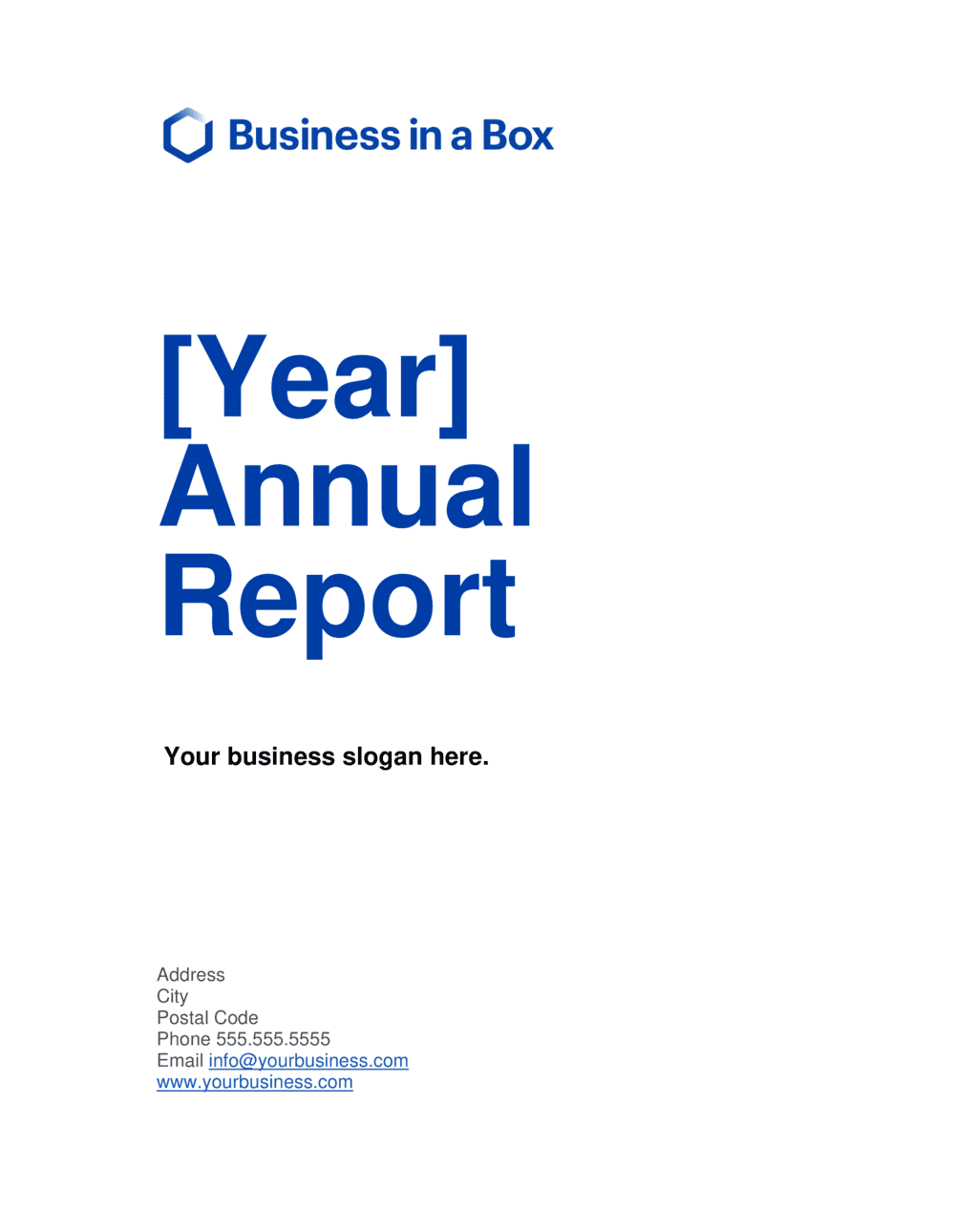
Annual Report Template

Free Word download β€’ Edit online β€’ Save & share with Drive β€’ Export to PDF

8 pagesβ€’25–30 min to fillβ€’Difficulty: Complex
Learn more ↓
FreeAnnual Report Template

At a glance

What it is
An Annual Report is a formal year-end document that summarizes a company's financial performance, strategic milestones, governance structure, and forward-looking outlook for the period just completed. This free Word download gives you a structured, professional starting point you can edit online and export as PDF to share with investors, board members, donors, regulators, or employees.
When you need it
Use it at the close of each fiscal year to communicate results to shareholders, lenders, or major donors β€” or whenever a board, regulator, or funding body requires a formal account of the organization's activity and financial position.
What's inside
Letter from the CEO or executive director, company overview, year-in-review highlights, full financial statements (income statement, balance sheet, cash flow), management discussion and analysis, governance section, and strategic outlook for the year ahead.

What is an Annual Report?

An Annual Report is a formal year-end publication that summarizes an organization's financial performance, strategic milestones, governance structure, risk landscape, and outlook for the fiscal year just completed. It brings together audited financial statements, management's narrative interpretation of those results, board and leadership disclosures, and forward-looking priorities into a single document addressed to shareholders, donors, lenders, or other key stakeholders. Public companies are required by law to publish one; nonprofits are expected to by most major funders; and private companies use them voluntarily to build credibility with investors and boards.

Why You Need This Document

Without a structured annual report, stakeholders are left to interpret raw financial statements without context β€” and raw numbers without a narrative raise more questions than they answer. Lenders and investors who receive incomplete year-end reporting may treat the gap as a governance red flag, triggering covenant reviews or reducing confidence ahead of a new funding round. For nonprofits, an absent or superficial annual report directly undermines grant applications and donor renewal rates. Beyond external audiences, the discipline of producing an annual report forces leadership to reconcile strategy with actual results, identify where the year deviated from the plan, and communicate a credible path forward. This template gives you the complete structure β€” from CEO letter through financial statements to strategic outlook β€” so you spend your time on the substance, not the format.

Which variant fits your situation?

If your situation is…Use this template
Publicly listed company with SEC or stock-exchange filing obligationsAnnual Report (Public Company)
Nonprofit or charity reporting to donors and grant-making bodiesNonprofit Annual Report
Private company reporting to a small investor group or boardAnnual Report (Private Company)
Summary update for employees and internal stakeholders onlyAnnual Business Review
Interim six-month update between annual reportsSemi-Annual Report
Single-page performance snapshot for quick stakeholder briefingsOne-Page Business Review
Department or division performance summary rolled up into the group reportDepartmental Performance Report

Common mistakes to avoid

❌ Narrative figures that don't match the financial statements

Why it matters: A revenue number in the MD&A that differs by even a rounding error from the income statement triggers immediate doubt about the accuracy of the entire report.

Fix: Maintain a locked reference spreadsheet with every figure cited in the narrative, keyed to the exact line in the audited statements. Run a final cross-check before publication.

❌ Presenting only one year of financial data

Why it matters: Without prior-year comparatives, readers cannot assess whether performance improved or deteriorated β€” a single year of numbers carries almost no analytical value.

Fix: Always present at least two years side-by-side on every financial statement. Three years is standard for investor-grade reports.

❌ Boilerplate risk language copied unchanged from prior years

Why it matters: Identical risk disclosures across multiple years signal that management did not actually reassess the risk landscape β€” and leave genuinely new risks undisclosed.

Fix: Review and rewrite the risk section from scratch each year, beginning with a fresh list of what actually kept leadership up at night during the period.

❌ Strategic outlook with no measurable targets

Why it matters: Vague forward guidance β€” 'we expect to continue growing' β€” gives readers nothing to evaluate and signals a lack of internal planning discipline.

Fix: Include at least two quantified targets in the outlook section, such as a revenue range, a customer count milestone, or a specific program expansion metric.

❌ CEO letter that ignores visible problems in the financials

Why it matters: When the letter celebrates success while the income statement shows a loss or a significant miss against prior guidance, readers perceive a credibility gap that is hard to recover from.

Fix: Acknowledge challenges directly in the letter, explain the root cause in one to two sentences, and describe the specific actions being taken β€” this builds more trust than omission.

❌ Omitting board independence and tenure disclosures

Why it matters: Institutional investors and major donors use governance quality as a proxy for organizational risk β€” missing independence data signals either weak governance or deliberate opacity.

Fix: Create a board composition table listing each director's name, tenure, independence status, and committee assignments, and include it in the governance section every year.

The 9 key sections, explained

Letter from the CEO / Executive Director

Company overview and mission

Year-in-review highlights

Financial statements

Management discussion and analysis (MD&A)

Governance and leadership

Risk factors and material uncertainties

Strategic outlook and priorities

Impact metrics and program results (nonprofit variant)

How to fill it out

  1. 1

    Gather audited or reviewed financial statements

    Before writing any narrative, obtain the final income statement, balance sheet, and cash flow statement for the fiscal year β€” along with the prior year comparatives. All narrative figures must match the statements exactly.

    πŸ’‘ Create a single 'source of truth' spreadsheet with every number used in the report and cross-reference it before publishing. One discrepancy between the narrative and the statements undermines credibility.

  2. 2

    Draft the company overview and update key facts

    Review last year's company description and update headcount, geographic footprint, product or service scope, and any structural changes (acquisitions, divestitures, rebranding).

    πŸ’‘ Include the report date explicitly β€” '1,200 employees as of December 31, [YEAR]' is more credible than '1,200 employees.'

  3. 3

    Compile year-in-review highlights

    List every significant milestone from the year, then cut the list to the five to eight events that materially affected strategy, financials, or mission delivery. Write one to two sentences on each.

    πŸ’‘ Use specific metrics wherever possible β€” 'expanded to three new cities' is weaker than 'opened offices in Austin, Toronto, and Amsterdam, adding 85 employees.'

  4. 4

    Write the MD&A section

    Explain revenue and cost variances versus the prior year in plain language. Address each material line item β€” what drove it, whether the trend is expected to continue, and what management is doing about any underperformance.

    πŸ’‘ Write the MD&A for a reader who has seen the financial statements but wants to understand the story behind the numbers β€” not for a reader who hasn't seen the financials at all.

  5. 5

    Complete the governance and leadership section

    List all board members with their independence status, tenure, and committee assignments. Update executive bios to reflect current roles. Add a summary of compensation ranges or total pay for named officers.

    πŸ’‘ Confirm each director's independence status annually β€” changes in business relationships can affect what was true the prior year.

  6. 6

    Update risk factors with current-year relevance

    Review the prior year's risk section and remove or update any risk that has materially changed. Add new risks that emerged during the year. Each risk should include a brief description of the mitigation approach.

    πŸ’‘ Order risks from most material to least β€” readers who skim will remember only the first two or three.

  7. 7

    Write the strategic outlook with quantified targets

    State the organization's top two to four strategic priorities for the coming year, supported by specific targets β€” revenue range, customer count, program enrollment, or capital deployment plan.

    πŸ’‘ Revisit last year's outlook section and explicitly confirm or explain deviations β€” this builds accountability and demonstrates management credibility over time.

  8. 8

    Write the CEO letter last

    Once every other section is complete, write the opening letter synthesizing the year's themes, the most significant wins and challenges, and the strategic direction ahead. Keep it to one to two pages.

    πŸ’‘ The CEO letter sets the tone before the reader reaches any data β€” lead with the single most important fact from the year, not a general statement about the environment.

Frequently asked questions

What is an annual report?

An annual report is a formal year-end document that summarizes an organization's financial performance, strategic milestones, governance structure, and outlook for the period just closed. Public companies are required by law to publish one; nonprofits are expected to by most major funders; and private companies use them voluntarily to communicate with investors, lenders, and boards.

What sections should an annual report include?

A complete annual report typically includes a CEO letter, company overview, year-in-review highlights, audited financial statements (income statement, balance sheet, cash flow), management discussion and analysis, governance and leadership section, risk factors, and strategic outlook. Nonprofits also include a program impact or mission results section alongside the financials.

Who is required to publish an annual report?

Public companies listed on stock exchanges are legally required to file annual reports with their national regulator β€” the SEC Form 10-K in the US, or equivalent filings in Canada, the UK, and the EU. Most nonprofits and charities are required to file annual financial returns with their regulatory body and are expected to produce a public-facing report for donors. Private companies face no legal requirement but often produce one to satisfy investor rights agreements or lender covenants.

What is the difference between an annual report and a 10-K?

A 10-K is the SEC's mandatory annual filing form for US public companies β€” it is a legal disclosure document with prescribed content and format. An annual report is the broader, often more visually polished document companies publish for shareholders and the public, which frequently incorporates or references the 10-K. Private companies and nonprofits produce annual reports without any 10-K obligation.

Does an annual report need to be audited?

Public companies must include audited financial statements prepared by an independent external auditor. Nonprofits above certain revenue thresholds β€” typically $750,000 in the US for federal grant recipients β€” are also required to have audited financials. Private companies can include reviewed or compiled statements if a full audit is not required by their lenders or investors, though audited figures carry significantly more credibility.

How long should an annual report be?

A typical corporate annual report runs 30–60 pages including financial statements and notes. Nonprofit annual reports are often shorter β€” 15–30 pages β€” with more emphasis on visual storytelling and program impact. The financial statement notes alone can add 10–20 pages for complex organizations. There is no universal minimum; the standard is that every material item must be disclosed, whatever length that requires.

Can a private company use this annual report template?

Yes. While private companies are not legally required to publish annual reports, many do so to communicate with angel investors, venture capital backers, bank lenders, or key employees. This template is structured for a private company audience β€” it covers the financial statements, MD&A, governance, and strategic outlook that sophisticated private stakeholders expect, without the regulatory boilerplate required in public filings.

What is an MD&A and why does it matter?

Management Discussion and Analysis is a narrative section where the leadership team explains the financial results in plain language β€” what drove revenue and cost changes, how liquidity evolved, and what risks and opportunities lie ahead. It matters because the financial statements show what happened; the MD&A explains why. Stakeholders who cannot interpret financial statements on their own rely heavily on the MD&A for context.

How far in advance should we start preparing the annual report?

Most organizations begin the process 6–8 weeks before the intended publication date. The critical path is the audit β€” financial statements cannot be finalized until the audit is complete, typically 4–8 weeks after fiscal year-end. Start drafting narrative sections (CEO letter, highlights, governance) in parallel with the audit to avoid delays once the numbers are locked.

How this compares to alternatives

vs Quarterly Report

A quarterly report covers a single 90-day period and typically focuses on financial results and near-term guidance with minimal narrative. An annual report covers the full fiscal year with audited financials, governance disclosures, CEO commentary, and a strategic outlook. Annual reports carry more regulatory weight and require significantly more preparation time.

vs Business Plan

A business plan is a forward-looking document designed to raise capital or align strategy around future goals. An annual report is a backward-looking accountability document that reports what actually happened and what was achieved. Growing companies need both β€” the business plan to attract investment, the annual report to retain it.

vs Board Report

A board report is an internal governance document prepared for directors before each board meeting, covering operational updates, financials, and decisions required. An annual report is a formal external publication for shareholders, donors, and the public. Board reports inform decisions in real time; annual reports account for the full year to external stakeholders.

vs Financial Report

A standalone financial report presents the three financial statements and accompanying notes without broader narrative context. An annual report wraps those statements in strategic, governance, and operational commentary that helps non-financial readers interpret the numbers. Sophisticated stakeholders expect the full annual report, not just the financials.

Industry-specific considerations

Financial Services

Includes regulatory capital ratios, credit quality metrics, net interest margin, and compliance disclosures required by banking or securities regulators.

Nonprofit and Social Sector

Emphasizes program outcome metrics, donor retention, restricted versus unrestricted fund balances, and Form 990 alignment for US-based organizations.

Technology / SaaS

Highlights ARR growth, net revenue retention, CAC payback, and R&D investment as the key metrics investors and acquirers benchmark against sector peers.

Manufacturing

Covers capacity utilization, input cost exposure, capex cycle, supply chain risks, and environmental and safety performance metrics increasingly expected by institutional investors.

Healthcare

Includes patient volume and outcomes data, reimbursement environment commentary, regulatory compliance status, and clinical trial progress for life sciences companies.

Real Estate

Reports net operating income, occupancy rates, same-store NOI growth, funds from operations, and debt maturity schedule alongside standard financial statements.

Template vs pro β€” what fits your needs?

PathBest forCostTime
Use the templatePrivate companies, small nonprofits, and startups preparing annual reports for boards and investorsFree2–4 weeks (40–60 hours)
Template + professional reviewOrganizations with institutional investors, lender covenants, or major grant funders requiring reviewed financials$500–$2,500 for a financial review and narrative edit by an accountant or communications consultant3–5 weeks
Custom draftedPublic companies, large nonprofits filing audited statements, or organizations with regulatory disclosure obligations$5,000–$30,000+ (audit firm, IR consultant, and design agency)6–12 weeks

Glossary

Management Discussion and Analysis (MD&A)
A narrative section written by management that explains the financial results, key drivers, risks, and outlook in plain language alongside the formal statements.
Auditor's Report
An independent auditor's opinion on whether the financial statements present a true and fair view in accordance with the applicable accounting standard.
Income Statement
A financial statement showing revenues, expenses, and net profit or loss over a defined period β€” also called a profit and loss statement.
Balance Sheet
A snapshot of a company's assets, liabilities, and equity at a specific point in time, showing what the organization owns and owes.
Cash Flow Statement
A financial statement that tracks actual cash inflows and outflows across operating, investing, and financing activities during the period.
EBITDA
Earnings Before Interest, Taxes, Depreciation, and Amortization β€” a common proxy for operating performance used in valuation and debt covenants.
Materiality
The threshold at which an omission or misstatement in a financial report could influence the decisions of a reasonable stakeholder.
Going Concern
An accounting assumption that the organization will continue operating for the foreseeable future β€” auditors flag doubt about this when financial stress is significant.
Key Performance Indicators (KPIs)
Quantified metrics β€” revenue growth, customer count, donor retention rate, or utilization β€” used to measure progress against strategic goals.
Comparative Financials
Financial statements that show the current year's figures side-by-side with the prior year, enabling readers to assess trends and changes.
Governance Disclosure
Information about board composition, executive compensation, audit committee activity, and internal controls β€” required for public companies and expected by most institutional donors.

Part of your Business Operating System

This document is one of 3,000+ business & legal templates included in Business in a Box.

  • Fill-in-the-blanks β€” ready in minutes
  • 100% customizable Word document
  • Compatible with all office suites
  • Export to PDF and share electronically

Create your document in 3 simple steps.

From template to signed document β€” all inside one Business Operating System.
1
Download or open template

Access over 3,000+ business and legal templates for any business task, project or initiative.

2
Edit and fill in the blanks with AI

Customize your ready-made business document template and save it in the cloud.

3
Save, Share, Send, Sign

Share your files and folders with your team. Create a space of seamless collaboration.

Save time, save money, and create top-quality documents.

β˜…β˜…β˜…β˜…β˜…

"Fantastic value! I'm not sure how I'd do without it. It's worth its weight in gold and paid back for itself many times."

Managing Director Β· Mall Farm
Robert Whalley
Managing Director, Mall Farm Proprietary Limited
β˜…β˜…β˜…β˜…β˜…

"I have been using Business in a Box for years. It has been the most useful source of templates I have encountered. I recommend it to anyone."

Business Owner Β· 4+ years
Dr Michael John Freestone
Business Owner
β˜…β˜…β˜…β˜…β˜…

"It has been a life saver so many times I have lost count. Business in a Box has saved me so much time and as you know, time is money."

Owner Β· Upstate Web
David G. Moore Jr.
Owner, Upstate Web

Run your business with a system β€” not scattered tools

Stop downloading documents. Start operating with clarity. Business in a Box gives you the Business Operating System used by over 250,000 companies worldwide to structure, run, and grow their business.

Start freeΒ Β·Β No credit card required