Information Memorandum Template

Free Word download β€’ Edit online β€’ Save & share with Drive β€’ Export to PDF

3 pagesβ€’20–25 min to fillβ€’Difficulty: Standard
Learn more ↓
FreeInformation Memorandum Template

At a glance

What it is
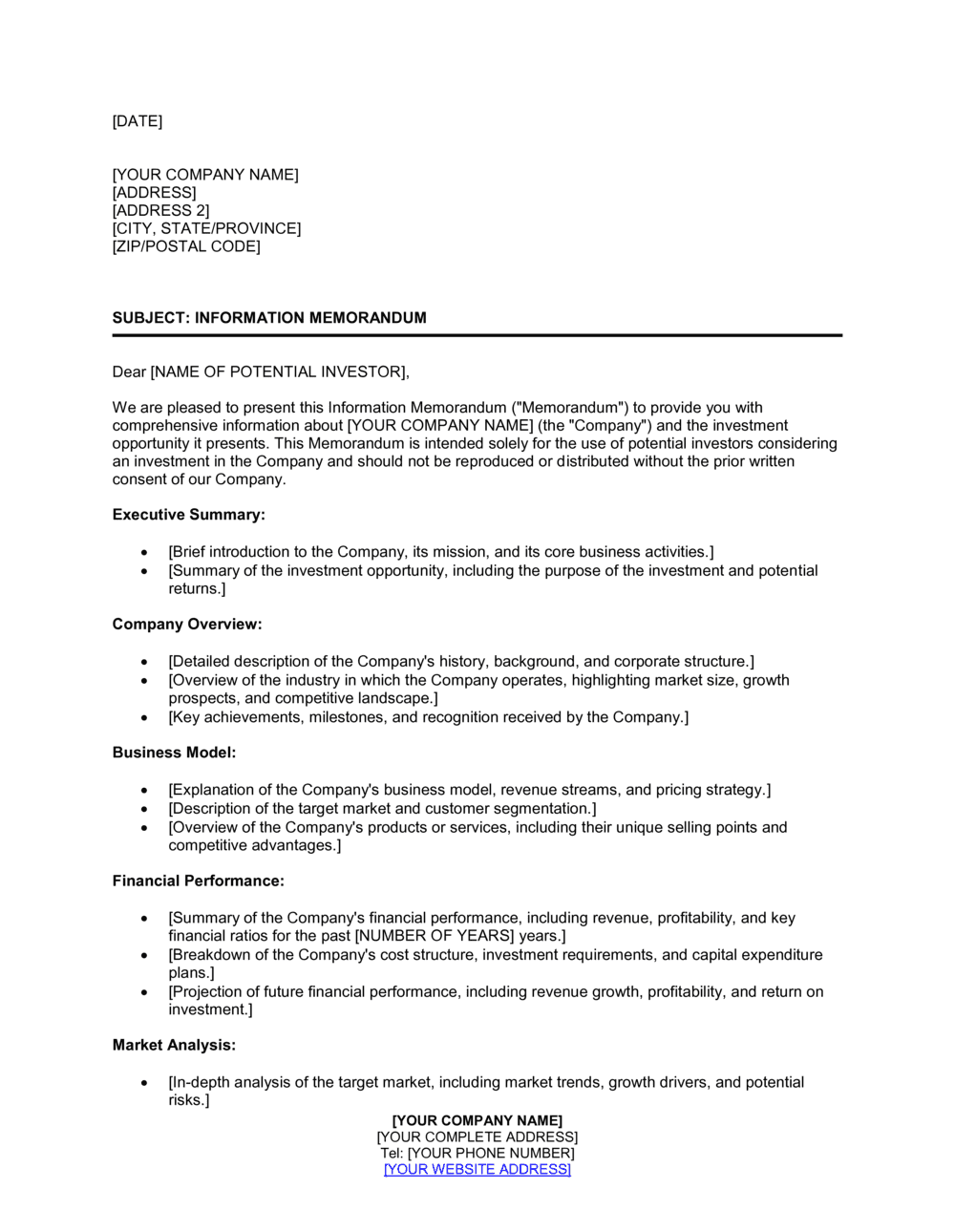
An Information Memorandum (IM) is a confidential document prepared by a company or its advisors to present the business in structured detail to prospective investors, lenders, or acquirers. This free Word download gives you a professionally structured starting point covering business history, market opportunity, financials, management team, and proposed transaction terms β€” ready to edit online and export as PDF.
When you need it
Use it when running a private capital raise, a debt financing process, or an M&A sale process and you need a single authoritative document to share with qualified buyers or investors under a non-disclosure agreement.
What's inside
Executive summary, company overview, market and competitive analysis, products and services, financial history and projections, management team profiles, transaction overview, and a disclaimer and confidentiality notice β€” structured to meet the expectations of institutional investors, private equity firms, and corporate acquirers.

What is an Information Memorandum?

An Information Memorandum (IM) is a confidential document prepared by a company β€” or its financial advisors β€” to present the business in structured detail to prospective investors, lenders, or acquirers. It covers the company's history, products and services, market position, competitive landscape, management team, financial performance, and the proposed transaction structure. Unlike a pitch deck, which summarizes an opportunity for a short introductory meeting, an IM is the full written record a qualified buyer or investor uses to formulate an indicative offer. It is always distributed under a signed non-disclosure agreement and typically runs 20–80 pages depending on the size and complexity of the business.

Why You Need This Document

Without a professionally structured information memorandum, a capital raise or sale process stalls at the first serious conversation. Investors and acquirers who cannot quickly locate normalized EBITDA, customer concentration data, or the growth strategy will make assumptions β€” and conservative assumptions produce lower offers. A poorly organized IM signals that the business itself may be poorly organized. Conversely, a clean, complete IM with a credible normalization bridge and cited market data shortens due diligence timelines, increases the number of qualified parties who submit offers, and creates the competitive tension that drives valuation. This template gives you the structure that investment bankers and M&A advisors use as a starting point, so you spend your time on the content that actually differentiates your business β€” not on figuring out what to include.

Which variant fits your situation?

If your situation is…Use this template
Raising equity capital from institutional investors in a formal deal processInformation Memorandum (Equity Capital Raise)
Selling the business outright through an M&A advisorConfidential Information Memorandum (M&A Sale)
Seeking a bank loan or private debt financingInformation Memorandum (Debt Financing)
Early-stage fundraising where a shorter document is appropriatePitch Deck / Investor Presentation
Providing a high-level teaser before distributing the full IMInvestment Teaser Template
Raising capital through a regulated securities offeringPrivate Placement Memorandum
Summarizing a deal opportunity for internal investment committee reviewInvestment Proposal

Common mistakes to avoid

❌ Distributing the IM without a signed NDA

Why it matters: Once confidential financial and operational data is shared without a binding agreement, the company has no legal recourse if a competitor or disqualified party uses the information.

Fix: Circulate the teaser first, collect a signed NDA, then release the full IM through a controlled data room with access logging.

❌ Presenting GAAP financials without a normalization bridge

Why it matters: Buyers underwrite to normalized EBITDA. An IM that omits adjustments forces buyers to guess, leading to lower indicative offers as they build in uncertainty.

Fix: Include a one-page EBITDA bridge table walking from reported to normalized earnings, with each add-back labeled and quantified.

❌ Using uncited market size figures

Why it matters: A single unsourced claim β€” 'the market is worth $50 billion' β€” causes sophisticated buyers to discount every other number in the document.

Fix: Cite at least two independent sources (industry report, trade association data, or analyst estimate) for every market sizing figure used.

❌ Omitting a transaction process timeline and bid deadline

Why it matters: Without a deadline, buyers treat the opportunity as open-ended and deprioritize it in favor of processes with clear timelines, reducing competitive tension.

Fix: State an indicative offer deadline, a management presentation window, and a target exclusivity date. Four to six weeks from IM distribution to indicative offers is standard.

❌ Leading the executive summary with company history instead of the investment thesis

Why it matters: A busy investor or buyer reads the executive summary first and often exclusively. Opening with a founding story rather than the deal opportunity buries the reason to engage.

Fix: Lead with the investment highlights β€” EBITDA, growth rate, competitive position, and transaction type β€” in the first paragraph. Move history to the company overview section.

❌ Providing revenue totals without customer concentration disclosure

Why it matters: If the top three customers represent 60% of revenue and a buyer discovers this in due diligence rather than in the IM, it damages trust and can reopen price negotiations.

Fix: Disclose customer concentration proactively in the financial or products section, paired with the length and terms of key customer contracts.

The 9 key sections, explained

Disclaimer and confidentiality notice

Executive summary

Company overview and history

Products and services

Market and competitive analysis

Financial performance and projections

Management team

Growth strategy and investment thesis

Transaction overview

How to fill it out

  1. 1

    Complete the disclaimer and confidentiality notice

    Insert the company's legal name, the governing jurisdiction for the confidentiality obligation, and the name of the receiving party if known. Place this on the cover page and as a footer on every subsequent page.

    πŸ’‘ Distribute the IM only after a signed NDA is on file. A confidentiality notice in the document does not substitute for a binding NDA.

  2. 2

    Draft the company overview and milestone timeline

    Describe the legal entity, ownership structure, employee count, and locations. Limit the milestone list to seven to ten events that directly support the investment thesis β€” founding, key product launches, major customer wins, and revenue inflection points.

    πŸ’‘ State the current ownership structure clearly β€” percentage held by founders, management, and any existing investors β€” as buyers will want this before they model a transaction structure.

  3. 3

    Document products, services, and revenue breakdown

    List each product or service line with its revenue contribution (in dollars and percentage of total), gross margin, and customer concentration. If one customer accounts for more than 15% of revenue, disclose it here.

    πŸ’‘ Show three years of revenue by product line, not just the current year. Trend lines are more persuasive than a single-year snapshot.

  4. 4

    Build the market and competitive section with cited sources

    Use at least two independent sources for market size figures. Map four to six named competitors on a two-axis positioning chart and write one paragraph explaining why the company's position is defensible.

    πŸ’‘ Name competitors specifically β€” 'fragmented market with many small players' reads as avoidance and reduces credibility with investors who know the space.

  5. 5

    Prepare the normalized financial summary

    Provide three to five years of historical P&L, a normalization bridge adjusting for non-recurring or owner-specific items, and two to three years of projections. State each projection assumption (growth rate, margin expansion driver) explicitly.

    πŸ’‘ Present an EBITDA bridge table β€” starting with reported EBITDA and walking line by line to normalized EBITDA β€” so buyers can see exactly what you are adding back and why.

  6. 6

    Write the management team profiles

    Profile four to six key executives. For each: current title, years at the company, one prior role at a recognizable company or institution, and one quantified achievement relevant to the business.

    πŸ’‘ Address management continuity explicitly β€” state which executives will remain post-transaction and for how long, as this is one of the first questions a buyer's integration team will ask.

  7. 7

    Articulate the growth strategy with specific initiatives and timelines

    Identify three to five growth levers, each with an estimated revenue or EBITDA impact and a target date. Tie these directly to the financial projections so the numbers are traceable to specific assumptions.

    πŸ’‘ If any growth initiative depends on a post-transaction investment (new hire, capex, market entry cost), say so β€” buyers will model it anyway, and identifying it proactively signals management credibility.

  8. 8

    Define the transaction overview and process timeline

    State the transaction type, indicative valuation range (if sharing one), bid deadline, data room access process, and the advisor or contact for expressions of interest.

    πŸ’‘ A tight, credible process timeline β€” typically four to six weeks from IM distribution to indicative offers β€” creates competitive tension and improves final valuation.

Frequently asked questions

What is an information memorandum?

An information memorandum is a detailed confidential document a company prepares β€” usually with its advisors β€” to present the business to prospective investors, lenders, or acquirers. It covers the company's history, products, market position, financials, management team, and the proposed transaction structure. It is the primary diligence document in private capital raises and M&A sale processes, always shared under a signed non-disclosure agreement.

What is the difference between an information memorandum and a pitch deck?

A pitch deck is a 10–15 slide visual summary designed for a 20-minute meeting β€” its purpose is to generate interest and secure follow-up conversations. An information memorandum is the full diligence document distributed after the deck has been reviewed and an NDA has been signed. The deck gets a buyer or investor engaged; the IM provides the depth they need to submit an indicative offer.

When should a company prepare an information memorandum?

Prepare an IM when running a formal M&A sale process, a private equity recapitalization, a growth equity raise, or a significant debt financing. It is most valuable when distributing to multiple qualified parties simultaneously β€” standardizing the information presented ensures a fair, competitive process. For a single bilateral conversation, a more informal investor presentation may be sufficient.

Does an information memorandum need to be signed?

The IM itself does not require a signature from the reader. However, the recipient should always sign a non-disclosure agreement before receiving it, and the distribution should be tracked through a data room with access logging. Some IMs include a cover sheet the recipient initials to acknowledge receipt and acceptance of the confidentiality terms.

What financial information should be included in an information memorandum?

At minimum: three to five years of historical P&L (revenue, gross profit, EBITDA), a normalization bridge adjusting reported EBITDA for one-time and non-recurring items, two to three years of financial projections with stated assumptions, a summary balance sheet, and key working capital metrics. Buyers will also expect a revenue breakdown by product line and customer concentration disclosure.

What is the difference between an information memorandum and a private placement memorandum?

A private placement memorandum (PPM) is a legally regulated securities offering document used to raise capital from investors under securities law exemptions such as Regulation D in the US. It carries specific legal disclosures and risk factor requirements. An information memorandum is an unregulated commercial document used in M&A and private financing processes β€” it has no prescribed legal format but carries its own confidentiality and accuracy obligations.

How long should an information memorandum be?

For mid-market M&A transactions, 40–80 pages is typical. Smaller business sales can be adequately covered in 20–35 pages. Adding more pages does not improve outcomes β€” buyers and investors read executive summaries and financials first. A concise, well-organized IM with clean financials outperforms a lengthy one with padding. Appendices (detailed financials, customer lists) do not count toward the main page target.

Who prepares an information memorandum?

In formal M&A and capital-raise processes, the IM is typically prepared by the company working with an investment bank, M&A advisor, or corporate finance boutique. For smaller transactions or early-stage raises, the founder or CFO may prepare the document directly using a structured template, sometimes with a financial advisor reviewing the final version.

What is the difference between a teaser and an information memorandum?

A teaser is a one-to-two page anonymous summary distributed before the IM to gauge buyer interest without disclosing the company's identity. Interested parties sign an NDA, after which they receive the full IM. The teaser creates competitive tension and filters out buyers who are not a genuine fit before confidential information is shared.

How this compares to alternatives

vs Pitch deck

A pitch deck is a 10–15 slide visual tool designed for an introductory investor meeting. An information memorandum is the full written diligence document distributed after initial interest is confirmed and an NDA is signed. The deck generates the conversation; the IM enables an offer. Both are needed in a formal capital-raise or sale process.

vs Investment proposal

An investment proposal is typically prepared by an investor or advisor to recommend that capital be deployed into an opportunity β€” it is an internal or committee-facing document. An information memorandum is prepared by the company seeking capital and distributed externally to prospective buyers or investors. They serve opposite sides of the same transaction.

vs Business plan

A business plan is primarily a strategic and operational document used for internal planning, loan applications, and early-stage fundraising. An information memorandum is a transaction-specific document that adds normalized historical financials, a deal structure section, and explicit confidentiality protections. An IM is typically shorter on strategy and deeper on historical financial performance.

vs Letter of intent

A letter of intent is a brief document signed by the buyer after reviewing the IM, setting out the proposed deal terms, price range, and exclusivity period before full due diligence begins. The IM precedes the LOI β€” it is the information basis on which the buyer formulates the offer the LOI records.

Industry-specific considerations

Technology / SaaS

MRR, ARR, net revenue retention, CAC payback, and R&D capitalization policies are the focal metrics; buyers will scrutinize churn cohorts and contract terms in detail.

Manufacturing and Industrials

Capex requirements, equipment age and condition, customer contract length, and supply chain concentration are central to the investment thesis and must be addressed in the operations section.

Professional Services

Revenue per employee, billable utilization, client concentration, and key-person dependency β€” particularly whether clients follow the founder β€” are the primary value and risk drivers buyers analyze.

Healthcare and Life Sciences

Regulatory status, reimbursement codes, compliance history, and any pending FDA or CMS actions must be disclosed prominently, as they directly affect transaction pricing and deal certainty.

Retail and Consumer Brands

Channel mix (direct vs. wholesale vs. marketplace), customer lifetime value, repeat purchase rate, and inventory aging are the key metrics buyers use to assess brand health and scalability.

Financial Services and Fintech

Regulatory licenses held, compliance cost structure, AUM or loan book quality, and any outstanding regulatory inquiries are material disclosures that shape both valuation and deal structure.

Template vs pro β€” what fits your needs?

PathBest forCostTime
Use the templateBusiness owners and CFOs preparing an IM for a smaller transaction (under $5M enterprise value) or an early-stage capital raiseFree2–4 weeks (40–60 hours)
Template + professional reviewMid-market transactions where an M&A advisor or corporate finance professional reviews and stress-tests the financials and narrative$2,000–$10,000 for advisor review and financial model audit3–5 weeks
Custom draftedFormal sell-side M&A processes, PE recapitalizations, or transactions above $10M where a full-service investment bank or M&A boutique manages the process$15,000–$75,000+ (typically a retainer plus success fee)6–12 weeks

Glossary

Information Memorandum (IM)
A detailed confidential document presenting a business to prospective investors, lenders, or buyers β€” also called a CIM, offering memorandum, or deal book.
Confidential Information Memorandum (CIM)
The M&A-specific term for an information memorandum distributed to qualified buyers during a structured sale process, always under a signed NDA.
EBITDA
Earnings Before Interest, Taxes, Depreciation, and Amortization β€” the primary profitability metric used to value businesses in M&A and private credit transactions.
Enterprise Value (EV)
The total value of a business, calculated as equity value plus net debt β€” the number an acquirer typically pays in an M&A transaction.
EBITDA Multiple
Enterprise value divided by EBITDA β€” the valuation shorthand used to compare deal pricing across similar businesses in the same industry.
Normalized Earnings
EBITDA or net income adjusted to remove one-time, non-recurring, or owner-specific expenses, giving buyers a cleaner view of underlying profitability.
Teaser
A one-to-two page anonymous summary of the business distributed before the IM to gauge buyer interest without disclosing the company's identity.
Non-Disclosure Agreement (NDA)
A confidentiality contract a prospective buyer or investor signs before receiving the information memorandum, restricting use and disclosure of the content.
Vendor Due Diligence (VDD)
A due diligence report commissioned by the seller and shared with buyers to accelerate the process and reduce information asymmetry.
Management Presentation
A live or recorded presentation given by the company's leadership team to shortlisted buyers after the IM has been reviewed, covering strategy and Q&A.
Working Capital
Current assets minus current liabilities β€” a key metric buyers analyze to assess how much cash is tied up in day-to-day operations at closing.
Indicative Offer
A non-binding initial valuation submitted by a buyer after reviewing the IM, used to shortlist candidates before the full due diligence phase.

Part of your Business Operating System

This document is one of 3,000+ business & legal templates included in Business in a Box.

  • Fill-in-the-blanks β€” ready in minutes
  • 100% customizable Word document
  • Compatible with all office suites
  • Export to PDF and share electronically

Create your document in 3 simple steps.

From template to signed document β€” all inside one Business Operating System.
1
Download or open template

Access over 3,000+ business and legal templates for any business task, project or initiative.

2
Edit and fill in the blanks with AI

Customize your ready-made business document template and save it in the cloud.

3
Save, Share, Send, Sign

Share your files and folders with your team. Create a space of seamless collaboration.

Save time, save money, and create top-quality documents.

β˜…β˜…β˜…β˜…β˜…

"Fantastic value! I'm not sure how I'd do without it. It's worth its weight in gold and paid back for itself many times."

Managing Director Β· Mall Farm
Robert Whalley
Managing Director, Mall Farm Proprietary Limited
β˜…β˜…β˜…β˜…β˜…

"I have been using Business in a Box for years. It has been the most useful source of templates I have encountered. I recommend it to anyone."

Business Owner Β· 4+ years
Dr Michael John Freestone
Business Owner
β˜…β˜…β˜…β˜…β˜…

"It has been a life saver so many times I have lost count. Business in a Box has saved me so much time and as you know, time is money."

Owner Β· Upstate Web
David G. Moore Jr.
Owner, Upstate Web

Run your business with a system β€” not scattered tools

Stop downloading documents. Start operating with clarity. Business in a Box gives you the Business Operating System used by over 250,000 companies worldwide to structure, run, and grow their business.

Free Forever PlanΒ Β·Β No credit card required