- Licensor
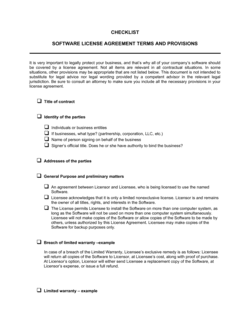
- The party that owns software or technology and grants usage rights to another party under a licence agreement.
- Licensee
- The party that receives the right to use software or technology under the terms of a licence agreement.
- End-User Licence Agreement (EULA)
- A contract between a software publisher and the individual or organisation that installs and uses the software.
- Work for hire
- A legal arrangement in which work created by a developer is automatically owned by the commissioning party rather than the creator.
- Source code
- The human-readable instructions that make up a software program, as distinct from compiled binary code that machines execute.
- Intellectual property assignment
- A written transfer of ownership of copyrights, patents, trade secrets, or other IP rights from one party to another.
- SLA (Service Level Agreement)
- A contractual commitment that defines minimum performance standards — such as uptime percentage or bug-fix response time — and the consequences of missing them.
- Royalty
- A periodic payment made to a licensor calculated as a percentage of revenue, units sold, or another agreed metric.
- Derivative work
- A new work based on or incorporating elements of an existing copyrighted work; ownership of derivative works must be addressed explicitly in software contracts.
- Escrow (source code escrow)
- An arrangement in which a neutral third party holds a copy of source code, releasing it to the licensee if the licensor ceases to maintain the software.
- Value-Added Reseller (VAR)
- A company that purchases software, bundles it with additional services or hardware, and resells the combined solution to end customers.
- Click-wrap agreement
- An online licence accepted by clicking a button or checkbox, considered binding in most jurisdictions when the terms are accessible before acceptance.