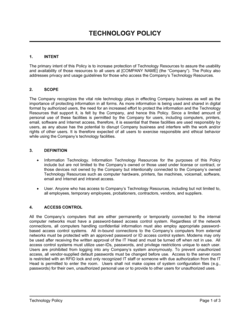
Bring Your Own Device Policy Byod Template

Free Word download β€’ Edit online β€’ Save & share with Drive β€’ Export to PDF

4 pagesβ€’20–30 min to fillβ€’Difficulty: Standard
Learn more ↓
FreeBring Your Own Device Policy Byod Template

At a glance

What it is
A Bring Your Own Device (BYOD) Policy is an operational document that establishes the rules under which employees may use personal smartphones, laptops, and tablets to access company systems, data, and networks. This free Word download gives you a structured, editable starting point you can tailor to your IT environment and export as PDF for employee acknowledgment.
When you need it
Use it when employees are accessing company email, cloud applications, or internal systems from personal devices β€” whether at the office, at home, or while traveling. It is particularly urgent before onboarding remote workers or expanding access to a corporate SaaS stack.
What's inside
Device eligibility and registration requirements, minimum security standards, acceptable and prohibited use rules, data separation and privacy guidelines, incident response procedures, and the consequences of non-compliance β€” all in a single structured policy document.

What is a Bring Your Own Device (BYOD) Policy?

A Bring Your Own Device (BYOD) Policy is an operational document that defines the rules under which employees may use personally owned smartphones, tablets, and laptops to access company systems, applications, and data. It establishes the minimum security requirements every enrolled device must meet, distinguishes permitted from prohibited uses of company data on personal hardware, addresses employee privacy rights, and sets out the procedures for device loss, theft, and offboarding. Rather than banning personal devices β€” a rule that is effectively unenforceable in a remote or hybrid workplace β€” a BYOD policy channels that access through a defined, auditable framework that protects both the organization and the employee.

Why You Need This Document

Every employee who checks work email on a personal phone or opens a shared document on a home laptop represents a potential entry point into your corporate network β€” one that IT has no visibility into without a documented policy and enrollment process. Without a BYOD policy, you have no enforceable basis to require security controls, no clear authority to revoke access on departure, and no record of employee acknowledgment if a breach occurs. For organizations subject to HIPAA, SOC 2, PCI DSS, or ISO 27001, the absence of a documented device policy is a direct audit finding. For any business, a departed employee retaining active access to company email or cloud applications is a data exposure that a one-page policy and a 24-hour offboarding step would have prevented. This template gives you the structure to close those gaps in a single afternoon.

Which variant fits your situation?

If your situation is…Use this template
Organization wants company-owned devices with strict controlsCorporate Device Acceptable Use Policy
Remote-first team needing a full remote work frameworkRemote Work Policy
Need a comprehensive information security governance documentInformation Security Policy
Addressing employee internet and email use on any deviceInternet and Email Acceptable Use Policy
Covering data handling and classification across the organizationData Classification Policy
Defining rules for all employee technology use, not just devicesIT Acceptable Use Policy
Satisfying a SOC 2 or ISO 27001 requirement for a formal asset inventoryIT Asset Management Policy

Common mistakes to avoid

❌ No minimum OS version requirement

Why it matters: Allowing devices on any OS version means unpatched vulnerabilities remain on your network indefinitely, and IT has no grounds to deny access to a device running a three-year-old OS.

Fix: Set and publish a minimum supported OS version for each platform and review it at least annually as vendors end security support for older releases.

❌ Vague incident reporting language

Why it matters: Telling employees to report a lost device 'as soon as possible' creates no enforceable obligation β€” a device with active company credentials can be exploited for days before IT is notified.

Fix: Specify a reporting window in hours, such as within four hours of discovery, and tie non-reporting to the violation consequences section.

❌ No offboarding procedure for device unenrollment

Why it matters: Without a documented unenrollment process, departed employees routinely retain active access to company email and cloud applications for weeks after their last day.

Fix: Add a step to the offboarding checklist that triggers MDM unenrollment within 24 hours of an employee's departure, and assign ownership to a specific IT role.

❌ Monitoring disclosure that understates what MDM software actually collects

Why it matters: If employees later discover the MDM collects location data or app inventories that the policy did not disclose, it creates trust damage and potential privacy liability under GDPR, CCPA, or provincial privacy laws.

Fix: Review your MDM vendor's data collection documentation before drafting the monitoring section, and disclose every data field collected β€” not just the ones that seem significant.

❌ No distinction between inadvertent and deliberate violations

Why it matters: Applying the same termination-level consequence to an employee who accidentally saved a file to personal Dropbox and one who intentionally exfiltrated customer data is both unfair and legally risky.

Fix: Create a tiered consequences framework: first inadvertent violation gets a corrective notice, repeated or deliberate violations escalate to access revocation and formal disciplinary action.

❌ Omitting a reimbursement cap or scope definition

Why it matters: A policy that offers to reimburse 'device-related costs' with no ceiling has been used by employees to claim laptop purchases, international data plans, and accessory costs the company never intended to cover.

Fix: State the exact dollar cap, the specific cost categories covered (e.g., monthly data plan only), and the documentation required to claim reimbursement.

The 10 key sections, explained

Policy purpose and scope

Eligible devices and registration

Security requirements

Acceptable use

Prohibited activities

Privacy and monitoring

Device loss, theft, and incident response

Employee departure and device offboarding

Reimbursement and cost allocation

Policy violations and consequences

How to fill it out

  1. 1

    Define the scope and covered personnel

    Identify which employees, contractors, and device types the policy covers. Specify whether it applies to all staff or only those with access to sensitive data or regulated systems.

    πŸ’‘ If your organization has both full-time employees and contractors, call each group out explicitly β€” contractors often fall into a gap if the policy says 'employees' only.

  2. 2

    List approved device types and minimum OS versions

    Enumerate supported platforms (iOS, Android, Windows, macOS) and the minimum OS version IT will support. Confirm the list with your IT team before publishing.

    πŸ’‘ Set the minimum OS version one major version behind current β€” requiring the absolute latest creates friction without meaningfully improving security.

  3. 3

    Define the mandatory security controls

    List every required control β€” encryption, screen lock PIN length, 2FA enrollment, antivirus, and patch cadence β€” and assign a verification method for each (e.g., MDM compliance report, self-attestation).

    πŸ’‘ Tie each control to a specific audit frequency, such as quarterly MDM compliance checks, so enforcement is built into the policy itself.

  4. 4

    Specify approved and prohibited storage locations

    Name the approved cloud storage and collaboration platforms (e.g., Microsoft 365, Google Workspace) and explicitly list personal accounts that are prohibited for company data.

    πŸ’‘ Employees need a list of approved apps, not just a prohibition on unapproved ones β€” make it easy to comply by telling them exactly where to go.

  5. 5

    Write the privacy and monitoring disclosure

    Confirm with your MDM vendor exactly what data the tool collects, then draft the monitoring section to match reality. Include what IT can see, what it cannot see, and under what legal process it might access more.

    πŸ’‘ Have your MDM vendor provide a written summary of collected data fields β€” use that document to draft accurate disclosure language rather than writing from memory.

  6. 6

    Set the incident reporting timeline and wipe protocol

    Define the exact number of hours an employee has to report a lost or stolen device. Confirm with IT whether your MDM supports selective wipe (corporate data only) versus full device wipe, and state which approach the company will use.

    πŸ’‘ Selective wipe is strongly preferable from a privacy standpoint β€” if your MDM supports it, make this explicit in the policy to reduce employee resistance to enrollment.

  7. 7

    Document the offboarding and reimbursement terms

    Specify the timeline for access revocation and data removal on departure. If you offer a stipend, enter the dollar amount, what it covers, and the submission process.

    πŸ’‘ Coordinate with HR and payroll on the stipend section before finalizing β€” reimbursement terms have compensation and tax implications that vary by jurisdiction.

  8. 8

    Obtain employee acknowledgment signatures

    Add a signature block or a link to a digital acknowledgment form at the end of the policy. Require all covered employees to sign before device enrollment is approved.

    πŸ’‘ Store signed acknowledgments in each employee's HR file β€” this record is your primary defense if a violation escalates to a disciplinary or legal proceeding.

Frequently asked questions

What is a BYOD policy?

A BYOD policy is a documented set of rules governing how employees may use personally owned devices β€” smartphones, tablets, and laptops β€” to access company systems, applications, and data. It defines which devices are eligible, what security controls must be in place, what data employees may and may not store on personal devices, and what happens when a device is lost or an employee leaves the company.

Why do businesses need a BYOD policy?

Without a BYOD policy, employees access corporate email and cloud applications from unmanaged personal devices with no consistent security baseline. A single compromised personal device can expose customer data, intellectual property, or regulated information to unauthorized parties. A documented policy also satisfies audit requirements under SOC 2, HIPAA, ISO 27001, and similar frameworks that require evidence of controlled device access.

What security requirements should a BYOD policy include?

At minimum: full-disk encryption, a screen lock PIN of at least six digits or biometric equivalent, two-factor authentication for all company accounts, a maximum of 30 days to apply OS security patches, and enrollment in a mobile device management platform. Higher-risk industries or organizations handling regulated data typically add containerization, DLP controls, and prohibition on jailbroken devices.

What is the difference between MDM and MAM in a BYOD context?

MDM (Mobile Device Management) gives IT control over the entire device β€” including the ability to remote-wipe all data, enforce OS settings, and view device inventory. MAM (Mobile Application Management) manages only the specific corporate applications on the device, leaving personal apps and data untouched. For BYOD programs, MAM or containerization is generally preferred because it reduces employee privacy concerns while still protecting corporate data.

Can an employer remotely wipe an employee's personal device?

Technically, yes β€” if the employee has enrolled the device in an MDM platform with that capability. Whether the employer can do so legally depends on local employment and privacy law and what the employee consented to at enrollment. The BYOD policy should clearly state under what circumstances a remote wipe will occur β€” typically loss, theft, or departure β€” and whether the wipe is selective (corporate data only) or full. Employees should sign an acknowledgment of this before enrolling.

Does a BYOD policy need to address employee privacy?

Yes, and omitting this section is one of the most common policy failures. Employees are entitled to know exactly what data the MDM software collects from their personal device and under what circumstances the company can access it. Disclosure requirements vary by jurisdiction β€” GDPR in the EU, CCPA in California, PIPEDA in Canada β€” but transparency is both legally prudent and critical for employee trust and enrollment rates.

How often should a BYOD policy be reviewed and updated?

At minimum, review the policy annually and whenever a significant platform change occurs β€” new MDM vendor, major OS version changes, acquisition of a new business unit, or a material change in the regulatory environment. Security-focused organizations often review BYOD policies every six months, particularly as new mobile threat vectors emerge or compliance frameworks are updated.

What happens to company data on a personal device when an employee leaves?

Under a properly implemented BYOD policy, IT triggers MDM unenrollment within a defined window β€” typically 24 hours of the employee's last day β€” which removes all corporate applications and data from the device. If selective wipe is not available, the policy should document the full-wipe process and provide the employee advance notice to back up personal content. Without a documented offboarding step, departed employees frequently retain active access for weeks.

Is a BYOD policy legally required?

No single law universally mandates a BYOD policy, but several compliance frameworks effectively require one. HIPAA requires covered entities to document controls over devices that access protected health information. SOC 2 Type II audits expect evidence of device access controls. ISO 27001 requires an asset management policy covering mobile devices. Even outside regulated industries, a documented policy is your primary protection in the event of a data breach investigation or employee dispute over monitoring.

How this compares to alternatives

vs IT Acceptable Use Policy

An IT Acceptable Use Policy governs how employees use company-owned technology infrastructure β€” networks, computers, and systems. A BYOD policy specifically addresses personal devices accessing those same systems. For organizations where all devices are company-owned, an AUP is sufficient; once personal devices are in scope, a separate BYOD policy is needed to address privacy, reimbursement, and device offboarding.

vs Remote Work Policy

A remote work policy covers where and when employees may work β€” home, co-working spaces, travel β€” along with productivity expectations and equipment provisions. A BYOD policy addresses the security controls on the devices used for that work. Both are needed for a remote-first organization; a remote work policy that does not address device security leaves a significant compliance gap.

vs Information Security Policy

An information security policy is a broad governance document covering the organization's entire security posture β€” data classification, access control, incident response, vendor risk, and more. A BYOD policy is a focused, operational subset that translates security principles into specific device rules employees can act on. Large organizations typically maintain both; smaller organizations may consolidate them.

vs Employee Handbook

An employee handbook aggregates all workplace policies into a single reference document, often including a brief device use section. That section rarely provides enough detail to be enforceable on its own. A standalone BYOD policy enables deeper coverage of technical requirements, MDM enrollment procedures, and incident response steps, and can be updated independently of the full handbook.

Industry-specific considerations

Healthcare

HIPAA requires covered entities and business associates to document controls over any device accessing protected health information, making a formal BYOD policy a compliance prerequisite rather than a best practice.

Financial Services

FINRA, SEC, and PCI DSS requirements for data retention and access control extend to personal devices β€” policies must address screen capture, communication archiving, and data residency.

Technology / SaaS

SOC 2 Type II audits specifically evaluate whether device access controls are documented and enforced, and enterprise customer due diligence questionnaires routinely request a copy of the BYOD policy.

Professional Services

Law firms, accounting firms, and consultancies handling client confidential data face heightened risk from personal device use and typically require stricter containerization and prohibition on personal cloud storage.

Template vs pro β€” what fits your needs?

PathBest forCostTime
Use the templateSmall and mid-size businesses establishing a BYOD policy for the first time without a formal MDM platformFree2–4 hours to customize and distribute
Template + professional reviewOrganizations subject to HIPAA, SOC 2, or PCI DSS that need the policy reviewed against a specific compliance framework$300–$800 for an IT compliance consultant or security advisor review3–5 business days
Custom draftedEnterprises with a complex MDM stack, multiple jurisdictions, or a pending SOC 2 Type II or ISO 27001 certification audit$1,500–$5,000 for a security policy specialist2–4 weeks

Glossary

BYOD (Bring Your Own Device)
A workplace practice allowing employees to use personally owned smartphones, tablets, or laptops to access company systems and data.
MDM (Mobile Device Management)
Software that allows IT administrators to remotely monitor, manage, and enforce security policies on enrolled devices.
MAM (Mobile Application Management)
A subset of MDM that manages and secures only specific applications on a device, rather than the entire device β€” preserving more employee privacy.
Containerization
A technical approach that partitions a personal device into separate zones β€” one for personal data and one for corporate data β€” preventing the two from mixing.
Remote Wipe
The ability for IT to erase all data from a device remotely, typically triggered when the device is lost, stolen, or the employee leaves the company.
Acceptable Use Policy (AUP)
A policy defining what activities employees are and are not permitted to perform on company systems or networks.
Endpoint Security
Security controls applied at the level of individual devices β€” including antivirus software, encryption, screen lock, and OS patch levels β€” to protect the network they connect to.
Two-Factor Authentication (2FA)
A login method requiring two separate forms of verification β€” typically a password plus a one-time code β€” before granting access to a system.
Data Loss Prevention (DLP)
Tools and policies designed to detect and prevent unauthorized transfer or exposure of sensitive company data outside approved systems.
Shadow IT
Unapproved software, apps, or services that employees use to access or store company data outside the IT department's knowledge or control.

Part of your Business Operating System

This document is one of 3,000+ business & legal templates included in Business in a Box.

  • Fill-in-the-blanks β€” ready in minutes
  • 100% customizable Word document
  • Compatible with all office suites
  • Export to PDF and share electronically

Create your document in 3 simple steps.

From template to signed document β€” all inside one Business Operating System.
1
Download or open template

Access over 3,000+ business and legal templates for any business task, project or initiative.

2
Edit and fill in the blanks with AI

Customize your ready-made business document template and save it in the cloud.

3
Save, Share, Send, Sign

Share your files and folders with your team. Create a space of seamless collaboration.

Save time, save money, and create top-quality documents.

β˜…β˜…β˜…β˜…β˜…

"Fantastic value! I'm not sure how I'd do without it. It's worth its weight in gold and paid back for itself many times."

Managing Director Β· Mall Farm
Robert Whalley
Managing Director, Mall Farm Proprietary Limited
β˜…β˜…β˜…β˜…β˜…

"I have been using Business in a Box for years. It has been the most useful source of templates I have encountered. I recommend it to anyone."

Business Owner Β· 4+ years
Dr Michael John Freestone
Business Owner
β˜…β˜…β˜…β˜…β˜…

"It has been a life saver so many times I have lost count. Business in a Box has saved me so much time and as you know, time is money."

Owner Β· Upstate Web
David G. Moore Jr.
Owner, Upstate Web

Run your business with a system β€” not scattered tools

Stop downloading documents. Start operating with clarity. Business in a Box gives you the Business Operating System used by over 250,000 companies worldwide to structure, run, and grow their business.

Start freeΒ Β·Β No credit card required