Online Privacy Policy Template

Free Word download β€’ Edit online β€’ Save & share with Drive β€’ Export to PDF

3 pagesβ€’20–30 min to fillβ€’Difficulty: Standard
Learn more ↓
FreeOnline Privacy Policy Template

At a glance

What it is
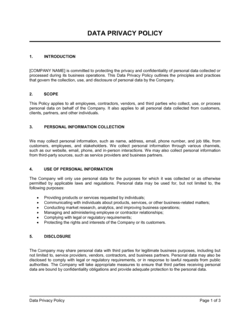
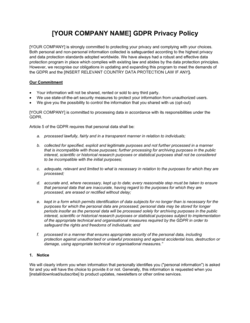
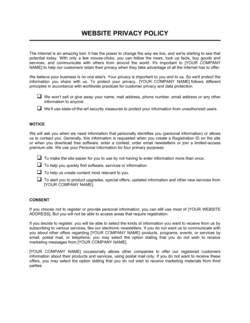
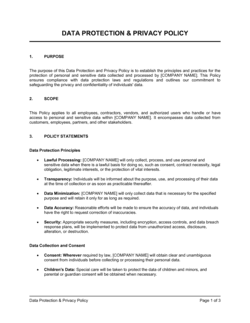
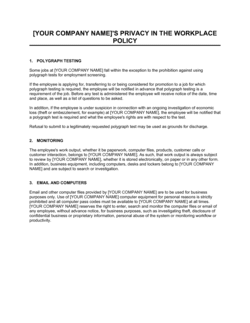
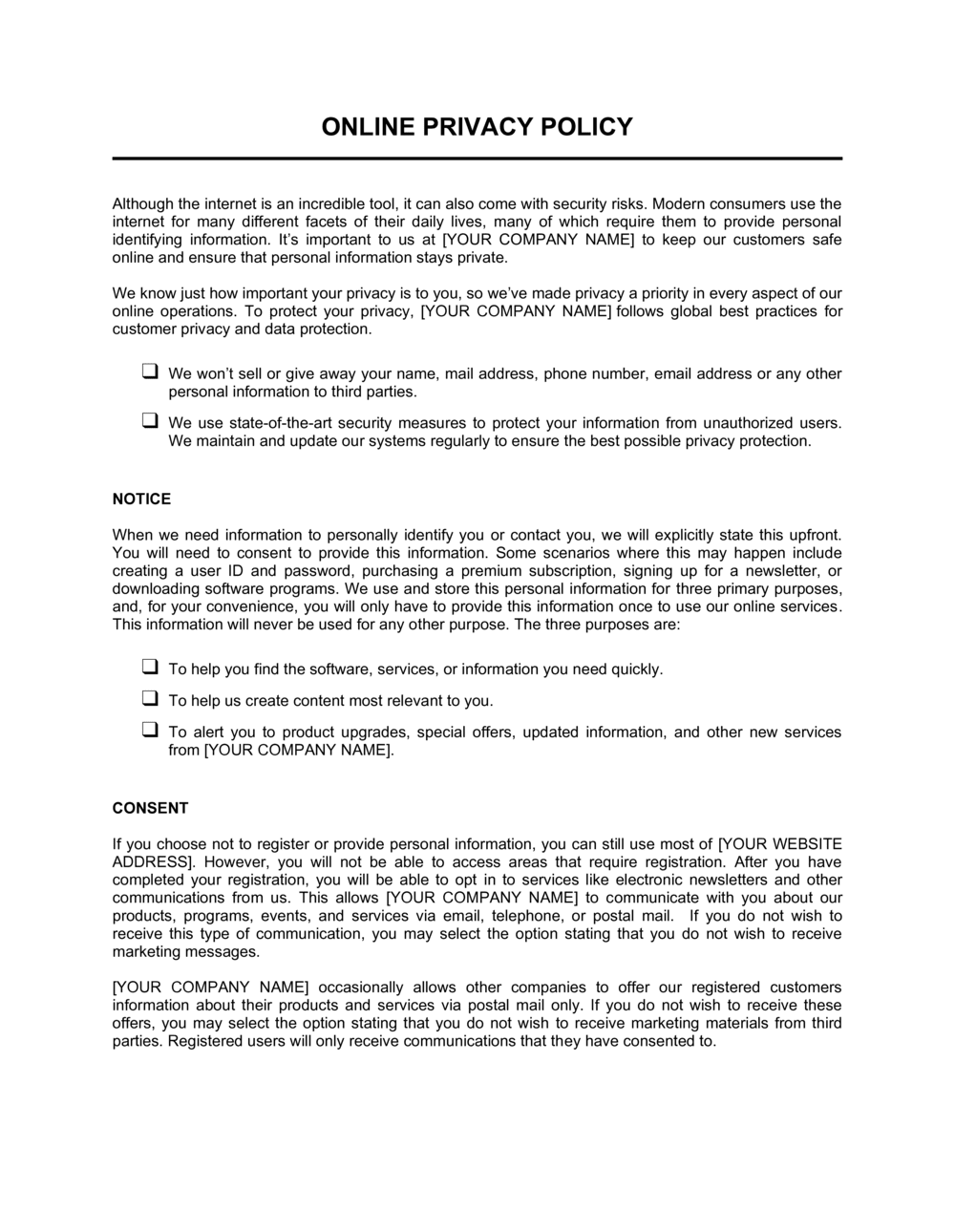
An Online Privacy Policy is a public-facing document that discloses how your website or app collects, uses, stores, shares, and protects user data. This free Word download gives you a structured, plain-English starting point you can edit online and publish directly to your site or export as PDF for internal compliance records.
When you need it
You need it as soon as your website or app collects any personal data β€” including names, email addresses, IP addresses, or cookies β€” from visitors or users. Many jurisdictions require a published privacy policy before you launch, and advertising platforms such as Google Ads and Meta require one before approving your account.
What's inside
The template covers data collection practices, lawful bases for processing, cookies and tracking technologies, third-party data sharing, user rights and opt-out mechanisms, data retention periods, security measures, contact details for privacy inquiries, and policy update procedures.

What is an Online Privacy Policy?

An Online Privacy Policy is a public-facing document that discloses exactly how your website or app collects, uses, stores, shares, and protects personal data from the people who interact with it. It identifies you as the data controller, explains the lawful basis for each processing activity, names the third-party tools and services that receive user data, specifies how long data is retained, and tells users what rights they have and how to exercise them. Unlike a Terms of Service agreement β€” which governs user behavior β€” a privacy policy governs your behavior as an organization handling someone else's personal information.

Why You Need This Document

Operating a website or app without a published privacy policy exposes your business to regulatory fines, ad platform account suspensions, and user trust damage that is difficult to recover from. GDPR fines reach €20 million or 4% of global annual turnover; CCPA penalties run up to $7,500 per intentional violation per consumer. Google AdSense, Meta Ads, and the Apple App Store all require a publicly accessible privacy policy before approving your account β€” missing one can halt a product launch or ad campaign at the worst possible moment. Beyond compliance, a clear and honest privacy policy signals to customers and partners that you handle their data responsibly, which is a genuine competitive differentiator as data privacy expectations continue to rise. This template gives you a structured, plain-English starting point that covers the core disclosures required across the major frameworks β€” so you can publish with confidence and update as your data practices evolve.

Which variant fits your situation?

If your situation is…Use this template
Website that only collects email addresses via a newsletter formSimple Website Privacy Policy
SaaS platform handling personal data for EU usersGDPR-Compliant Privacy Policy
E-commerce store with California customersCCPA Privacy Policy
Mobile app collecting location or health dataMobile App Privacy Policy
Company collecting employee data in addition to customer dataEmployee Privacy Policy
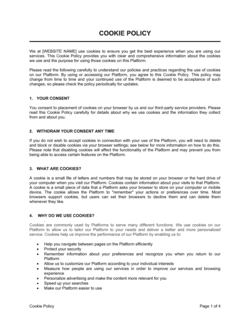
Website using analytics, retargeting pixels, and affiliate cookiesCookie Policy
Platform that allows users to share or post content publiclyTerms of Service + Privacy Policy Bundle

Common mistakes to avoid

❌ Copying a competitor's privacy policy verbatim

Why it matters: A copied policy describes someone else's data practices, not yours. When your actual practices differ β€” different tools, different retention periods β€” the policy becomes actively misleading, which regulators treat more seriously than no policy at all.

Fix: Start from a template you control, then customize every section to reflect your specific data collection, tools, and retention practices before publishing.

❌ Omitting automatically collected data from the disclosure

Why it matters: IP addresses, session data, and analytics identifiers are personal data under GDPR and CCPA. Failing to disclose their collection is a regulatory violation even if you never intended to use them to identify anyone.

Fix: Audit your analytics, server logs, and third-party scripts before drafting the data collection section and include every category, including those collected passively.

❌ Publishing the policy without linking it from required locations

Why it matters: A policy buried in a subfolder that users cannot find from the homepage, sign-up form, or cookie banner is treated by regulators as effectively absent β€” the FTC and EU data protection authorities have cited this specifically.

Fix: Link the privacy policy in the site footer, within every sign-up and checkout form, in your cookie consent banner, and in your app store listing.

❌ Using vague retention language without specific timeframes

Why it matters: Phrases like 'we keep your data as long as necessary' give users no meaningful information and fail the GDPR requirement to specify retention periods or the criteria used to determine them.

Fix: Assign a concrete retention period to every data category β€” expressed in months or years β€” and tie each one to a business or legal justification.

❌ Not updating the policy after adding new tools or features

Why it matters: Adding a new CRM, live chat widget, or retargeting pixel without updating the policy means users are uninformed about a new data collection activity β€” each undisclosed tool is a separate compliance gap.

Fix: Include a privacy policy review in your product and marketing launch checklists so any new data-collection tool triggers an automatic policy update.

❌ Failing to provide a working opt-out mechanism for California users

Why it matters: CCPA requires businesses above the statutory thresholds to provide a 'Do Not Sell or Share My Personal Information' link that actually functions β€” a broken link or an email address with no response process exposes you to $7,500 per intentional violation.

Fix: Test your opt-out link and internal fulfillment process before publishing, and assign a named owner responsible for processing CCPA requests within 45 days.

The 10 key sections, explained

Introduction and scope

Data we collect

How we use your data

Cookies and tracking technologies

Sharing and disclosure

Data retention

Your rights and choices

Security measures

Third-party links and services

Policy updates and contact information

How to fill it out

  1. 1

    Identify your legal entity and data controller details

    Enter your full registered company name, physical address, and a dedicated privacy contact email. These details identify you as the data controller and are required by GDPR, CCPA, and most app store policies.

    πŸ’‘ Use a dedicated inbox like privacy@yourdomain.com rather than a general info@ address β€” this signals to regulators that privacy requests are handled separately and tracked.

  2. 2

    Audit every category of data your site or app collects

    Before filling in the data collection section, run through all your forms, analytics tools, pixels, and third-party integrations and list every piece of personal data each one touches. Include IP addresses, device identifiers, and cookie data β€” not just form submissions.

    πŸ’‘ Use your browser's developer tools or a tag auditing tool to discover tracking scripts you may have forgotten β€” undisclosed collection is the most common compliance gap.

  3. 3

    Map each data category to a specific use purpose

    For every category of data you listed in Step 2, write a plain-English sentence explaining why you collect it. Where GDPR applies, assign one of the six lawful bases: consent, contract, legal obligation, vital interests, public task, or legitimate interests.

    πŸ’‘ If you cannot articulate a clear purpose for a data category, stop collecting it β€” 'we might use it later' is not a lawful basis under GDPR.

  4. 4

    List every third-party tool and service provider by name

    In the sharing and cookies sections, name each third-party service β€” Google Analytics, Stripe, Mailchimp, Meta Pixel β€” and describe what data it receives. Generic references to 'service providers' without naming them are insufficient under GDPR transparency rules.

    πŸ’‘ Check each tool's own data processing agreement; you are required to have a signed DPA with any processor handling EU personal data.

  5. 5

    Set specific data retention periods

    For each data category, assign a retention period tied to a business or legal justification β€” for example, transaction records for 7 years to meet tax requirements, or marketing email lists until unsubscribe. Avoid open-ended language like 'as long as necessary.'

    πŸ’‘ Match your retention periods to your actual data deletion schedule β€” a policy that says 2 years but a database that retains data indefinitely is a compliance liability.

  6. 6

    Define the user rights process

    Write out how users submit access, deletion, or opt-out requests, and who handles them internally. Include a response time commitment β€” 30 days for GDPR, 45 days for CCPA.

    πŸ’‘ Test your own process by submitting a dummy request before publishing β€” if you cannot respond within your stated timeline, fix the workflow before going live.

  7. 7

    Publish, link, and set a review schedule

    Upload the completed policy to a permanent URL (e.g., yourdomain.com/privacy-policy), link it in your website footer, cookie banner, sign-up forms, and app store listing. Set a calendar reminder to review the policy annually or after any material change to your data practices.

    πŸ’‘ Screenshot or archive the published policy with its effective date each time you update it β€” version history matters if a user complaint references a prior version.

Frequently asked questions

What is an online privacy policy?

An online privacy policy is a public-facing document that discloses how a website or app collects, uses, stores, and shares personal data from visitors and users. It tells users what information is gathered, why it is collected, who it is shared with, how long it is kept, and what rights users have over their own data. Most jurisdictions with data protection laws require one as a condition of collecting any personal information.

Is a privacy policy legally required for my website?

In most cases, yes. If your website collects any personal data β€” including email addresses, IP addresses, or cookies β€” laws such as GDPR (EU/UK), CCPA (California), PIPEDA (Canada), and Australia's Privacy Act typically require a published privacy policy. Beyond legal requirements, Google AdSense, Google Ads, Meta Ads, and the Apple App Store all mandate a privacy policy as a condition of account approval.

Does my privacy policy need to be GDPR compliant?

If any of your users are located in the EU or UK, GDPR applies regardless of where your business is based. GDPR-compliant policies must identify the lawful basis for each processing activity, list all data categories collected, name data processors, specify retention periods, explain user rights (access, deletion, portability), and provide contact details for the data controller. Non-compliance can result in fines of up to €20 million or 4% of global annual turnover.

What is the CCPA and how does it affect my privacy policy?

The California Consumer Privacy Act gives California residents the right to know what personal data is collected about them, the right to delete it, and the right to opt out of the sale or sharing of their data. Businesses that meet the CCPA thresholds β€” annual gross revenue over $25 million, data on 100,000+ consumers, or 50%+ of revenue from selling data β€” must add specific disclosures and a 'Do Not Sell or Share My Personal Information' mechanism to their privacy policy.

How long should a privacy policy be?

Long enough to cover every required disclosure, short enough to be readable. A typical small-business privacy policy runs 800–1,500 words. Larger platforms with complex data practices β€” multiple products, many third-party integrations, international operations β€” often publish 3,000–5,000-word policies with layered summaries. Brevity is valued by users; completeness is required by regulators. Prioritize clear, plain-English language over legal length.

Can I copy a privacy policy from another website?

No. Copying another company's policy is both a copyright issue and a compliance risk. The copied policy describes their data practices, not yours. If your tools, retention periods, or sharing arrangements differ β€” and they almost certainly do β€” the copied policy is factually inaccurate. Regulators treat an inaccurate privacy policy as a more serious violation than a missing one because it actively misleads users.

How often should I update my privacy policy?

Review it at least annually and update it whenever you add a new data collection tool, change a retention period, add a new third-party integration, launch in a new jurisdiction, or change your product in a way that affects data practices. Each update should carry a new effective date. For material changes affecting existing users, GDPR and CCPA both recommend proactive notification by email rather than a quiet update.

Where should the privacy policy be linked on my website?

At minimum: the site footer (visible on every page), within any sign-up or registration form, in your cookie consent banner, and in any email marketing sign-up flow. Mobile apps must link it in the app store listing and within the app itself β€” typically in settings or the onboarding flow. Google Ads and Meta Ads require the policy to be accessible from the landing page URL used in the ad.

How this compares to alternatives

vs Terms of Service

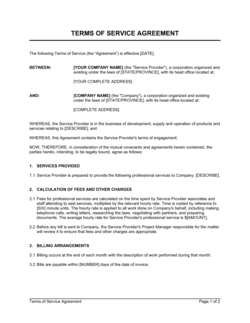
A Terms of Service agreement defines the rules users must follow when using your site or app β€” acceptable use, liability limits, dispute resolution, and intellectual property. A privacy policy discloses how user data is handled. They govern different aspects of the user relationship and both are typically required; one does not substitute for the other.

vs Cookie Policy

A cookie policy is a focused document covering only tracking technologies β€” which cookies are set, their purpose, and how users manage them. A privacy policy covers all personal data, of which cookies are one subset. Under GDPR, a separate cookie policy or a clearly linked cookie section within the privacy policy is best practice when using analytics or advertising cookies.

vs Data Processing Agreement (DPA)

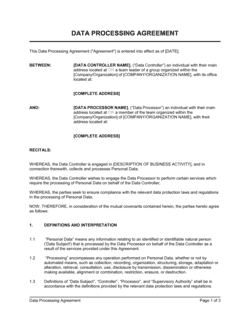
A DPA is a B2B contract between a data controller and a data processor that governs how the processor handles personal data on the controller's behalf β€” required under GDPR Article 28. A privacy policy is a public disclosure to end users. A business typically needs both: the privacy policy for users and a DPA with each vendor that processes user data.

vs Employee Privacy Policy

An employee privacy policy discloses how an employer collects and uses data about its own staff β€” monitoring, HR records, benefits data, and device usage. An online privacy policy covers customer and visitor data. Many organizations publish both separately, as the legal bases, retention periods, and applicable rights differ significantly between the two contexts.

Industry-specific considerations

SaaS / Technology

Must disclose account data handling, API integrations, sub-processor lists, and data residency options for enterprise customers requiring DPA addenda.

E-commerce / Retail

Covers payment data handling (typically via a PCI-compliant processor), purchase history retention, shipping address sharing with fulfillment partners, and CCPA opt-out for data shared with advertising platforms.

Healthcare / Wellness

Health and wellness apps collecting symptom, fitness, or mental health data face heightened sensitivity requirements and must address HIPAA applicability, state health data laws, and restrictions on sharing with advertisers.

Education / EdTech

Platforms serving users under 13 must comply with COPPA (US) and restrict behavioral advertising; schools using the platform as operators have separate FERPA obligations that the policy must acknowledge.

Marketing / Advertising

Agencies and AdTech platforms typically process data across multiple clients and must clearly separate controller and processor roles, disclose cross-site tracking, and document consent mechanisms for each client's users.

Financial Services / Fintech

Subject to GLBA (US) annual privacy notice requirements and stricter data sharing restrictions; must disclose whether financial data is shared with affiliates and provide opt-out rights beyond standard CCPA requirements.

Template vs pro β€” what fits your needs?

PathBest forCostTime
Use the templateSmall websites, blogs, and early-stage apps with straightforward data practices and no EU or California usersFree1–2 hours
Template + professional reviewE-commerce stores, SaaS platforms, or any site actively collecting EU or California user data$300–$800 for a one-hour privacy attorney review2–5 days
Custom draftedRegulated industries (healthcare, fintech), platforms with complex third-party data sharing, or enterprise SaaS requiring customer DPA addenda$1,500–$5,000+1–3 weeks

Glossary

Personal Data
Any information that identifies or could identify a living individual β€” including names, email addresses, IP addresses, and device identifiers.
Data Controller
The organization or person that determines the purposes and means of processing personal data β€” typically the website or app operator.
Data Processor
A third party that processes personal data on behalf of the data controller, such as an email marketing platform or cloud hosting provider.
Lawful Basis for Processing
Under GDPR, one of six legal justifications that must exist before processing personal data β€” including consent, contract performance, and legitimate interests.
Cookie
A small text file placed on a user's device by a website to remember preferences, track sessions, or support analytics and advertising.
GDPR
The General Data Protection Regulation β€” EU law effective May 2018 that sets strict standards for collecting, processing, and storing personal data of EU residents.
CCPA
The California Consumer Privacy Act β€” US state law giving California residents the right to know what personal data is collected, to delete it, and to opt out of its sale.
Data Retention Period
The defined length of time an organization keeps personal data before securely deleting or anonymizing it.
Opt-Out Mechanism
A clear method β€” typically a link, toggle, or email address β€” by which a user can withdraw consent or request that their data not be sold or shared.
Data Breach
An unauthorized access, disclosure, or loss of personal data that may trigger notification obligations to regulators and affected individuals.
Legitimate Interests
A GDPR lawful basis allowing processing when the controller's business interests are not overridden by the individual's privacy rights β€” requires a documented balancing test.
Part of your Business Operating System

This document is one of 3,000+ business & legal templates included in Business in a Box.

  • Fill-in-the-blanks β€” ready in minutes
  • 100% customizable Word document
  • Compatible with all office suites
  • Export to PDF and share electronically

Create your document in 3 simple steps.

From template to signed document β€” all inside one Business Operating System.
1
Download or open template

Access over 3,000+ business and legal templates for any business task, project or initiative.

2
Edit and fill in the blanks with AI

Customize your ready-made business document template and save it in the cloud.

3
Save, Share, Send, Sign

Share your files and folders with your team. Create a space of seamless collaboration.

Save time, save money, and create top-quality documents.

β˜…β˜…β˜…β˜…β˜…

"Fantastic value! I'm not sure how I'd do without it. It's worth its weight in gold and paid back for itself many times."

Managing Director Β· Mall Farm
Robert Whalley
Managing Director, Mall Farm Proprietary Limited
β˜…β˜…β˜…β˜…β˜…

"I have been using Business in a Box for years. It has been the most useful source of templates I have encountered. I recommend it to anyone."

Business Owner Β· 4+ years
Dr Michael John Freestone
Business Owner
β˜…β˜…β˜…β˜…β˜…

"It has been a life saver so many times I have lost count. Business in a Box has saved me so much time and as you know, time is money."

Owner Β· Upstate Web
David G. Moore Jr.
Owner, Upstate Web

Run your business with a system β€” not scattered tools

Stop downloading documents. Start operating with clarity. Business in a Box gives you the Business Operating System used by over 250,000 companies worldwide to structure, run, and grow their business.

Free Forever PlanΒ Β·Β No credit card required