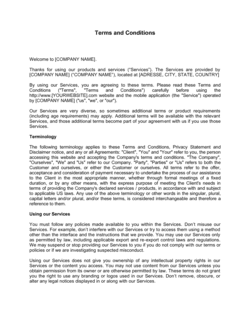
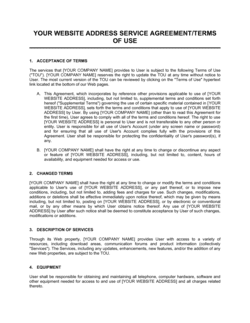
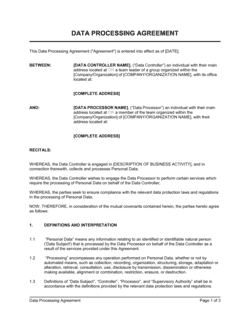
GDPR Privacy Policy Template

Free Word download β€’ Edit online β€’ Save & share with Drive β€’ Export to PDF

4 pagesβ€’25–30 min to fillβ€’Difficulty: Standard
Learn more ↓
FreeGDPR Privacy Policy Template

At a glance

What it is
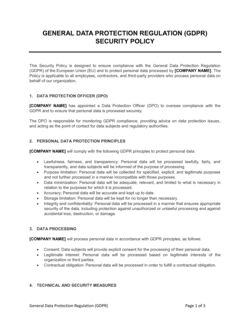
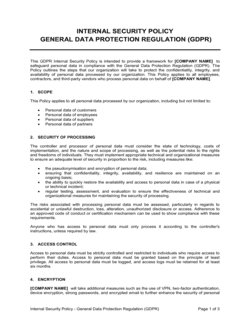
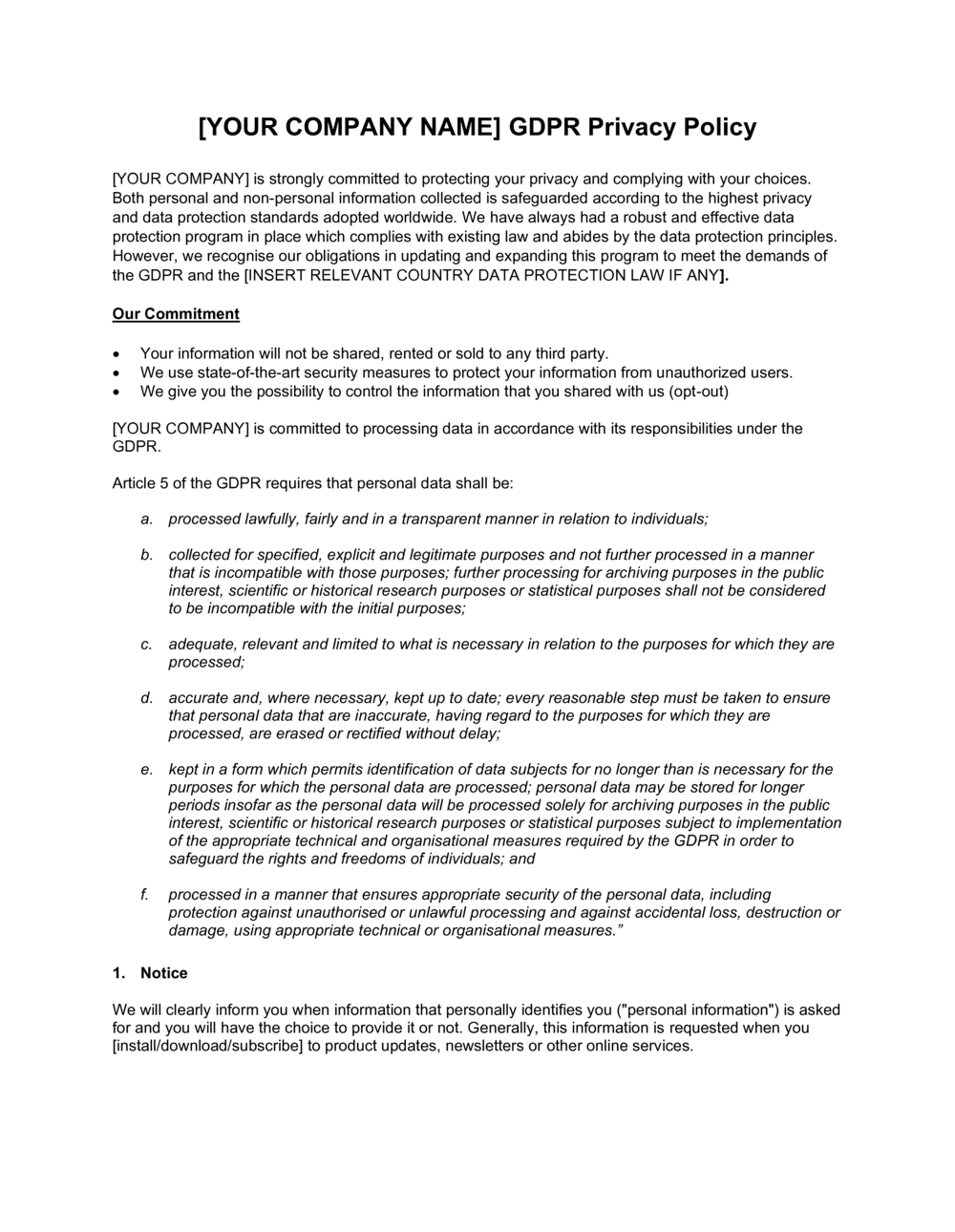
A GDPR Privacy Policy is a public-facing document that tells individuals what personal data your organisation collects, why you collect it, how long you keep it, who you share it with, and what rights they have over it under the EU General Data Protection Regulation. This free Word download gives you a structured, regulation-aligned starting point you can edit online and publish to your website or share with users as a standalone privacy notice.
When you need it
You need it the moment your website, app, or business collects, stores, or processes personal data from individuals in the European Economic Area β€” including names, email addresses, IP addresses, cookies, or payment information. GDPR Article 13 and 14 require the notice to be provided at the point of data collection, before processing begins.
What's inside
Identity and contact details of the data controller, lawful bases for each processing activity, categories of personal data collected, data retention periods, third-party sharing and international transfers, cookie policy, data subject rights and how to exercise them, and contact details for your Data Protection Officer or privacy lead.

What is a GDPR Privacy Policy?

A GDPR Privacy Policy is a public-facing transparency document that tells individuals what personal data your organisation collects, why you collect it, what legal basis you rely on, who you share it with, how long you keep it, and what rights they have under the EU General Data Protection Regulation (Regulation 2016/679). It is not optional β€” Articles 13 and 14 of the GDPR require the information to be provided at the point of data collection, in plain language, free of charge. This free Word download gives you a structured, regulation-aligned starting point covering every mandatory disclosure element, which you can edit to match your actual data processing activities and publish directly to your website or app.

Why You Need This Document

Operating without a GDPR-compliant privacy policy exposes your organisation to fines of up to €20 million or 4% of global annual turnover under Article 83, whichever is higher β€” and data protection authorities across the EU and UK actively investigate complaints from users who cannot find adequate privacy information. Beyond fines, the absence of a policy undermines user trust at exactly the moment users are deciding whether to share their data with you, directly affecting conversion rates and customer retention. A correctly completed policy also protects you operationally: it forces you to audit what data you actually collect, identify every processor with access to that data, and set retention periods you can defend β€” the same information regulators request in the first 72 hours of an investigation. This template gives you the structure to get compliant quickly, without starting from a blank page.

Which variant fits your situation?

If your situation is…Use this template
Public-facing website collecting cookies and analytics dataWebsite Privacy Policy (GDPR)
Mobile app collecting location, device, or health dataMobile App Privacy Policy
HR processing employee or job applicant personal dataEmployee Privacy Notice (GDPR)
B2B SaaS acting as a data processor for clientsData Processing Agreement
Organisation sharing data with a third country outside the EEAInternational Data Transfer Agreement
Business needing a cookie consent and disclosure noticeCookie Policy
Company documenting its internal data handling proceduresData Protection Policy (Internal)

Common mistakes to avoid

❌ Citing consent as the lawful basis for everything

Why it matters: If consent is your stated basis but you continue processing after a user withdraws it, you are in breach. Consent is also harder to obtain and maintain than legitimate interests or contract.

Fix: Map each processing activity to the most legally appropriate basis. Use consent only for email marketing and non-essential cookies where it is genuinely the right basis.

❌ Vague or absent retention periods

Why it matters: Stating 'we keep data as long as necessary' without specifying periods fails GDPR Article 13(2)(a) and leaves you unable to defend a deletion request or a regulator's audit.

Fix: Define a specific retention period for every data category β€” e.g., '7 years for financial records per [APPLICABLE TAX LAW]' β€” and build a corresponding data deletion schedule.

❌ Omitting the right to complain to a supervisory authority

Why it matters: GDPR Article 13(2)(d) explicitly requires this disclosure. Omitting it is a straightforward compliance failure that regulators check for during routine reviews.

Fix: Add a dedicated paragraph naming the relevant supervisory authority (e.g., the ICO for UK organisations, your lead DPA for EU operations) with a link to their complaints page.

❌ Copying a competitor's privacy policy verbatim

Why it matters: Their policy reflects their data practices, not yours. Claiming to collect only what they collect β€” or disclosing processors you don't use while omitting ones you do β€” creates an inaccurate and potentially misleading notice.

Fix: Start from your own data audit. Use a template as a structural guide, but every factual claim in the policy must reflect your actual processing activities.

❌ Publishing the privacy policy without updating it after adding new tools

Why it matters: Adding a new analytics platform, CRM, or marketing tool typically adds new processing activities and processors β€” none of which are disclosed in the original policy, leaving users uninformed.

Fix: Build a process that triggers a privacy policy review whenever a new data-processing tool is adopted. Assign this responsibility to a named owner in your compliance workflow.

❌ Mislabelling advertising cookies as analytics cookies

Why it matters: Using retargeting or behavioural advertising cookies under a consent banner that only describes 'analytics' means consent was not validly obtained for the actual purpose β€” a priority enforcement area for EU data protection authorities.

Fix: Categorise each cookie by its actual function. Advertising and retargeting cookies require their own consent category, separate from analytics.

The 10 key sections, explained

Identity of the data controller

What personal data we collect and how

Lawful basis for each processing activity

How and why we use your data (purposes)

Third-party sharing and data processors

International data transfers

Data retention periods

Data subject rights and how to exercise them

Cookies and tracking technologies

How we protect your data and policy updates

How to fill it out

  1. 1

    Identify your legal entity and data controller details

    Enter the full registered legal name, address, company registration number, and the email address or contact form link for privacy enquiries. If your organisation requires a DPO under GDPR Article 37, include their name and contact details.

    πŸ’‘ Check your official corporate registry filing to confirm the exact legal name β€” using a brand name alone creates enforcement ambiguity.

  2. 2

    Audit and list every category of personal data you collect

    Before filling in the template, conduct a data mapping exercise to identify every touchpoint where personal data enters your systems β€” website forms, checkout, cookies, email sign-ups, CRM imports, and HR records. List each data category in the relevant section.

    πŸ’‘ Include technical data like IP addresses and cookie identifiers β€” many organisations overlook these, but they are personal data under GDPR.

  3. 3

    Assign a lawful basis to each processing activity

    For each purpose listed in step 2, select the most appropriate lawful basis from the six options in Article 6. Document your reasoning in an internal record of processing activities (ROPA) β€” the privacy policy should state the basis, but the ROPA should contain your full justification.

    πŸ’‘ Default to legitimate interests for analytics and fraud prevention, contract for service delivery, and legal obligation for tax and accounting records β€” reserve consent for email marketing and non-essential cookies.

  4. 4

    Name your third-party processors and data-sharing arrangements

    List every service provider, analytics platform, payment processor, and cloud host that receives personal data. For each, state the purpose of the transfer and confirm a data processing agreement is in place.

    πŸ’‘ Check your software stack against your data map β€” SaaS tools embedded in your workflow often process personal data without your team realising it.

  5. 5

    Document international transfers and their safeguards

    Identify whether any processor or data recipient is based outside the EEA. For each non-EEA transfer, state the legal mechanism β€” adequacy decision (e.g., UK, Japan, Canada) or standard contractual clauses β€” and link to or reference the relevant decision.

    πŸ’‘ US-based SaaS providers processing EU data must rely on SCCs since the invalidation of Privacy Shield in 2020 β€” verify each provider's transfer mechanism is current.

  6. 6

    Set specific retention periods for each data category

    Define a concrete retention period for every category of data β€” do not use 'as long as necessary' without a qualifier. Cross-reference statutory retention obligations (tax: typically 6–7 years, employment: varies by jurisdiction) to set defensible minimums and maximums.

    πŸ’‘ Build a retention schedule as a separate internal document and reference it in the privacy policy β€” this also satisfies Article 30 ROPA requirements.

  7. 7

    Describe the data subject rights process

    Confirm the email address or web form users should contact to exercise rights, and state the 30-day response deadline. Include the name and website of the relevant supervisory authority β€” for UK organisations, the ICO; for EU organisations, your lead supervisory authority under the one-stop-shop mechanism.

    πŸ’‘ Set up a dedicated privacy inbox (e.g., privacy@yourdomain.com) so rights requests are never missed in a general enquiries inbox.

  8. 8

    Add the last-updated date and version number

    Enter the current date as the 'last updated' date and add a version number (e.g., v1.0, v2.3) to the footer of the document. Update both whenever you make a material change to the policy.

    πŸ’‘ Archive each previous version with its effective date β€” regulators sometimes request historical privacy policies when investigating complaints about practices from a prior period.

Frequently asked questions

What is a GDPR privacy policy?

A GDPR privacy policy is a public-facing document that explains how an organisation collects, uses, stores, and shares personal data belonging to individuals in the European Economic Area. It must be provided at the point of data collection, written in plain language, and cover the lawful basis for processing, data subject rights, retention periods, and contact details for privacy enquiries. It satisfies the transparency obligations in GDPR Articles 13 and 14.

Do I need a GDPR privacy policy if my business is outside the EU?

Yes β€” if your website, app, or service collects personal data from individuals located in the EEA, GDPR applies regardless of where your business is incorporated. This includes US, UK, Australian, and Canadian businesses that target or monitor EU residents. The determining factor is the location of the data subject, not the data controller. Failure to comply exposes non-EU businesses to the same fines as EU-based entities.

What is the difference between a privacy policy and a privacy notice?

The terms are often used interchangeably, but technically a privacy notice is directed at data subjects (users, customers, employees) to inform them of their rights and your practices β€” it is the public-facing document. A privacy policy is an internal governance document describing how the organisation manages personal data. For most small to mid-size organisations, a single document serves both functions and is referred to as a privacy policy or privacy notice.

What are the six lawful bases under GDPR?

GDPR Article 6 sets out six lawful bases: (1) consent β€” the individual has given clear, specific agreement; (2) contract β€” processing is necessary to fulfil a contract with the individual; (3) legal obligation β€” processing is required by law; (4) vital interests β€” processing is necessary to protect someone's life; (5) public task β€” processing is needed to perform an official function; and (6) legitimate interests β€” the controller's interest is proportionate and does not override the individual's rights. Most businesses rely primarily on consent, contract, legal obligation, and legitimate interests.

What happens if my privacy policy is not GDPR compliant?

Non-compliance with GDPR transparency obligations can result in fines of up to €10 million or 2% of global annual turnover (whichever is higher) under Article 83(4), or up to €20 million / 4% of turnover for more serious violations. Regulators also issue public reprimands, require corrective action, and can impose temporary bans on processing. Beyond fines, data subjects can seek compensation for material or non-material damage caused by the violation.

How often should I update my GDPR privacy policy?

Review the policy whenever you make a material change to your data processing β€” adding a new tool, changing a processor, entering a new market, or introducing a new product feature that collects additional data. At minimum, conduct a formal annual review against your current data processing activities. Notify users of material changes at least 30 days before they take effect and update the 'last updated' date every time you publish a revision.

Do cookies count as personal data under GDPR?

Yes. Cookie identifiers, IP addresses, and device fingerprints are considered personal data under GDPR when they can be linked to an identifiable individual β€” which is the case for most analytics and advertising cookies. Non-essential cookies therefore require valid consent before being set, and your privacy policy must disclose which cookies are used, their purpose, duration, and the provider.

When do I need a Data Protection Officer (DPO)?

GDPR Article 37 requires a DPO for: public authorities and bodies; organisations whose core activities involve large-scale, systematic monitoring of data subjects; and organisations that process special category data (health, biometric, criminal records) on a large scale. Even if not mandatory, many organisations appoint a DPO or a privacy lead voluntarily. If you have one, their contact details must be included in the privacy policy.

Can I use a free privacy policy generator instead of this template?

Generic generators produce boilerplate text that rarely maps to your actual processing activities. They typically omit retention periods, use vague lawful basis language, and fail to name your specific processors. This template gives you a structured starting point that you populate with the facts from your own data audit, producing a policy that accurately reflects what you actually do β€” which is what GDPR requires and what regulators check.

How this compares to alternatives

vs Data Processing Agreement

A data processing agreement (DPA) is a contract between a data controller and a data processor governing how the processor handles personal data on the controller's behalf. A GDPR privacy policy is a public-facing transparency document directed at data subjects. Both are required under GDPR but serve entirely different purposes β€” the DPA is a B2B contract; the privacy policy is a user-facing disclosure.

vs Cookie Policy

A cookie policy is a dedicated document focused solely on the types of cookies used, their purpose, duration, and how users can manage consent. A GDPR privacy policy covers all personal data processing, of which cookies are one component. Many organisations publish both β€” a comprehensive privacy policy and a shorter, standalone cookie policy linked from the consent banner.

vs Terms and Conditions

Terms and conditions set out the contractual rules governing use of a product or service β€” they are binding on both parties. A privacy policy discloses how personal data is processed and is not a contract. They are complementary documents: T&Cs govern the commercial relationship; the privacy policy governs data rights. Both should be linked from every website footer.

vs Data Protection Policy (Internal)

An internal data protection policy documents how the organisation's staff must handle personal data β€” governance procedures, breach response, access controls, and training requirements. A GDPR privacy policy is an external document for data subjects. The internal policy governs employee behaviour; the privacy policy informs users of their rights. Both are required for a complete GDPR compliance framework.

Industry-specific considerations

SaaS / Technology

Must disclose sub-processor chains (cloud hosts, analytics, support tools), handle data processor versus controller distinctions carefully, and address standard contractual clauses for US-based infrastructure.

E-commerce / Retail

Payment processor disclosure, cookie consent for advertising retargeting, and 7-year retention of transaction records for tax compliance are the key requirements.

Healthcare / MedTech

Processing health data triggers Article 9 special category rules, requiring an explicit consent basis, a data protection impact assessment, and enhanced security disclosures.

Professional Services

Client data processed during engagements requires disclosure of retention tied to professional indemnity and statutory limitation periods, typically 6–7 years post-engagement.

HR and Recruitment

Job applicant data retention is a common compliance gap β€” most organisations should keep unsuccessful candidate data for no more than 6–12 months unless explicit consent for longer retention is obtained.

Marketing and Advertising

Consent management for email marketing, cookie categorisation for behavioural advertising, and profiling disclosures under Article 22 are the highest-risk areas for this sector.

Template vs pro β€” what fits your needs?

PathBest forCostTime
Use the templateSmall to mid-size businesses with standard data flows β€” website contact forms, email marketing, e-commerce transactions, and common SaaS toolsFree2–4 hours including data audit
Template + professional reviewOrganisations processing special category data, operating across multiple EU jurisdictions, or with complex processor chains$500–$1,500 for a data protection consultant or privacy lawyer review3–5 business days
Custom draftedLarge enterprises, regulated sectors (healthcare, fintech, HR tech), or organisations subject to supervisory authority scrutiny$2,000–$8,000+ for a full GDPR compliance engagement including ROPA and DPIAs2–6 weeks

Glossary

Personal Data
Any information that relates to an identified or identifiable living individual, including names, email addresses, IP addresses, and cookie identifiers.
Data Controller
The organisation or individual that determines the purposes and means of processing personal data β€” the party legally responsible for GDPR compliance.
Data Processor
A third party that processes personal data on behalf of the controller β€” such as a cloud hosting provider or email marketing platform.
Lawful Basis
One of six legal grounds under GDPR Article 6 that must exist before processing personal data β€” consent, contract, legal obligation, vital interests, public task, or legitimate interests.
Data Subject
The living individual whose personal data is being collected or processed β€” typically a customer, user, employee, or website visitor.
Data Subject Rights
GDPR-guaranteed entitlements including the right to access, rectify, erase, restrict, port, and object to the processing of one's personal data.
Legitimate Interests
A lawful basis permitting processing when the controller's interest is balanced against and does not override the data subject's rights β€” requires a documented legitimate interests assessment.
Data Retention Period
The defined length of time personal data is kept before it is securely deleted or anonymised, which must be disclosed in the privacy notice.
Data Protection Officer (DPO)
A designated individual responsible for overseeing GDPR compliance β€” mandatory for public authorities, organisations processing data at large scale, or those processing special categories of data.
Special Category Data
Sensitive personal data requiring enhanced protection under GDPR Article 9, including health information, racial or ethnic origin, biometric data, and political opinions.
International Transfer
The movement of personal data to a country outside the European Economic Area, which requires an adequacy decision, standard contractual clauses, or another approved safeguard.
Privacy by Design
A GDPR principle requiring data protection to be built into systems and processes from the outset rather than added as an afterthought.

Part of your Business Operating System

This document is one of 3,000+ business & legal templates included in Business in a Box.

  • Fill-in-the-blanks β€” ready in minutes
  • 100% customizable Word document
  • Compatible with all office suites
  • Export to PDF and share electronically

Create your document in 3 simple steps.

From template to signed document β€” all inside one Business Operating System.
1
Download or open template

Access over 3,000+ business and legal templates for any business task, project or initiative.

2
Edit and fill in the blanks with AI

Customize your ready-made business document template and save it in the cloud.

3
Save, Share, Send, Sign

Share your files and folders with your team. Create a space of seamless collaboration.

Save time, save money, and create top-quality documents.

β˜…β˜…β˜…β˜…β˜…

"Fantastic value! I'm not sure how I'd do without it. It's worth its weight in gold and paid back for itself many times."

Managing Director Β· Mall Farm
Robert Whalley
Managing Director, Mall Farm Proprietary Limited
β˜…β˜…β˜…β˜…β˜…

"I have been using Business in a Box for years. It has been the most useful source of templates I have encountered. I recommend it to anyone."

Business Owner Β· 4+ years
Dr Michael John Freestone
Business Owner
β˜…β˜…β˜…β˜…β˜…

"It has been a life saver so many times I have lost count. Business in a Box has saved me so much time and as you know, time is money."

Owner Β· Upstate Web
David G. Moore Jr.
Owner, Upstate Web

Run your business with a system β€” not scattered tools

Stop downloading documents. Start operating with clarity. Business in a Box gives you the Business Operating System used by over 250,000 companies worldwide to structure, run, and grow their business.

Start freeΒ Β·Β No credit card required