Personnel Security Policy Template

Free Word download β€’ Edit online β€’ Save & share with Drive β€’ Export to PDF

4 pagesβ€’20–30 min to fillβ€’Difficulty: Standard
Learn more ↓
FreePersonnel Security Policy Template

At a glance

What it is
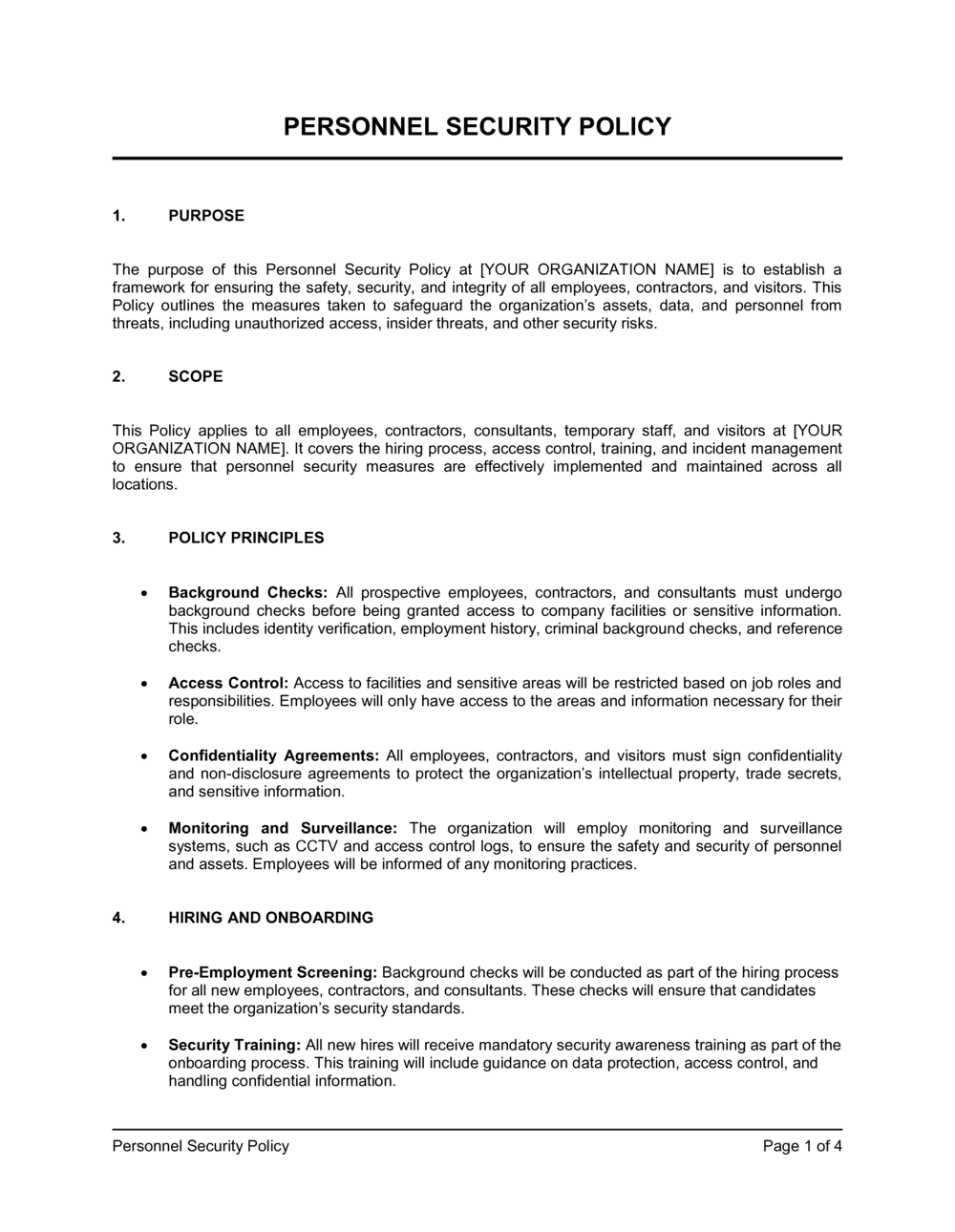
A Personnel Security Policy is a formal organizational document that defines the rules, standards, and procedures governing how a company screens, monitors, and manages employees and contractors with respect to security risks. This free Word download gives you a structured, editable template you can tailor to your organization's size and risk profile, then export as PDF for distribution to HR, IT, and management teams.
When you need it
Use it when onboarding employees into roles with access to sensitive data or physical assets, when establishing a formal security program for compliance purposes, or when a security incident reveals gaps in your existing workforce controls. Regulated industries β€” finance, healthcare, defense contracting β€” typically require a documented personnel security policy as a baseline compliance requirement.
What's inside
The template covers the full employee security lifecycle: pre-employment screening criteria, access provisioning and revocation, security awareness training requirements, insider threat monitoring, disciplinary procedures for policy violations, and termination and offboarding controls. Supporting sections define roles and responsibilities, policy scope, and review cadence.

What is a Personnel Security Policy?

A Personnel Security Policy is a formal organizational document that defines the procedures, standards, and responsibilities governing how an organization manages security risks associated with its workforce β€” from the moment a candidate is screened before hire through to the final day of employment and beyond. It establishes who can access what systems, data, and facilities; what vetting is required before that access is granted; how behavior is monitored for signs of insider risk; and what steps are taken when employment ends. Unlike a general code of conduct or an employee handbook, a personnel security policy is operationally specific β€” it names role owners, sets timelines, and defines consequences with enough precision to be audited and enforced.

Why You Need This Document

Without a documented personnel security policy, access rights accumulate unchecked as employees change roles, background check standards vary by hiring manager, and departing employees routinely retain live credentials for days or weeks after their last day β€” the window during which most post-employment data theft occurs. The absence of a formal policy also disqualifies organizations from SOC 2, ISO 27001, CMMC, and HIPAA compliance, where personnel security controls are explicitly audited. A single insider incident β€” whether intentional or negligent β€” can expose customer data, trigger regulatory fines, and generate litigation costs that dwarf the time investment of establishing clear controls from the start. This template gives you a complete, structured starting point that covers the full employment lifecycle, assigns accountability to named roles, and is ready to customize for your organization's size and risk profile in a matter of hours.

Which variant fits your situation?

If your situation is…Use this template
Covering only data-handling and IT access for office staffInformation Security Policy
Documenting security requirements for remote and hybrid workers specificallyRemote Work Security Policy
Setting rules for third-party vendors and contractors accessing systemsThird-Party Vendor Security Policy
Addressing physical building access, badge control, and visitor managementPhysical Security Policy
Meeting ISO 27001 or SOC 2 personnel security control requirementsInformation Security Management Policy
Creating an employee code of conduct covering security expectations broadlyCode of Conduct Policy
Establishing rules for handling and classifying sensitive business dataData Classification Policy

Common mistakes to avoid

❌ Excluding contractors from the policy scope

Why it matters: Contractors frequently hold the same system and physical access as employees. Excluding them leaves a documented gap that attackers and auditors both exploit.

Fix: Explicitly include all contractors, temporary staff, and third-party personnel in the scope section, and define which screening and access procedures apply to each category.

❌ No defined revocation timeline for departing employees

Why it matters: Access that persists after termination is the primary enabler of post-employment data theft. Every day of delay is a window of active risk.

Fix: Set a specific revocation deadline β€” same-day for involuntary terminations, no more than 24 hours for voluntary departures β€” and assign a named role responsible for executing it.

❌ Listing only termination in the disciplinary section

Why it matters: A policy that jumps straight to termination for any violation is disproportionate and legally problematic, and managers avoid enforcing it because the only tool available is too blunt.

Fix: Define a proportionate disciplinary ladder with at least three levels β€” verbal or written warning, suspension or retraining, and termination β€” calibrated to the severity and intent of the violation.

❌ Publishing the policy without an assigned review date

Why it matters: A personnel security policy with no review schedule becomes stale within 12–18 months as systems, roles, and regulations change β€” and an outdated policy offers no audit or legal protection.

Fix: Add a mandatory annual review date and a named policy owner to the document footer before publishing. Block the review date in the policy owner's calendar immediately.

❌ Using identical screening criteria for all roles

Why it matters: Applying executive-level vetting to every hire slows time-to-start, increases screening costs, and can deter strong candidates from low-risk roles unnecessarily.

Fix: Define two or three risk-tiered screening levels and map each job category to the appropriate tier based on the sensitivity of assets the role can access.

❌ No anonymous reporting mechanism for insider threat concerns

Why it matters: Employees who observe suspicious behavior by colleagues are unlikely to report it if the only channel is a named complaint to a direct manager, particularly when the colleague is a peer or superior.

Fix: Establish and document at least one anonymous reporting channel β€” a dedicated email alias or third-party hotline β€” and reference it explicitly in the insider threat section of the policy.

The 10 key sections, explained

Purpose and scope

Roles and responsibilities

Pre-employment screening

Access provisioning and least-privilege controls

Security awareness training requirements

Insider threat monitoring and reporting

Employment status changes and access reviews

Disciplinary procedures for policy violations

Offboarding and termination procedures

Policy review and update schedule

How to fill it out

  1. 1

    Define the scope and covered personnel

    Enter your organization's name and list every personnel category the policy covers β€” employees, contractors, interns, and third-party staff. Be explicit about whether remote workers and temporary staff are included.

    πŸ’‘ Scope gaps are the first thing auditors look for β€” when in doubt, include a category and add a note that specific procedures may vary by role type.

  2. 2

    Assign named role owners to each responsibility

    Replace every generic 'Management' placeholder with a specific job title β€” HR Manager, IT Security Manager, or CISO. For small organizations, one person may own multiple functions; document that explicitly.

    πŸ’‘ Confirm with each named role owner that they accept responsibility before publishing β€” surprises at incident time are costlier than conversations now.

  3. 3

    Calibrate screening requirements by role risk level

    Create two or three tiers of screening depth β€” standard, elevated, and high-trust β€” and map each job category to a tier. Document the specific checks (criminal, credit, reference) required for each tier.

    πŸ’‘ Roles with access to customer PII, financial systems, or physical assets typically warrant at least one tier above your general-population standard.

  4. 4

    Set concrete timelines for access provisioning and revocation

    Fill in the exact number of business days within which access must be granted for new hires and β€” critically β€” revoked for departures and role changes. Treat revocation timelines as non-negotiable minimums.

    πŸ’‘ Same-day revocation on the last day of employment is the standard for any employee with privileged system access β€” build the process to support it.

  5. 5

    Specify training completion deadlines and consequences

    Enter a specific number of days for new-hire training completion and a calendar deadline for annual refreshers. Write out the exact consequence for non-completion so managers can enforce it consistently.

    πŸ’‘ Connecting training completion to system-access continuation is the most effective enforcement mechanism β€” non-completers lose access until they finish.

  6. 6

    Document the reporting and escalation path for insider threats

    Name the reporting contact, provide an anonymous channel option (email alias or hotline), and write out the escalation steps from initial report through investigation and resolution.

    πŸ’‘ Test the reporting channel before publishing the policy β€” a hotline number that reaches voicemail or a dead email alias destroys employee trust in the process.

  7. 7

    Set the review schedule and owner

    Enter the annual review date, the role responsible for initiating it, and the approval chain for policy updates. Add a trigger clause for unscheduled reviews after material security incidents.

    πŸ’‘ Schedule the annual review 60 days before the policy's anniversary date β€” that gives enough time to consult stakeholders, draft changes, and get approvals before the policy lapses.

  8. 8

    Distribute and obtain acknowledgment

    Share the final policy with all covered personnel, require a signed or electronically confirmed acknowledgment, and store acknowledgment records in HR files for at least [X] years.

    πŸ’‘ Include policy acknowledgment as a step in your onboarding checklist β€” new hires who receive it on day one are far more likely to retain and apply it than those who get it weeks later.

Frequently asked questions

What is a personnel security policy?

A personnel security policy is a formal document that defines how an organization screens, monitors, and manages the security risks associated with its employees, contractors, and other personnel. It covers the full employment lifecycle β€” from pre-hire background checks through onboarding, role changes, and termination β€” and establishes the rules for granting, reviewing, and revoking access to systems, data, and facilities.

Who needs a personnel security policy?

Any organization that employs staff with access to sensitive data, financial systems, or restricted physical locations benefits from a documented personnel security policy. It is a baseline requirement for organizations subject to ISO 27001, SOC 2, HIPAA, PCI-DSS, CMMC, or government contracting standards. Small businesses handling customer PII or payment card data are also well served by a lightweight version of the policy.

What is the difference between a personnel security policy and an information security policy?

An information security policy governs how data and systems are protected β€” technical controls, encryption standards, and incident response. A personnel security policy governs the people who have access to those systems β€” screening criteria, access controls tied to employment status, and the human behaviors that create risk. The two documents are complementary and most security frameworks require both.

What background checks should a personnel security policy require?

The specific checks depend on the role's risk level. Standard positions typically require identity verification, criminal record checks, and reference checks. Elevated-risk roles β€” those with access to financial systems, customer PII, or physical assets β€” typically add employment history verification and may include credit checks where legally permissible. High-trust roles may require government-issued security clearances. The policy should define at least two screening tiers and map each role category to a tier.

How does a personnel security policy address insider threats?

The policy should define behavioral indicators that employees and managers should report, establish a confidential or anonymous reporting channel, and outline the escalation and investigation process for confirmed concerns. It should also specify the technical controls β€” activity monitoring, access logging, and least-privilege provisioning β€” that limit the damage an insider can do before detection.

How often should a personnel security policy be reviewed?

Annual review is the standard minimum. An unscheduled review should also be triggered by any material personnel security incident, a significant organizational restructure, the adoption of new systems or data categories, or changes to applicable regulations. Assign a named policy owner and put the review date in the document footer so it is never overlooked.

Does a personnel security policy need to be signed by employees?

No signature is legally required, but obtaining a written or electronic acknowledgment from each covered employee is strongly recommended. An acknowledgment record demonstrates that the employee was aware of the policy β€” which is essential for enforcing disciplinary action in the event of a violation. Include policy acknowledgment as a step in the onboarding checklist and retain records for the duration of employment plus a defined post-employment period.

What should a personnel security policy say about terminated employees?

It should specify the exact steps and timelines for revoking all system and physical access, collecting company-issued devices and credentials, conducting an exit briefing that reminds the individual of post-employment confidentiality obligations, and obtaining a signed exit acknowledgment. For involuntary terminations, same-day access revocation should be the stated standard. The policy should also name the roles responsible for each step so there is no ambiguity under time pressure.

Can a small business use this template without a dedicated security team?

Yes. Small businesses without a dedicated security team can use the template by assigning each responsibility to an existing role β€” for example, the office manager handles HR screening steps and the IT provider handles access provisioning. What matters is that every function has a named owner, not that each owner is a specialist. A streamlined version of the policy covering three to five core controls is more effective than a comprehensive policy that no one is resourced to follow.

How this compares to alternatives

vs Information Security Policy

An information security policy governs technical controls β€” data encryption, network security, and incident response. A personnel security policy governs the people operating those systems β€” screening, access rights tied to employment status, and human-behavior risks. Most security frameworks require both; start with the personnel policy if workforce trust and access control are your primary concern.

vs Code of Conduct Policy

A code of conduct sets broad behavioral expectations covering ethics, professionalism, and values. A personnel security policy is narrower and more operational β€” it specifies the concrete procedures for background checks, access provisioning, and termination steps. The code of conduct sets the culture; the personnel security policy enforces the controls.

vs Employee Handbook

An employee handbook is a comprehensive reference document covering all HR policies β€” benefits, leave, conduct, and compliance. A personnel security policy is a standalone, enforceable security document with more operational detail on screening, access, and incident response than a handbook typically provides. Large organizations maintain both; small businesses may embed a condensed security section in the handbook.

vs Non-Disclosure Agreement

An NDA is a legally binding contract that obligates an individual to keep specific information confidential. A personnel security policy is an internal governance document that defines the organization's procedures for managing security risks across the workforce. The NDA creates legal obligations; the personnel security policy operationalizes how those obligations are supported by process and controls.

Industry-specific considerations

Financial Services

Regulatory requirements from FINRA, FCA, and PCI-DSS mandate documented personnel screening and access controls; roles handling client funds typically require credit checks and enhanced ongoing monitoring.

Healthcare

HIPAA requires covered entities to implement workforce security procedures, including role-based access to patient records and documented sanctions for policy violations.

Technology / SaaS

SOC 2 Type II audits require evidence of personnel security controls including background checks, access reviews, and security awareness training records for all employees with production system access.

Government Contracting

CMMC and NIST SP 800-171 compliance requires a documented personnel security policy covering pre-employment screening, access control, and personnel termination procedures as explicit control requirements.

Template vs pro β€” what fits your needs?

PathBest forCostTime
Use the templateSmall to mid-size businesses establishing baseline personnel security controls without a dedicated security teamFree2–4 hours to customize and distribute
Template + professional reviewOrganizations pursuing ISO 27001, SOC 2, or CMMC certification where the policy will be audited$300–$1,000 for a security consultant or HR attorney review3–5 business days
Custom draftedGovernment contractors, financial institutions, or healthcare organizations with complex regulatory personnel security requirements$2,000–$8,000 for a specialized security consultant or compliance firm2–6 weeks

Glossary

Personnel Security
The set of policies and procedures designed to ensure that individuals with access to organizational assets, data, or facilities meet defined trust and risk criteria.
Background Check
A pre-employment or periodic verification of a candidate's identity, criminal history, employment history, and credentials before granting access to sensitive roles.
Insider Threat
A security risk originating from a current or former employee, contractor, or partner who misuses authorized access β€” intentionally or negligently β€” to harm the organization.
Least Privilege
A security principle requiring that each user be granted only the minimum access rights necessary to perform their specific job function.
Security Clearance
A formal authorization β€” issued by an employer or government agency β€” permitting an individual to access classified, confidential, or sensitive information.
Offboarding Controls
The set of steps taken when an employee leaves β€” revoking system access, collecting credentials and devices, and briefing the individual on post-employment confidentiality obligations.
Security Awareness Training
Mandatory instruction that teaches employees to recognize and respond to threats such as phishing, social engineering, and data handling violations.
Need-to-Know Basis
An access-control principle limiting information sharing to individuals whose job responsibilities specifically require that information.
Position of Trust
A role that grants the occupant unusual access to sensitive assets, systems, funds, or data β€” typically requiring enhanced vetting before and during employment.
Non-Disclosure Agreement (NDA)
A legally binding contract requiring an employee or contractor to keep designated information confidential, often executed as part of onboarding.

Part of your Business Operating System

This document is one of 3,000+ business & legal templates included in Business in a Box.

  • Fill-in-the-blanks β€” ready in minutes
  • 100% customizable Word document
  • Compatible with all office suites
  • Export to PDF and share electronically

Create your document in 3 simple steps.

From template to signed document β€” all inside one Business Operating System.
1
Download or open template

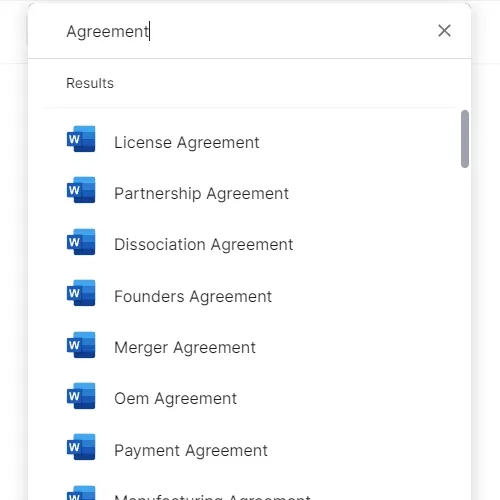
Access over 3,000+ business and legal templates for any business task, project or initiative.

2
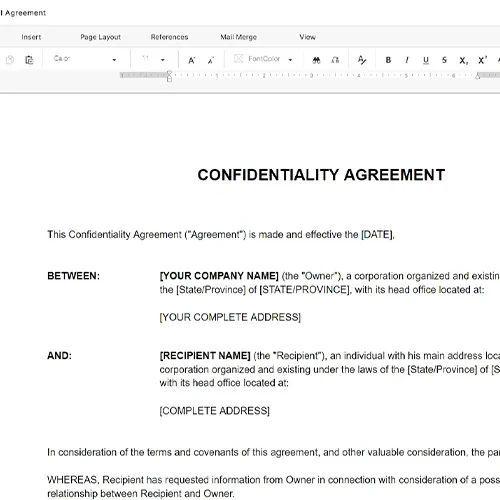
Edit and fill in the blanks with AI

Customize your ready-made business document template and save it in the cloud.

3
Save, Share, Send, Sign

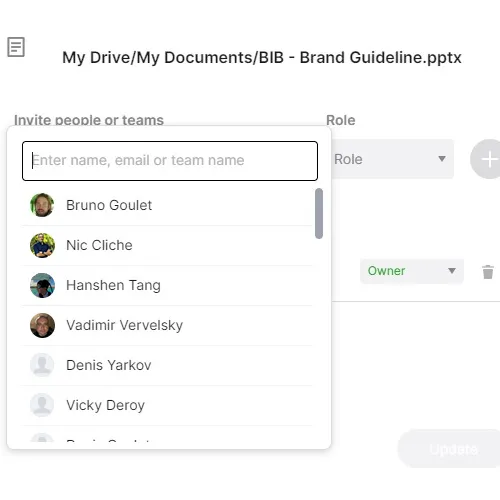
Share your files and folders with your team. Create a space of seamless collaboration.

Save time, save money, and create top-quality documents.

β˜…β˜…β˜…β˜…β˜…

"Fantastic value! I'm not sure how I'd do without it. It's worth its weight in gold and paid back for itself many times."

Managing Director Β· Mall Farm
Robert Whalley
Managing Director, Mall Farm Proprietary Limited
β˜…β˜…β˜…β˜…β˜…

"I have been using Business in a Box for years. It has been the most useful source of templates I have encountered. I recommend it to anyone."

Business Owner Β· 4+ years
Dr Michael John Freestone
Business Owner
β˜…β˜…β˜…β˜…β˜…

"It has been a life saver so many times I have lost count. Business in a Box has saved me so much time and as you know, time is money."

Owner Β· Upstate Web
David G. Moore Jr.
Owner, Upstate Web

Run your business with a system β€” not scattered tools

Stop downloading documents. Start operating with clarity. Business in a Box gives you the Business Operating System used by over 250,000 companies worldwide to structure, run, and grow their business.

Free Forever PlanΒ Β·Β No credit card required