Non-Profit Organizations Templates
Charities, foundations, NGOs, religious organizations, mutual aid.
Instant downloads • Fully editable • Export to Word, Excel or PDF
27 templates
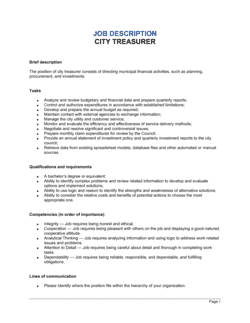
Includes Articles of Incorporation (Nonprofit), City Treasurer Job Description, Community Center Business Plan and 24 more.
At a glance
What it is
Non-profit organizations — charities, foundations, NGOs, religious bodies, and mutual aid groups — operate under distinct legal, governance, and accountability requirements that for-profit templates don't address. This filter surfaces the specific documents these organizations need to incorporate properly, govern their boards, protect donor gifts, engage volunteers, and satisfy regulatory expectations.
When you need one
Reach for these templates when forming a new nonprofit, preparing for a board audit, onboarding volunteers, or accepting a major gift that requires a written policy. They are equally useful when an existing organization needs to update its governance documents to meet funder requirements or regulatory changes.
Popular Non-Profit Organizations Templates



Which template fits your situation?
The right starting point depends on where your organization sits in its lifecycle — formation, active governance, fundraising, or expanding partnerships. Use the scenarios below to match your immediate need to the right document.
How non-profit operators get the most from these templates
Working through these templates in roughly chronological order — formation first, then governance, then fundraising controls — reduces the risk of gaps that funders or regulators flag later.
Start with your formation documents
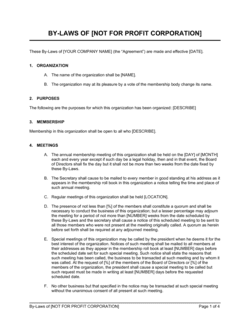
File your articles of incorporation and draft your bylaws before applying for tax-exempt status; most authorities require both.
Adopt mandatory governance policies at your first board meeting
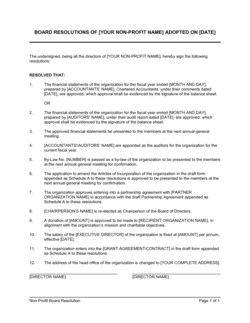
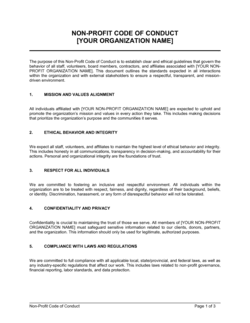
Pass a board resolution adopting the conflict-of-interest, whistleblower, and code-of-conduct policies in a single session to create a clear adoption date.
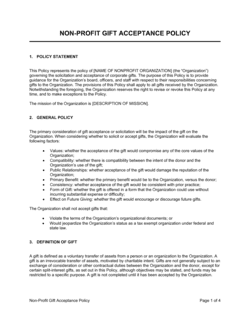
Set your gift acceptance policy before your first fundraising push
Having a written gift acceptance policy prevents the organization from accepting assets it cannot manage or that carry legal risk.
Put every volunteer relationship in writing
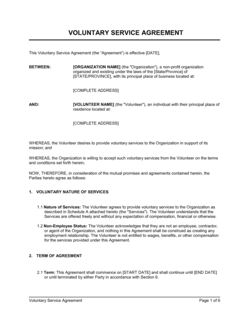
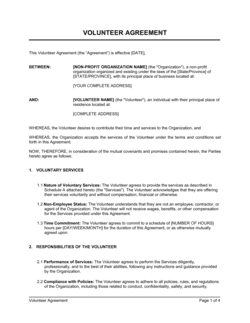
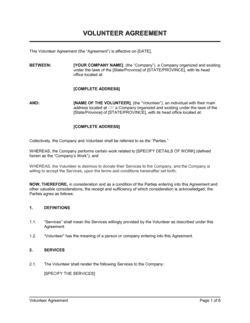
Use the volunteer agreement to document roles, confidentiality obligations, and the fact that volunteers are not employees.
Document partnerships with MOUs before programs begin
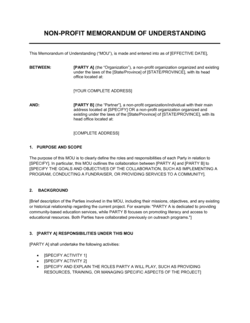
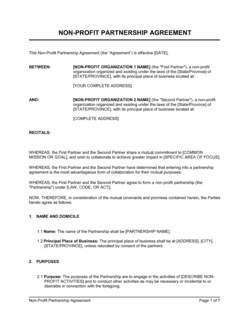
A memorandum of understanding with partner organizations clarifies each party's commitments and avoids disputes over credit, funding, or scope.
Build a grant-ready business plan
Use the non-profit business plan template to structure your mission, theory of change, program descriptions, and multi-year financial projections in the format funders expect.
Review and update annually
Schedule a yearly board review of all governance policies and financial controls to keep documents current with regulatory requirements and organizational changes.
Glossary
- articles of incorporation
- The founding legal document filed with a state or national authority that formally creates a nonprofit corporation and states its charitable purpose.
- bylaws
- The internal rules that govern how a nonprofit corporation operates, including board structure, officer roles, meeting procedures, and voting requirements.
- conflict-of-interest policy
- A written policy requiring board members and officers to disclose personal interests that could influence their decisions on behalf of the organization.
- gift acceptance policy
- A board-approved document specifying which types of donated assets the organization will accept, decline, or subject to additional review before acceptance.
- board resolution
- A formal written record of a decision made by the board of directors, used to authorize actions, adopt policies, or document votes.
- memorandum of understanding (MOU)
- A non-binding written agreement between two or more organizations that outlines their shared goals and respective responsibilities for a collaboration.
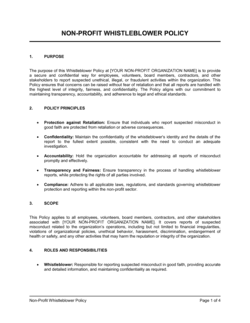
- whistleblower policy
- A policy that provides a protected process for staff, volunteers, or board members to report suspected fraud or misconduct without fear of retaliation.
- restricted funds
- Donations given by a donor for a specific stated purpose, which the organization is legally required to use only for that purpose.
- unrestricted funds
- Donations with no donor-imposed conditions, which the organization may use for any purpose aligned with its mission.
- Form 990
- The annual information return filed with the IRS by most U.S. tax-exempt organizations, which is publicly available and reviewed by donors and funders.
- fiduciary duty
- The legal obligation of board members to act in the best interests of the nonprofit and its mission rather than their own personal interests.
- dissolution clause
- A provision in founding documents specifying that remaining assets must be transferred to another tax-exempt organization if the nonprofit ceases to operate.
Non-Profit Organizations Templates by department
Browse other industries
Frequently asked questions
What non-profit organizations templates are available?
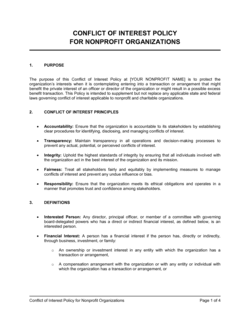
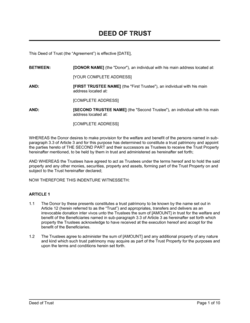
27 non-profit organizations templates, including Articles of Incorporation (Nonprofit), City Treasurer Job Description, Community Center Business Plan, Conflict of Interest Policy for Nonprofits, Deed of Trust Donation.
What documents does a nonprofit need when it first incorporates?
At incorporation, a nonprofit typically needs articles of incorporation and bylaws as minimum legal requirements. Most tax authorities also require a conflict-of-interest policy and a description of the organization's charitable purpose before granting tax-exempt status. A business plan is not legally required but is expected by most grant-makers. This filter includes all three foundational documents to help new organizations file correctly from the start.
Are nonprofit templates different from standard business templates?
Yes, in several important ways. Nonprofit governance documents address board fiduciary duties, donor restrictions, and tax-exempt compliance rather than shareholder returns or profit distribution. Policies like gift acceptance and whistleblower protection are specific to the nonprofit sector and are required by IRS Form 990 in the United States and equivalent filings in other countries. Using for-profit templates for nonprofit governance can create regulatory and liability gaps.
Does a nonprofit need a conflict-of-interest policy even if it is small?
Yes. The IRS Form 990 asks whether the organization has a written conflict-of-interest policy, and many state charity regulators require one regardless of size. Funders increasingly check for it as part of due diligence. Adopting a policy early, while the board is small, is far easier than retrofitting one after a conflict has already arisen.
What is a non-profit gift acceptance policy and when is it required?
A gift acceptance policy sets out the types of donations the organization will and will not accept — cash, securities, real estate, personal property, planned gifts — and the steps required before accepting each type. It is not universally required by law, but many community foundations and major donors ask to see one before making a significant gift, and it protects the organization from accepting assets that carry environmental liability or that conflict with its mission.
Can a nonprofit use the same NDA or non-compete templates as a for-profit business?
For confidentiality agreements with paid staff, consultants, or vendors, standard NDA templates are generally appropriate with minor adjustments. For volunteers, it is better to include confidentiality obligations directly in the volunteer agreement rather than a separate NDA, since volunteers are not employees and different legal standards may apply. Consider consulting a lawyer before restricting volunteer activities through a non-compete clause.
What is the difference between a non-profit operating agreement and bylaws?
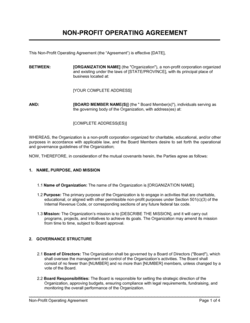
Bylaws govern the internal rules of a nonprofit corporation — board structure, meeting procedures, voting — and are required for incorporated nonprofits in most jurisdictions. An operating agreement serves a similar function for nonprofit LLCs or unincorporated associations and may also address day-to-day operational procedures in more detail. The right document depends on your legal structure; many organizations need both.
How should a nonprofit document a partnership with another organization?
A memorandum of understanding (MOU) is the standard first document for nonprofit partnerships — it captures each party's roles, resource contributions, and expectations without creating a binding contract. If the partnership involves shared funding, deliverables, or intellectual property, a formal partnership agreement provides stronger legal protection. Start with the MOU for exploratory collaborations and escalate to a full agreement when financial stakes or long-term commitments are involved.
Do these templates work for foundations and religious organizations as well as charities?
Yes. The governance and compliance templates in this filter apply broadly to any organization operating on a tax-exempt, non-profit-distributing basis, including private foundations, community foundations, religious congregations, and mutual aid societies. Some templates — particularly business plans and partnership agreements — may need minor adjustments to reflect the specific legal framework (foundation rules, religious corporation law) that applies in your jurisdiction.
One document. A more organized business.
Your documents are part of how your business operates. Business in a Box brings the work, people and information around them into one workspace.
Start with the template you need. Bring the rest of your business together when you're ready.
How our templates are made
Every template is written by the Business in a Box editorial team and published by Bruno Goulet, CEO & Editor-in-Chief. Business in a Box has published business and legal templates for more than 20 years. Each document page explains what the template covers and how to fill it in; for legal documents, have a qualified professional review the final version when the stakes warrant it.