Manufacturing Templates
Production, fabrication, assembly, and industrial operations.
Instant downloads • Fully editable • Export to Word, Excel or PDF
26 templates
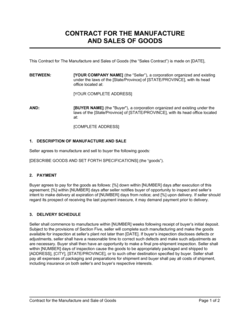
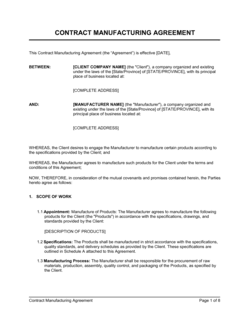
Includes Cabinet Making Business Plan, Contract for the Manufacture and Sale of Goods, Contract Manufacturing Agreement and 23 more.
At a glance
What it is
Manufacturing operators need a distinct set of documents covering production agreements, supply chain management, quality standards, and distribution relationships. This filter surfaces templates built for businesses that produce, fabricate, assemble, or process physical goods — from a single-product workshop to a multi-facility operation.
When you need one
Reach for these templates when you are formalizing a relationship with a contract manufacturer, locking in a supplier, drafting a quality standard for a production run, or writing a business plan to attract investors to a new production facility. They are equally useful when entering a distribution agreement or assessing your value chain for cost reduction.
Popular Manufacturing Templates

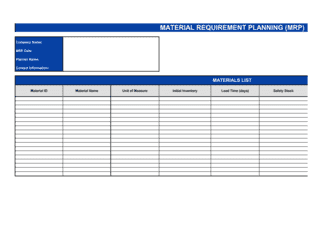 XLS
Which template fits your situation?
The right starting template depends on where in the production lifecycle you are operating — planning the business, contracting with producers or suppliers, or managing ongoing quality and distribution.
How manufacturing operators get the most from these templates
Working through these templates in sequence — from planning to contracting to ongoing operations — helps manufacturers avoid the gaps that cause disputes and production delays.
Start with your business plan
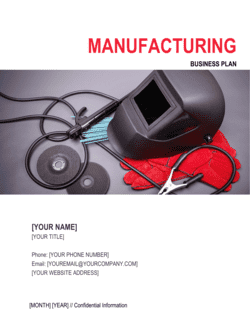
Use a Manufacturing Business Plan to document your production model, capacity assumptions, and financial projections before approaching lenders or partners.
Map your supply chain
Complete the Supply Chain Plan to identify every input, supplier, and logistics node so you can spot single points of failure before they disrupt production.
Formalize supplier relationships
Execute a Supply Agreement or Exclusive Supply Agreement with each critical vendor to lock in pricing, lead times, and volume commitments.
Contract with your production partners
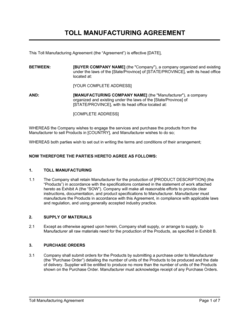
Use a Contract Manufacturing Agreement or Toll Manufacturing Agreement to define specs, IP ownership, and quality obligations with any third-party facility.
Set quality standards in writing
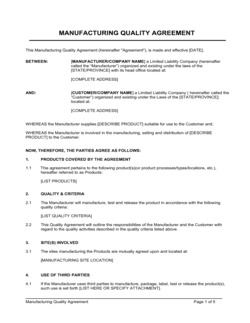
Attach a Manufacturing Quality Agreement to every production contract so inspection criteria and rejection rights are unambiguous.
Appoint representatives and distributors
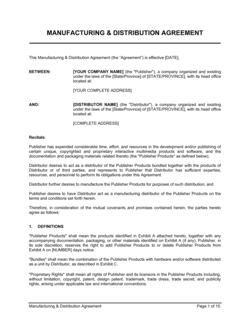
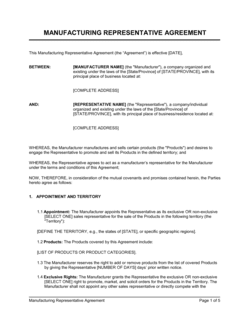
Use a Manufacturing Representative Agreement and Manufacturing Distribution Agreement to expand market reach through third parties without losing control of brand standards.
Analyse and optimize your value chain
Run a Value Chain Analysis periodically to identify activities where cost reductions or quality improvements will have the greatest impact on margins.
Glossary
- contract manufacturing
- An arrangement in which a brand owner outsources the full production of its goods to a third-party factory under a defined set of specifications.
- toll manufacturing
- A processing arrangement in which the customer supplies raw materials and pays a factory a fee to convert them into finished goods, retaining ownership of materials throughout.
- value chain
- The sequence of activities — from inbound logistics through production to after-sales service — that together create and deliver value to the end customer.
- supply agreement
- A master contract between a buyer and a supplier that sets ongoing terms for the sale of goods, including pricing, volume, quality, and delivery.
- exclusive supply agreement
- A supply contract in which the supplier commits to selling specified goods only to that buyer, or the buyer commits to purchasing only from that supplier, within a defined scope.
- manufacturing quality agreement
- A contract that specifies the quality standards, inspection procedures, and corrective-action obligations that a manufacturer must meet on every production run.
- manufacturing representative
- An independent sales agent appointed by a manufacturer to solicit orders within a defined territory, typically compensated by commission rather than salary.
- bill of materials (BOM)
- A structured list of every raw material, sub-component, and assembly required to produce one unit of a finished product.
- acceptable quality limit (AQL)
- The maximum percentage of defective units in a batch that a buyer is willing to accept before rejecting the entire shipment.
- lead time
- The total elapsed time from placing a production or purchase order to receiving finished goods ready for use or sale.
- tooling
- The moulds, dies, jigs, and fixtures created specifically to manufacture a product, often representing significant capital investment.
Manufacturing Templates by department
Browse other industries
Frequently asked questions
What manufacturing templates are available?
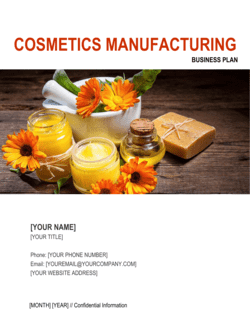
26 manufacturing templates, including Cabinet Making Business Plan, Contract for the Manufacture and Sale of Goods, Contract Manufacturing Agreement, Cosmetics Manufacturing Business Plan, Custom RV and Trailer Business Plan.
What is a manufacturing agreement and when do I need one?
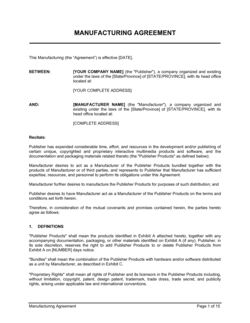
A manufacturing agreement is a contract between a brand owner and a producer that sets out the terms under which goods will be made. You need one any time a third party will fabricate, assemble, or process your product — even informally. Without a signed agreement, disputes over specifications, defects, IP ownership, and payment terms are resolved entirely on the manufacturer's terms or in court.
What is the difference between a contract manufacturing agreement and a toll manufacturing agreement?
A contract manufacturing agreement typically covers the entire production process, including sourcing inputs. A toll manufacturing agreement is narrower: you supply the raw materials and the toll manufacturer processes them into finished goods for a fee. The toll model is common when you want to retain ownership of the formula or recipe and simply rent production capacity.
Do I need a separate quality agreement if quality requirements are in my manufacturing agreement?
In many cases, yes. A standalone Manufacturing Quality Agreement allows you to update inspection criteria, testing protocols, and acceptable quality limits without renegotiating the main commercial contract. For high-volume or regulated products, keeping quality terms in a separate document is considered best practice.
What should a manufacturing business plan include that a generic business plan does not?
A manufacturing business plan should include a production capacity analysis, a breakdown of capital equipment requirements, a cost-of-goods model that accounts for raw materials, labour, and overhead, and a supply chain risk section. These are the sections investors and lenders look for when evaluating a production business specifically.
How do I protect my product design when working with a contract manufacturer?
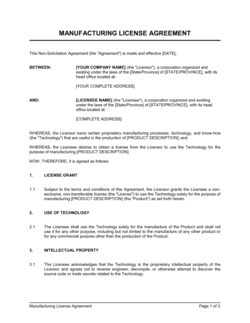
Include an intellectual property clause in your Contract Manufacturing Agreement that assigns all tooling, moulds, and production know-how to you. Pair this with a non-disclosure agreement and, where applicable, a Manufacturing License Agreement that explicitly limits the manufacturer's rights to use your IP for other customers. Consider registering patents or designs before sharing detailed specifications.
What templates do I need to appoint a manufacturing sales representative?
Use a Manufacturing Representative Agreement to define the rep's territory, commission rate, exclusivity status, and performance targets. If the rep will also stock or redistribute product, a Manufacturing Distribution Agreement may be more appropriate. For reps handling sensitive product data, add a non-disclosure agreement from the agreements filter.
How is a supply agreement different from a purchase order?
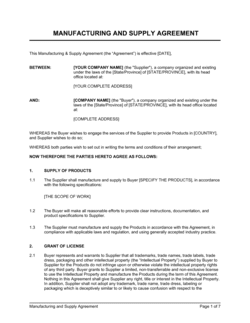
A supply agreement is a master contract that governs an ongoing supplier relationship — pricing mechanisms, quality standards, minimum volumes, and dispute resolution. A purchase order is a transaction-level document that calls off a specific quantity under those master terms. Typically you execute the supply agreement once and issue purchase orders repeatedly against it.
Can these templates be used for food, cosmetics, or beauty product manufacturing?
Yes. The catalog includes a Cosmetics Manufacturing Business Plan and a Beauty Supply Business Plan alongside the general manufacturing templates. For regulated categories, the templates provide the commercial and operational structure, but you should have a lawyer review compliance obligations specific to your jurisdiction and product category.
One document. A more organized business.
Your documents are part of how your business operates. Business in a Box brings the work, people and information around them into one workspace.
Start with the template you need. Bring the rest of your business together when you're ready.
How our templates are made
Every template is written by the Business in a Box editorial team and published by Bruno Goulet, CEO & Editor-in-Chief. Business in a Box has published business and legal templates for more than 20 years. Each document page explains what the template covers and how to fill it in; for legal documents, have a qualified professional review the final version when the stakes warrant it.