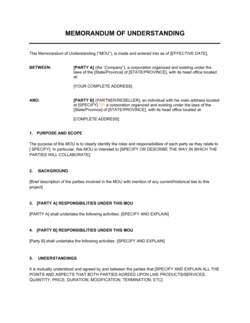
Non-Profit Memorandum Of Understanding Template

Free Word download • Edit online • Save & share with Drive • Export to PDF

3 pages20–30 min to fillDifficulty: StandardSignature requiredLegal review recommended
Learn more ↓
FreeNon-Profit Memorandum Of Understanding Template

At a glance

What it is
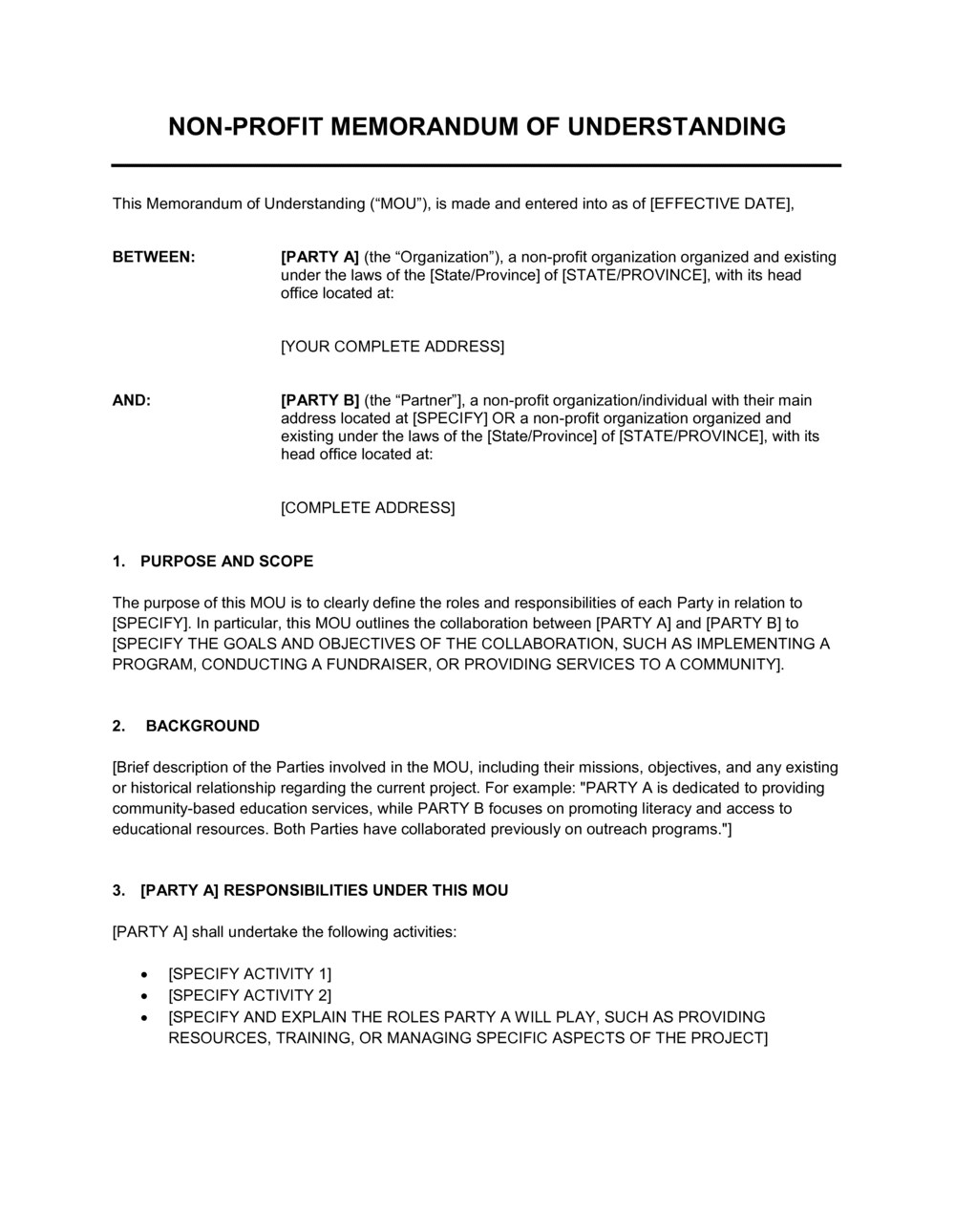
A Non-Profit Memorandum of Understanding (MOU) is a written framework agreement between a non-profit organization and one or more partner entities — another nonprofit, a government agency, or a for-profit company — that defines the terms of a shared collaboration. This free Word download gives you an editable, signature-ready starting point covering shared goals, each party's contributions, governance responsibilities, IP ownership, branding use, and the term of the arrangement.
When you need it
Use it when two or more organizations agree to work together on a program, initiative, or project and need a documented record of roles, resources, and expectations before detailed contracts are negotiated or funding is confirmed.
What's inside
Parties and recitals, purpose and shared goals, each party's contributions and responsibilities, governance and decision-making, intellectual property and data ownership, branding and communications guidelines, confidentiality, term and termination, and dispute resolution.

What is a Non-Profit Memorandum of Understanding?

A Non-Profit Memorandum of Understanding (MOU) is a written framework document that records the agreed terms of a collaboration between a nonprofit organization and one or more partner entities — which may be another nonprofit, a government agency, a university, or a for-profit corporation. It defines the shared goals of the partnership, specifies what each party will contribute in terms of staff, funds, facilities, or expertise, establishes governance and decision-making authority, and addresses ownership of jointly created intellectual property, use of each organization's brand, confidentiality obligations, and the term and termination conditions of the arrangement. While often framed as non-binding, a well-drafted nonprofit MOU functions as the authoritative accountability document for the collaboration and is routinely required by funders as evidence that partners have formally committed to defined roles.

Why You Need This Document

Proceeding with a nonprofit collaboration without a signed MOU creates four concrete risks. First, funders — particularly government agencies and national foundations — commonly require a written MOU as a condition of award; without one, grant applications stall or awards are delayed. Second, when contributions are not documented in writing, disputes about which party is responsible for under-delivered activities are resolved by whoever has better institutional memory, not by a shared agreement. Third, jointly created curricula, data tools, or program materials with no IP clause can be used, modified, or licensed by either party without the other's consent — including by a departing partner. Fourth, the absence of a termination mechanism leaves both organizations legally tethered to an arrangement that may have broken down operationally. This template gives you a structured, signature-ready starting point that closes all four gaps, with space to tailor contributions, governance, and IP ownership to the specific collaboration before a lawyer reviews the final document.

Which variant fits your situation?

If your situation is…Use this template
Collaboration between two nonprofits on a joint program with shared fundingNon-Profit Memorandum of Understanding
Formal binding subgrant relationship where one party passes funds to anotherSubgrant Agreement
A for-profit company sponsoring a nonprofit event or programSponsorship Agreement
Two organizations forming a legally separate joint entityJoint Venture Agreement
A nonprofit contracting a vendor or consultant for paid servicesService Agreement
A nonprofit sharing confidential donor or program data with a partnerNon-Disclosure Agreement
A coalition of nonprofits adopting shared operating rules and membership termsConsortium Agreement

Common mistakes to avoid

❌ Treating the MOU as entirely non-binding and skipping the detail

Why it matters: While MOUs are often non-binding as formal contracts, courts in some jurisdictions have found them enforceable when they contain specific obligations, consideration, and signatures. Vague language does not guarantee non-enforceability — it just makes the document useless for either purpose.

Fix: Draft the MOU with sufficient specificity to be useful as an accountability document, and add an explicit clause stating whether the parties intend it to be legally binding or not.

❌ No defined contribution levels for each party

Why it matters: When one partner believes they are carrying disproportionate responsibility, disputes escalate quickly — and a vague MOU provides no reference point to resolve them.

Fix: Quantify every contribution — hours, dollars, deliverables, or dates — so both parties can assess compliance at any point during the collaboration.

❌ Omitting IP and data ownership provisions

Why it matters: A jointly produced curriculum, database, or training tool with no ownership clause defaults to joint undivided ownership in most jurisdictions, meaning either party can license it to competitors without the other's consent.

Fix: Specify ownership of all likely work product and attach a data sharing addendum if beneficiary or program data will be exchanged.

❌ Signing with a non-authorized representative

Why it matters: An MOU signed by a program manager or development officer who lacks authority to bind the organization may be unenforceable and can create internal governance problems when the executive director or board was unaware.

Fix: Confirm in advance that the signatory holds the authority to execute agreements on behalf of their organization, and note the title alongside the signature line.

❌ No termination or wind-down clause

Why it matters: Without an exit mechanism, a partnership that has broken down creates legal and reputational risk — neither party can cleanly disengage, and ongoing obligations remain theoretically in effect.

Fix: Include a notice-based termination right for either party and specify what each party must do — return data, complete deliverables, issue a final report — within a set number of days of termination.

❌ Misaligning the MOU term with funder grant periods

Why it matters: An MOU that expires six months before the grant it supports creates a period of undefined partnership, complicating grant reporting and potentially triggering compliance questions from the funder.

Fix: Check the primary funder's award period before entering dates and build in an automatic renewal clause or a process for timely extension.

The 9 key clauses, explained

Parties and recitals

In plain language: Identifies each organization by legal name and type, describes the background of the relationship, and states why the parties are entering the MOU.

Sample language
This Memorandum of Understanding is entered into as of [DATE] by and between [NONPROFIT LEGAL NAME], a [STATE] nonprofit corporation ('Organization A'), and [PARTNER LEGAL NAME], a [ENTITY TYPE] ('Organization B'). The parties wish to collaborate on [PROJECT/PROGRAM NAME] as described herein.

Common mistake: Using a program name or trade name instead of the registered legal entity name, which can make the MOU unenforceable against the correct legal party and complicate grant reporting.

Purpose and shared goals

In plain language: States the specific objectives the collaboration is intended to achieve, the target population or geography served, and the measurable outcomes both parties expect.

Sample language
The purpose of this MOU is to advance [SHARED GOAL] by [SPECIFIC ACTIVITIES] serving [TARGET POPULATION] in [GEOGRAPHY]. Success will be measured by [OUTCOME METRICS] evaluated on a [QUARTERLY/ANNUAL] basis.

Common mistake: Writing vague purpose language like 'to advance our shared mission' without specifying activities or outcomes, which makes accountability conversations impossible when performance falls short.

Contributions and responsibilities

In plain language: Lists exactly what each party commits to provide — staff time, funding, facilities, expertise, or data — and the specific activities each is responsible for delivering.

Sample language
Organization A shall contribute: [X FTE] staff hours per month, access to [FACILITY], and $[AMOUNT] in program funding. Organization B shall contribute: [SPECIFIC SERVICES/EXPERTISE], [IN-KIND RESOURCE], and [DELIVERABLE] by [DATE].

Common mistake: Listing contributions symmetrically as 'best efforts' rather than quantifying them. Unspecified contributions become contested when one party believes the other is under-delivering.

Governance and decision-making

In plain language: Establishes who has authority to make decisions on behalf of each organization, whether a joint governing committee exists, how meetings are called, and what requires unanimous versus majority approval.

Sample language
The parties shall establish a Joint Steering Committee ('JSC') comprising [NUMBER] representatives from each party. The JSC shall meet [FREQUENCY] and make decisions by [MAJORITY/CONSENSUS]. Material amendments to this MOU require written approval from authorized signatories of both parties.

Common mistake: Omitting a governance clause entirely, leaving no mechanism to resolve disagreements about program direction — which typically forces the collaboration to collapse or leads to one party acting unilaterally.

Intellectual property and data ownership

In plain language: Clarifies who owns IP and data created during the collaboration, what each party may do with jointly created materials, and how pre-existing IP may be used.

Sample language
Pre-existing IP of each party remains that party's sole property. Jointly created materials ('Joint IP') shall be owned [equally / by Organization A as lead organization] and each party is granted a [royalty-free / non-exclusive] license to use Joint IP for [PERMITTED PURPOSES]. Data collected in connection with this MOU shall be governed by the Data Sharing Addendum attached hereto.

Common mistake: Defaulting to silence on IP, which in many jurisdictions means joint creators each hold an undivided interest — including the right to license the work to third parties without the other party's consent.

Branding and communications

In plain language: Defines how each party's name and logo may appear in joint materials, who must approve public statements about the collaboration, and what happens when brand standards conflict.

Sample language
Neither party shall use the other's name, logo, or marks without prior written approval. Joint communications shall credit both organizations as follows: '[APPROVED CREDIT LINE].' Press releases and media statements relating to this collaboration require [X]-day advance review by both parties.

Common mistake: Allowing open-ended logo use without an approval process, which exposes a nonprofit's brand to misuse or association with activities that conflict with its values or funder expectations.

Confidentiality

In plain language: Requires each party to protect the other's non-public information — including donor data, financials, program strategy, and beneficiary records — during and after the MOU term.

Sample language
Each party agrees to hold the other's Confidential Information in strict confidence and not to disclose it to any third party without prior written consent, except as required by law. This obligation survives termination of this MOU for a period of [X] years.

Common mistake: Failing to address what happens to confidential information — especially beneficiary data — after the MOU ends, leaving organizations exposed to data-handling complaints or regulatory action.

Term and termination

In plain language: Sets the start and end dates, specifies how the MOU may be renewed, and states how either party may exit — including notice periods and wind-down obligations.

Sample language
This MOU shall commence on [START DATE] and expire on [END DATE], unless renewed by written agreement of both parties. Either party may terminate this MOU upon [30/60/90] days' written notice. Upon termination, each party shall return or destroy the other's Confidential Information and fulfill any outstanding obligations within [X] days.

Common mistake: Setting no termination mechanism at all, making it awkward or legally ambiguous to exit a partnership that is no longer working — and potentially leaving one party liable for obligations they can no longer fulfill.

Dispute resolution and governing law

In plain language: Specifies the jurisdiction's law that governs the MOU and the ordered process for resolving disagreements — starting with direct negotiation, then mediation, before any formal proceedings.

Sample language
This MOU is governed by the laws of [STATE/PROVINCE/COUNTRY]. In the event of a dispute, the parties shall first attempt resolution through good-faith negotiation within [30] days. If unresolved, the parties agree to non-binding mediation before [MEDIATION BODY] prior to pursuing any other remedy.

Common mistake: Omitting governing law and relying on a general 'both parties agree to cooperate' clause, which forces parties to litigate which jurisdiction's law applies before they can even address the substance of the dispute.

How to fill it out

  1. 1

    Enter the full legal names and entity types of all parties

    Use each organization's registered legal name — not a program name or acronym. Include the state or country of incorporation and the entity type (nonprofit corporation, government agency, LLC, etc.).

    💡 Request a copy of each partner's current registration or articles of incorporation before filling this section — discrepancies in legal names surface most often at the signing stage.

  2. 2

    Define the purpose with specific activities and outcomes

    Write the shared goal in one or two sentences, then list the specific activities each party will undertake and the measurable outcomes you expect to achieve within the MOU term.

    💡 Attach a logic model or program description as an exhibit if the collaboration is complex — the MOU body should be concise, with detail in the attachment.

  3. 3

    Quantify each party's contributions

    Assign specific, countable commitments to each party — dollar amounts, FTE hours per month, facility access dates, or deliverable deadlines. Avoid language like 'reasonable efforts' unless you also define what reasonable means.

    💡 Use a two-column table in the contributions clause — one column per party — so obligations are visually parallel and easy to audit mid-partnership.

  4. 4

    Establish a governance structure

    Name the individuals or titles authorized to make decisions for each party. Decide whether a joint steering committee is needed and, if so, how many representatives each party has, how often they meet, and what voting threshold applies.

    💡 For multi-party MOUs with three or more organizations, majority voting is more practical than consensus — specify a tie-breaking mechanism to avoid deadlock.

  5. 5

    Assign IP ownership and data rights

    Identify any tools, curricula, databases, or creative works likely to be produced during the collaboration. Decide upfront whether jointly created materials will be owned equally, by the lead organization, or by the party that funded creation.

    💡 If one party is the grant recipient, their funder may have IP requirements built into the award — check grant terms before completing this clause.

  6. 6

    Set branding approval rules

    Agree on the exact credit line for joint materials and the review period each party has to approve public communications. Include what happens if one party misses the review deadline.

    💡 A 5-business-day default approval window with silence deemed approval is practical for fast-moving campaigns — specify it explicitly rather than leaving it to informal agreement.

  7. 7

    Set the term and termination notice period

    Enter the specific start and end dates. Choose a notice period (30, 60, or 90 days) that gives both parties enough time to transition program responsibilities and notify beneficiaries.

    💡 Align the MOU term to the primary funder's grant period whenever possible — mismatched terms create gaps in accountability and can affect grant reporting compliance.

  8. 8

    Sign before the collaboration begins

    Both parties must sign before any joint activities start, funds are transferred, or public announcements are made. Collect the signature of an authorized officer — typically the executive director or CEO — not a program staff member.

    💡 Confirm each signatory's authority to bind their organization before execution — some nonprofit boards require board approval for MOUs above a certain funding threshold.

Frequently asked questions

What is a non-profit memorandum of understanding?

A non-profit memorandum of understanding is a written document that frames a collaboration between a nonprofit organization and one or more partners — another nonprofit, a government agency, or a for-profit company. It records shared goals, each party's contributions, governance responsibilities, IP and data ownership, branding rules, and the term of the arrangement. MOUs are typically non-binding as formal contracts, but they carry significant accountability weight and are routinely required by funders as evidence of a formal partnership.

Is a memorandum of understanding legally binding?

Whether an MOU is legally binding depends on its language and the jurisdiction. In many cases, an MOU expresses intent and commitment without creating enforceable contract obligations. However, courts in the US, Canada, and the UK have found MOUs enforceable when they contain specific obligations, defined consideration, and authorized signatures. The safest approach is to include an explicit clause stating whether the parties intend the MOU to be binding, and to consult a lawyer for high-stakes collaborations.

What is the difference between an MOU and a contract?

A contract is a legally binding agreement that creates enforceable rights and obligations, with remedies for breach. An MOU typically records mutual understanding and intent without the same enforcement mechanism. Nonprofits use MOUs to establish a collaboration framework before detailed contracts — subgrant agreements, service contracts, or data sharing agreements — are finalized. If the relationship involves significant money or IP, a binding contract should follow the MOU.

Do funders require a memorandum of understanding?

Many government agencies, foundations, and corporate funders require a signed MOU as part of a grant application or award process when the project involves multiple organizations. The MOU demonstrates that partners have formally agreed on roles, contributions, and accountability — reducing the funder's risk that the collaboration will fall apart mid-grant. Review your funder's requirements carefully, as some specify minimum content that must appear in the MOU.

Can a for-profit company be a party to a nonprofit MOU?

Yes. Nonprofits frequently enter MOUs with for-profit corporations for corporate social responsibility programs, cause-related marketing initiatives, employee volunteer partnerships, and resource-sharing arrangements. The MOU should address the for-profit's branding rights carefully, ensure the nonprofit's tax-exempt status is not jeopardized by the arrangement, and clarify how any commercial benefit to the for-profit partner is characterized and limited.

How long should a nonprofit MOU last?

Most nonprofit MOUs align with a program cycle or funder grant period — typically one to three years. A defined term with a renewal option is more practical than an open-ended arrangement, because it creates natural checkpoints to reassess the collaboration, update contributions, and renegotiate terms. Build in a 60-day pre-expiration review window so neither party is caught off guard by an approaching end date.

What happens to shared data when a nonprofit MOU ends?

Without explicit language, both parties may retain copies of shared data indefinitely — which can create privacy, confidentiality, and funder compliance problems. The MOU should specify whether shared data must be returned, destroyed, or de-identified at termination, who bears responsibility for notifying beneficiaries, and what retention obligations apply under applicable law, including HIPAA, FERPA, or GDPR if relevant.

Does a nonprofit MOU need to be approved by the board of directors?

Board approval requirements depend on the nonprofit's bylaws and the significance of the arrangement. Many nonprofits require board approval for any agreement committing organizational funds, staff resources above a threshold, or use of the organization's name and brand. Check the bylaws and any board-adopted policies before execution, and document the authorization — particularly if the MOU will be shown to funders.

Can an MOU be terminated early?

Yes, provided the MOU includes a termination clause. A standard provision allows either party to terminate on 30 to 90 days' written notice, without cause. For grant-funded collaborations, early termination may trigger funder notification requirements, return-of-funds provisions, or amended reporting obligations — so the MOU should reference those grant requirements and specify what happens to unspent funds and incomplete deliverables on exit.

How this compares to alternatives

vs Subgrant Agreement

A subgrant agreement is a binding contract through which a primary grant recipient passes funds and compliance obligations to a subgrantee. An MOU frames the partnership relationship at a higher level and often precedes the subgrant. When money flows from one party to another, a subgrant or contract is needed — an MOU alone is insufficient.

vs Non-Disclosure Agreement

An NDA protects confidential information exchanged between parties but does not address collaboration structure, contributions, governance, or IP. Nonprofits entering a collaboration that involves sharing sensitive data often need both — an MOU to frame the partnership and an NDA or data sharing addendum to govern what is shared and how.

vs Joint Venture Agreement

A joint venture agreement creates a formal legal relationship — and sometimes a new legal entity — between parties combining resources for a defined business purpose. A nonprofit MOU is a lighter-weight framework document that does not create a separate entity or binding financial liability. Use a joint venture agreement when the collaboration requires a new legal structure or pooled ownership of significant assets.

vs Service Agreement

A service agreement is a binding contract under which one party pays another to deliver defined services. An MOU documents a collaborative partnership where both parties contribute and benefit, typically without a traditional buyer-seller dynamic. If one organization is simply paying another to perform work, a service agreement is the correct document — not an MOU.

Industry-specific considerations

Social Services and Human Services

Client referral protocols, data privacy for beneficiary records, and lead-agency designation for government-funded service delivery networks.

Education and Workforce Development

Curriculum co-ownership, student data sharing under FERPA, and co-branded certification programs with employer partners.

Healthcare and Public Health

HIPAA-compliant data sharing, community health worker deployment across partner organizations, and joint grant reporting to public health funders.

Environmental and Conservation

Land stewardship responsibilities, co-management of conservation easements, and joint public communications about restoration outcomes.

Jurisdictional notes

United States

In the US, MOUs are generally non-binding unless they meet the elements of a contract — offer, acceptance, and consideration. State nonprofit laws vary on what requires board authorization. Grant-funded MOUs may be subject to Uniform Guidance (2 CFR Part 200) requirements for federal awards, including conflict-of-interest policies and procurement standards for any services provided by MOU partners.

Canada

Canadian courts have found MOUs enforceable when they demonstrate clear intention to be bound. Provincial nonprofit legislation — such as Ontario's Not-for-Profit Corporations Act — may require board authorization for significant agreements. Quebec nonprofits must comply with civil law principles, and any MOU intended for use in Quebec should be drafted in French or include a French version for provincially regulated activities.

United Kingdom

UK charity law requires trustees to act in the charity's best interests when entering any partnership arrangement. The Charity Commission expects charities to have written agreements for significant collaborations, particularly those involving shared staff, premises, or funds. MOUs with for-profit partners should be reviewed to ensure they do not constitute a trading arrangement that could affect charitable status or create an unrelated business income tax liability.

European Union

EU-funded nonprofit collaborations are typically governed by grant consortium agreements that sit alongside or replace standalone MOUs. GDPR applies to any MOU involving personal data exchange between parties — a Data Processing Agreement or data sharing addendum is required. Member state nonprofit law varies significantly; French associations, German gemeinnützige Vereine, and Dutch stichtingen each have distinct authorization and registration requirements.

Template vs lawyer — what fits your deal?

PathBest forCostTime
Use the templateNonprofits entering straightforward program collaborations with a single partner, with no significant fund transfers or sensitive IPFree1–2 hours
Template + legal reviewPartnerships involving grant fund pass-throughs, jointly created IP, beneficiary data sharing, or a for-profit partner$300–$750 for a nonprofit attorney review3–5 business days
Custom draftedMulti-party coalitions, government agency partnerships with regulatory compliance requirements, or collaborations with material IP or real estate components$1,500–$4,000+2–4 weeks

Glossary

Memorandum of Understanding (MOU)
A written, signed document recording the agreed framework for a collaboration between two or more organizations, typically non-binding as a contract but carrying significant moral and reputational weight.
Non-Binding Agreement
An arrangement where the parties express intent and commitment without creating enforceable legal obligations to perform specific acts or pay damages for non-performance.
In-Kind Contribution
A non-cash resource provided by a partner — such as staff time, equipment, facilities, or expertise — valued and counted as part of that party's commitment to the collaboration.
Lead Organization
The party in a multi-organization partnership designated to hold primary accountability for grant compliance, financial reporting, or program delivery on behalf of all partners.
Governing Committee
A joint body — typically with representatives from each partner — responsible for overseeing the collaboration, resolving disputes, and approving material changes to the MOU.
Intellectual Property (IP)
Creations of the mind — curricula, tools, research outputs, software, or branding — whose ownership and licensing rights must be defined when multiple organizations contribute to creating them.
Co-Branding
The use of two or more organizations' names, logos, or marks together in public-facing materials, requiring explicit approval rights and usage standards from each party.
Term
The defined start and end date of the MOU's coverage period, after which the arrangement expires unless renewed in writing by all parties.
Force Majeure
A clause excusing a party's non-performance when an extraordinary event beyond their control — such as a natural disaster, pandemic, or government order — prevents them from meeting their obligations.
Dispute Resolution
The agreed process for handling disagreements between the parties — typically beginning with good-faith negotiation, escalating to mediation, and reserving litigation as a last resort.
Confidential Information
Non-public data, donor records, financial details, program strategies, or personal information shared between partners that must not be disclosed to third parties without consent.

Part of your Business Operating System

This document is one of 3,000+ business & legal templates included in Business in a Box.

  • Fill-in-the-blanks — ready in minutes
  • 100% customizable Word document
  • Compatible with all office suites
  • Export to PDF and share electronically

Create your document in 3 simple steps.

From template to signed document — all inside one Business Operating System.
1
Download or open template

Access over 3,000+ business and legal templates for any business task, project or initiative.

2
Edit and fill in the blanks with AI

Customize your ready-made business document template and save it in the cloud.

3
Save, Share, Send, Sign

Share your files and folders with your team. Create a space of seamless collaboration.

Save time, save money, and create top-quality documents.

★★★★★

"Fantastic value! I'm not sure how I'd do without it. It's worth its weight in gold and paid back for itself many times."

Managing Director · Mall Farm
Robert Whalley
Managing Director, Mall Farm Proprietary Limited
★★★★★

"I have been using Business in a Box for years. It has been the most useful source of templates I have encountered. I recommend it to anyone."

Business Owner · 4+ years
Dr Michael John Freestone
Business Owner
★★★★★

"It has been a life saver so many times I have lost count. Business in a Box has saved me so much time and as you know, time is money."

Owner · Upstate Web
David G. Moore Jr.
Owner, Upstate Web

Run your business with a system — not scattered tools

Stop downloading documents. Start operating with clarity. Business in a Box gives you the Business Operating System used by over 250,000 companies worldwide to structure, run, and grow their business.

Start free · No credit card required