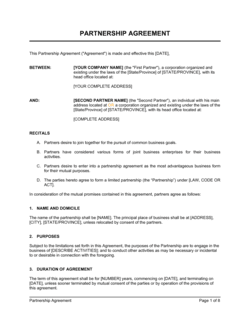
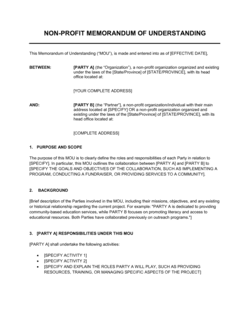
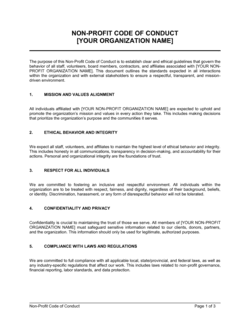
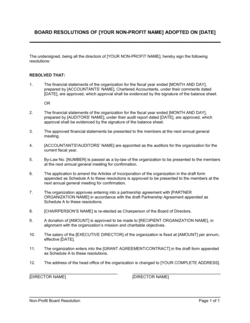
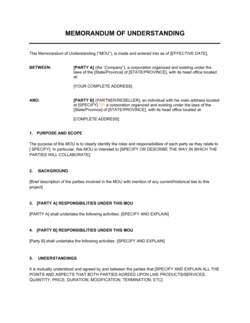
Non-Profit Partnership Agreement Template

Free Word download • Edit online • Save & share with Drive • Export to PDF

4 pages25–35 min to fillDifficulty: ComplexSignature requiredLegal review recommended
Learn more ↓
FreeNon-Profit Partnership Agreement Template

At a glance

What it is
A Non-Profit Partnership Agreement is a legally binding document between two or more organizations — whether nonprofit-to-nonprofit or nonprofit-to-for-profit — formalizing a shared program, grant initiative, or long-term collaboration. This free Word download covers contributions, governance, IP ownership, fundraising rights, branding use, liability allocation, and exit procedures in a single structured document you can edit online and export as PDF.
When you need it
Use it when two or more organizations are jointly delivering a program, applying for a grant together, sharing staff or facilities, or co-branding a fundraising campaign. Handshake arrangements and informal MOUs leave every organization exposed when funding is delayed, staff change, or a partner exits.
What's inside
Partner roles and contribution schedules, governance and decision-making authority, grant and fund management, intellectual property assignment and licensing, branding and communications rules, liability and indemnification, term and termination procedures, and dispute resolution.

What is a Non-Profit Partnership Agreement?

A Non-Profit Partnership Agreement is a legally binding contract between two or more organizations — whether nonprofit-to-nonprofit or nonprofit-to-for-profit — that formalizes a shared program, grant initiative, or long-term collaboration. It defines each organization's contributions, governance rights, IP ownership, fund management obligations, branding rules, liability allocation, and the procedures for ending the arrangement. Unlike a letter of intent or memorandum of understanding, a properly executed partnership agreement creates enforceable obligations on every signing party and provides a clear legal basis for remedies if a partner misuses funds, fails to deliver, or exits without notice.

Why You Need This Document

Without a written partnership agreement, every dimension of your collaboration rests on informal understanding — and informal understanding fails precisely when the stakes are highest. Grant auditors who find no documented sub-recipient agreement can require fund return and flag the lead organization for future monitoring. Disputes over who owns jointly created curricula, databases, or training materials are resolved by whatever a court can infer from email threads, which rarely matches what either party intended. A partner's sudden exit mid-program can leave vulnerable beneficiaries without services and the remaining organization liable to the funder for unmet deliverables. This template gives every party a clear, negotiated record of what was agreed before a dollar is transferred or a staff member is deployed — reducing audit risk, protecting each organization's tax-exempt status, and providing an enforceable path to resolution if the collaboration breaks down.

Which variant fits your situation?

If your situation is…Use this template
Two nonprofits jointly applying for and delivering a government grantNon-Profit Partnership Agreement
A nonprofit and a for-profit company running a cause-marketing campaignCorporate Sponsorship Agreement
Early-stage collaboration with no shared funding yetMemorandum of Understanding (MOU)
A fiscal sponsor holding funds on behalf of an unincorporated projectFiscal Sponsorship Agreement
Two nonprofits sharing staff, office space, or equipmentResource Sharing Agreement
A nonprofit licensing its brand or curriculum to another organizationLicensing Agreement
Full legal merger or acquisition of one nonprofit by anotherLetter of Intent (Merger)

Common mistakes to avoid

❌ Using an MOU instead of a binding agreement

Why it matters: A Memorandum of Understanding is typically non-binding. When a partner misuses funds, exits early, or fails to deliver, there is no enforceable mechanism for recovery or remedy.

Fix: Use a fully executed partnership agreement with consideration and clear obligations. Reserve MOUs for early-stage explorations before any money or program activity is involved.

❌ No language on unspent or returned grant funds

Why it matters: Disputes over surplus restricted funds are among the most common sources of nonprofit partnership litigation. Without explicit terms, both parties can credibly claim entitlement.

Fix: Include a specific provision stating that unspent restricted funds revert to the funder per grant terms, and that any unrestricted surplus is allocated by a defined formula — e.g., pro rata to each partner's contribution.

❌ Omitting beneficiary data and privacy obligations

Why it matters: Nonprofit programs frequently share personally identifiable information about service recipients. Without a confidentiality clause that explicitly covers beneficiary data, partners face exposure under HIPAA, FERPA, or state privacy statutes.

Fix: Add a data-sharing addendum or exhibit that identifies the categories of personal data being shared, the legal basis, retention periods, and each party's obligations upon termination.

❌ No wind-down period for program participants

Why it matters: Terminating a partnership agreement immediately without a transition window can cut off services to vulnerable beneficiaries, creating reputational damage and potential liability to funders who require continuity.

Fix: Include a minimum 30-to-90-day wind-down period following any termination notice, during which both parties continue essential program activities and coordinate handoff of participant records.

❌ Signing after program activities or fund transfers have already begun

Why it matters: IP created, funds disbursed, and liabilities incurred before the agreement is signed are not governed by its terms, leaving both parties exposed for the pre-agreement period.

Fix: Execute the agreement before any staff are deployed, funds transferred, or the program is publicly announced. If circumstances require backdating, obtain legal advice on the implications in your jurisdiction.

❌ No defined decision-making threshold for material changes

Why it matters: Without specifying which decisions require unanimous versus majority consent, a dominant partner can unilaterally redirect budgets, change program scope, or issue press releases that bind the other party.

Fix: List specific decision categories — budget changes above a dollar threshold, scope changes, public communications, new sub-recipients — and state explicitly whether each requires unanimity or majority vote.

The 10 key clauses, explained

Parties, purpose, and term

In plain language: Identifies every partner organization by legal name and tax-exempt status, describes the shared program or initiative, and sets the agreement's start and end dates.

Sample language
This Non-Profit Partnership Agreement ('Agreement') is entered into on [DATE] between [LEAD PARTNER LEGAL NAME], a [STATE] nonprofit corporation exempt under IRC §[501(c)(3)/other] ('Lead Partner'), and [PARTNER 2 LEGAL NAME], a [STATE] nonprofit corporation ('Partner'). The parties agree to collaborate on [PROGRAM NAME] ('Program') for the term commencing [START DATE] and ending [END DATE], unless earlier terminated.

Common mistake: Listing a trade name or DBA instead of the organization's registered legal name — this creates ambiguity about which entity is bound and can complicate grant compliance audits.

Roles, responsibilities, and contributions

In plain language: Defines what each partner is responsible for delivering — staff, facilities, services, or cash — and attaches a contribution schedule as an exhibit.

Sample language
Lead Partner shall [DESCRIBE LEAD RESPONSIBILITIES]. Partner shall [DESCRIBE PARTNER RESPONSIBILITIES]. Each party's financial and in-kind contributions are set out in Exhibit A. Either party may propose changes to Exhibit A by written notice, subject to mutual written agreement.

Common mistake: Describing contributions in vague terms like 'reasonable support' instead of specific deliverables, FTE commitments, or dollar amounts — leaving no basis for accountability when a partner underperforms.

Grant and fund management

In plain language: Specifies how grant or donated funds are received, held, disbursed to sub-recipients, and reported — including restrictions on use and what happens to unspent funds.

Sample language
Lead Partner shall receive and administer all Program funds in a segregated account. Funds disbursed to Partner shall be used solely for [PURPOSE] as specified in the grant award. Partner shall submit expenditure reports to Lead Partner by the [Nth] day of each month. Unspent restricted funds shall be returned to the funder in accordance with grant terms.

Common mistake: No language on unspent or returned funds. When a program ends with money remaining, partners frequently dispute whether surplus funds revert to the funder, are retained by the lead, or are split — absent explicit terms, this becomes a legal and funder-relations problem.

Governance and decision-making

In plain language: Establishes a joint governance committee, defines voting rights, quorum, and which decisions require unanimous versus majority consent.

Sample language
The parties shall form a Joint Governance Committee ('JGC') consisting of [NUMBER] representatives from each party. The JGC shall meet [monthly / quarterly] and decisions shall be made by [majority / unanimous] vote. Decisions involving budget changes exceeding $[THRESHOLD], program scope changes, or public communications require unanimous approval.

Common mistake: Failing to specify which decisions require unanimity. Without this, a dominant partner can unilaterally redirect a program, exclude the other party from communications, or approve expenditures that the smaller partner cannot block.

Intellectual property ownership and licensing

In plain language: Allocates ownership of existing IP each party brings in and new IP created during the collaboration, and grants any cross-licenses needed to deliver the program.

Sample language
Each party retains ownership of its Pre-Existing IP. All Program IP jointly created under this Agreement ('Joint IP') shall be jointly owned by the parties unless otherwise agreed in writing. Each party grants the other a non-exclusive, royalty-free license to use its Pre-Existing IP solely for Program purposes during the term.

Common mistake: No definition of 'Pre-Existing IP' — without a clear boundary, newly created curricula, tools, or data can be claimed by either party, resulting in disputes over who can use materials after the partnership ends.

Branding, communications, and public statements

In plain language: Sets rules for using each organization's name, logo, and marks — including approval rights for press releases, social media, grant applications that reference the partnership, and co-branded materials.

Sample language
Neither party shall use the other's name, logo, or marks without prior written approval, which shall not be unreasonably withheld. All public communications referencing the Program shall identify both parties and be approved by the JGC before release. Each party shall comply with the other's brand guidelines as provided from time to time.

Common mistake: No approval workflow for external communications. In practice, one partner issues a press release naming the other — often misrepresenting the scope or nature of the collaboration — without review, creating reputational and funder-relations issues.

Confidentiality

In plain language: Restricts disclosure of non-public program data, donor information, beneficiary records, financial details, and proprietary methods shared between partners.

Sample language
Each party shall hold the other's Confidential Information in strict confidence and shall not disclose it to any third party without prior written consent. 'Confidential Information' excludes information that is publicly available, independently developed, or required to be disclosed by law or funder mandate. Obligations survive termination for [3] years.

Common mistake: Omitting beneficiary or client data from the confidentiality definition. Nonprofit programs routinely share personally identifiable information about service recipients — without explicit protection, this creates regulatory exposure under HIPAA, FERPA, or state privacy laws.

Liability, indemnification, and insurance

In plain language: Allocates legal and financial responsibility for each party's own acts and omissions, requires each to carry appropriate insurance, and limits cross-liability exposure.

Sample language
Each party shall indemnify, defend, and hold harmless the other from any claims, damages, or costs arising from its own acts, omissions, or breach of this Agreement. Each party shall maintain general liability insurance of at least $[AMOUNT] per occurrence and provide certificates of insurance upon request.

Common mistake: No mutual indemnification — only one party is indemnified. Courts will read silence as no indemnification obligation, leaving the unprotected partner exposed for losses caused by the other's negligence.

Term, termination, and wind-down

In plain language: States the agreement's duration, the notice required to terminate for convenience or cause, and the obligations that survive — including fund return, data deletion, and IP reversion.

Sample language
Either party may terminate this Agreement for convenience with [60] days' written notice. Either party may terminate immediately for Material Breach. Upon termination: (a) each party shall return the other's Confidential Information and Pre-Existing IP; (b) restricted funds shall be returned to the funder; (c) Joint IP licenses survive for [12] months to allow orderly program transition.

Common mistake: No wind-down period for program participants. Abrupt termination that cuts off services to vulnerable beneficiaries creates reputational and potentially legal liability — a transition window of 30–90 days is standard for program-facing partnerships.

Governing law and dispute resolution

In plain language: Specifies which jurisdiction's law governs the agreement and the process for resolving disputes — typically mediation before arbitration or litigation.

Sample language
This Agreement is governed by the laws of [STATE / PROVINCE / COUNTRY]. The parties shall attempt to resolve disputes through good-faith negotiation for [30] days, followed by non-binding mediation administered by [MEDIATOR / ORGANIZATION] before initiating arbitration or litigation.

Common mistake: Choosing a governing law in a state where neither party operates. Nonprofit law is highly state-specific — directors' duties, charitable solicitation registration, and fund restriction enforcement all vary, and a mismatched governing law creates compliance confusion.

How to fill it out

  1. 1

    Identify and verify each partner's legal status

    Enter the full registered legal name, state or province of incorporation, and tax-exempt status (e.g., IRC §501(c)(3), Canadian registered charity number) for every signing party. Confirm active good standing with the relevant state or federal registry before execution.

    💡 Cross-check each organization's status on the IRS Tax Exempt Organization Search or Canada Revenue Agency registry — lapsed status at a sub-recipient can jeopardize the lead partner's grant compliance.

  2. 2

    Define each partner's specific contributions in Exhibit A

    List every contribution — cash, in-kind staff hours, facilities, equipment — with dollar values, delivery dates, and responsible contacts. Attach this as Exhibit A and have each party initial it separately.

    💡 Value in-kind contributions at fair market rate (not cost) to accurately represent program leverage for grant reporting and funder credibility.

  3. 3

    Establish the governance committee structure

    Name the initial JGC representatives from each partner, define meeting frequency, quorum requirements, and the threshold above which decisions require unanimity versus simple majority.

    💡 For partnerships with unequal resource contributions, consider a weighted voting structure that reflects each party's financial stake — this prevents resentment from the larger contributor while still giving the smaller party a meaningful voice.

  4. 4

    Map all grant and fund-flow obligations

    Identify every funder, grant award number, and restriction on use. Enter disbursement timelines, reporting deadlines, and the account into which funds will be received. Confirm these terms match the actual grant award documents.

    💡 Attach a copy of every relevant grant award summary as an exhibit — discrepancies between the partnership agreement and the funder's terms are the most common source of audit findings.

  5. 5

    Allocate IP and agree on pre-existing IP boundaries

    List each party's Pre-Existing IP by category (e.g., 'Partner's licensed curriculum,' 'Lead Partner's database schema') and describe the scope of the license granted for program use. Document who will own any jointly created materials.

    💡 Photograph, version-stamp, or register key pre-existing materials before the agreement is signed — this creates a clear evidentiary baseline if ownership is disputed after the partnership ends.

  6. 6

    Set branding and communications approval rules

    Attach each party's current brand guidelines and specify the approval workflow — who reviews, turnaround time, and what happens if approval is not given within the stated window.

    💡 A 5-business-day default approval window with deemed-approved language is standard practice and prevents communications bottlenecks.

  7. 7

    Confirm insurance requirements and exchange certificates

    Enter the minimum coverage amounts, name any additional insured requirements, and set a deadline for exchanging certificates of insurance before program activities begin.

    💡 Ask each partner's insurer whether the partnership arrangement triggers any exclusions — shared grant programs sometimes fall outside standard nonprofit general liability policies.

  8. 8

    Sign before any program activity or fund disbursement begins

    All authorized signatories — typically executive directors or board-authorized officers — must sign before staff are deployed, funds are transferred, or the program is publicly announced.

    💡 Use a digital signature tool to timestamp execution and store the fully executed agreement with your grant files — funders frequently request the partnership agreement at audit or renewal.

Frequently asked questions

What is a non-profit partnership agreement?

A non-profit partnership agreement is a legally binding contract between two or more organizations — whether both nonprofits or a nonprofit and a for-profit company — that formalizes a collaboration on a shared program, grant, or initiative. It defines each party's contributions, governance rights, IP ownership, fund management obligations, and what happens when the collaboration ends. Unlike a memorandum of understanding, a properly executed partnership agreement creates enforceable obligations on both sides.

Is a non-profit partnership agreement the same as a memorandum of understanding?

No. A memorandum of understanding (MOU) is typically non-binding and used for early-stage collaborations where both parties want to signal intent without committing legally. A non-profit partnership agreement is a binding contract with enforceable obligations, consideration, and remedies for breach. If your collaboration involves shared funding, staff deployment, or public program delivery, a binding agreement is the appropriate instrument.

Do non-profit organizations need a partnership agreement?

Yes, whenever two or more organizations are jointly delivering a program, co-applying for a grant, sharing staff or facilities, or co-branding a fundraising effort. Funders — especially government and foundation grantors — frequently require a signed partnership agreement as a condition of award. Without one, disputes over fund use, IP ownership, and exit obligations are resolved by whatever a court can infer from emails and verbal agreements, which is rarely what either party intended.

Can a nonprofit partner with a for-profit company?

Yes. Nonprofits regularly partner with for-profit businesses for cause-marketing campaigns, program sponsorships, and joint service delivery. The agreement must clearly address how the arrangement avoids private benefit or private inurement — both of which can jeopardize a nonprofit's tax-exempt status. In cause-marketing arrangements, several US states require the for-profit to register as a commercial co-venturer and file disclosures. Legal review is strongly recommended before executing any nonprofit-to-for-profit partnership.

Who should sign a non-profit partnership agreement?

Each organization's authorized signatory — typically the executive director or a board-authorized officer — must sign. Check your organization's bylaws or board resolution to confirm who has authority to bind the organization contractually. For partnerships involving grants above a certain dollar threshold, many nonprofit boards require a board resolution authorizing execution before the executive director can sign.

What happens to intellectual property created during a nonprofit partnership?

Ownership of jointly created IP — curricula, databases, software, training materials — depends entirely on what the agreement says. Without an explicit IP clause, joint creation typically results in joint ownership under US copyright law, meaning either party can use the materials independently without accounting to the other. If one party contributes significantly more to the creation, a full assignment to that party (with a license-back to the other) is often more practical than joint ownership.

What should happen to grant funds if the partnership ends early?

Restricted grant funds must generally be returned to the funder or redirected to an approved purpose — the partnership agreement cannot override the grant terms. Unrestricted surplus funds should be allocated by a specific formula written into the agreement, such as pro-rata return based on each partner's financial contribution. Without explicit terms, disputes over surplus are common and expensive. Some funders require prior approval before any partner exits a jointly funded program.

Do non-profit partnership agreements need to be reviewed by a lawyer?

For straightforward collaborations involving small grants and established partners, a high-quality template is often a practical starting point. However, legal review is strongly recommended when the partnership involves government grants with compliance obligations, a nonprofit-to-for-profit arrangement that could affect tax-exempt status, significant jointly created IP, cross-border partners subject to different nonprofit laws, or material indemnification and liability exposure. A 1–3 hour review typically costs $300–$800 and is worthwhile before any material program activity begins.

How long should a non-profit partnership agreement be in effect?

The term should match the program or grant cycle — commonly one to three years, with renewal options. Multi-year agreements should include annual review checkpoints at which either party can flag material changes in contribution levels, governance, or program scope. Automatically renewing agreements are convenient but create risk if neither party actively monitors the renewal date and circumstances have changed significantly since original execution.

How this compares to alternatives

vs Memorandum of Understanding (MOU)

An MOU signals intent and establishes a framework for collaboration but is typically non-binding and provides no remedy if a party fails to perform. A non-profit partnership agreement creates enforceable obligations covering fund management, IP, liability, and exit. Use an MOU to explore a relationship; use a partnership agreement once money, staff, or program delivery is involved.

vs Corporate Sponsorship Agreement

A corporate sponsorship agreement governs a for-profit company's financial support of a nonprofit event or program in exchange for brand exposure. A non-profit partnership agreement is broader — it covers joint governance, shared IP, mutual contributions, and ongoing co-delivery of a program. Use sponsorship for one-directional funding with recognition; use a partnership agreement for genuine bilateral collaboration.

vs Fiscal Sponsorship Agreement

A fiscal sponsorship agreement allows an established nonprofit to hold tax-exempt status and funds on behalf of an unincorporated project. A non-profit partnership agreement assumes both parties are independent legal entities with their own governance. If one partner lacks incorporated status or tax exemption, fiscal sponsorship is the appropriate structure.

vs Joint Venture Agreement

A joint venture agreement typically creates a separate legal entity or enterprise owned by both parties, with shared profit and loss. A non-profit partnership agreement keeps each organization legally independent while coordinating a specific program or initiative. Nonprofits rarely form joint venture entities due to tax and governance complexity — a partnership agreement achieves collaboration without creating a new taxable structure.

Industry-specific considerations

Education and youth development

FERPA compliance for shared student data, school district approval requirements, and volunteer background-check obligations built into the contributions schedule.

Healthcare and social services

HIPAA Business Associate Agreement attachment for shared beneficiary health data, credentialing requirements for clinical staff, and mandatory reporting obligations for each partner.

Community development and housing

HUD and CDBG grant compliance, Davis-Bacon prevailing wage requirements referenced in the fund-management clause, and community benefit reporting tied to funder conditions.

Arts and culture

Complex IP ownership for co-produced creative works, venue and production liability allocation, and co-branding rules for ticketed events and public exhibitions.

Environmental and conservation

Land trust and easement considerations, regulatory permit compliance shared between partners, and data-sharing obligations for scientific monitoring programs.

International development

Multi-currency fund management, USAID or FCDO sub-award compliance requirements, and governing law selection across jurisdictions where partners are incorporated.

Jurisdictional notes

United States

Nonprofits partnering with for-profit companies must ensure the arrangement does not create private inurement or excess benefit, which can trigger IRS intermediate sanctions and jeopardize 501(c)(3) status. Cause-marketing arrangements may require the for-profit to register as a commercial co-venturer in states including California, New York, and Massachusetts. Sub-recipient arrangements under federal grants are subject to 2 CFR Part 200 (Uniform Guidance) flow-down requirements.

Canada

Canadian registered charities must ensure partnership activities fall within their approved charitable purposes — activities that primarily benefit a for-profit partner risk CRA review for undue private benefit. Disbursement quota rules require charities to disburse at least 3.5% of the average value of their assets annually, and partnerships that restrict fund use need to be structured to avoid quota complications. Quebec partnerships involving French-speaking beneficiaries should ensure all communications and agreements are available in French under the Charter of the French Language.

United Kingdom

UK charities entering partnerships must ensure the collaboration advances their charitable objects as registered with the Charity Commission — agreements that stray beyond those objects require a Commission order or scheme. The Charity Governance Code recommends board-level approval for material partnerships. Data sharing between partners involving personal data of beneficiaries must comply with UK GDPR and requires a Data Sharing Agreement or, where one party processes data on behalf of the other, a Data Processing Agreement under Article 28.

European Union

EU member states regulate nonprofit status at the national level with significant variation — German gemeinnützige organizations, French associations loi 1901, and Dutch stichtingen each have different rules on commercial co-ventures and partnership structures. Any sharing of personal beneficiary data between EU-based partners must comply with GDPR, including a lawful basis for processing, data subject rights, and a Data Processing Agreement where applicable. Cross-border partnerships that apply for EU-funded grants (Horizon Europe, ERASMUS+) must follow the EC's consortium agreement requirements, which typically supersede the parties' own partnership agreement on fund-management terms.

Template vs lawyer — what fits your deal?

PathBest forCostTime
Use the templateEstablished nonprofits entering straightforward program collaborations with a known partner and grants under $100KFree1–3 hours
Template + legal reviewPartnerships involving government grants, shared beneficiary data, significant IP creation, or a nonprofit-to-for-profit arrangement$300–$8003–5 days
Custom draftedMulti-party international collaborations, partnerships that affect tax-exempt status, or programs with complex sub-award compliance obligations$1,500–$5,000+2–4 weeks

Glossary

Lead Partner
The organization designated as the primary contact with funders, regulators, and the public — typically responsible for grant reporting and fiscal oversight.
Sub-Recipient
A partner organization that receives a portion of grant funds passed through the lead partner and is subject to the same compliance obligations as the lead.
Fiscal Sponsorship
An arrangement where an established nonprofit holds tax-exempt status and funds on behalf of a project or smaller organization that lacks its own 501(c)(3) status.
In-Kind Contribution
Non-cash support — such as staff time, facilities, equipment, or services — provided by a partner in lieu of or in addition to monetary funding.
Joint Governance Committee
A decision-making body composed of representatives from each partner organization, responsible for overseeing program delivery and resolving disputes.
Intellectual Property (IP)
Copyrights, trademarks, training materials, curricula, software, and other intangible assets created or contributed to the collaboration.
Cause-Marketing Agreement
A commercial arrangement where a for-profit company promotes a nonprofit's mission in connection with product sales, with a defined portion of proceeds donated.
Restricted Funds
Grant or donor funds designated for a specific purpose that cannot legally be redirected to other uses without funder approval.
Indemnification
A contractual obligation by one party to compensate the other for losses, damages, or legal costs arising from defined acts or omissions.
Wind-Down Clause
A provision specifying how remaining assets, liabilities, data, and obligations are allocated among partners when the collaboration ends.
Material Breach
A failure to perform a core obligation under the agreement — such as misusing restricted funds — that entitles the non-breaching party to terminate immediately.
Co-Applicant
An organization that signs a grant application alongside the lead applicant and shares accountability for program outcomes and compliance.

Part of your Business Operating System

This document is one of 3,000+ business & legal templates included in Business in a Box.

  • Fill-in-the-blanks — ready in minutes
  • 100% customizable Word document
  • Compatible with all office suites
  • Export to PDF and share electronically

Create your document in 3 simple steps.

From template to signed document — all inside one Business Operating System.
1
Download or open template

Access over 3,000+ business and legal templates for any business task, project or initiative.

2
Edit and fill in the blanks with AI

Customize your ready-made business document template and save it in the cloud.

3
Save, Share, Send, Sign

Share your files and folders with your team. Create a space of seamless collaboration.

Save time, save money, and create top-quality documents.

★★★★★

"Fantastic value! I'm not sure how I'd do without it. It's worth its weight in gold and paid back for itself many times."

Managing Director · Mall Farm
Robert Whalley
Managing Director, Mall Farm Proprietary Limited
★★★★★

"I have been using Business in a Box for years. It has been the most useful source of templates I have encountered. I recommend it to anyone."

Business Owner · 4+ years
Dr Michael John Freestone
Business Owner
★★★★★

"It has been a life saver so many times I have lost count. Business in a Box has saved me so much time and as you know, time is money."

Owner · Upstate Web
David G. Moore Jr.
Owner, Upstate Web

Run your business with a system — not scattered tools

Stop downloading documents. Start operating with clarity. Business in a Box gives you the Business Operating System used by over 250,000 companies worldwide to structure, run, and grow their business.

Free Forever Plan · No credit card required