City Treasurer Job Description Template

Free Word download • Edit online • Save & share with Drive • Export to PDF

3 pages25–30 min to fillDifficulty: StandardSignature requiredLegal review recommended
Learn more ↓
FreeCity Treasurer Job Description Template

At a glance

What it is
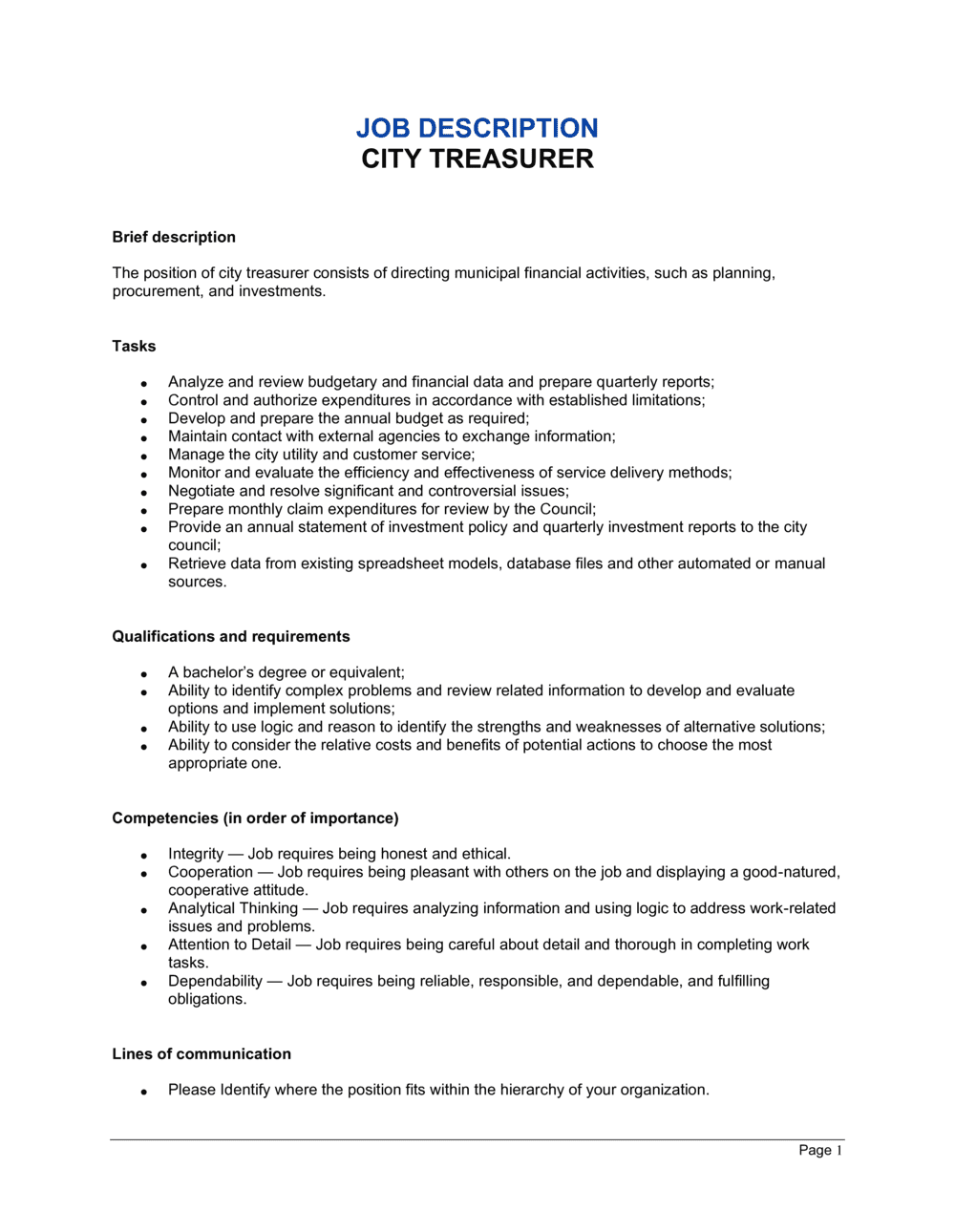
A City Treasurer Job Description is a formal, binding document that defines the responsibilities, qualifications, reporting relationships, compensation range, and performance expectations for a municipal treasurer position. This free Word download gives you a complete, editable template you can adapt to your city's charter requirements and export as PDF for posting, recruitment, or official classification records.
When you need it
Use it when a municipality is creating a new treasurer position, backfilling a vacancy, reclassifying an existing role after a charter amendment, or aligning an inherited position description with current statutory duties and compensation schedules.
What's inside
Position title and department, position summary, essential duties and responsibilities, supervisory responsibilities, minimum qualifications, preferred qualifications, physical and environmental requirements, compensation and benefits band, compliance and ethics obligations, and signature and approval block.

What is a City Treasurer Job Description?

A City Treasurer Job Description is a formal, legally significant document that defines the scope of authority, essential duties, minimum qualifications, compliance obligations, and compensation parameters for the municipal treasurer position. It functions as the official record of what the role requires, establishes the baseline for performance management and civil service classification, and — when paired with an appointment letter or employment contract — sets the enforceable terms under which the incumbent holds office. Unlike a corporate job posting, a municipal job description carries statutory weight: it is used by civil service boards, courts, and audit bodies to evaluate whether hiring decisions were lawful, whether terminations were defensible, and whether the city's bonding and financial disclosure obligations were properly communicated.

Why You Need This Document

Without a properly drafted city treasurer job description, municipalities expose themselves to civil service challenges, audit findings, and equal employment liability simultaneously. Terminations for cause are extremely difficult to defend before a civil service board when the duties on record are too vague to demonstrate the employee failed to meet them. Hiring decisions are vulnerable to disparate-impact claims if qualification thresholds were never documented as operationally necessary. And state auditors routinely cite municipalities that lack documented bonding requirements or financial disclosure obligations in the position's official classification record. A complete, reviewed job description closes all of these gaps before the position is posted — protecting the city legally, supporting effective recruitment, and giving the incoming treasurer a clear, enforceable framework for the role from day one.

Which variant fits your situation?

If your situation is…Use this template
Hiring a treasurer for a large city with a full finance departmentCity Treasurer Job Description (Senior Level)
Defining a part-time or appointed treasurer role for a small townPart-Time Municipal Treasurer Job Description
Posting a deputy or assistant treasurer positionDeputy Treasurer Job Description
Recruiting a finance director who subsumes the treasurer functionFinance Director Job Description
Defining an elected treasurer's statutory duties post-electionElected Official Duties and Responsibilities Statement
Classifying the role under a civil service grade systemPosition Classification and Compensation Plan
Creating a full municipal finance team structureMunicipal Finance Department Organizational Chart

Common mistakes to avoid

❌ Omitting the fidelity bond requirement

Why it matters: Many state statutes require treasurers handling public funds to be bonded for a minimum amount. A job description that fails to specify this requirement may mean the city is unknowingly out of compliance from the moment of hire.

Fix: Confirm your state's statutory bond minimum, insert the specific dollar amount and bond type into the compliance clause, and add bonding as a condition of employment that must be satisfied before the first day of work.

❌ Listing duties at a level too vague to support performance management

Why it matters: Phrases like 'manages city finances' give HR and legal counsel nothing to stand on when documenting a performance deficiency or defending a termination-for-cause decision before a civil service board.

Fix: Replace every general duty with a specific, measurable action — include the system used, the deadline, and the standard, such as 'reconciles the general fund ledger in [SYSTEM] by the 5th business day of each month.'

❌ Mixing minimum and preferred qualifications in one list

Why it matters: Candidates who meet all minimum requirements but not a 'preferred' item listed in the same section may have grounds to challenge a rejection as arbitrary, creating civil service appeal or disparate-impact exposure.

Fix: Use two clearly labeled sections — 'Minimum Qualifications' and 'Preferred Qualifications' — and include an explicit disclaimer that preferred items are used for ranking, not screening.

❌ Not including the non-contract disclaimer in the signature block

Why it matters: Courts in some jurisdictions have found that highly detailed municipal job descriptions create implied contractual obligations, limiting the city's ability to reassign duties or modify the role without a formal amendment process.

Fix: Add a one-sentence disclaimer to the signature block: 'This job description does not constitute an employment contract and may be amended by the City with reasonable written notice.'

❌ Setting a fixed salary instead of a pay band

Why it matters: A single fixed salary prevents the city from offering above-midpoint compensation to attract a highly experienced candidate, and can trigger equal-pay complaints if different incumbents over time are paid different amounts for the same classification.

Fix: Replace any fixed salary figure with an adopted salary range tied to the civil service classification schedule, and include language that actual placement within the range depends on qualifications and experience.

❌ Skipping the physical requirements section for an office-based role

Why it matters: Without a documented physical requirements baseline, the municipality has no reference point for evaluating accommodation requests under the ADA or equivalent state statutes, creating liability if an accommodation decision is later challenged.

Fix: Include a brief physical requirements section for every position, even sedentary ones, describing the typical demands such as prolonged sitting, computer use, and any lifting requirements — however modest.

The 10 key clauses, explained

Position title, department, and classification

In plain language: States the official job title, the department it sits within, the FLSA exemption status, and the civil service pay grade or band.

Sample language
Position Title: City Treasurer | Department: Finance | Reports To: City Manager | FLSA Status: Exempt | Pay Grade: [GRADE/BAND] | Position Type: Full-Time, [At-Will / Civil Service Protected]

Common mistake: Omitting the FLSA exemption status. If the treasurer is later found to be non-exempt, the municipality faces back overtime liability that can span years.

Position summary

In plain language: A 3–5 sentence overview of the role's core purpose — managing municipal revenues, disbursements, investments, and debt obligations in compliance with applicable law.

Sample language
Under the direction of the City Manager, the City Treasurer is responsible for the custody, investment, and disbursement of all municipal funds in accordance with [STATE] statutes and adopted City financial policies. The Treasurer oversees cash management, debt service, financial reporting, and maintains the City's investment portfolio within the parameters of the adopted Investment Policy Statement.

Common mistake: Writing a summary that mirrors the city charter verbatim without translating statutory language into operational duties. Generic statutory language creates ambiguity about day-to-day expectations.

Essential duties and responsibilities

In plain language: An enumerated list of the treasurer's primary job functions — typically 10–15 specific duties covering collections, disbursements, investments, reporting, and compliance.

Sample language
1. Receive, deposit, and account for all City revenues within [X] business days of collection. 2. Manage the City's investment portfolio in compliance with the Investment Policy Statement and [STATE] Government Code §[SECTION]. 3. Prepare monthly cash flow projections and present to City Council on a [QUARTERLY] basis. 4. Administer debt service schedules and coordinate with bond counsel on issuance. 5. Ensure [SYSTEM NAME] accounting system reconciliations are completed by the [Xth] business day of each month.

Common mistake: Listing duties at too high a level — 'manages city finances' rather than 'reconciles the general ledger by the 5th business day of each month.' Vague duties make performance evaluations and termination-for-cause defenses significantly harder.

Supervisory responsibilities

In plain language: Identifies the positions the treasurer directly supervises, the indirect reports, and the extent of hiring and performance management authority.

Sample language
The City Treasurer directly supervises [NUMBER] positions, including [Deputy Treasurer / Accounting Technician / Payroll Specialist]. The Treasurer carries full supervisory authority including hiring recommendations, performance evaluations, and disciplinary actions subject to City HR policy.

Common mistake: Failing to specify whether supervisory authority is direct or functional. Ambiguity here causes organizational conflict and undermines the treasurer's ability to manage the team.

Minimum qualifications

In plain language: The non-negotiable education, licensure, experience, and certification thresholds applicants must meet to be considered — these become the legal baseline for screening decisions.

Sample language
Bachelor's degree in Finance, Accounting, Public Administration, or a related field required. Minimum [5] years of progressively responsible public finance experience. Must possess or obtain Certified Public Finance Officer (CPFO) designation within [24] months of hire. Valid [STATE] driver's license required.

Common mistake: Setting degree requirements that screen out qualified candidates in violation of state or local anti-discrimination guidelines. Several jurisdictions require municipalities to document that degree requirements are operationally necessary.

Preferred qualifications

In plain language: Additional credentials, experience, or skills that strengthen a candidate's application but are not disqualifying if absent — used to rank finalists.

Sample language
Master's degree in Public Administration or Accounting preferred. Active CPA license. Experience with [ERP SYSTEM NAME] or equivalent government ERP. Prior experience managing bond issuance of $[X]M or more. Bilingual in [LANGUAGE] preferred.

Common mistake: Blending preferred qualifications into the minimum qualifications section. This creates legal exposure if a well-qualified candidate who meets minimums is rejected for not meeting a 'preferred' criterion listed as mandatory.

Compliance, ethics, and bonding requirements

In plain language: States the treasurer's obligation to comply with state financial disclosure laws, conflict-of-interest statutes, records retention requirements, and the requirement to obtain and maintain a fidelity bond.

Sample language
The City Treasurer shall file annual financial disclosure statements as required by [STATE] Government Code §[SECTION]. The Treasurer shall maintain a fidelity bond in the minimum amount of $[AMOUNT] throughout the term of employment. Violation of the City's ethics policy or applicable statute is grounds for immediate termination for cause.

Common mistake: Omitting the fidelity bond requirement entirely. Many state statutes mandate bonding for treasurers handling public funds — a job description that doesn't reference it may create an unenforceable position if bonding is later contested.

Physical requirements and working conditions

In plain language: Documents the physical demands of the role — sedentary office environment, occasional attendance at evening council meetings, travel to training or conferences — as required by ADA and civil service classification standards.

Sample language
Work is primarily performed in a standard office environment. The position requires the ability to sit for extended periods, use a computer for up to [8] hours per day, and occasionally lift files or equipment up to [25] pounds. Attendance at evening City Council meetings (approximately [X] per year) is required.

Common mistake: Skipping this section for office-based roles. ADA compliance documentation requires that physical requirements are listed even for sedentary positions, so the municipality can demonstrate any accommodation requests were evaluated against a documented baseline.

Compensation, benefits, and classification band

In plain language: States the salary range or pay grade band, benefit eligibility, retirement plan participation (e.g., state pension), and any performance pay or merit increase schedule.

Sample language
Annual salary range: $[MIN]–$[MAX] depending on qualifications and experience. The City Treasurer is eligible for the full City benefits package including medical, dental, vision, and participation in the [STATE] Public Employees' Retirement System (PERS). Performance evaluations conducted annually; merit increases subject to City Council budget approval.

Common mistake: Stating a single fixed salary instead of a band. A fixed salary creates equal-pay and negotiation problems and prevents the city from offering above-midpoint compensation for an exceptionally qualified candidate.

Approval and authorization signatures

In plain language: Records the signatures of the city manager, HR director, and relevant council authority confirming the description has been reviewed, approved, and placed in the official classification system.

Sample language
Approved by: City Manager [SIGNATURE / NAME / DATE] | HR Director [SIGNATURE / NAME / DATE] | Reviewed by City Council on [DATE] per Resolution No. [NUMBER]. This job description does not constitute an employment contract and may be amended by the City with reasonable notice.

Common mistake: Not including the disclaimer that the job description is not an employment contract. In jurisdictions where courts have found that detailed job descriptions create implied contractual obligations, this omission can limit the city's flexibility to modify duties.

How to fill it out

  1. 1

    Confirm the position's legal status and reporting structure

    Determine whether the treasurer is an appointed or elected position under your city's charter, and identify the direct reporting line (city manager, finance director, or city council). This determines which sections are binding versus advisory.

    💡 Check your state's municipal finance statutes before completing this section — some states specify the treasurer's statutory authority regardless of what the job description says.

  2. 2

    Set the FLSA status and civil service classification

    Assign the correct FLSA exemption status (almost always exempt for a treasurer role) and identify the applicable civil service pay grade or classification band. Coordinate with your HR department to ensure the grade aligns with your compensation schedule.

    💡 Document the basis for the exempt classification using the FLSA executive or administrative exemption criteria — a one-paragraph rationale in the HR file protects against future misclassification claims.

  3. 3

    Write specific, measurable essential duties

    List 10–15 duties that describe actual day-to-day and periodic responsibilities with enough specificity that a new employee could use them as a performance checklist. Include frequency (daily, monthly, quarterly, annually) for recurring tasks.

    💡 Reference the specific accounting system, reporting deadlines, and statutory code sections where applicable — vague duties are the single most common source of termination disputes for municipal employees.

  4. 4

    Define minimum qualifications against operational necessity

    State the minimum education, experience, certifications, and licensure required. For each requirement, confirm it is operationally necessary — municipalities in several states must be prepared to defend degree and credential requirements as job-related.

    💡 Cross-reference your state's civil service classification guidelines before finalizing minimum qualifications to ensure they conform to adopted classification standards.

  5. 5

    Separate minimum from preferred qualifications

    List preferred qualifications in a clearly labeled separate section. These are used to rank candidates, not to disqualify them. Ensure no preferred qualification has been included in the minimum section by mistake.

    💡 Mark preferred qualifications explicitly with language like 'preferred but not required' to reduce exposure if a candidate later claims they were screened out based on a non-mandatory criterion.

  6. 6

    Insert compliance, bonding, and ethics obligations

    Include the fidelity bond amount required by state law, the financial disclosure filing obligation, and a cross-reference to the city's ethics policy. Confirm the bond amount meets or exceeds the statutory minimum for your jurisdiction.

    💡 Call your state's municipal league or attorney general's office to confirm the current statutory minimum bond amount — these figures are updated periodically and many cities use outdated figures.

  7. 7

    State the salary band and benefits eligibility

    Enter the adopted salary range from your compensation schedule, reference the applicable state retirement system, and note the performance evaluation cycle. Do not state a fixed salary.

    💡 If the position is new and no adopted range exists, benchmark against the midpoint salaries of comparable cities within your region and propose a range to the council for adoption before posting.

  8. 8

    Obtain required approvals and execute signature blocks

    Route the completed description through HR director review, city manager approval, and city council or finance committee authorization as required by your charter. Record the resolution number authorizing the position.

    💡 Add the approved job description to the official position classification file on the same day it is signed — delayed filing creates discrepancies that complicate civil service challenges.

Frequently asked questions

What does a city treasurer do?

A city treasurer is responsible for the custody, investment, and disbursement of all municipal funds in compliance with state statutes and the city's adopted financial policies. Core duties include managing daily cash flow, administering the city's investment portfolio, overseeing debt service payments, preparing financial reports for the city council, and ensuring all collections and disbursements are properly recorded. In smaller municipalities, the treasurer may also perform payroll and accounts payable functions.

Is a city treasurer elected or appointed?

It depends on the jurisdiction. In many US states, the city treasurer is an elected position whose authority derives directly from the municipal code or state statute. In others, particularly in council-manager form governments, the treasurer is an appointed civil service employee who reports to the finance director or city manager. The job description template covers both models — the relevant reporting structure and authority section should be completed based on your city charter.

What qualifications are typically required for a city treasurer?

Most municipalities require a bachelor's degree in finance, accounting, or public administration and a minimum of three to five years of progressively responsible public finance experience. Many cities also require or strongly prefer the Certified Public Finance Officer (CPFO) designation issued by the Government Finance Officers Association. A CPA license is often listed as preferred. State-specific licensing or financial disclosure registration may also be required by statute.

Does a city treasurer need to be bonded?

In most US states, yes. State municipal finance statutes typically require any official handling public funds to maintain a fidelity bond in a minimum amount set by statute — often ranging from $50,000 to $500,000 or more depending on the size of the municipality's budget. The bonding requirement should be explicitly stated in the job description and treated as a condition of employment. Municipalities should confirm the current statutory minimum with their state's municipal league or legal counsel.

What is the difference between a city treasurer and a finance director?

A city treasurer is primarily responsible for the custody, investment, and disbursement of public funds — a fiduciary and cash management role. A finance director has broader responsibility for the entire finance function, including budgeting, financial planning, accounting, and often supervision of the treasurer. In larger cities, both positions exist in a hierarchy with the treasurer reporting to the finance director. In smaller municipalities, one person may hold both titles or the roles may be combined.

What laws govern a city treasurer's duties in the US?

At the federal level, the FLSA governs compensation and overtime classification. At the state level, each state's municipal finance act, government code, or public funds investment act defines the treasurer's specific statutory duties, permitted investment instruments, and reporting obligations. GASB standards govern financial reporting. The job description should reference the applicable state code sections so incumbents and candidates understand the statutory context of the role.

How should a city treasurer job description handle civil service protections?

The description should state whether the position is covered by civil service protection and, if so, under which classification system. For civil service positions, the description should reference the adopted pay grade and the performance evaluation process. The signature block should include a disclaimer that the description does not constitute an employment contract, and any modifications to duties should follow the civil service amendment procedures required by your jurisdiction's rules.

Can a city modify a treasurer's job description after hiring?

Generally yes, with appropriate notice, as long as the modification is consistent with the civil service classification and does not constitute a constructive demotion. The job description should include a standard disclaimer confirming that duties may be modified by the city with reasonable notice. For elected treasurers, modifications to statutory duties may require a charter amendment or council resolution, not just an HR action.

What is a CPFO designation and why does it matter for this role?

The Certified Public Finance Officer (CPFO) designation is issued by the Government Finance Officers Association and covers five core areas of public finance: debt management, treasury and investment management, accounting and financial reporting, budgeting, and retirement benefits administration. Requiring or preferring the CPFO signals that the city expects professional-level competency in all dimensions of public finance, not just bookkeeping. It also provides a defensible, objective credential threshold for screening and ranking candidates.

How this compares to alternatives

vs Finance Director Job Description

A finance director job description covers the full scope of a municipality's finance function — budgeting, accounting, financial planning, and often treasury. A city treasurer job description focuses specifically on the fiduciary custody and investment of public funds. In larger cities both roles coexist; in smaller ones the finance director absorbs the treasurer function. Use the treasurer description when the role is legally distinct and separately classified.

vs Corporate Treasurer Job Description

A corporate treasurer description covers private-sector cash management, banking relationships, FX exposure, and capital structure. A city treasurer description operates under statutory authority, public investment policy constraints, civil service rules, and mandatory bonding — the legal framework, reporting obligations, and accountability mechanisms are fundamentally different. Do not use a corporate template for a municipal posting.

vs City Controller Job Description

A city controller is responsible for accounting, financial reporting, internal controls, and audit coordination. A city treasurer focuses on cash custody, disbursements, and investment management. The two roles are complementary checks on each other — in a well-structured finance department, the controller records transactions and the treasurer holds and invests the funds. Some smaller cities combine both functions under a single title.

vs Employment Contract

An employment contract is a binding bilateral agreement that governs the full employment relationship including compensation, termination, non-compete, and severance. A job description defines the duties and qualifications for a position but does not by itself create a contractual obligation — it should include an explicit non-contract disclaimer. For senior municipal hires, an employment contract or appointment letter is typically issued alongside the job description.

Industry-specific considerations

Municipal and Local Government

Core use case — defines the statutory and operational scope of the treasurer role within the city's civil service classification and charter framework.

Regional and County Government

County treasurers often manage larger investment portfolios and tax collection functions, requiring additional clauses covering property tax administration and state remittance obligations.

Special Districts and Authorities

Water, transit, and utility districts use treasurer job descriptions adapted to enterprise fund accounting, rate-setting oversight, and bond covenant compliance.

Nonprofit and Quasi-Governmental Organizations

Quasi-public entities and large nonprofits with bond debt or government grants adapt municipal treasurer descriptions to cover GAAP-based reporting and grantor compliance requirements.

Jurisdictional notes

United States

Requirements vary significantly by state. Most states have a public funds investment act that restricts the instruments a city treasurer may use, and a municipal finance code that specifies bonding minimums and financial disclosure obligations. The FLSA governs overtime exemption status, and the ADA requires physical requirements to be documented. California, Texas, Florida, and New York each have detailed statutory frameworks that should be reviewed before finalizing minimum qualifications.

Canada

In Canada, municipal treasurer roles are governed by provincial municipal acts — the Municipal Act in Ontario, the Community Charter in British Columbia, and equivalents in other provinces. Most provinces require the treasurer to be a designated accounting professional (CPA designation). Quebec municipalities must comply with the Act Respecting Municipal Taxation and may require bilingual job postings. Public sector employment standards vary by province and collective agreement.

United Kingdom

UK local authorities are required by statute to designate a Section 151 Officer (under the Local Government Finance Act 1988) responsible for the proper administration of financial affairs — a role broadly equivalent to a city treasurer. The CIPFA (Chartered Institute of Public Finance and Accountancy) qualification is the standard credential. Job descriptions must comply with the Equality Act 2010 requirements for objective justification of any qualification thresholds.

European Union

EU member states each maintain distinct frameworks for local government finance officers. In Germany, the Kämmerer role carries statutory authority under state municipal codes (Gemeindeordnung). French municipalities designate a comptable public under Treasury oversight. GDPR requirements apply to any personal data collected during the recruitment process, including candidate application materials and background check results. Job postings must comply with EU equal treatment directives.

Template vs lawyer — what fits your deal?

PathBest forCostTime
Use the templateCities with an established HR department and civil service classification system creating or backfilling a standard treasurer positionFree2–4 hours to complete and route for approval
Template + legal reviewMunicipalities creating the position for the first time, combining roles, or operating in a state with complex public employment or bonding statutes$300–$800 for a municipal attorney or HR consultant review3–5 business days
Custom draftedLarge cities with charter amendments, elected treasurer transitions, multi-jurisdictional special districts, or labor union classification disputes$1,500–$5,000+ for municipal law firm drafting and council review2–4 weeks

Glossary

Position Classification
The formal assignment of a job to a grade or pay band within a civil service or municipal compensation schedule based on duties and qualifications.
FLSA Exempt Status
A federal designation under the Fair Labor Standards Act indicating that a salaried executive or professional employee is not entitled to overtime pay.
Fidelity Bond
A surety instrument that protects a municipality against financial loss caused by dishonest acts of a bonded employee such as a treasurer.
Cash Management
The process of collecting, concentrating, investing, and disbursing municipal funds to maximize liquidity while minimizing idle cash.
Debt Service
Scheduled payments of principal and interest on a municipality's outstanding bonds and other long-term obligations.
GAAP
Generally Accepted Accounting Principles — the standardized framework governing financial reporting for public and private entities in the United States.
GASB
The Governmental Accounting Standards Board, which sets accounting and financial reporting standards specifically for state and local governments.
At-Will Employment
An employment relationship in most US states where either party may terminate without cause or advance notice, though many municipal roles carry civil service protections that modify this default.
Civil Service Protection
Statutory safeguards that restrict arbitrary dismissal of public employees, typically requiring documented cause and a formal hearing process.
Elected vs. Appointed Treasurer
In some jurisdictions the treasurer is elected directly by voters and derives authority from statute; in others the role is appointed by the city manager or council and is subject to standard employment terms.
Investment Policy Statement
A governing document adopted by the city council that defines permitted investment instruments, risk tolerances, and reporting requirements for public funds.

Part of your Business Operating System

This document is one of 3,000+ business & legal templates included in Business in a Box.

  • Fill-in-the-blanks — ready in minutes
  • 100% customizable Word document
  • Compatible with all office suites
  • Export to PDF and share electronically

Create your document in 3 simple steps.

From template to signed document — all inside one Business Operating System.
1
Download or open template

Access over 3,000+ business and legal templates for any business task, project or initiative.

2
Edit and fill in the blanks with AI

Customize your ready-made business document template and save it in the cloud.

3
Save, Share, Send, Sign

Share your files and folders with your team. Create a space of seamless collaboration.

Save time, save money, and create top-quality documents.

★★★★★

"Fantastic value! I'm not sure how I'd do without it. It's worth its weight in gold and paid back for itself many times."

Managing Director · Mall Farm
Robert Whalley
Managing Director, Mall Farm Proprietary Limited
★★★★★

"I have been using Business in a Box for years. It has been the most useful source of templates I have encountered. I recommend it to anyone."

Business Owner · 4+ years
Dr Michael John Freestone
Business Owner
★★★★★

"It has been a life saver so many times I have lost count. Business in a Box has saved me so much time and as you know, time is money."

Owner · Upstate Web
David G. Moore Jr.
Owner, Upstate Web

Run your business with a system — not scattered tools

Stop downloading documents. Start operating with clarity. Business in a Box gives you the Business Operating System used by over 250,000 companies worldwide to structure, run, and grow their business.

Start free · No credit card required