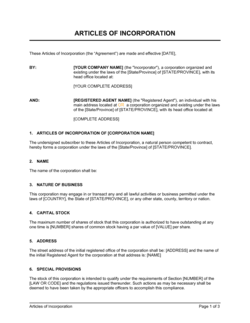
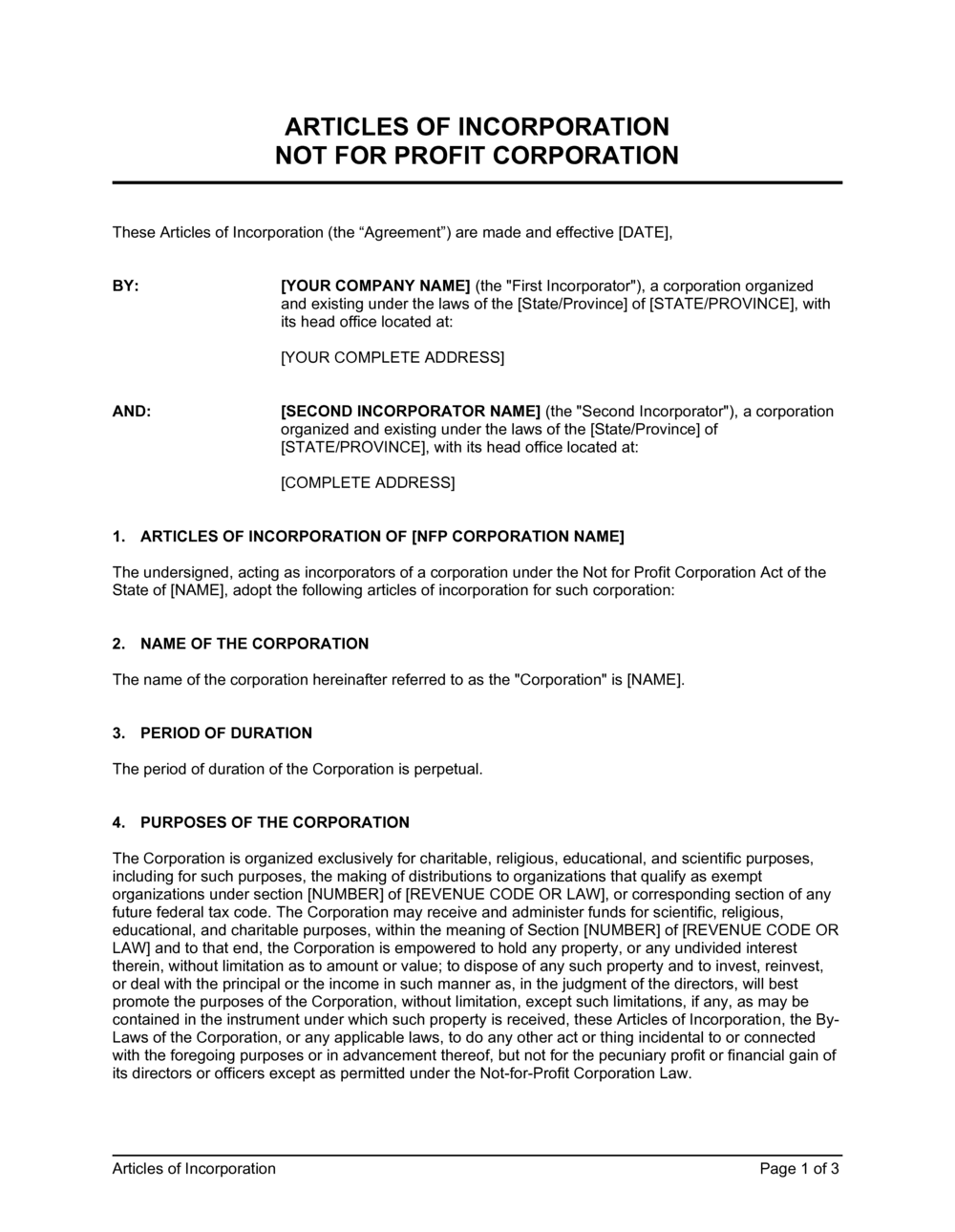
Articles of Incorporation Not for Profit Organization Template

Free Word download • Edit online • Save & share with Drive • Export to PDF

3 pages25–30 min to fillDifficulty: StandardSignature requiredLegal review recommended
Learn more ↓
FreeArticles of Incorporation Not for Profit Organization Template

At a glance

What it is
Articles of Incorporation for a Not-for-Profit Organization is the foundational legal document filed with the state (or provincial/national equivalent) to formally create a nonprofit corporation. This free Word download gives you a structured, government-ready starting point covering all required clauses — from organizational purpose to dissolution provisions — that you can edit online and export as PDF before filing.
When you need it
Use it when formally establishing a new nonprofit corporation, charitable organization, religious association, or other not-for-profit entity that requires legal recognition from a government authority. It is also required before applying for 501(c)(3) federal tax-exempt status in the United States or its equivalent in other jurisdictions.
What's inside
Corporate name and registered office, statement of nonprofit purpose, limitations on activities, director and officer structure, membership provisions, prohibition on private inurement, dissolution and asset distribution clause, and indemnification. Together these clauses satisfy typical state filing requirements and lay the groundwork for tax-exempt status applications.

What is Articles of Incorporation for a Not-for-Profit Organization?

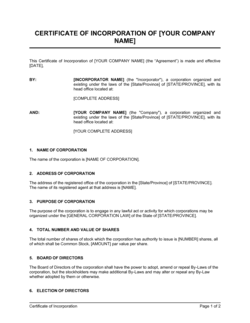
Articles of Incorporation for a Not-for-Profit Organization is the foundational legal document filed with a state (or national) government authority to formally create a nonprofit corporation as a distinct legal entity. It establishes the organization's legal name, charitable or public benefit purpose, governing board structure, membership provisions, and the mandatory clauses — including private inurement prohibition and asset distribution upon dissolution — required to qualify for federal tax-exempt status under Section 501(c)(3) of the Internal Revenue Code or its international equivalent. Once accepted by the state, the articles give the nonprofit separate legal existence from its founders, enabling it to enter contracts, hold property, open bank accounts, and receive tax-deductible donations.

Why You Need This Document

Without filed articles of incorporation, a nonprofit organization has no legal existence — it cannot open a bank account, sign a lease, employ staff, or receive a tax-deductible contribution. Donors writing checks to an unincorporated group cannot deduct those gifts, which materially reduces fundraising capacity for any organization dependent on charitable giving. More critically, the IRS will not issue a 501(c)(3) determination letter without a copy of filed articles that include the specific purpose, private inurement prohibition, and dissolution clauses it requires — and operating without that determination leaves founders personally exposed to tax liability on every dollar the organization collects. Filing well-drafted articles on day one is the single action that separates a legally protected mission-driven organization from an informal group whose founders bear personal liability for every contract it signs and every dollar it spends.

Which variant fits your situation?

If your situation is…Use this template
Forming a public charity seeking 501(c)(3) statusArticles of Incorporation — Public Charity
Forming a private foundation with a single donor or familyArticles of Incorporation — Private Foundation
Creating a trade association or professional society (501(c)(6))Articles of Incorporation — Trade Association
Establishing an unincorporated voluntary associationAssociation Bylaws
Setting out internal governance rules after incorporationNonprofit Bylaws
Documenting the first board meeting after filingMinutes of First Meeting of Board of Directors
Forming a for-profit corporation insteadArticles of Incorporation (For-Profit)

Common mistakes to avoid

❌ Omitting the IRS-required dissolution clause

Why it matters: Without language directing remaining assets to another 501(c)(3) upon dissolution, the IRS will deny the tax-exemption application. Assets that could revert to founders make the organization indistinguishable from a for-profit.

Fix: Use the IRS model dissolution language verbatim and confirm it names a qualifying 501(c)(3) recipient organization or class of organizations — not individuals or non-exempt entities.

❌ Writing an overly broad or vague purpose statement

Why it matters: Purpose language like 'to engage in any lawful nonprofit activity' does not satisfy the IRS's specificity requirement and delays the 501(c)(3) determination letter while the IRS requests clarification.

Fix: Describe the specific activities the organization will conduct, the population it will serve, and the geographic area of operation — then include the Section 501(c)(3) reference and the appropriate activity category (charitable, educational, religious, or scientific).

❌ Filing without verifying state-specific requirements

Why it matters: Each state has unique requirements for nonprofit articles — minimum director counts, required clauses, filing fees, and attachment requirements vary. A document that meets federal standards may still be rejected by the state.

Fix: Download the state's official nonprofit articles of incorporation form or checklist before drafting, and cross-reference every required element before submitting.

❌ Listing only one or two directors

Why it matters: Most states require a minimum of three directors for nonprofit corporations, and the IRS views a small, related-party board as a governance red flag that can trigger additional scrutiny during 501(c)(3) review.

Fix: Recruit at least three independent directors before filing. 'Independent' means no family relationships or financial entanglements with each other or with the organization's founders.

❌ Not filing Form 1023 within 27 months of incorporation

Why it matters: Missing the 27-month window means the IRS will only recognize tax-exempt status from the application date — not the incorporation date — leaving donations received in the interim potentially non-deductible for donors.

Fix: File the EIN application the day incorporation is confirmed, then begin Form 1023 preparation immediately. Use Form 1023-EZ if gross receipts are projected under $50,000/year to expedite approval.

❌ Using a P.O. Box as the registered office address

Why it matters: Virtually every state requires a physical street address for the registered office. Filing with a P.O. Box results in immediate rejection and delays legal formation.

Fix: Use the organization's physical office address, a director's home address (if permitted by state law), or a commercial registered agent service address as the registered office.

The 10 key clauses, explained

Corporate Name

In plain language: States the full legal name of the nonprofit corporation exactly as it will appear on government filings and official records.

Sample language
The name of this corporation is [ORGANIZATION FULL LEGAL NAME] (the 'Corporation').

Common mistake: Choosing a name that is already registered in the state or one that is too similar to an existing entity — the state will reject the filing and the organization loses its planned launch date.

Registered Office and Registered Agent

In plain language: Identifies the physical street address and the named agent who will receive legal notices and government correspondence on behalf of the corporation.

Sample language
The registered office of the Corporation is located at [STREET ADDRESS, CITY, STATE, ZIP]. The registered agent at that address is [REGISTERED AGENT NAME].

Common mistake: Using a P.O. Box as the registered office address. Most states require a physical street address; a P.O. Box causes rejection of the filing.

Statement of Nonprofit Purpose

In plain language: Describes the specific charitable, educational, religious, or public benefit purpose for which the organization is formed — this language must align with the intended tax-exempt classification.

Sample language
The Corporation is organized exclusively for [charitable / educational / religious / scientific] purposes within the meaning of Section 501(c)(3) of the Internal Revenue Code, including [SPECIFIC PURPOSE — e.g., providing free legal aid to low-income individuals in [COUNTY/REGION]].

Common mistake: Writing a purpose clause that is too broad (e.g., 'to do any lawful nonprofit activity') or too narrow (e.g., tied to a specific program that may change). The IRS scrutinizes purpose language during 501(c)(3) determination reviews.

Limitations on Activities

In plain language: Restricts the organization from engaging in activities inconsistent with its tax-exempt status — specifically prohibiting substantial lobbying, political campaign intervention, and private inurement.

Sample language
No substantial part of the activities of the Corporation shall consist of carrying on propaganda or otherwise attempting to influence legislation. The Corporation shall not participate in or intervene in any political campaign on behalf of or in opposition to any candidate for public office.

Common mistake: Omitting this clause entirely to save space. The IRS treats its absence as a red flag during 501(c)(3) review and will request an amendment before issuing a determination letter.

Prohibition on Private Inurement

In plain language: Explicitly prohibits the organization's net earnings from benefiting any private individual, director, officer, or insider beyond reasonable compensation for services rendered.

Sample language
No part of the net earnings of the Corporation shall inure to the benefit of, or be distributable to, its members, directors, officers, or other private individuals, except that the Corporation is authorized to pay reasonable compensation for services rendered.

Common mistake: Conflating private inurement language with the compensation policy. The articles must contain a categorical prohibition; the specifics of compensation approval belong in the bylaws or a conflict-of-interest policy.

Number and Qualification of Directors

In plain language: States the initial number of directors (or a range), how they are selected, and any eligibility requirements — establishing the minimum governance structure required for corporate formation.

Sample language
The Corporation shall be governed by a Board of Directors consisting of not fewer than [MINIMUM NUMBER] and not more than [MAXIMUM NUMBER] directors. The initial directors are: [NAME, ADDRESS]; [NAME, ADDRESS]; [NAME, ADDRESS].

Common mistake: Listing only one director. Most states require a minimum of three directors for a nonprofit, and the IRS views a single-director nonprofit with suspicion during 501(c)(3) review.

Membership Provisions

In plain language: States whether the corporation has members with voting rights (membership organization) or is governed solely by its board (non-membership organization), which has significant implications for governance and elections.

Sample language
The Corporation shall have no members as defined under [STATE] Nonprofit Corporation Law. All rights that would otherwise vest in members are vested in the Board of Directors.

Common mistake: Inadvertently creating a membership structure by including vague language about 'supporters' or 'community members.' Unintended membership classes can require elections, quorum rules, and annual meetings that the organization is not prepared to administer.

Dissolution and Distribution of Assets

In plain language: Specifies that upon dissolution, after paying all debts, the remaining assets must be transferred to one or more qualifying tax-exempt organizations — a mandatory requirement for 501(c)(3) status.

Sample language
Upon the dissolution of the Corporation, the Board of Directors shall, after paying or making provision for payment of all liabilities, distribute the remaining assets to one or more organizations that qualify under Section 501(c)(3) of the Internal Revenue Code, as the Board shall determine.

Common mistake: Omitting the requirement that successor organizations be 501(c)(3) qualified or allowing assets to revert to incorporators. This language is mandatory for IRS approval and its absence will result in denial of tax-exempt status.

Indemnification

In plain language: Authorizes the corporation to indemnify directors, officers, and employees against personal liability for actions taken in good faith on behalf of the organization, to the extent permitted by state law.

Sample language
The Corporation shall indemnify each director, officer, employee, and agent of the Corporation to the fullest extent permitted by [STATE] law, against expenses, judgments, fines, and amounts paid in settlement in connection with any proceeding arising by reason of the fact that such person is or was a director, officer, employee, or agent of the Corporation.

Common mistake: Providing unlimited indemnification without tying it to the state law cap. Courts will enforce the state-law ceiling regardless, but language that implies broader indemnification can create false expectations among board members.

Incorporator Signature and Effective Date

In plain language: Identifies the person(s) executing the articles and the date, completing the formal execution requirement for state filing.

Sample language
I, the undersigned incorporator, hereby execute these Articles of Incorporation on [DATE]. Incorporator: [INCORPORATOR NAME], [ADDRESS].

Common mistake: Having a director or officer — rather than the designated incorporator — sign the document. The state filing requires the incorporator's signature specifically; mismatches between the named incorporator and the signatory cause rejection.

How to fill it out

  1. 1

    Conduct a name availability search

    Search your state's business entity database to confirm the proposed corporate name is available and distinguishable from existing registrations. Reserve the name if your state offers that option.

    💡 Run the name through the IRS's online search tool as well — a name too similar to an existing 501(c)(3) can complicate your determination letter application even if the state accepts it.

  2. 2

    Identify and confirm your registered agent

    Designate a registered agent with a physical street address in the state of incorporation. This can be an individual officer, a director, or a commercial registered agent service.

    💡 Using a commercial registered agent service ($50–$300/year) ensures address continuity if your office moves and prevents missed legal notices.

  3. 3

    Draft the purpose clause to match your tax-exempt category

    Write a purpose statement specific enough to describe your activities but broad enough to accommodate program growth. For 501(c)(3) organizations, include the Section 501(c)(3) reference verbatim.

    💡 Review IRS Publication 557 before drafting — it lists approved purpose language patterns and common deficiencies flagged during determination reviews.

  4. 4

    Insert the limitations, private inurement, and dissolution clauses

    Copy the IRS-required language for lobbying limitations, private inurement prohibition, and asset distribution upon dissolution exactly as required. These three clauses are non-negotiable for 501(c)(3) qualification.

    💡 Do not paraphrase the IRS model language for these three clauses. Minor deviations trigger additional IRS correspondence that can delay your determination letter by 3–6 months.

  5. 5

    List the initial board of directors

    Enter the full legal name and address of each initial director. Confirm your state's minimum director count and ensure you meet it — most states require at least three for nonprofits.

    💡 Directors should be independent — avoid listing more than one family member or related party, as the IRS scrutinizes governance independence during 501(c)(3) review.

  6. 6

    Decide on a membership or non-membership structure

    Choose whether the corporation will have formal voting members or will be governed solely by the board. State this explicitly in the articles to avoid ambiguity in your governance structure.

    💡 Most small nonprofits choose non-membership structures to simplify governance. A membership structure requires annual elections, quorum rules, and member meeting notices — meaningful administrative burden.

  7. 7

    Execute and file with the state

    Have the incorporator sign the completed articles and submit them to the appropriate state office — typically the Secretary of State — along with the required filing fee (commonly $25–$100).

    💡 Request a certified copy of the filed articles at the same time you submit. You will need it for your bank account application and IRS Form 1023 filing.

  8. 8

    Apply for your EIN and 501(c)(3) status

    Obtain a federal Employer Identification Number from the IRS immediately after filing. Then prepare and submit Form 1023 (or Form 1023-EZ for eligible smaller organizations) to apply for tax-exempt status.

    💡 Apply for the EIN online at IRS.gov — it is issued instantly. File Form 1023 within 27 months of incorporation to have tax-exempt status recognized retroactively to the formation date.

Frequently asked questions

What are articles of incorporation for a nonprofit organization?

Articles of incorporation for a nonprofit organization are the foundational legal document filed with a state government authority to formally create a nonprofit corporation. They establish the organization's legal name, purpose, governance structure, and operational limitations. Once accepted by the state, the articles give the organization legal existence as a corporate entity — separate from its founders — and are a prerequisite to applying for federal 501(c)(3) tax-exempt status in the United States.

What is the difference between articles of incorporation and bylaws?

Articles of incorporation are the external-facing public document filed with the government to create the corporation — they define purpose, directors, and required legal provisions. Bylaws are the internal governance document that supplements the articles by setting out meeting procedures, officer roles, voting rules, and day-to-day operating procedures. The articles come first; bylaws are typically adopted at the first board meeting after incorporation. Both are required for a well-governed nonprofit.

Do I need articles of incorporation to get 501(c)(3) status?

Yes. The IRS requires a copy of your filed articles of incorporation as part of the Form 1023 application for 501(c)(3) tax-exempt status. The articles must contain specific language — including a public benefit purpose statement, prohibition on private inurement, and a qualifying dissolution clause — before the IRS will approve the application. A state-filed document without these provisions will require amendment before the IRS determination letter is issued.

Who signs articles of incorporation for a nonprofit?

The incorporator — the person designated to file the formation documents — signs the articles of incorporation. The incorporator is often a founder, attorney, or trusted individual acting on behalf of the organizing group. In most states, a single incorporator is sufficient. The incorporator's role typically ends once the initial board of directors is seated and the organizational meeting is held.

How much does it cost to file articles of incorporation for a nonprofit?

State filing fees for nonprofit articles of incorporation typically range from $25 to $100 in most US states, though a few states charge more. Some states offer expedited processing for an additional fee. Federal 501(c)(3) application fees run $275 for Form 1023-EZ (eligible organizations) or $600 for the standard Form 1023. Total first-year formation costs — including state filing, EIN, and federal application — commonly run $350–$750 without legal fees.

Can I amend articles of incorporation after filing?

Yes. Most states allow a nonprofit to amend its articles by passing a board resolution (and, if applicable, a member vote), preparing amended articles, and filing them with the Secretary of State for a modest amendment fee. However, material amendments — such as changing the purpose clause or dissolution provisions — must be reported to the IRS if the organization already holds 501(c)(3) status, as they can affect the determination.

What is the difference between a nonprofit corporation and an unincorporated association?

A nonprofit corporation is a distinct legal entity created by state filing, providing liability protection for directors and officers, a clear governance structure, and the ability to enter contracts, hold property, and receive tax-deductible donations. An unincorporated association is an informal group with no separate legal existence — its members can be personally liable for the organization's debts, and it generally cannot obtain 501(c)(3) status without first incorporating.

Does a nonprofit need a lawyer to file articles of incorporation?

For simple charitable organizations with straightforward purposes, a high-quality template is generally sufficient for state filing. Legal review is recommended when the organization has a complex governance structure, operates in multiple states, has employees from day one, involves substantial real-estate or intellectual property, or anticipates significant donor funds in the first year. Form 1023 preparation — particularly for organizations expecting over $50,000 in gross receipts — benefits from experienced nonprofit legal counsel.

How long does it take for articles of incorporation to be approved?

Processing times vary by state. Most states approve nonprofit articles of incorporation within 1–4 weeks by mail or 1–5 business days online. Expedited filing options — available in most states for an additional fee — can reduce turnaround to 24–48 hours. The federal 501(c)(3) determination letter, which is a separate process, currently takes 3–6 months for standard Form 1023 applications and 2–4 weeks for Form 1023-EZ eligible organizations.

How this compares to alternatives

vs Articles of Incorporation (For-Profit)

For-profit articles of incorporation create a corporation designed to generate and distribute profit to shareholders, with an authorized share structure at the core. Nonprofit articles instead focus on public benefit purpose, private inurement prohibition, and dissolution provisions that route assets to other exempt organizations. The two documents have fundamentally different governance and tax implications and should never be interchanged.

vs Nonprofit Bylaws

Articles of incorporation are the external formation document filed with the government — they create the corporation. Bylaws are the internal governance document adopted by the board after incorporation — they define how the organization operates. Both are required: the articles give the organization legal existence; the bylaws tell the board how to govern it.

vs Non-Disclosure Agreement

An NDA is a bilateral confidentiality contract between two parties protecting sensitive information during a specific interaction or relationship. Articles of incorporation are a unilateral formation filing with the government that creates a legal entity. They serve entirely different functions and are used at different stages — NDAs during operations, articles at formation.

vs Operating Agreement (LLC)

An LLC operating agreement governs a for-profit limited liability company — a flexible entity structure designed for profit distribution among members. Articles of incorporation for a nonprofit create a legally distinct entity type that cannot distribute profits and must maintain a public benefit purpose. Nonprofits cannot be organized as LLCs for 501(c)(3) purposes in most US states.

Industry-specific considerations

Education and Schools

Private schools, tutoring cooperatives, and scholarship funds incorporate as nonprofits to qualify for tax-deductible donations and state education grants, with purpose clauses specifically referencing educational activities under Section 501(c)(3).

Healthcare and Social Services

Community health clinics, food banks, and social service agencies use nonprofit articles to establish the legal entity required for government grants, Medicaid reimbursement, and major foundation funding.

Religious Organizations

Churches, mosques, synagogues, and religious associations often incorporate to gain liability protection and the ability to hold real property, with purpose clauses referencing religious activities — though many qualify for automatic 501(c)(3) recognition without a separate IRS application.

Arts and Culture

Theater companies, museums, and arts education organizations incorporate as nonprofits to access NEA and state arts council grants, with purpose clauses explicitly referencing public benefit through artistic or cultural programming.

Jurisdictional notes

United States

Nonprofit corporations are formed under state law, so requirements vary across all 50 states. Most states require a minimum of three directors, a registered agent with a physical address, and specific purpose and dissolution language tied to 501(c)(3). California requires additional disclosures and an independent audit for organizations with revenues above $2 million. Delaware is a common choice for large nonprofits due to its well-developed corporate law, but the organization must also register in any state where it actively solicits donations.

Canada

Canadian nonprofits can incorporate federally under the Canada Not-for-profit Corporations Act (NFP Act) or provincially under equivalent statutes. Federal incorporation provides a national presence; provincial incorporation (e.g., Ontario's Not-for-Profit Corporations Act, 2010) is simpler for locally focused organizations. Charitable status is granted separately by the Canada Revenue Agency — the CRA requires a charitable purpose clause and restrictions on political activity similar to IRS requirements. Quebec organizations should ensure articles comply with the Civil Code of Québec and are available in French.

United Kingdom

In England and Wales, charities most commonly incorporate as Charitable Incorporated Organisations (CIOs) — which combine incorporation and charity registration in a single filing with the Charity Commission — or as companies limited by guarantee registered at Companies House. Scotland has a separate Scottish Charitable Incorporated Organisation (SCIO) structure. Traditional articles of incorporation are used for guarantee companies but CIO constitutions replace them for most new charities. Registration with the Charity Commission is required for organizations with income above £5,000 per year.

European Union

There is no unified EU nonprofit corporation form — organizations incorporate under the national law of each member state. Common structures include the French association loi 1901, the German eingetragener Verein (e.V.), and the Dutch stichting. Cross-border activities may trigger registration obligations in each country of operation. GDPR applies to all nonprofit organizations processing personal data of EU residents, requiring appropriate data protection language in operational policies. Some member states require government approval before a nonprofit can receive foreign donations.

Template vs lawyer — what fits your deal?

PathBest forCostTime
Use the templateSimple public charities, community organizations, and educational nonprofits with straightforward purposes filing in a single stateFree (plus state filing fee of $25–$100)2–4 hours to complete; 1–4 weeks for state processing
Template + legal reviewOrganizations expecting significant donor revenue in Year 1, those with complex governance structures, or founders unsure whether their purpose qualifies for 501(c)(3)$500–$1,500 for a nonprofit attorney review and Form 1023 guidance3–7 days for review; add 3–6 months for IRS determination
Custom draftedHospital systems, large foundations, multi-state nonprofits, organizations with employees at launch, or those with real-estate or IP holdings$2,000–$8,000 for full formation and 501(c)(3) application preparation2–6 weeks for drafting; 3–6 months for IRS determination

Glossary

Articles of Incorporation
The primary formation document filed with a government authority to create a corporation — sometimes called a certificate of incorporation or corporate charter.
Not-for-Profit Corporation
A legal entity organized for a purpose other than generating profit for owners or shareholders, with net revenue reinvested in the mission rather than distributed.
Registered Agent
A person or entity designated to receive official government correspondence and legal process on behalf of the corporation at a physical address in the state of incorporation.
501(c)(3)
The US Internal Revenue Code section that grants federal income tax exemption to qualifying charitable, religious, educational, and scientific organizations.
Private Inurement
The prohibited use of a nonprofit's assets or earnings to benefit an insider — such as a director, officer, or key employee — beyond reasonable compensation.
Dissolution Clause
A provision specifying how the organization's remaining assets will be distributed if it ceases operations — for 501(c)(3) purposes, assets must go to another exempt organization.
Incorporator
The person or persons who sign and file the articles of incorporation, initiating the legal creation of the corporation.
Board of Directors
The governing body of a nonprofit corporation, responsible for fiduciary oversight, strategic direction, and ensuring the organization fulfills its stated mission.
Public Benefit Purpose
The stated reason for the organization's existence that serves the general public or a segment of it, required for most charitable tax-exempt classifications.
Bylaws
The internal governance document that supplements the articles of incorporation by setting out meeting procedures, voting rights, officer roles, and day-to-day operating rules.
Charitable Purpose Limitation
Language in the articles restricting the organization's activities to those permitted under the applicable tax-exempt category, preventing scope creep that could jeopardize exempt status.

Part of your Business Operating System

This document is one of 3,000+ business & legal templates included in Business in a Box.

  • Fill-in-the-blanks — ready in minutes
  • 100% customizable Word document
  • Compatible with all office suites
  • Export to PDF and share electronically

Create your document in 3 simple steps.

From template to signed document — all inside one Business Operating System.
1
Download or open template

Access over 3,000+ business and legal templates for any business task, project or initiative.

2
Edit and fill in the blanks with AI

Customize your ready-made business document template and save it in the cloud.

3
Save, Share, Send, Sign

Share your files and folders with your team. Create a space of seamless collaboration.

Save time, save money, and create top-quality documents.

★★★★★

"Fantastic value! I'm not sure how I'd do without it. It's worth its weight in gold and paid back for itself many times."

Managing Director · Mall Farm
Robert Whalley
Managing Director, Mall Farm Proprietary Limited
★★★★★

"I have been using Business in a Box for years. It has been the most useful source of templates I have encountered. I recommend it to anyone."

Business Owner · 4+ years
Dr Michael John Freestone
Business Owner
★★★★★

"It has been a life saver so many times I have lost count. Business in a Box has saved me so much time and as you know, time is money."

Owner · Upstate Web
David G. Moore Jr.
Owner, Upstate Web

Run your business with a system — not scattered tools

Stop downloading documents. Start operating with clarity. Business in a Box gives you the Business Operating System used by over 250,000 companies worldwide to structure, run, and grow their business.

Start free · No credit card required