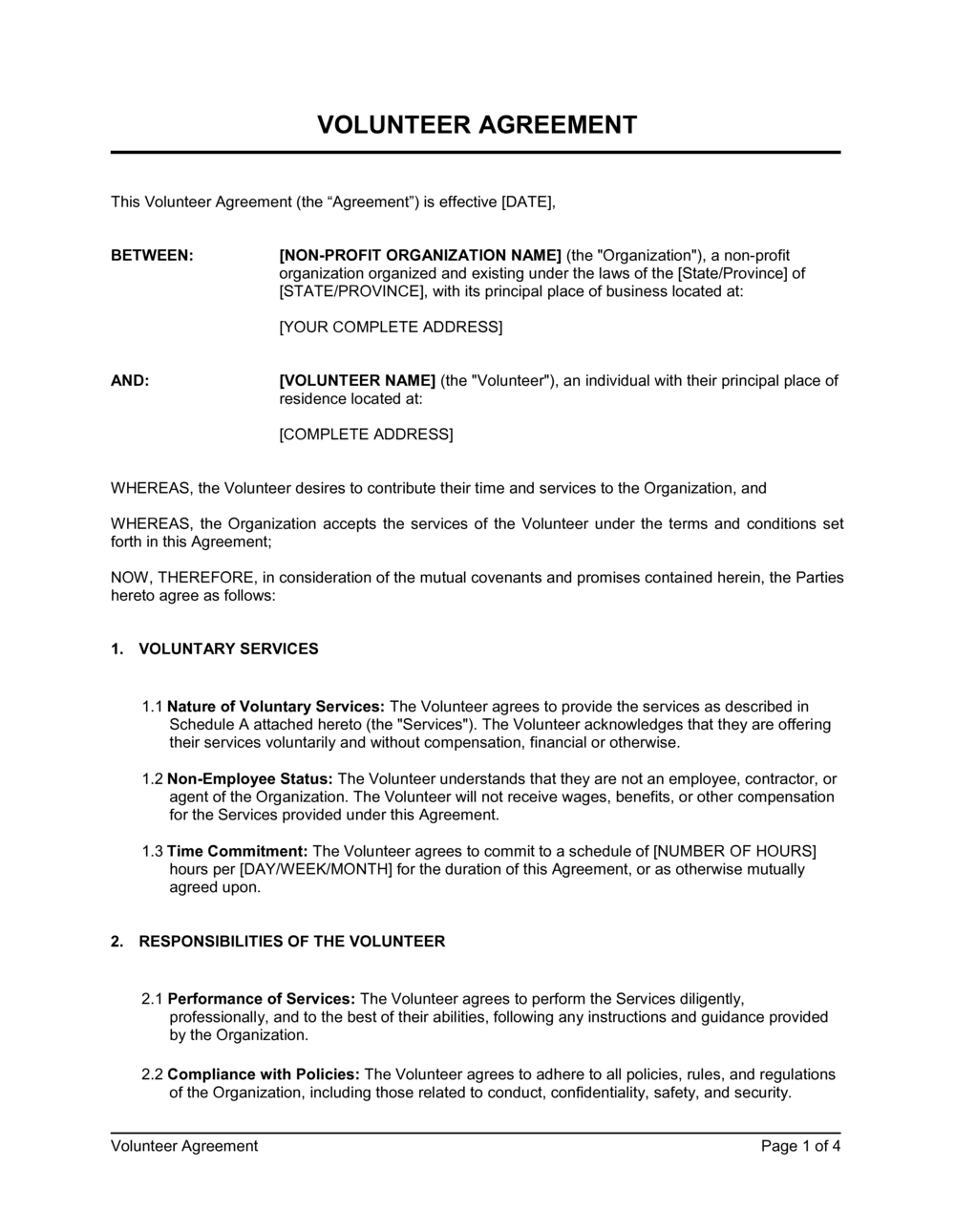
Volunteer Agreement For Non Profit Template

Free Word download β€’ Edit online β€’ Save & share with Drive β€’ Export to PDF

4 pagesβ€’25–30 min to fillβ€’Difficulty: Standardβ€’Signature requiredβ€’Legal review recommended
Learn more ↓
FreeVolunteer Agreement For Non Profit Template

At a glance

What it is
A Volunteer Agreement for Non Profit is a legally binding document between a nonprofit organization and an individual volunteer that defines the scope of volunteer duties, confidentiality obligations, liability limitations, and termination conditions. This free Word download is fully editable online and can be exported as PDF for signature before a volunteer's first shift.
When you need it
Use it before any volunteer begins work with your organization β€” whether for a one-time event, an ongoing program role, or a seasonal campaign. It is especially critical when volunteers will have access to vulnerable populations, confidential data, or organizational assets.
What's inside
Volunteer role and duties, service schedule, confidentiality and data protection obligations, liability waiver and indemnification, code of conduct, intellectual property assignment, insurance notice, and termination provisions.

What is a Volunteer Agreement for Non Profit?

A Volunteer Agreement for Non Profit is a legally binding document between a nonprofit organization and an individual volunteer that establishes the terms under which unpaid services will be provided. It defines the volunteer's specific role and duties, confirms the non-compensatory nature of the arrangement, and sets out enforceable obligations covering confidentiality, liability, intellectual property, code of conduct, and termination. Unlike a handshake arrangement or an informal orientation checklist, a signed volunteer agreement creates a documented record of mutual expectations β€” one that courts and insurers can rely on if a dispute, injury, or data breach occurs. The document protects both parties: the organization secures enforceable obligations; the volunteer receives clarity on what is expected and what protections apply.

Why You Need This Document

Operating a volunteer program without a signed agreement exposes your nonprofit to four concrete risks. First, any content, photographs, or materials created by a volunteer remain that volunteer's intellectual property under copyright law unless ownership is explicitly transferred in writing β€” meaning a departing volunteer can demand removal of collateral your organization has published and distributed. Second, without a confidentiality clause, there is no enforceable basis to prevent a volunteer from sharing donor lists, client intake records, or grant strategy with third parties. Third, the absence of a liability waiver leaves the organization without a documented acknowledgment of assumed risk when volunteers are injured during activities β€” a significant exposure for organizations running physical programs, events, or fieldwork. Fourth, if a dispute arises about whether a long-serving volunteer was effectively an employee, the agreement's non-compensatory acknowledgment is the first document a labor authority or court will request. A well-drafted volunteer agreement, executed before the first shift, closes all four gaps β€” and costs less than an hour to complete with this template.

Which variant fits your situation?

If your situation is…Use this template
Engaging a skilled professional volunteering their expertise (pro bono)Pro Bono Services Agreement
Managing a large group of event-day volunteers under a single umbrellaEvent Volunteer Agreement
Placing volunteers at a third-party partner siteVolunteer Placement Agreement
Hiring a paid part-time worker to supplement volunteer staffPart-Time Employment Contract
Engaging an independent contractor for a nonprofit projectIndependent Contractor Agreement
Onboarding a board member with governance obligationsBoard Member Agreement
Documenting an intern's unpaid placement at a nonprofitInternship Agreement

Common mistakes to avoid

❌ Misclassifying a paid worker as a volunteer

Why it matters: Labeling a compensated worker as a volunteer to avoid payroll taxes and employment law obligations is worker misclassification. Tax authorities in the US, Canada, and UK treat this as a serious violation, triggering back taxes, penalties, and potential civil liability.

Fix: Reserve volunteer agreements strictly for individuals receiving no wages or material benefits. If any payment, stipend, or in-kind compensation above a nominal threshold is involved, use an employment or contractor agreement instead.

❌ Signing the agreement after the volunteer's first shift

Why it matters: A volunteer who has already performed services gave no new consideration for post-start obligations such as confidentiality or IP assignment, potentially voiding those clauses in common-law jurisdictions.

Fix: Execute the agreement before the volunteer performs any services. If circumstances prevent this, provide a documented additional benefit β€” such as a training session or equipment β€” as fresh consideration at the time of late signing.

❌ Using a liability waiver that covers gross negligence

Why it matters: Courts in most jurisdictions will not enforce a waiver that purports to release an organization from liability for its own gross negligence or intentional misconduct. Including such language can render the entire waiver unenforceable.

Fix: Limit the waiver to ordinary negligence and clearly carve out gross negligence and wilful misconduct from the release. Have a lawyer review the specific language for the jurisdiction where activities take place.

❌ No survival clause for confidentiality and IP obligations

Why it matters: Without explicit survival language, a departing volunteer may argue that all obligations terminated when the agreement ended β€” leaving donor lists, client records, and produced content unprotected.

Fix: Add a survival clause stating that confidentiality, IP assignment, and indemnification obligations remain in effect indefinitely after termination of the volunteer relationship.

The 10 key clauses, explained

Parties, role, and commencement

In plain language: Identifies the nonprofit organization and the volunteer by full legal name, states the volunteer's title or role, and records the date service begins.

Sample language
This Volunteer Agreement is entered into on [DATE] between [NONPROFIT LEGAL NAME], a [STATE/COUNTRY] nonprofit corporation ('Organization'), and [VOLUNTEER FULL NAME] ('Volunteer'). Volunteer will serve as [ROLE/TITLE] commencing [START DATE].

Common mistake: Using only the organization's trade name instead of its registered legal name. If the legal name on the agreement doesn't match the registered entity, enforcing liability or confidentiality clauses against the right organization becomes complicated.

Scope of duties and schedule

In plain language: Describes the specific tasks the volunteer will perform, the expected time commitment, location, and any reporting structure.

Sample language
Volunteer shall perform the duties set out in Schedule A, including [SPECIFIC TASKS], at [LOCATION] on an approximate schedule of [HOURS/DAYS PER WEEK]. Volunteer shall report to [SUPERVISOR NAME/TITLE].

Common mistake: Leaving duties so vague that performance expectations cannot be measured or that any task can be assigned without limit β€” which risks courts treating the arrangement as de facto employment.

Non-compensatory status

In plain language: Explicitly states that the volunteer receives no wages, salary, or employment benefits and does not expect remuneration, protecting the organization from minimum wage or employment claims.

Sample language
Volunteer acknowledges that this arrangement is purely voluntary, that no compensation, wages, or benefits of any kind are payable, and that Volunteer does not expect or anticipate remuneration for services rendered.

Common mistake: Omitting this clause entirely and assuming voluntary intent is obvious. Without written acknowledgment, a volunteer who later claims constructive employment can point to the absence of any agreed non-compensatory terms.

Confidentiality

In plain language: Prohibits the volunteer from disclosing or misusing the organization's confidential information β€” client records, donor data, financials, or strategy β€” during and after their service.

Sample language
Volunteer agrees not to disclose, use, or reproduce any Confidential Information of the Organization without prior written consent. 'Confidential Information' includes but is not limited to client and donor records, financial data, internal communications, and program strategies.

Common mistake: Failing to define 'Confidential Information' with at least three concrete examples. Overly generic language ('everything is confidential') is difficult to enforce and may be struck down as unreasonably broad.

Liability waiver and assumption of risk

In plain language: The volunteer acknowledges the risks of their activities, assumes personal responsibility for those risks, and releases the organization from liability for injuries or losses not caused by the organization's gross negligence.

Sample language
Volunteer assumes all risks associated with volunteer activities and releases [NONPROFIT LEGAL NAME], its officers, directors, employees, and agents from any claims arising out of Volunteer's participation, except those resulting from the Organization's gross negligence or wilful misconduct.

Common mistake: Using a blanket waiver that purports to release the organization from liability for its own gross negligence or intentional acts. Courts routinely void these provisions, and their presence can undermine the enforceability of the rest of the waiver.

Indemnification

In plain language: Requires the volunteer to indemnify the organization for losses arising from the volunteer's own negligent or intentional acts committed outside the scope of their assigned duties.

Sample language
Volunteer agrees to indemnify and hold harmless [NONPROFIT LEGAL NAME] from any claims, damages, or expenses arising from Volunteer's acts or omissions that are outside the scope of the duties described in this Agreement.

Common mistake: Drafting an indemnification clause so broad that it requires the volunteer to cover losses the organization caused. Courts will not enforce indemnity provisions that effectively shield the organization from its own wrongdoing.

Intellectual property

In plain language: Assigns to the organization all work product, content, photographs, code, or materials created by the volunteer in connection with their service.

Sample language
Any work product, materials, or creative works produced by Volunteer in the course of or related to their volunteer service are the sole property of [NONPROFIT LEGAL NAME] and are hereby irrevocably assigned to the Organization.

Common mistake: No IP clause at all, or one that only covers work done on organization premises. Volunteers who create content or collateral at home retain personal copyright without an explicit assignment clause.

Code of conduct and organizational policies

In plain language: Requires the volunteer to comply with the organization's written policies β€” including its anti-harassment, health and safety, social media, and safeguarding policies β€” and acknowledges they have received copies.

Sample language
Volunteer agrees to comply with all policies and procedures of [NONPROFIT LEGAL NAME] as amended from time to time, including the Code of Conduct, Anti-Harassment Policy, and Safeguarding Policy attached as Schedule B.

Common mistake: Referencing policies by name in the agreement but not attaching them at signing. If a volunteer claims they never received the policy, the organization cannot enforce the conduct standard without proof of delivery.

Termination

In plain language: States that either party may end the volunteer relationship at any time with or without cause, describes how notice is given, and confirms obligations that survive termination.

Sample language
Either party may terminate this Agreement at any time with [X days'] written notice, or immediately in cases of misconduct or breach. Volunteer's confidentiality, IP assignment, and indemnification obligations survive termination.

Common mistake: No survival clause. When a volunteer departs without one, obligations like confidentiality and IP assignment may be argued to have lapsed β€” leaving donor lists, client data, or produced content unprotected.

Governing law and entire agreement

In plain language: Specifies the jurisdiction whose law governs the agreement and confirms that the written document is the complete statement of terms, superseding any prior verbal agreements.

Sample language
This Agreement is governed by the laws of [STATE/PROVINCE/COUNTRY]. It constitutes the entire agreement between the parties and supersedes all prior representations or understandings. Amendments must be in writing and signed by both parties.

Common mistake: Choosing a governing law based on where the organization is incorporated rather than where the volunteer actually works. Several jurisdictions apply local law regardless of a contractual choice-of-law clause.

How to fill it out

  1. 1

    Enter the organization's registered legal name and the volunteer's details

    Use the nonprofit's full registered corporate or charitable name β€” not a program name or trade name β€” and the volunteer's legal name as it appears on government ID. Include the volunteer's assigned role and supervisor.

    πŸ’‘ Cross-check the registered name against your state or national charity registry before finalizing. A mismatch between the agreement and registration records can complicate enforcement.

  2. 2

    Define the volunteer role and schedule in Schedule A

    List the volunteer's specific duties, expected hours or shifts, primary location, and any performance standards. Attach this as Schedule A rather than embedding all detail in the body to allow role adjustments without amending the main contract.

    πŸ’‘ Specific duties reduce the risk of a volunteer claiming the arrangement was functionally an employment relationship β€” vague 'general assistance' language invites that argument.

  3. 3

    Confirm the non-compensatory status clause is present and acknowledged

    Ensure the clause explicitly states no wages, salary, or benefits are payable and that the volunteer signs or initials this section separately to confirm understanding.

    πŸ’‘ In jurisdictions with strong minimum-wage protections, a volunteer performing work that directly benefits the organization commercially may qualify for employment status regardless of the label β€” consult a local employment lawyer if the role is borderline.

  4. 4

    Tailor the confidentiality clause to your data

    Replace generic placeholders with at least three concrete categories of confidential information specific to your organization β€” e.g., client intake records, donor contact lists, grant application details, or program financial data.

    πŸ’‘ If volunteers will handle personal data of clients or beneficiaries, add an explicit reference to applicable privacy law (HIPAA, PIPEDA, GDPR) so the clause is aligned with your compliance obligations.

  5. 5

    Attach all referenced policies as Schedule B

    Print or attach the Code of Conduct, Anti-Harassment Policy, and Safeguarding Policy (if applicable) and have the volunteer initial each one at signing. This creates a documented record of delivery.

    πŸ’‘ Update Schedule B whenever a policy changes β€” you only need a new Schedule B page, not a full new agreement, if the body clause references policies 'as amended from time to time.'

  6. 6

    Set the termination notice period and survival clause

    Choose a notice period appropriate to the role β€” 7 days is common for event volunteers, 14–30 days for ongoing program roles. Confirm that confidentiality, IP, and indemnification obligations survive termination in the clause itself.

    πŸ’‘ For roles involving vulnerable populations or sensitive data, consider requiring the organization's right to terminate immediately for cause β€” including any safeguarding concern β€” without notice.

  7. 7

    Sign before the volunteer's first day of service

    Both parties must sign and date the agreement before the volunteer begins any activities. Post-start-date signatures create consideration problems in common-law jurisdictions and may void restrictive clauses.

    πŸ’‘ Use a digital signature tool to timestamp execution and store the fully executed copy in a centralized volunteer management file.

  8. 8

    Conduct a background check if the role requires it

    For roles working with children, elderly persons, or vulnerable adults, obtain written background-check consent (which can be included as Schedule C) before service begins and before the agreement takes effect.

    πŸ’‘ Some jurisdictions legally require background checks for volunteers working with minors β€” verify your local obligation before treating this as optional.

Frequently asked questions

What is a volunteer agreement for a nonprofit?

A volunteer agreement for a nonprofit is a written document that defines the terms of the relationship between a nonprofit organization and an individual who provides unpaid services. It covers the volunteer's role and duties, confidentiality obligations, liability waiver, code of conduct, IP assignment, and termination conditions. Unlike an employment contract, it explicitly acknowledges that no wages or benefits are being exchanged.

Is a volunteer agreement legally binding?

A volunteer agreement can be legally binding when it meets the basic requirements of a contract in the applicable jurisdiction β€” offer, acceptance, and consideration. Because no wages are paid, the consideration is typically the organization's agreement to provide training, supervision, and the opportunity to serve. Courts in most jurisdictions have upheld confidentiality clauses, liability waivers, and IP assignments in volunteer agreements when they are clearly worded and signed before service begins.

Do nonprofits legally need a volunteer agreement?

No jurisdiction universally mandates a written volunteer agreement, but most nonprofit risk-management frameworks and insurance carriers strongly recommend one. Without a written agreement, the organization has no enforceable confidentiality, IP, or conduct obligations against volunteers. Some grant-makers and accreditation bodies also require documented volunteer policies as a condition of funding or certification.

What is the difference between a volunteer agreement and an employment contract?

An employment contract establishes a compensated employment relationship with entitlements to wages, benefits, and statutory protections. A volunteer agreement documents an unpaid service arrangement with no employment entitlements. The critical distinction is compensation β€” and it must be genuine. Using a volunteer agreement to avoid paying a worker who performs the duties of an employee is worker misclassification, which triggers back-tax liability and civil penalties.

Can a nonprofit be held liable for a volunteer's actions?

Generally, yes β€” nonprofits can be vicariously liable for harm caused by volunteers acting within the scope of their assigned duties. In the US, the Volunteer Protection Act of 1997 provides limited personal immunity to individual volunteers for ordinary negligence but does not protect the organization itself. A liability waiver in the agreement limits the organization's exposure to the volunteer's own claims, but does not protect against third-party claims arising from the volunteer's conduct.

Should a volunteer agreement include a background check provision?

For roles involving children, elderly individuals, or vulnerable adults, a background check consent clause is strongly recommended and in some jurisdictions legally required. The agreement should include written authorization for the check as a condition of service, either in the body of the agreement or as an attached schedule. Conducting checks without written consent can expose the organization to privacy law liability in Canada, the UK, and the EU.

Does a volunteer agreement need to be signed before the first shift?

Yes β€” the agreement should be signed before the volunteer performs any services. In common-law jurisdictions (US, Canada, UK, Australia), clauses added after the volunteer has already begun serving may lack consideration and be unenforceable. Pre-start execution ensures that all confidentiality, liability, and IP terms are valid from the first day of service.

What happens to a volunteer's IP under the agreement?

Without an IP assignment clause, a volunteer typically retains copyright in any materials they create β€” photographs, written content, code, or graphic designs β€” even if created entirely for the organization's benefit. An IP assignment clause transfers ownership of all such work product to the nonprofit at the moment of creation. Nonprofits that produce regular communications, campaigns, or digital content should treat this clause as non-negotiable.

How long should a volunteer agreement remain in effect?

Most volunteer agreements run until terminated by either party, with a short notice period of 7–30 days depending on the role's ongoing nature. For event-specific volunteers, a fixed term matching the event dates is common. Regardless of term, confidentiality and IP obligations should survive termination indefinitely. Retain signed copies for at least 3–7 years after the volunteer's service ends, consistent with your jurisdiction's document-retention requirements.

How this compares to alternatives

vs Independent Contractor Agreement

An independent contractor agreement engages a self-employed individual for compensated project-based work. A volunteer agreement documents an unpaid service arrangement with no entitlement to fees or benefits. Using a volunteer agreement for a compensated relationship constitutes worker misclassification β€” with significant tax and employment law consequences. The defining question is whether any meaningful compensation changes hands.

vs Employment Contract

An employment contract creates a paid employment relationship with statutory entitlements to wages, overtime, and benefits. A volunteer agreement explicitly documents the absence of compensation and the non-employment nature of the relationship. Nonprofits that transition a volunteer into a paid role must replace the volunteer agreement with an employment contract before the first paid shift.

vs Internship Agreement

An internship agreement governs a structured educational placement β€” often unpaid or modestly stipended β€” where a student receives training credit or academic benefit. A volunteer agreement covers community service with no educational-placement component. The distinction matters because unpaid interns may be entitled to minimum wage in jurisdictions where the 'primary benefit' test is not met, whereas true volunteers are not.

vs Non-Disclosure Agreement

A standalone NDA covers only confidentiality and is typically used in commercial contexts before sharing sensitive business information. A volunteer agreement includes confidentiality as one clause among many β€” duties, liability, IP, conduct, and termination β€” making it the more appropriate governing document for the full volunteer relationship. A separate NDA is unnecessary when a comprehensive volunteer agreement with a strong confidentiality clause is already in place.

Industry-specific considerations

Healthcare and social services

Volunteers with access to patient or client records must be bound by HIPAA (US), PIPEDA (Canada), or GDPR (EU/UK) confidentiality terms; background checks are typically mandatory for patient-facing roles.

Education and youth programs

Child safeguarding policies, mandatory background checks, and duty-of-care provisions must be embedded in or attached to the agreement; many jurisdictions legally require these for volunteers working with minors.

Arts, culture, and events

Event-day liability waivers, photography and IP assignment clauses for content created at events, and short fixed-term structures aligned to specific performances or exhibitions.

Environmental and conservation organizations

Physical risk assumption-of-risk clauses for outdoor fieldwork, equipment liability terms, and duty to follow safety protocols established by the organization.

Jurisdictional notes

United States

The federal Volunteer Protection Act of 1997 provides limited immunity to individual volunteers for ordinary negligence but does not shield the organization. Liability waiver enforceability varies significantly by state β€” California imposes strict limits on waivers for activities involving public interest. Nonprofits with volunteers working with minors must comply with state-specific background-check mandates, which vary widely. Worker misclassification between volunteer and employee status is enforced by the IRS and Department of Labor.

Canada

Provincial employment standards legislation (e.g., Ontario's Employment Standards Act, BC Employment Standards Act) generally excludes true volunteers from employee protections, but the test for whether a relationship is voluntary is strictly applied. Confidentiality clauses referencing personal data must align with PIPEDA federally or provincial privacy statutes (Quebec Law 25 in particular requires detailed data-handling language). Background check consent must be explicit under PIPEDA. Quebec agreements should be available in French for provincially regulated nonprofits.

United Kingdom

UK law does not formally recognize volunteers as employees or workers, but courts examine the substance of the arrangement β€” particularly whether obligations to attend and perform are mutually binding β€” to determine if employment status arises. The Disclosure and Barring Service (DBS) check is legally required for volunteers working in regulated activity with children or vulnerable adults. GDPR obligations under the UK Data Protection Act 2018 apply to any personal data the volunteer accesses, and the agreement should reference the organization's privacy notice.

European Union

EU member states vary significantly in how volunteer status is defined in law β€” some countries (France, Germany, Italy) have specific statutory frameworks for voluntary service with associated protections. GDPR applies to any personal data of clients, donors, or third parties that volunteers handle, and organizations must document volunteers' data-processing roles in their records of processing activities. Liability waivers are subject to consumer protection and unfair contract terms directives in most member states and should be reviewed by local counsel.

Template vs lawyer β€” what fits your deal?

PathBest forCostTime
Use the templateSmall nonprofits onboarding general volunteers for low-risk administrative or event-support rolesFree20–30 minutes per volunteer
Template + legal reviewNonprofits with volunteers in client-facing, data-handling, or physically hazardous roles$300–$6001–3 days
Custom draftedLarge nonprofits operating across multiple jurisdictions, healthcare or social-service providers, or organizations with complex safeguarding obligations$1,000–$3,000+1–3 weeks

Glossary

Volunteer
An individual who freely contributes services to an organization without expectation of wages or employment benefits.
Liability Waiver
A clause in which the volunteer acknowledges the risks of their activities and agrees not to hold the organization liable for certain injuries or losses.
Indemnification
A commitment by one party to cover the legal costs and damages incurred by the other party as a result of specified acts or omissions.
Confidential Information
Non-public data the volunteer encounters during service β€” including client records, donor lists, financials, and internal strategy β€” that must not be disclosed outside the organization.
Code of Conduct
A written set of behavioral expectations and ethical standards a volunteer must follow while representing the organization.
Intellectual Property Assignment
A clause transferring ownership of any materials, content, or creative work produced by the volunteer during their service to the nonprofit.
At-Will Volunteer Relationship
An arrangement in which either the organization or the volunteer may end the relationship at any time without cause or advance notice, unless a specific term is agreed.
Worker Misclassification
The error of treating a paid worker as a volunteer β€” or vice versa β€” which can trigger employment tax liability, minimum wage claims, and regulatory penalties.
Background Check Consent
Written authorization from the volunteer permitting the organization to conduct criminal or reference screening prior to or during their service.
GDPR / Privacy Compliance
Obligations under data protection law requiring organizations to handle volunteers' personal data lawfully, transparently, and with appropriate security measures.

Part of your Business Operating System

This document is one of 3,000+ business & legal templates included in Business in a Box.

  • Fill-in-the-blanks β€” ready in minutes
  • 100% customizable Word document
  • Compatible with all office suites
  • Export to PDF and share electronically

Create your document in 3 simple steps.

From template to signed document β€” all inside one Business Operating System.
1
Download or open template

Access over 3,000+ business and legal templates for any business task, project or initiative.

2
Edit and fill in the blanks with AI

Customize your ready-made business document template and save it in the cloud.

3
Save, Share, Send, Sign

Share your files and folders with your team. Create a space of seamless collaboration.

Save time, save money, and create top-quality documents.

β˜…β˜…β˜…β˜…β˜…

"Fantastic value! I'm not sure how I'd do without it. It's worth its weight in gold and paid back for itself many times."

Managing Director Β· Mall Farm
Robert Whalley
Managing Director, Mall Farm Proprietary Limited
β˜…β˜…β˜…β˜…β˜…

"I have been using Business in a Box for years. It has been the most useful source of templates I have encountered. I recommend it to anyone."

Business Owner Β· 4+ years
Dr Michael John Freestone
Business Owner
β˜…β˜…β˜…β˜…β˜…

"It has been a life saver so many times I have lost count. Business in a Box has saved me so much time and as you know, time is money."

Owner Β· Upstate Web
David G. Moore Jr.
Owner, Upstate Web

Run your business with a system β€” not scattered tools

Stop downloading documents. Start operating with clarity. Business in a Box gives you the Business Operating System used by over 250,000 companies worldwide to structure, run, and grow their business.

Start freeΒ Β·Β No credit card required