Fiscal Sponsorship Agreement Template

Free Word download β€’ Edit online β€’ Save & share with Drive β€’ Export to PDF

7 pagesβ€’25–35 min to fillβ€’Difficulty: Complexβ€’Signature requiredβ€’Legal review recommended
Learn more ↓
FreeFiscal Sponsorship Agreement Template

At a glance

What it is
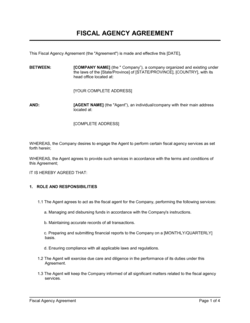
A Fiscal Sponsorship Agreement is a legally binding contract between a tax-exempt nonprofit organization (the fiscal sponsor) and a project, program, or individual (the sponsored project) that allows the sponsored party to receive tax-deductible donations and grants under the sponsor's 501(c)(3) umbrella. This free Word download gives you a structured, attorney-informed starting point you can edit online and export as PDF to formalize the relationship before accepting any funds.
When you need it
Use it when a charitable project, social enterprise, or emerging nonprofit is not yet independently tax-exempt but needs to accept tax-deductible contributions, apply for foundation grants, or operate under an established organization's legal and financial infrastructure.
What's inside
Definitions of sponsor and project roles, scope of the sponsored project, fund management and accounting obligations, administrative fee structure, grant and donation acceptance procedures, IP ownership, reporting requirements, liability allocation, and termination with asset disposition.

What is a Fiscal Sponsorship Agreement?

A Fiscal Sponsorship Agreement is a legally binding contract between a tax-exempt 501(c)(3) nonprofit organization β€” the fiscal sponsor β€” and a charitable project, program, or initiative that has not yet obtained independent tax-exempt status. Under the agreement, the sponsor lends its tax-exempt standing to the project, allowing it to receive tax-deductible donations and apply for foundation grants that require a 501(c)(3) applicant of record. In exchange, the sponsor assumes legal ownership and control of all donated funds, charges an administrative fee to cover its compliance and accounting costs, and holds the project accountable through regular financial and programmatic reporting. The most common structure is the Model A arrangement, in which the sponsored project operates as a program of the sponsor rather than as a legally independent entity.

Why You Need This Document

Operating a charitable project under a fiscal sponsor without a written agreement creates serious legal and financial exposure for both parties. Without documented fund control, the IRS may reclassify the arrangement as a mere conduit β€” invalidating the charitable deduction for every donation received. Without a signed scope and reporting structure, the sponsor's board faces personal liability for activities it cannot monitor or control. Without an IP clause, departing projects and their sponsors routinely end up in costly disputes over who owns the film footage, curriculum, website, or brand built under the arrangement. Without a termination and asset disposition clause, active restricted grants can be left in legal limbo when the relationship ends β€” putting the sponsor in breach of its obligations to institutional funders. This template gives sponsors and projects a structured, attorney-informed foundation that protects both parties from day one, satisfies funder due diligence requirements, and creates a clear governance framework for the entire duration of the relationship.

Which variant fits your situation?

If your situation is…Use this template
Sponsor retains full legal and financial control of all donated funds (Model A)Comprehensive Fiscal Sponsorship Agreement (Model A)
Sponsor acts as a conduit β€” project controls its own funds (Model C)Pre-Approved Grant Relationship Agreement (Model C)
Project is a separate legal entity needing a temporary fiscal umbrellaFiscal Sponsorship Agreement for Incorporated Projects
Sponsor is a community foundation managing donor-advised fundsDonor-Advised Fund Agreement
Project involves a single grant cycle onlyGrant Fiscal Agent Letter Agreement
International project receiving US-sourced charitable contributionsInternational Fiscal Sponsorship Agreement
Project is winding down and transferring assets to sponsor or new hostFiscal Sponsorship Termination and Asset Transfer Agreement

Common mistakes to avoid

❌ Project director controlling the bank account

Why it matters: Under Model A sponsorship, the sponsor must have actual legal control of all donated funds. A project director with signatory authority over the account transforms the arrangement into a conduit relationship that may not support tax-deductible contributions.

Fix: Open a segregated sub-account in the sponsor's name, with only sponsor-authorized signatories. The project director submits disbursement requests with supporting documentation.

❌ Project issuing its own donor acknowledgment letters

Why it matters: The IRS requires the legal recipient of charitable contributions β€” the fiscal sponsor β€” to issue written acknowledgments for gifts above $250. Project-issued letters do not satisfy this requirement and may expose donors to disallowed deductions.

Fix: Require all acknowledgment letters to be issued on sponsor letterhead, signed by a sponsor officer, and reference the sponsor's EIN. The project may draft the letters for sponsor review, but the sponsor must be the issuing party.

❌ No termination process for restricted grant funds

Why it matters: Restricted grants often have grant agreements that specify how unused funds must be returned or redirected. Without a termination clause addressing restricted funds specifically, the sponsor may be contractually obligated to the funder in ways the departing project cannot satisfy.

Fix: Add a clause requiring the project to notify all active grant-makers of a pending termination, obtain their written approval for any fund transfer, and provide the sponsor with copies of all correspondence with funders before the termination effective date.

❌ Vague or missing scope definition

Why it matters: If the project expands its activities without a contract amendment, the sponsor may inadvertently backstop programs outside its own exempt purpose β€” creating IRS exposure for both parties and personal liability for the sponsor's board members.

Fix: Define scope specifically in Exhibit A and include a written amendment requirement for any change in activities, geography, or target population. Schedule an annual scope review as part of the reporting cycle.

❌ No insurance requirement for the project

Why it matters: The sponsor is the legal entity of record. If a project event causes injury, property damage, or employment-related claims and the project carries no insurance, plaintiffs will name the sponsor β€” and the sponsor's general liability policy may exclude project-specific activities.

Fix: Require the project to carry general liability insurance of at least $1,000,000 per occurrence, naming the sponsor as additional insured, and provide certificates of insurance annually and 30 days before any public event.

❌ Oral agreement on the administrative fee

Why it matters: Undocumented fee arrangements are the single most common source of fiscal sponsorship disputes. If the fee is not in writing, either party can claim a different rate was agreed, and any below-market fee may constitute an impermissible private benefit to the project.

Fix: State the fee percentage, the basis on which it is calculated, the deduction timing, and the notice period for any change in the signed agreement. Document the sponsor board's approval of the rate in meeting minutes.

The 9 key clauses, explained

Recitals and definitions

In plain language: Identifies both parties by legal name, confirms the sponsor's 501(c)(3) status, describes the sponsored project's charitable purpose, and defines key terms used throughout the agreement.

Sample language
[FISCAL SPONSOR LEGAL NAME] ('Sponsor') is a tax-exempt organization under IRC Section 501(c)(3) (EIN: [SPONSOR EIN]). [PROJECT NAME] ('Project') is a charitable initiative described in Exhibit A. The parties agree that all Project activities must further Sponsor's exempt purposes.

Common mistake: Describing the project's purpose loosely or differently from the sponsor's IRS determination letter. If the project's activities fall outside the sponsor's exempt purpose, donations may not be tax-deductible and the sponsor risks its own tax-exempt status.

Scope of the sponsored project

In plain language: Defines exactly which activities, programs, and geographic areas fall under the fiscal sponsorship umbrella, and explicitly excludes activities the sponsor will not backstop.

Sample language
The Project shall consist exclusively of [SPECIFIC ACTIVITIES] as described in Exhibit A. Any material change to the scope of the Project requires prior written approval from Sponsor. The following activities are expressly excluded from this Agreement: [EXCLUDED ACTIVITIES].

Common mistake: Defining scope so broadly that the sponsor unknowingly backstops activities outside its exempt purpose β€” exposing the sponsor to IRS scrutiny and potential excise taxes.

Fund management and accounting

In plain language: States that the sponsor owns and controls all donated funds, how they are held (segregated account vs. general fund), what accounting records must be maintained, and how the project director requests disbursements.

Sample language
All funds received on behalf of the Project are the legal property of Sponsor and shall be maintained in a segregated account designated '[PROJECT NAME] Fund.' Project Director may request disbursements by submitting a written request with receipts or invoices. Sponsor shall disburse approved funds within [X] business days.

Common mistake: Allowing the project director to receive donor checks directly or control the bank account. Under Model A sponsorship, the sponsor must have actual legal control of all funds or the IRS may treat the arrangement as a mere conduit, voiding the charitable deduction.

Administrative fee

In plain language: Sets the percentage of gross receipts the sponsor retains as compensation for its overhead, accounting, compliance, and administrative services, and specifies when and how the fee is deducted.

Sample language
Sponsor shall retain [X]% of all contributions received on behalf of the Project as an administrative fee, deducted at the time funds are deposited. The fee covers bookkeeping, Form 990 reporting, bank fees, and compliance oversight. Fee adjustments require [30] days' written notice.

Common mistake: Agreeing verbally on the fee without documenting it in the contract. Undocumented fee changes create disputes and, if the sponsor charges less than fair market value, may create a private-benefit issue for the sponsor's board.

Donation and grant acceptance procedures

In plain language: Establishes how donations and grants are solicited and accepted β€” who signs grant applications, whose name appears on donor acknowledgment letters, and how grant award letters are reviewed for compliance.

Sample language
All solicitation materials must be approved by Sponsor before distribution. Grant applications shall be submitted in Sponsor's name with a reference to the Project. Donor acknowledgment letters shall be issued by Sponsor on Sponsor letterhead within [5] business days of receipt. Sponsor reserves the right to decline any gift that conflicts with its exempt purpose or gift acceptance policy.

Common mistake: Allowing the project to issue its own tax acknowledgment letters. The IRS requires that the sponsor β€” as the legal recipient of funds β€” issue all written acknowledgments for contributions above $250. Project-issued letters do not satisfy this requirement.

Intellectual property ownership

In plain language: Allocates ownership of work product, content, branding, and other IP created under the sponsorship β€” distinguishing between materials the sponsor retains and materials the project may take upon departure.

Sample language
Work product created with Project funds and within the scope of the Project is owned by Sponsor during the term of this Agreement. Upon termination, Sponsor shall grant Project a [royalty-free / exclusive / non-exclusive] license to [SPECIFIED IP] subject to Section [X] (Asset Disposition). Sponsor's name, logo, and EIN may not be used by Project after termination.

Common mistake: No IP clause at all. When the sponsorship ends β€” especially acrimoniously β€” disputes over who owns the film footage, website, curriculum, or brand are extremely common and expensive to resolve without prior written agreement.

Reporting and compliance obligations

In plain language: Requires the project to provide financial and programmatic reports to the sponsor on a regular schedule so the sponsor can fulfill its own IRS reporting, grant compliance, and board oversight duties.

Sample language
Project Director shall submit to Sponsor: (a) monthly financial reports by the [15th] of the following month; (b) a quarterly narrative report on activities and outcomes; and (c) copies of all grant reports due to funders within [3] business days of submission. Sponsor may conduct an audit of Project records upon [30] days' written notice.

Common mistake: Setting reporting obligations but specifying no consequence for non-compliance. Without a stated remedy β€” suspension of disbursements, or termination β€” sponsors have no practical enforcement mechanism when projects go dark.

Liability, indemnification, and insurance

In plain language: Allocates legal liability between sponsor and project, requires the project to indemnify the sponsor for claims arising from the project's own activities, and sets minimum insurance requirements.

Sample language
Project shall indemnify, defend, and hold harmless Sponsor from any claims, damages, or expenses arising from Project's activities, including acts of Project staff or volunteers. Project shall maintain general liability insurance of at least $[1,000,000] per occurrence naming Sponsor as additional insured. Sponsor shall not be liable for any project obligations beyond funds held in the Project Fund.

Common mistake: No insurance requirement in the agreement. If a project event causes injury and the project carries no insurance, the claimant may pursue the sponsor as the legally recognized entity β€” and the sponsor's general liability policy may not cover project-specific activities.

Termination and asset disposition

In plain language: States the conditions under which either party may end the agreement, the notice period required, and what happens to remaining funds, grants, and property β€” specifying that assets must go to another exempt organization, not to the project director personally.

Sample language
Either party may terminate this Agreement with [60] days' written notice. Sponsor may terminate immediately for cause, including Project's material breach, illegal activity, or conduct inconsistent with Sponsor's exempt purpose. Upon termination, remaining funds in the Project Fund shall be: (a) transferred to a successor fiscal sponsor approved by Sponsor; (b) granted to another 501(c)(3) designated by Project and approved by Sponsor; or (c) retained by Sponsor for use in furtherance of its exempt purposes.

Common mistake: No successor sponsor provision. If the project exits and there is no agreed process for transferring remaining funds to another exempt organization, the sponsor must use them for its own purposes β€” which may conflict with donor intent and trigger donor disputes.

How to fill it out

  1. 1

    Confirm the sponsor's 501(c)(3) status and exempt purpose

    Enter the fiscal sponsor's full legal name, EIN, and jurisdiction of incorporation. Verify that the project's activities fall within the four corners of the sponsor's IRS determination letter before drafting the scope clause.

    πŸ’‘ Check the IRS Tax Exempt Organization Search (apps.irs.gov) to confirm the sponsor is in good standing and has not had its exempt status revoked.

  2. 2

    Define the sponsored project in Exhibit A

    Write a specific, bounded description of the project's activities, target population, geographic area, and timeline. Attach it as Exhibit A and reference it throughout the agreement.

    πŸ’‘ The project description in Exhibit A should mirror the language used in grant applications so funders, the sponsor, and the IRS are reading the same scope.

  3. 3

    Choose and document the fiscal sponsorship model

    Decide whether you are using Model A (sponsor owns all funds, project is a program of the sponsor) or Model C (conduit relationship). The fund management and accounting clause must clearly reflect which model governs.

    πŸ’‘ Most foundation grants require Model A. If the grant-maker specifies fiscal agency rather than fiscal sponsorship, confirm which model they accept before signing.

  4. 4

    Set the administrative fee and disbursement process

    Enter the fee percentage (typically 5–15%), specify whether it applies to gross receipts or net grants, and describe the disbursement request procedure including turnaround time and documentation required.

    πŸ’‘ Survey two or three comparable fiscal sponsors in your field before setting the fee β€” rates vary by project type and sponsor capacity. Document the basis for the rate in a board resolution to protect the sponsor's governance record.

  5. 5

    Draft the donation and grant acceptance procedures

    Specify that all solicitation materials require sponsor pre-approval, that grant applications are submitted in the sponsor's name, and that acknowledgment letters are issued by the sponsor. Attach the sponsor's gift acceptance policy as an exhibit.

    πŸ’‘ Ask the sponsor for a copy of its gift acceptance policy before finalizing this section β€” some sponsors decline gifts of real property, cryptocurrency, or restricted stock, and the agreement should reflect those limits.

  6. 6

    Allocate IP ownership and post-termination license rights

    List specific categories of work product created under the sponsorship β€” film footage, curriculum materials, website content, trademarks β€” and state who owns each during the term and after termination.

    πŸ’‘ If the project anticipates creating commercially valuable IP, negotiate a specific post-termination license or assignment in writing before signing. Do not rely on a vague 'good faith negotiation' clause.

  7. 7

    Set reporting obligations with enforceable consequences

    Enter the reporting schedule (monthly financial, quarterly narrative), specify the form and format of each report, and state that failure to deliver reports within [X] days allows the sponsor to suspend disbursements.

    πŸ’‘ Build reporting deadlines around the sponsor's Form 990 preparation timeline β€” typically January through April for calendar-year filers β€” so the sponsor can include project data without last-minute scrambles.

  8. 8

    Execute before accepting any funds

    Both the sponsor's authorized officer and the project's authorized representative must sign before the project accepts any donation or submits any grant application naming the sponsor as fiscal agent.

    πŸ’‘ Date the agreement to precede any grant application submission or donation solicitation. Retroactive fiscal sponsorship arrangements are not recognized by most institutional funders and create IRS risk.

Frequently asked questions

What is a fiscal sponsorship agreement?

A fiscal sponsorship agreement is a legally binding contract between a tax-exempt 501(c)(3) nonprofit (the fiscal sponsor) and a project or program (the sponsored project) that allows the project to receive tax-deductible donations and apply for grants under the sponsor's tax-exempt umbrella. The agreement defines how funds are managed, what administrative fee the sponsor charges, what the project must report, and what happens when the relationship ends.

What is the difference between Model A and Model C fiscal sponsorship?

In a Model A arrangement, the sponsored project becomes a program of the fiscal sponsor β€” all donated funds are legally owned and controlled by the sponsor, and the project operates as an internal initiative. In a Model C arrangement, the sponsor acts as a conduit, making pre-approved grants to an independent project that retains operational control of its own funds. Most foundations require Model A. Model C is more flexible but offers fewer legal protections to the sponsor.

Do I need a fiscal sponsorship agreement before accepting donations?

Yes. Without a signed agreement in place, donations received under a sponsor's name may not be legally attributable to the sponsor, putting the tax-deductibility of those contributions in doubt. Institutional funders typically require a copy of the signed fiscal sponsorship agreement before they will process a grant application. Execute the agreement before any solicitation begins.

How much does a fiscal sponsor typically charge?

Administrative fees typically range from 5% to 15% of gross donations and grants, depending on the sponsor's size, the complexity of the project, and the services included. Community foundations and large umbrella sponsors often charge 8–10%. Smaller sponsors covering payroll, HR, and benefits administration may charge 12–15%. The fee should be documented in the agreement and approved by the sponsor's board.

Who owns the intellectual property created under a fiscal sponsorship?

Under a Model A arrangement, work product created with sponsored funds is typically owned by the fiscal sponsor during the term of the agreement. Upon termination, the sponsor may license or assign specific IP to the departing project by written agreement. Without an explicit IP clause, disputes over ownership of films, curricula, websites, and trademarks are extremely common. Always negotiate and document IP allocation before signing.

Can a fiscal sponsorship agreement be terminated early?

Yes, most agreements allow either party to terminate with 30–90 days' written notice, and the sponsor typically retains the right to terminate immediately for cause β€” such as illegal activity, mission drift, or material breach. The critical issue on early termination is what happens to remaining funds and any active restricted grants. The agreement must specify a clear asset disposition process to avoid funder disputes and IRS issues.

Is a fiscal sponsorship agreement required to be in writing?

No statute mandates a written fiscal sponsorship agreement in most jurisdictions, but operating without one exposes both parties to significant legal and tax risk. The IRS expects sponsors to exercise full control over donated funds, and an oral arrangement provides no documented evidence of that control. Most institutional funders require a written agreement as a condition of any grant where a fiscal sponsor is the applicant of record.

What happens to grant funds when a fiscal sponsorship ends?

Remaining unrestricted funds in the project account are typically transferred to a successor fiscal sponsor, granted to another 501(c)(3) designated by the project, or retained by the sponsor for its own exempt purposes. Restricted grant funds require individual funder approval for any transfer or reallocation. The agreement should specify this process in detail β€” projects that exit without addressing active grants can leave the sponsor in breach of grant agreements.

Do I need a lawyer to draft a fiscal sponsorship agreement?

For straightforward single-project arrangements with an established sponsor, a high-quality template reviewed by the sponsor's board is typically sufficient. Engage a nonprofit attorney when the project involves significant restricted grant funds, cross-border activities, employees or contractors, commercially valuable IP, or when the sponsor is onboarding multiple projects under a standardized program. A 1–2 hour attorney review typically costs $300–$800 and is worth it for any arrangement involving grants above $50,000.

How this compares to alternatives

vs Nonprofit incorporation

Forming an independent 501(c)(3) gives the project full legal autonomy, its own bank accounts, and complete control over governance and IP. Fiscal sponsorship is faster β€” weeks versus 6–18 months for IRS determination β€” and avoids ongoing corporate compliance costs, but the project operates under the sponsor's control and ownership of funds. Fiscal sponsorship is best as a temporary bridge; independence is best for projects expecting long-term operation.

vs Grant agreement

A grant agreement documents a funder's conditions on a specific grant disbursed to an existing organization. A fiscal sponsorship agreement governs the ongoing structural relationship between a sponsor and a project across multiple funding sources. They often coexist β€” the fiscal sponsor signs the grant agreement as the applicant, and the fiscal sponsorship agreement governs how those grant funds are managed internally.

vs Fiscal agency letter

A fiscal agency letter is a short, single-grant document in which one organization agrees to pass through a specific grant to another. It lacks the comprehensive governance, reporting, IP, and termination provisions of a full fiscal sponsorship agreement. Fiscal agency letters are appropriate for one-time, limited arrangements; a fiscal sponsorship agreement is required for any ongoing or multi-grant relationship.

vs Donor-advised fund agreement

A donor-advised fund agreement governs a donor's relationship with a sponsoring organization that manages charitable assets the donor recommends for distribution. A fiscal sponsorship agreement governs a project's relationship with a sponsor that manages funds raised for that specific project. Donor-advised funds serve individual donors; fiscal sponsorship serves charitable projects and programs.

Industry-specific considerations

Arts and culture

Documentary filmmakers, visual artists, and performing arts companies frequently use fiscal sponsorship to access foundation grants that require a 501(c)(3) applicant, with IP clauses covering film rights and exhibition materials.

Community and social services

Neighborhood initiatives, mutual aid networks, and community organizing projects use fiscal sponsorship to raise tax-deductible contributions before forming an independent nonprofit, with scope clauses tied to a specific geographic community.

Scientific research and education

Independent researchers, open-source education projects, and citizen science initiatives use fiscal sponsorship to receive government and foundation grants, with strict grant compliance and expenditure responsibility reporting requirements.

International development

US-based fiscal sponsors supporting international programs must comply with IRS expenditure responsibility rules, OFAC sanctions screening, and anti-terrorism certification requirements, making the compliance and reporting clauses especially detailed.

Jurisdictional notes

United States

Fiscal sponsorship is primarily a US construct built around IRS Section 501(c)(3). Under Model A, the sponsor must exercise discretion and control over all donated funds to support the charitable deduction. Private foundation grants to sponsored projects trigger IRS expenditure responsibility requirements under IRC Section 4945. State attorneys general in California, New York, and Massachusetts actively oversee charitable solicitations and may require registration before a project solicits funds under a sponsor's umbrella.

Canada

Canada does not have a direct equivalent to US fiscal sponsorship. Canadian registered charities (CRA-registered) may fund or partner with non-qualified donees under the 'own activities' framework introduced in 2022, but the structural and legal requirements differ materially from US Model A arrangements. Cross-border arrangements where a US sponsor receives Canadian donations for a Canadian project require careful CRA and IRS analysis. Quebec charities are subject to additional provincial oversight.

United Kingdom

The UK does not use the term fiscal sponsorship, but Charity Commission-registered organizations may act as host organizations for unincorporated projects under similar structures. The host charity bears full legal and financial responsibility for hosted activities and must be able to demonstrate charitable purpose alignment to the Charity Commission. Gift Aid claims on donations to hosted projects must be made by the registered host, not the project. Scotland and Northern Ireland have separate charity regulators with comparable requirements.

European Union

No unified EU framework for fiscal sponsorship exists; rules vary by member state. In Germany, France, and the Netherlands, established foundations and associations with public benefit status may host affiliated projects, but the host bears full tax and compliance liability. GDPR applies to all donor data collected by EU-based sponsors or projects with EU donors, requiring explicit consent and data processing agreements. Cross-border grant flows from EU foundations to US fiscal sponsors may trigger local grant-making regulations in the funder's jurisdiction.

Template vs lawyer β€” what fits your deal?

PathBest forCostTime
Use the templateEstablished fiscal sponsors onboarding small projects with straightforward activities and no employeesFree30–60 minutes
Template + legal reviewProjects with restricted grants above $25,000, employees or contractors, or commercially valuable IP$300–$800 (nonprofit attorney review)3–7 days
Custom draftedLarge-scale programs, international activities, multi-party arrangements, or sponsors building a standardized platform for multiple projects$1,500–$5,000+2–4 weeks

Glossary

Fiscal Sponsor
A tax-exempt 501(c)(3) organization that accepts, manages, and disburses funds on behalf of a sponsored project, lending its tax-exempt status to that project.
Sponsored Project
The program, initiative, or individual operating under a fiscal sponsor's legal and financial umbrella rather than holding independent tax-exempt status.
Model A Fiscal Sponsorship
An arrangement in which the sponsored project becomes a program of the fiscal sponsor β€” all funds are legally owned and controlled by the sponsor, not the project.
Model C Fiscal Sponsorship
A pre-approved grant relationship where the fiscal sponsor acts as a conduit, passing funds through to an independent project that retains operational control.
Administrative Fee
A percentage of gross donations or grants β€” typically 5–15% β€” charged by the fiscal sponsor to cover overhead, accounting, and compliance costs.
Charitable Purpose
The specific tax-exempt mission or activity the sponsored project must pursue to remain eligible for tax-deductible contributions under IRS Section 501(c)(3).
Restricted Fund
Donated money designated by the donor or grant-maker for a specific purpose that the sponsor and project must honor in spending and reporting.
IRS Form 990
The annual information return filed by tax-exempt organizations; the fiscal sponsor typically includes sponsored project activity in its own Form 990.
Letter of Inquiry (LOI)
A preliminary document submitted to a foundation describing a project's goals and budget before a full grant application is invited β€” often requires a fiscal sponsor's signature.
Asset Disposition
The contractual process determining where remaining funds and property go when the fiscal sponsorship relationship ends β€” typically returned to the sponsor or transferred to another exempt organization.
Expenditure Responsibility
An IRS requirement that private foundations ensure their grants are spent only for the approved charitable purpose, typically satisfied through reporting from the fiscal sponsor.

Part of your Business Operating System

This document is one of 3,000+ business & legal templates included in Business in a Box.

  • Fill-in-the-blanks β€” ready in minutes
  • 100% customizable Word document
  • Compatible with all office suites
  • Export to PDF and share electronically

Create your document in 3 simple steps.

From template to signed document β€” all inside one Business Operating System.
1
Download or open template

Access over 3,000+ business and legal templates for any business task, project or initiative.

2
Edit and fill in the blanks with AI

Customize your ready-made business document template and save it in the cloud.

3
Save, Share, Send, Sign

Share your files and folders with your team. Create a space of seamless collaboration.

Save time, save money, and create top-quality documents.

β˜…β˜…β˜…β˜…β˜…

"Fantastic value! I'm not sure how I'd do without it. It's worth its weight in gold and paid back for itself many times."

Managing Director Β· Mall Farm
Robert Whalley
Managing Director, Mall Farm Proprietary Limited
β˜…β˜…β˜…β˜…β˜…

"I have been using Business in a Box for years. It has been the most useful source of templates I have encountered. I recommend it to anyone."

Business Owner Β· 4+ years
Dr Michael John Freestone
Business Owner
β˜…β˜…β˜…β˜…β˜…

"It has been a life saver so many times I have lost count. Business in a Box has saved me so much time and as you know, time is money."

Owner Β· Upstate Web
David G. Moore Jr.
Owner, Upstate Web

Run your business with a system β€” not scattered tools

Stop downloading documents. Start operating with clarity. Business in a Box gives you the Business Operating System used by over 250,000 companies worldwide to structure, run, and grow their business.

Start freeΒ Β·Β No credit card required