- Investment Policy Statement (IPS)
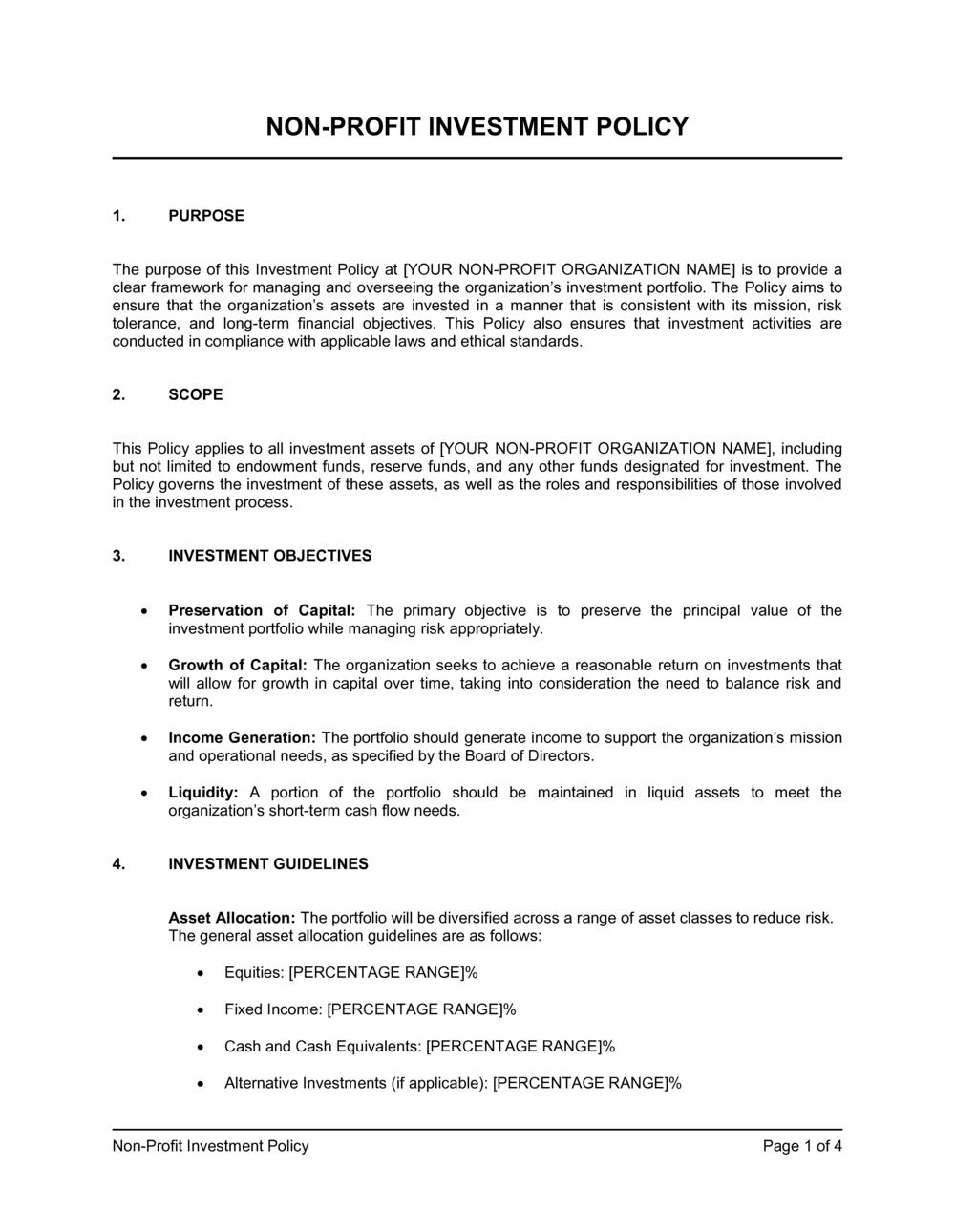
- A written document that defines an organization's investment objectives, risk tolerance, asset allocation, and governance procedures for managing invested funds.
- Endowment
- A fund in which the principal is preserved in perpetuity and only a defined portion of investment returns is spent annually to support operations or programs.
- Asset Allocation
- The distribution of invested assets across categories — equities, fixed income, cash, and alternatives — to balance return objectives with risk tolerance.
- Spending Rate
- The annual percentage of an endowment's average market value that the organization may distribute for operating or programmatic purposes.
- Fiduciary Duty
- The legal obligation of board members and investment committee members to act solely in the best interests of the organization when making financial decisions.
- Benchmark
- A market index or blended index used to measure whether the investment portfolio is generating returns consistent with its asset allocation and risk profile.
- Rebalancing
- Periodically buying or selling asset classes to restore the portfolio to its target allocation after market movements have shifted the actual weights.
- Socially Responsible Investing (SRI)
- An investment approach that screens out or prioritizes holdings based on environmental, social, or governance criteria aligned with the organization's mission.
- Underwater Endowment
- An endowment fund whose current market value has fallen below the original gift principal, restricting distributions under most state uniform prudent management laws.
- UPMIFA
- The Uniform Prudent Management of Institutional Funds Act, adopted in most US states, which sets the legal standard of care for nonprofit investment management and endowment spending.
- Operating Reserve
- Liquid funds set aside to cover 3–6 months of operating expenses, held separately from the endowment and governed by a distinct liquidity and risk standard.