Employment and Contractor Agreement Templates
★★★★★4.7from 280+ reviews· Trusted by 20M+ businesses
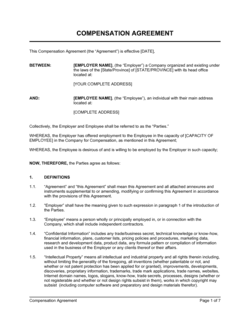
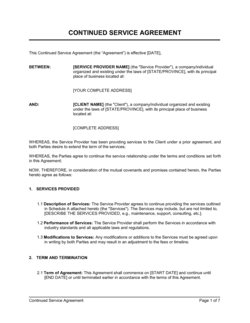
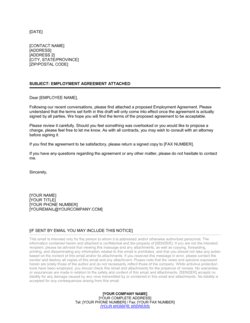
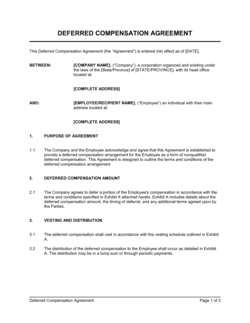
Hire employees and contractors with confidence using the right agreement for every working relationship.
WordEditable onlinePDF50+ employment and contractor templates
Other Legal Agreements categories
Most popular employment templates
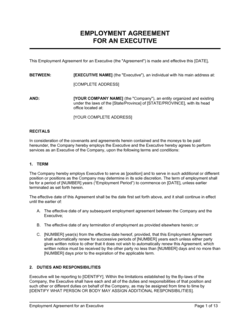
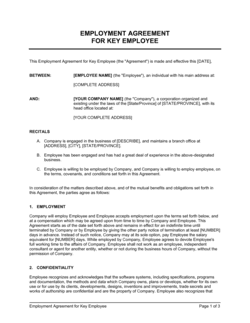
Executive and key employee agreements
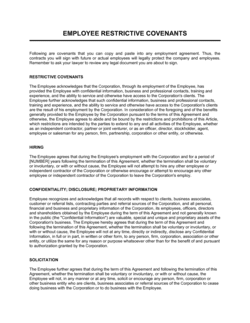
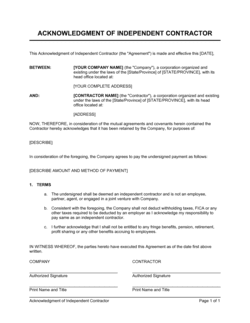
Contractor and consultant documents
Pre-employment and onboarding
Policies, handbooks, and reference letters
Termination and post-employment
More employment and contractor agreement templates
250K+Clients
20M+Free users
20+Years
190+Countries
10,000+Law firms
50M+Downloads
Trusted across review platforms
- Capterra★★★★☆4.649 reviews
- G2★★★★☆4.713 reviews
- GetApp★★★★☆4.649 reviews
- Google Play★★★★☆4.6179 ratings
- Google Reviews★★★★☆4.567 reviews
Frequently asked questions
What should an employment agreement include?
At minimum, an employment agreement should cover the parties' names, job title and duties, compensation and benefits, start date, termination conditions, confidentiality obligations, and governing law. Agreements for senior or technical employees typically also include IP assignment and restrictive covenants. Missing any of these elements can create ambiguity that is costly to resolve later.
What is the difference between an employee and an independent contractor?
The key distinction is control. An employee works under the direction of the employer — set hours, designated tools, supervised tasks — and is entitled to statutory benefits and protections. An independent contractor controls how, when, and where they complete work and is responsible for their own taxes and insurance. Misclassifying a worker as a contractor when they function as an employee can result in back-taxes, penalties, and liability for unpaid benefits.
Is an employment agreement required by law?
In most jurisdictions, there is no strict legal requirement for a written employment agreement, but employment law in many countries implies statutory minimum terms by default. A written agreement makes those terms explicit, reduces disputes, and gives both parties clear remedies if things go wrong. Consider consulting a labor lawyer in your jurisdiction before finalizing any agreement.
What is an at-will employment agreement?
An at-will employment agreement documents that either the employer or the employee can end the working relationship at any time, for any lawful reason, without advance notice. At-will employment is the default rule in most US states but is not recognized in many other countries. Even in at-will jurisdictions, having a written agreement that confirms at-will status — and sets out any exceptions — helps prevent wrongful termination claims.
Can I use one employment agreement template for all employees?
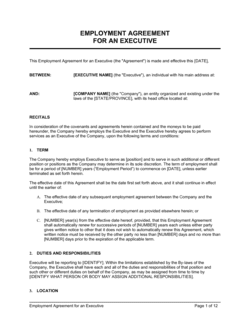
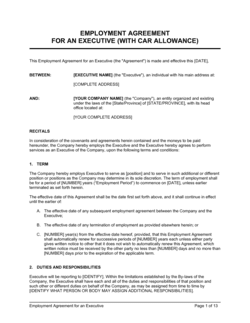
A general employment agreement works for most standard hires, but certain roles need tailored documents. Executives typically need additional clauses covering severance, equity, and enhanced restrictive covenants. Technical employees need IP assignment language. Temporary hires need a fixed end date. Using the wrong template for a senior or specialized role can leave important protections out.
How long should restrictive covenants last?
Courts in most jurisdictions scrutinize non-compete and non-solicitation clauses for reasonableness. Twelve months is a widely accepted duration for non-solicitation; non-compete periods beyond two years are often unenforceable. Geographic scope should match where the business actually competes. Overly broad covenants risk being struck down entirely, so narrower and more specific is generally better.
Do I need a separate confidentiality agreement if the employment agreement already has one?
Not usually. A well-drafted employment agreement includes a confidentiality clause that covers the same ground as a standalone NDA. A separate confidentiality agreement is most useful when you need to share sensitive information with a candidate before they formally accept an offer, or when a contractor engagement has no other written contract in place.
What is an employee handbook and is it legally binding?
An employee handbook sets out company policies — conduct, leave, expense reimbursement, remote work, and more. Whether it is legally binding depends on its language and jurisdiction. Handbooks typically include a disclaimer stating they are not a contract. Employment agreements, by contrast, are explicitly binding. Both documents work together: the agreement sets the core legal terms; the handbook fills in day-to-day operational detail.
Employment and Contractor Agreement vs. related documents
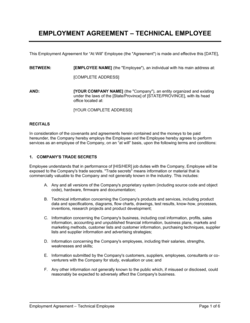
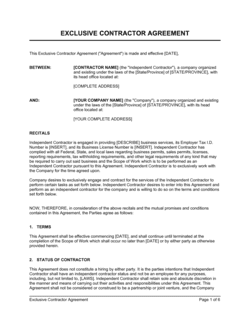
An employment agreement creates an employer-employee relationship with obligations around benefits, tax withholding, and labor protections. An independent contractor agreement establishes a business-to-business relationship where the contractor controls how work is done and is responsible for their own taxes. Misclassifying an employee as a contractor can result in significant tax penalties and back-pay liability, so the distinction matters. Choose based on how much control you exercise over the work, not just the title you prefer.
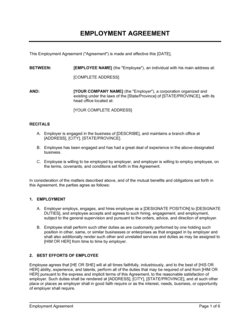
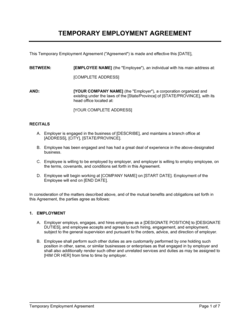
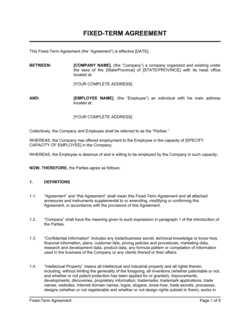
A standard employment agreement is typically open-ended and continues until either party ends it. A temporary employment contract includes a fixed end date or a project-completion trigger. Use a temporary contract for seasonal hires, project-based roles, or maternity/parental leave cover. Either form can include the same clause protections for IP, confidentiality, and conduct.
Employment and Contractor Agreement vs. Offer Letter
An offer letter is a short, informal document that outlines the key terms of a job offer — start date, title, salary, and reporting line. An employment agreement is a formal binding contract covering all terms of the relationship including termination, IP ownership, and restrictive covenants. Offer letters are a useful first step but should always be followed by a signed employment agreement before the hire starts.
A consulting agreement governs a professional services relationship where the consultant provides expertise, advice, or deliverables — similar to a contractor agreement but often focused on knowledge work rather than labour. A consulting agreement should clarify who owns deliverables, the confidentiality obligations, and how disputes are resolved. Employment agreements are not appropriate for consultants, as using one may imply an employment relationship and its associated obligations.
Key clauses every Employment and Contractor Agreement contains
Whether you're hiring a full-time employee or a short-term contractor, every agreement in this category is built from the same core clauses.
- Parties and commencement date. Identifies the employer and worker by legal name and sets the first day the agreement takes effect.
- Role and duties. Describes the position title, core responsibilities, and who the worker reports to.
- Compensation and benefits. States base salary or rate, payment frequency, bonuses, equity, and any benefits entitlements.
- Term and termination. Defines whether the engagement is indefinite, fixed-term, or at-will, and how either party can end it.
- Confidentiality. Prevents the worker from disclosing proprietary information, trade secrets, or client data during and after the engagement.
- Intellectual property assignment. Confirms that work product created during the engagement belongs to the company, not the individual.
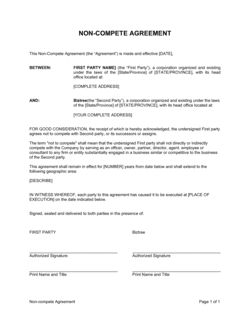
- Restrictive covenants. Post-separation obligations such as non-compete, non-solicitation of clients, and non-solicitation of employees.
- Governing law and dispute resolution. Specifies which jurisdiction's law governs and how disputes will be handled — typically arbitration or litigation.
How to write an employment agreement
A well-drafted employment agreement protects both parties from day one. Follow these steps to build one that covers the essentials.
1
Identify the parties and role
Use full legal names for the employer entity and the individual, and state the job title and department clearly.
2
Classify the relationship correctly
Decide upfront whether this is an employee, at-will employee, fixed-term hire, or independent contractor — each requires a different template.
3
Define compensation and benefits
Spell out the salary or rate, pay schedule, bonus eligibility, equity, health benefits, and any allowances such as car or phone.
4
State the term and termination conditions
Specify the start date, whether the role is open-ended or fixed-term, and the notice period required to end the agreement.
5
Add confidentiality and IP assignment clauses
Protect trade secrets and ensure any work product created on company time belongs to the company.
6
Include restrictive covenants where appropriate
For key employees and executives, add non-compete and non-solicitation clauses that are reasonable in duration and geographic scope.
7
Specify governing law and obtain signatures
Name the jurisdiction whose law applies, then have both parties sign before the first day of work.
At a glance
- What it is
- An employment or contractor agreement is a written contract that defines the terms of a working relationship — pay, duties, duration, confidentiality, and what happens when the relationship ends. It protects both the hiring company and the worker by making expectations explicit and legally binding.
- When you need one
- Any time you bring on a new employee, temporary hire, executive, or independent contractor, a written agreement should be in place before the first day of work begins.
Which Employment and Contractor Agreement do I need?
The right template depends on the type of worker you're hiring and the nature of the engagement — permanent, temporary, executive, or independent.
Your situation
Recommended template
Hiring a full-time permanent employee for an ongoing role
Covers all standard employment terms for a permanent, ongoing working relationship.Engaging a freelancer or self-employed contractor for project work
Establishes contractor status, deliverables, and payment without creating employment.Bringing on a C-suite or senior executive with equity or incentives
Includes provisions for bonuses, equity, severance, and enhanced restrictive covenants.Filling a role on a fixed-term or seasonal basis
Defines a clear end date and terms suited to short-term or seasonal arrangements.Hiring a technical employee who will create or access proprietary IP
Includes IP assignment and invention disclosure clauses alongside standard terms.Retaining a consultant or contractor who will handle confidential data
Adds a confidentiality layer to any consulting or contractor engagement.Hiring an employee in a state or country with at-will employment rules
Explicitly documents at-will status and mutual right to end employment at any time.Setting out restrictive post-employment obligations for key staff
Covers non-compete, non-solicitation, and confidentiality obligations after separation.Glossary
- At-will employment
- An employment arrangement where either party can end the relationship at any time for any lawful reason, without requiring advance notice or cause.
- Restrictive covenant
- A clause that limits what a departing employee or contractor can do after the engagement ends, typically covering competition, client solicitation, and staff poaching.
- IP assignment
- A contractual provision transferring ownership of work created during the engagement from the individual to the company.
- Independent contractor
- A self-employed individual or business engaged to complete specific work, who controls how the work is done and is not entitled to employment benefits.
- Fixed-term contract
- An employment agreement with a defined end date or project-completion trigger, after which the engagement automatically concludes.
- Non-solicitation clause
- A post-employment restriction preventing a former employee from poaching clients or colleagues for a defined period.
- Severance
- Compensation paid to an employee upon termination, typically in exchange for a release of claims against the employer.
- Probationary period
- An initial phase of employment during which either party can end the relationship more easily while suitability is assessed.
- Work for hire
- A legal doctrine under which creative or technical work produced by an employee within the scope of their job automatically belongs to the employer.
- Governing law clause
- A contractual provision specifying which jurisdiction's laws apply if a dispute arises under the agreement.
What is an employment agreement?
An employment agreement — also called an employment contract — is a legally
binding document that sets out the terms and conditions governing the relationship
between an employer and a worker. It records what the worker will do, what they
will be paid, how long the arrangement lasts, and what obligations remain after
the relationship ends. A well-drafted agreement protects the employer's trade
secrets and business relationships while giving the worker clarity on their rights
and entitlements.
Employment agreements come in several forms to match different working
relationships. A standard employment agreement covers permanent full-time and
part-time hires. An at-will employment agreement is used in jurisdictions
where either party can end the relationship without cause. An executive employment
agreement includes additional clauses for bonuses, equity, and severance. A
temporary employment contract fixes a defined end date. And an
independent contractor agreement governs project-based engagements where no
employment relationship is intended. Each form carries different legal implications,
so matching the right template to the right relationship from the start prevents
expensive misclassification disputes later.
When you need an employment agreement
You need a written employment or contractor agreement any time a person starts
doing paid work for your business — before the first day of work, not after. A
handshake or informal email exchange does not protect either party if the
relationship turns sour. Common triggers:
- Hiring a full-time or part-time employee for an ongoing role
- Bringing on a temporary or seasonal worker for a fixed period
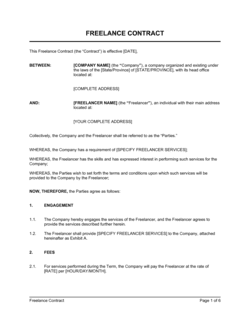
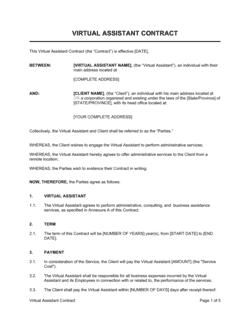
- Engaging a freelancer, consultant, or independent contractor for project work
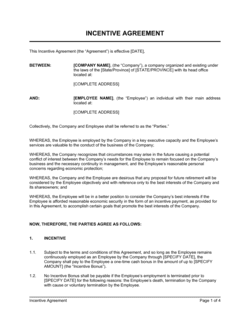
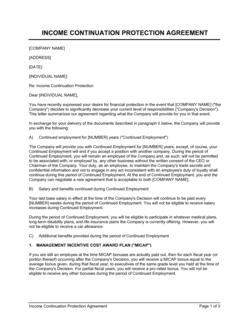
- Appointing a C-suite executive or key manager with equity or severance provisions
- Hiring a developer, engineer, or designer who will create proprietary IP
- Onboarding a remote worker who needs clear policy and conduct expectations
- Formalizing an existing informal working arrangement that has grown in scope
Skipping a written agreement doesn't eliminate the obligations — it just makes
them harder to enforce and easier to dispute. Courts in most jurisdictions will
imply minimum terms regardless of whether a contract was signed, but those implied
terms rarely match what either party actually intended. A signed agreement drawn
from the right template closes that gap at minimal cost and effort.
Award-winning platform
- Great Place to Work 2025
- BIG Award — Product of the Year 2025
- Smartest Companies 2025
- Global 100 Excellence 2026
- Best of the Best 2025