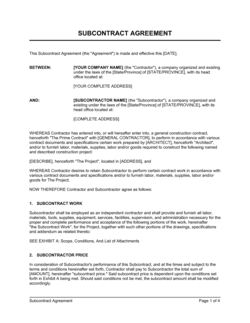
Virtual Assistant Contract Template

Free Word download β€’ Edit online β€’ Save & share with Drive β€’ Export to PDF

5 pagesβ€’25–35 min to fillβ€’Difficulty: Complexβ€’Signature requiredβ€’Legal review recommended
Learn more ↓
FreeVirtual Assistant Contract Template

At a glance

What it is
A Virtual Assistant Contract is a legally binding agreement between a business or individual client and a self-employed virtual assistant (VA) that defines the scope of services, payment terms, confidentiality obligations, IP ownership, and termination conditions. This free Word download lets you edit the template online, fill in your specifics, and export it as PDF β€” ready to sign before your VA starts their first task.
When you need it
Use it any time you engage a remote VA to handle recurring or project-based tasks β€” administrative support, scheduling, social media management, inbox management, research, or data entry. It is especially important when the VA will access sensitive business systems, client data, or financial accounts.
What's inside
Parties and engagement type, detailed scope of services, compensation and invoicing schedule, independent contractor classification, confidentiality and data security, intellectual property assignment, termination and notice, and governing law β€” all in a single 6-to-8 page document.

What is a Virtual Assistant Contract?

A Virtual Assistant Contract is a legally binding agreement between a client and a self-employed virtual assistant that governs every material dimension of their remote working relationship: the specific tasks the VA will perform, the rate and invoicing schedule, the VA's status as an independent contractor, confidentiality and data security obligations, ownership of work product, non-solicitation restrictions, and the conditions under which either party may end the engagement. Unlike a casual email agreement or a simple offer letter, a properly drafted VA contract creates enforceable obligations on both sides and eliminates the ambiguity that routinely turns productive business relationships into costly disputes.

Why You Need This Document

Without a written contract, a VA engagement carries four concrete risks simultaneously. First, the VA retains copyright in any content, graphics, or code they create β€” because intellectual property vests in the creator by default in every major jurisdiction unless explicitly assigned in writing. Second, a departing VA faces no legal barrier to taking your processes, contacts, or business systems knowledge to a competitor. Third, a client who controls the VA's schedule and methods too closely can be reclassified as an employer by the IRS, CRA, or HMRC, triggering back payroll taxes and benefit liability. Fourth, there is no binding basis to compel the VA to return credentials or delete sensitive data after the relationship ends. A signed virtual assistant contract, executed before the first task begins, closes all four gaps β€” and this template gives you a professionally structured starting point you can adapt and sign in under 30 minutes.

Which variant fits your situation?

If your situation is…Use this template
Engaging a VA for ongoing monthly retainer workVirtual Assistant Contract (Retainer)
Hiring a VA for a single defined project with a fixed deliverableIndependent Contractor Agreement
Bringing on a full-time remote employee rather than a contractorRemote Work Employment Agreement
Engaging a VA who will handle sensitive client or patient dataVirtual Assistant Contract with NDA
Subcontracting VA work through an agency to an end clientSubcontractor Agreement
Outsourcing a specific business process rather than general adminService Agreement
Engaging a VA in a heavily regulated industry such as healthcare or financeProfessional Services Agreement

Common mistakes to avoid

❌ Starting work before the contract is signed

Why it matters: Restrictive covenants β€” confidentiality, IP assignment, non-solicitation β€” signed after work begins may be unenforceable in common-law jurisdictions without fresh consideration. If the VA misappropriates data or retains IP, you have limited legal recourse.

Fix: Make signing a non-negotiable prerequisite to granting any system access or beginning any task. Use eSignature to remove the friction of the paper process.

❌ Vague scope of services

Why it matters: A scope described only as 'general admin support' gives the VA no clear deliverables to meet and gives the client no objective basis to flag underperformance or terminate for cause.

Fix: List every task category and attach a Schedule A for granular detail. Include a change-order process for tasks that fall outside the original scope.

❌ No IP assignment clause

Why it matters: Copyright in content, graphics, or code created by a VA vests in the creator by default in most jurisdictions. Without an explicit assignment, the client may be licensing β€” not owning β€” the work product.

Fix: Include both a work-made-for-hire declaration and a backup assignment clause, since work-made-for-hire status is fact-specific and not guaranteed for independent contractors.

❌ Using at-will termination language without a notice period

Why it matters: Immediate at-will termination can leave the client without coverage for time-sensitive tasks and expose the client to a quantum meruit claim for work completed but not yet invoiced.

Fix: Use a 14-day mutual notice period with an option to pay in lieu of notice. This gives both parties a transition window and eliminates disputes about final payment.

❌ Omitting a data-return or credential-revocation clause

Why it matters: A VA who retains login credentials, client files, or customer data after termination is a security and privacy liability β€” and without a contractual obligation, compelling return is slow and legally uncertain.

Fix: Add a clause requiring the VA to return, delete, or destroy all confidential data and credentials within 48 hours of termination, and to confirm compliance in writing.

❌ No liability cap

Why it matters: Without an agreed ceiling on damages, a dispute over a missed deadline or a billing error can escalate into a claim for consequential losses disproportionate to the contract value.

Fix: Cap each party's liability at the total fees paid in the preceding three months. Courts routinely uphold proportional liability caps in service contracts.

The 10 key clauses, explained

Parties and engagement type

In plain language: Identifies the client and the VA as legal persons or entities, confirms the VA is engaged as an independent contractor (not an employee), and states the effective date.

Sample language
This Virtual Assistant Contract is entered into as of [DATE] between [CLIENT LEGAL NAME] ('Client') and [VA FULL NAME / BUSINESS NAME] ('Contractor'). Contractor is engaged as an independent contractor and not as an employee of Client.

Common mistake: Using a trade name instead of the VA's legal name or registered business name. If the VA operates through an LLC, the contract must name the LLC β€” otherwise enforcing payment or IP clauses against the right legal entity becomes difficult.

Scope of services

In plain language: Specifies exactly which tasks the VA is responsible for, the expected output or deliverables, working hours or availability windows, and any tasks that are explicitly out of scope.

Sample language
Contractor shall provide the following services to Client: [LIST OF TASKS]. Services do not include [EXCLUSIONS]. Contractor shall be available during [HOURS/TIMEZONE] and shall respond to Client communications within [X] business hours.

Common mistake: Describing scope as 'general administrative support' with no further detail. Vague scope leads to disputes about what the VA is obligated to do, makes performance evaluation impossible, and gives neither party a clear basis for termination.

Compensation and invoicing

In plain language: States the rate (hourly, per-project, or monthly retainer), the invoicing schedule, the payment due date, and any late-payment fee that applies to overdue invoices.

Sample language
Client shall pay Contractor at a rate of $[AMOUNT] per [hour / month / project]. Contractor shall invoice Client on the [1st / 15th] of each month. Payment is due within [NET 14 / NET 30] days of invoice date. Overdue balances accrue interest at [1.5]% per month.

Common mistake: Agreeing on a rate verbally and not including a late-payment fee clause. Without a written fee, collecting overdue payments typically requires a demand letter and small-claims filing β€” both avoidable with two sentences in the contract.

Independent contractor classification

In plain language: Confirms the VA controls how, when, and with what tools they perform the services, and that the client does not direct the method of work β€” the key distinction between contractor and employee status.

Sample language
Contractor retains the right to determine the method, details, and means of performing the services. Client shall have no right to direct or control the manner in which Contractor performs the services, only the result to be achieved.

Common mistake: Including language that gives the client control over the VA's daily schedule, mandatory login times, or required equipment β€” behavior that courts and tax authorities use to reclassify the relationship as employment, triggering back payroll taxes and benefits liability.

Confidentiality and data security

In plain language: Prohibits the VA from disclosing or misusing the client's confidential information β€” including login credentials, customer data, financial records, and business strategies β€” during and after the engagement.

Sample language
Contractor agrees to hold all Confidential Information of Client in strict confidence, not to disclose it to any third party without prior written consent, and to use it solely for the purpose of performing services under this Agreement. This obligation survives termination of this Agreement.

Common mistake: Omitting a definition of 'Confidential Information' and relying on a catch-all. Courts apply a reasonableness test β€” an undefined or overbroad confidentiality clause can be unenforceable, leaving the client's data legally unprotected.

Intellectual property assignment

In plain language: Assigns to the client full ownership of all work product, content, designs, code, and materials created by the VA in connection with the engagement.

Sample language
All work product, deliverables, and materials created by Contractor in the course of performing services under this Agreement shall be deemed works made for hire where applicable, and Contractor hereby irrevocably assigns to Client all right, title, and interest in such materials, including all intellectual property rights.

Common mistake: No IP assignment clause at all, or a clause that only covers materials created on the client's premises or equipment. VAs work remotely on personal devices β€” without explicit assignment language, the VA may retain copyright in content, graphics, or code they create.

Non-solicitation

In plain language: Prevents the VA from directly soliciting the client's customers, vendors, or other contractors for competing work for a defined period after the engagement ends.

Sample language
For a period of [12] months following the termination of this Agreement, Contractor shall not directly solicit any customer, client, vendor, or contractor of Client with whom Contractor had contact during the engagement, for the purpose of providing competing services.

Common mistake: Including a broad non-compete alongside a non-solicitation clause. Non-compete clauses restricting a VA from doing any similar work are routinely struck down as unreasonable β€” a targeted non-solicitation is far more enforceable and achieves the core business protection needed.

Termination and notice

In plain language: States the notice period for voluntary termination by either party, the conditions that allow immediate termination for cause, and what happens to outstanding payments and deliverables upon termination.

Sample language
Either party may terminate this Agreement with [14] days' written notice. Client may terminate immediately for cause upon written notice if Contractor materially breaches this Agreement. Upon termination, Client shall pay all fees earned through the termination date.

Common mistake: No termination clause at all, or one that omits what happens to work in progress. Without clear language, a dispute over a partially completed project can hold up final payment and the return of access credentials for weeks.

Indemnification and liability

In plain language: Allocates responsibility between the parties if the VA's work causes harm or loss β€” typically limiting the client's liability for the VA's independent actions and requiring the VA to indemnify the client for damages caused by their own negligence or misconduct.

Sample language
Contractor shall indemnify, defend, and hold harmless Client from any claims, damages, or expenses arising from Contractor's negligent or wrongful acts. Client's aggregate liability to Contractor under this Agreement shall not exceed the total fees paid in the [3] months preceding the claim.

Common mistake: Omitting a liability cap entirely. Without one, a client could theoretically face unlimited claims from a VA for alleged breach β€” a liability cap proportional to fees paid is standard and routinely upheld.

Governing law and dispute resolution

In plain language: Specifies which jurisdiction's law governs the contract and how disputes will be handled β€” negotiation first, then mediation or arbitration, before any court proceeding.

Sample language
This Agreement is governed by the laws of [STATE / PROVINCE / COUNTRY]. Any dispute shall first be submitted to good-faith negotiation. If unresolved within [30] days, the dispute shall be referred to binding arbitration administered by [AAA / applicable body] in [CITY].

Common mistake: Choosing governing law based solely on the client's preference without considering where the VA is located. Several jurisdictions β€” particularly in the EU and Canada β€” apply local labor and contractor protections regardless of the governing law clause, rendering a mismatched choice ineffective.

How to fill it out

  1. 1

    Enter both parties' legal names and effective date

    Use the client's full registered business name and the VA's legal name or LLC name β€” not a brand name or first name only. Set the effective date to the date of signing, not the first day of work.

    πŸ’‘ If the VA operates through an LLC or sole proprietorship, ask for their business registration name upfront to avoid a mismatch with their invoices.

  2. 2

    Define the scope of services with specific tasks

    List every category of task the VA will perform and any tasks that are explicitly excluded. Include the expected weekly hours or monthly deliverables, availability window, and response-time expectations.

    πŸ’‘ Attach a Schedule A for detailed task lists so you can update the scope without amending the main contract body.

  3. 3

    Set the rate, invoicing schedule, and late-fee terms

    Enter the hourly rate, monthly retainer, or per-project fee. Specify the invoicing date, payment due date (Net 14 or Net 30), and the monthly interest rate applied to overdue balances.

    πŸ’‘ Net 14 payment terms are standard for VA contracts β€” the shorter cycle improves the VA's cash flow and reduces follow-up time for both parties.

  4. 4

    Confirm independent contractor status

    Review the contractor classification clause and ensure you have not included language that controls the method of work (mandatory hours, required equipment, daily check-ins). Delete or revise any language that resembles an employment relationship.

    πŸ’‘ The IRS and CRA both examine behavioral control, financial control, and the type of relationship β€” a VA who works exclusively for one client and follows rigid daily direction is at higher risk of reclassification.

  5. 5

    Customize the confidentiality and data security clause

    Define 'Confidential Information' specifically β€” list login credentials, customer data, financial records, and any proprietary systems. Add a data-return or data-destruction clause requiring the VA to delete access after termination.

    πŸ’‘ If the VA will access cloud platforms (CRM, email, social accounts), name those platforms in the confidentiality clause and require the VA to use a password manager rather than storing credentials locally.

  6. 6

    Include IP assignment and set non-solicitation terms

    Confirm the IP assignment clause covers all work product created on any device. Set the non-solicitation period (12 months is standard) and define which contacts it covers β€” customers, vendors, and other contractors the VA interacted with.

    πŸ’‘ Remove or narrow any non-compete language that restricts the VA from doing similar work generally β€” courts routinely void broad non-competes for independent contractors.

  7. 7

    Set notice periods and termination-for-cause conditions

    Enter the mutual notice period (14 days is common for VAs), list the specific behaviors that trigger immediate for-cause termination (confidentiality breach, abandonment, fraud), and specify what happens to in-progress work and outstanding invoices.

    πŸ’‘ Include a clause requiring the VA to return or delete all client data and credentials within 48 hours of termination β€” access revocation is often overlooked until a dispute arises.

  8. 8

    Sign before the first task begins

    Both parties must sign before any work starts. In common-law jurisdictions, restrictive covenants signed after work has begun may require fresh consideration to be enforceable. Use an eSignature tool to timestamp execution.

    πŸ’‘ Store the fully executed copy in a secure document repository and send a copy to the VA on the day of signing β€” not after the first invoice arrives.

Frequently asked questions

What is a virtual assistant contract?

A virtual assistant contract is a legally binding agreement between a client and a self-employed VA that sets out the terms of their working relationship β€” scope of services, compensation, confidentiality, IP ownership, and termination conditions. It establishes the VA as an independent contractor rather than an employee and creates enforceable obligations on both sides before any work or system access begins.

Is a virtual assistant an employee or an independent contractor?

In most cases, a VA is engaged as an independent contractor β€” they set their own schedule, use their own equipment, and typically work for multiple clients. However, misclassification risk arises when a client controls the method and hours of work, requires exclusivity, or provides the VA's tools. The IRS, CRA, and HMRC all apply multi-factor tests to determine true status, and misclassification can trigger significant back taxes and penalties for the client.

What should a virtual assistant contract include?

At minimum: parties and effective date, scope of services with specific tasks, compensation rate and invoicing terms, independent contractor classification, confidentiality obligations, IP assignment, non-solicitation restrictions, termination notice and for-cause conditions, indemnification, a liability cap, and governing law. Missing any of these creates gaps that are filled by jurisdiction-specific defaults β€” usually less favorable to the client.

Do I need a lawyer to draft a virtual assistant contract?

For most straightforward VA engagements, a well-structured template is sufficient β€” especially if the VA handles low-risk administrative tasks. Consider engaging a lawyer when the VA will access sensitive customer data, financial systems, or proprietary IP; when the contract involves cross-border parties; or when the monthly contract value is significant enough that a dispute would be costly. A one-hour template review typically costs $150–$400 and is worthwhile for senior or ongoing engagements.

Can a virtual assistant keep work they created without an IP clause?

Yes β€” under copyright law in the US, UK, Canada, and the EU, the default rule is that the creator owns their work. Without an explicit IP assignment clause, a VA retains copyright in content, graphics, and code they produce. The client may have a license to use the work, but they do not own it. A properly drafted assignment clause transfers all intellectual property rights to the client at the moment of creation.

How much notice should a virtual assistant contract require?

Fourteen days is the standard mutual notice period for VA contracts β€” long enough to allow an orderly transition and knowledge handoff, short enough that neither party is locked in longer than necessary. Higher-value or more operationally critical engagements sometimes use 30 days. Always pair the notice period with a for-cause termination clause that allows immediate exit for serious breaches like a confidentiality violation.

What happens to confidential data when a virtual assistant contract ends?

Without a specific clause, there is no automatic legal obligation for the VA to delete or return client data and credentials after termination. Best practice is to include a clause requiring the VA to return, delete, or destroy all confidential materials within 48 hours of termination and to confirm compliance in writing. Revoke system access on the same day notice is given, regardless of whether the notice period has run.

Are non-compete clauses enforceable in virtual assistant contracts?

Broad non-compete clauses β€” restricting a VA from doing any similar work for any client in any geography β€” are routinely struck down as unreasonable for independent contractors. California bans them almost entirely; courts in the UK and Canada apply a strict reasonableness test. A targeted non-solicitation clause (preventing the VA from directly approaching the client's specific customers or contractors) is far more consistently enforceable and provides the core protection most clients need.

Can I use one virtual assistant contract template for multiple VAs?

Yes β€” a well-drafted template is designed to be reused. You should customize the scope of services, rate, and availability terms for each VA while keeping the legal clauses (IP, confidentiality, termination, governing law) consistent. If you engage VAs in multiple jurisdictions, review the governing law and contractor classification clause for each location, as legal requirements vary significantly between US states, Canadian provinces, the UK, and EU member states.

How this compares to alternatives

vs Independent Contractor Agreement

An independent contractor agreement is a general-purpose template for any self-employed service provider. A virtual assistant contract is specifically structured for remote administrative and support services β€” covering VA-specific concerns like platform access protocols, remote data security, and task-based scope. Use the contractor agreement for project-based professional services; use the VA contract for ongoing remote support roles.

vs Remote Work Employment Agreement

A remote work employment agreement governs a full-time or part-time employee who works from home β€” with payroll withholding, benefits, and employer direction over working methods. A virtual assistant contract engages a self-employed contractor with no employment entitlements. Choosing the wrong document risks worker misclassification, back taxes, and benefits liability.

vs Service Agreement

A service agreement is a broad template for any business-to-business service engagement. A virtual assistant contract addresses the specific legal dynamics of the VA relationship β€” independent contractor status, remote data access, confidentiality of business operations, and task-level scope management. For VA engagements, the specialized contract provides clearer guidance and better protection than a generic service agreement.

vs Non-Disclosure Agreement

A standalone NDA covers confidentiality only β€” it creates no obligation to perform services and sets no payment or termination terms. A virtual assistant contract includes a full confidentiality clause alongside all other governing terms. Use an NDA before sharing sensitive information during initial conversations with a prospective VA; once engaged, the VA contract's confidentiality clause supersedes and replaces it.

Industry-specific considerations

Professional Services

VAs handling client scheduling, document preparation, and CRM updates require tight confidentiality clauses covering client privilege and engagement data.

E-commerce and Retail

VAs managing product listings, order processing, and customer communications need defined scope for each platform and clear IP assignment over any created product descriptions or graphics.

Healthcare and Wellness

VAs accessing appointment systems or patient records trigger HIPAA (US) or PIPEDA (Canada) obligations β€” a Business Associate Agreement or equivalent data processing addendum is required alongside the main contract.

Creative and Marketing Agencies

Agency VAs handling client social accounts, ad campaigns, or content production require clear IP assignment, platform access protocols, and non-solicitation covering the agency's end clients.

Technology / SaaS

VAs with access to development tools, internal documentation, or customer data need enhanced confidentiality language and a specific clause governing acceptable use of AI tools and data handling.

Finance and Accounting

VAs handling bookkeeping, payroll data, or financial records require strict data security obligations, a prohibition on unauthorized fund transfers, and indemnification covering errors in financial records.

Jurisdictional notes

United States

The IRS applies a three-category test (behavioral control, financial control, type of relationship) to determine contractor vs. employee status. California AB5 applies a stricter ABC test that makes independent contractor classification harder to establish. Non-compete clauses are unenforceable for independent contractors in California, Minnesota, and several other states. Choose governing law in a state connected to where the client β€” or the VA β€” is actually located.

Canada

The CRA applies similar factors to determine contractor vs. employee status; misclassification triggers CPP and EI liability for the engaging party. Provincial employment standards legislation varies β€” Ontario and British Columbia have specific tests for dependent contractor status that can attract notice entitlements even without an employment relationship. Non-competes must be reasonable in scope and duration to be enforceable. Contracts for Quebec-based VAs should be available in French under the Charter of the French Language.

United Kingdom

HMRC's IR35 rules can reclassify a VA working through a personal service company as an employee for tax purposes if the client exercises significant control. Workers may have intermediate 'worker' status entitling them to minimum wage and holiday pay even without full employment status. Post-termination non-solicitation clauses are enforceable if limited in scope and duration. GDPR-compliant data processing terms are required if the VA handles personal data of UK or EEA residents.

European Union

GDPR requires a data processing agreement (DPA) or appropriate clauses whenever a VA processes personal data of EU residents on behalf of the client β€” the VA acts as a data processor and the client as data controller. Several EU member states β€” including France, Germany, and Spain β€” have solo self-employed protections that can impose notice and compensation obligations regardless of contractor classification. Post-employment restrictions typically require financial compensation to the VA to be enforceable in many member states.

Template vs lawyer β€” what fits your deal?

PathBest forCostTime
Use the templateStraightforward domestic VA engagements handling low-to-medium sensitivity administrative tasksFree20–30 minutes
Template + legal reviewVAs accessing sensitive customer data, financial systems, or proprietary IP; cross-border engagements; retainers above $2,000/month$150–$4001–3 days
Custom draftedMulti-VA agency arrangements, regulated industries such as healthcare or finance, or complex IP and non-solicitation requirements$800–$2,500+1–2 weeks

Glossary

Independent Contractor
A self-employed person engaged to perform specific services for a client without becoming that client's employee β€” responsible for their own taxes and equipment.
Scope of Services
A written description of exactly which tasks, deliverables, and responsibilities the VA is engaged to perform, and which are expressly excluded.
Retainer
A fixed monthly fee paid in advance that reserves a set number of hours or a defined bundle of services from the VA each billing period.
Confidential Information
Any non-public data β€” client lists, financial records, login credentials, business strategies, or personal information β€” that the VA agrees not to disclose or misuse.
IP Assignment
A clause transferring ownership of any work product, content, or materials created by the VA during the engagement to the client.
Worker Misclassification
Treating someone who meets the legal definition of an employee as an independent contractor, exposing the business to back taxes, penalties, and benefits liability.
Non-Solicitation Clause
A restriction preventing the VA from directly approaching the client's customers or other contractors to offer competing services for a defined period after the engagement ends.
Termination for Cause
Ending the contract immediately, without notice or payment in lieu, due to a specific documented breach β€” such as a confidentiality violation or abandonment of work.
Governing Law
The jurisdiction whose laws apply to interpret and enforce the contract, typically the state, province, or country where the client is located.
Indemnification
A clause requiring one party to cover the other's losses, legal costs, or liability arising from a specific event β€” such as the VA's negligent act causing harm to a client's customer.

Part of your Business Operating System

This document is one of 3,000+ business & legal templates included in Business in a Box.

  • Fill-in-the-blanks β€” ready in minutes
  • 100% customizable Word document
  • Compatible with all office suites
  • Export to PDF and share electronically

Create your document in 3 simple steps.

From template to signed document β€” all inside one Business Operating System.
1
Download or open template

Access over 3,000+ business and legal templates for any business task, project or initiative.

2
Edit and fill in the blanks with AI

Customize your ready-made business document template and save it in the cloud.

3
Save, Share, Send, Sign

Share your files and folders with your team. Create a space of seamless collaboration.

Save time, save money, and create top-quality documents.

β˜…β˜…β˜…β˜…β˜…

"Fantastic value! I'm not sure how I'd do without it. It's worth its weight in gold and paid back for itself many times."

Managing Director Β· Mall Farm
Robert Whalley
Managing Director, Mall Farm Proprietary Limited
β˜…β˜…β˜…β˜…β˜…

"I have been using Business in a Box for years. It has been the most useful source of templates I have encountered. I recommend it to anyone."

Business Owner Β· 4+ years
Dr Michael John Freestone
Business Owner
β˜…β˜…β˜…β˜…β˜…

"It has been a life saver so many times I have lost count. Business in a Box has saved me so much time and as you know, time is money."

Owner Β· Upstate Web
David G. Moore Jr.
Owner, Upstate Web

Run your business with a system β€” not scattered tools

Stop downloading documents. Start operating with clarity. Business in a Box gives you the Business Operating System used by over 250,000 companies worldwide to structure, run, and grow their business.

Free Forever PlanΒ Β·Β No credit card required