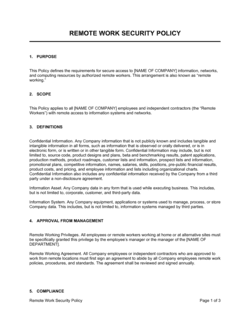
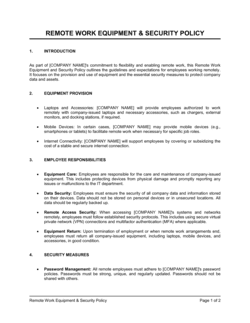
Remote Work Agreement Template

Free Word download • Edit online • Save & share with Drive • Export to PDF

8 pages30–40 min to fillDifficulty: ComplexSignature requiredLegal review recommended
Learn more ↓
FreeRemote Work Agreement Template

At a glance

What it is
A Remote Work Agreement is a legally binding document between an employer and an employee that defines the terms under which the employee performs their duties from a location outside the company's primary office — typically a home, co-working space, or other approved site. This free Word download covers approved work location, equipment, data security, working hours, expense reimbursement, performance expectations, and termination of remote privileges in a single structured document you can edit online and export as PDF.
When you need it
Use it when onboarding a fully remote employee, converting an existing in-office employee to a hybrid or fully remote arrangement, or formalizing an informal work-from-home situation that has grown without written terms. It is also appropriate when an employee requests a permanent remote arrangement after a trial period.
What's inside
Approved work location and schedule, equipment and technology provisions, data security and confidentiality obligations, expense reimbursement policy, performance and availability expectations, and the conditions under which remote work privileges may be suspended or terminated.

What is a Remote Work Agreement?

A Remote Work Agreement is a legally binding document between an employer and an employee that defines the terms under which the employee performs their job duties from a location outside the company's primary office — most commonly a home address, but also a co-working space or other approved site. It specifies the approved work location, core working hours, equipment ownership and return obligations, data security requirements, expense reimbursement entitlements, performance expectations, and the conditions under which the employer may revoke the remote work authorization. Unlike an informal email approval or a general remote work policy, a signed remote work agreement creates enforceable, bilateral obligations that protect both parties if the arrangement breaks down.

Why You Need This Document

Without a written remote work agreement, the practical and legal gaps multiply quickly. Employers discover unregistered tax nexus in a new state only after an audit. Equipment issued without a serial-number record goes unrecovered at separation. Monitoring programs deployed without advance disclosure trigger privacy complaints. Employees who have worked remotely for two years without a written revocation clause argue constructive dismissal when asked to return to office — and in Canada and the UK, they are often right. On the employee side, an undocumented arrangement offers no guarantee that the remote arrangement continues, no clarity on reimbursable expenses, and no recourse if the employer withdraws the privilege overnight. A properly drafted remote work agreement, executed before the first remote day, closes every one of these gaps in 30 minutes. This template gives you a jurisdiction-aware starting point that covers the clauses employment lawyers most commonly add when reviewing these arrangements from scratch.

Which variant fits your situation?

If your situation is…Use this template
Employee works fully remote, never in the officeRemote Work Agreement (Fully Remote)
Employee splits time between home and office on a set scheduleHybrid Work Agreement
Short-term or trial remote arrangement with a defined review dateTemporary Remote Work Agreement
Employee is an independent contractor working remotelyIndependent Contractor Agreement
Employee relocates to a different state or country to work remotelyRemote Work Agreement (Cross-Border)
Entire workforce is remote and policy applies company-wideRemote Work Policy
Employee requests ad hoc remote days on an occasional basisFlexible Work Arrangement Agreement

Common mistakes to avoid

❌ Using a city or region instead of a full address for the approved work location

Why it matters: An imprecise location creates tax nexus ambiguity — if the employee works remotely in a jurisdiction where the employer has no registration, the employer may unknowingly owe payroll tax, corporate income tax, or both.

Fix: Enter the full street address of every approved location and add a clause requiring written approval before the employee works from any other address, including temporary stays.

❌ Omitting expense reimbursement in jurisdictions that mandate it

Why it matters: California, Illinois, the District of Columbia, and several EU countries legally require employers to reimburse necessary remote work costs. A policy of zero reimbursement exposes the employer to wage claims and penalties.

Fix: Review the applicable state, provincial, or national statute before finalizing the reimbursement section and set caps that at minimum meet the legal floor in the employee's work jurisdiction.

❌ Including undisclosed or overbroad monitoring rights

Why it matters: Monitoring employee activity on personal devices or without advance disclosure can violate wiretapping statutes, GDPR, and state privacy laws — exposing the employer to regulatory fines and civil claims.

Fix: Limit monitoring rights explicitly to company-owned devices and systems, disclose them in advance in writing, and confirm the scope complies with the applicable privacy framework before signing.

❌ Failing to clarify that revoking remote privileges is not a termination of employment

Why it matters: In common-law jurisdictions, if remote work has become an established and material term of employment, requiring a return to office without adequate notice may constitute constructive dismissal — a claim that can result in months of severance.

Fix: Include a clause explicitly stating that revocation of remote work authorization does not constitute termination of employment, and set a notice period of at least 2–4 weeks to allow the employee to make practical arrangements.

❌ Not cross-referencing the underlying employment contract

Why it matters: A remote work agreement that operates in isolation can inadvertently create obligations that contradict the employment contract — particularly around hours, location, and IP — leaving both documents partially unenforceable.

Fix: Cite the employment contract by entity name and date in the remote work agreement, and confirm that the two documents are read together as a single arrangement.

❌ Neglecting to list equipment by serial number in Schedule A

Why it matters: Without an itemized equipment record, recovering company devices at separation becomes a factual dispute the employer often loses — employees claim equipment was never issued or was returned in different condition.

Fix: Complete Schedule A with every device's make, model, and serial number before the employee's first remote day, and have the employee sign the schedule separately to confirm receipt.

The 10 key clauses, explained

Parties, role, and remote work designation

In plain language: Identifies the employer and employee, states the job title, and formally designates the arrangement as fully remote, hybrid, or temporary.

Sample language
This Remote Work Agreement ('Agreement') is entered into on [DATE] between [EMPLOYER LEGAL NAME] ('Employer') and [EMPLOYEE FULL NAME] ('Employee'). Employee's position is [JOB TITLE] and is designated as [FULLY REMOTE / HYBRID / TEMPORARY REMOTE] effective [START DATE].

Common mistake: Using a trade name instead of the registered legal entity as the employer — if a dispute arises, the entity named must match the payroll and tax records exactly.

Approved work location

In plain language: Specifies the exact address or addresses where the employee may work remotely, and requires written approval before working from any other location.

Sample language
Employee is authorized to perform duties from [HOME ADDRESS / APPROVED ADDRESS] ('Approved Location'). Employee must obtain prior written approval from [MANAGER TITLE] before working from any other location, including temporary or international locations.

Common mistake: Listing only a city or region instead of a full address — this creates ambiguity when the employee works internationally or moves, triggering unintended tax nexus for the employer.

Working hours and availability

In plain language: States the employee's core working hours, time zone expectations, response time standards, and any required overlap with team members in other locations.

Sample language
Employee shall be available and responsive during core hours of [START TIME] to [END TIME] [TIME ZONE], Monday through Friday. Employee shall acknowledge communications within [X] hours during core hours and attend scheduled meetings via [VIDEO PLATFORM].

Common mistake: Omitting time zone requirements for distributed teams — without them, employees interpret 'business hours' according to their own local time, causing recurring scheduling conflicts.

Equipment, technology, and IT support

In plain language: Defines who provides equipment, what the employee is permitted to use, IT support responsibilities, and what happens to company-issued devices on termination.

Sample language
Employer shall provide [LIST OF EQUIPMENT] as detailed in Schedule A. Equipment remains the property of Employer at all times. Employee shall not use company-issued equipment for personal use beyond incidental purposes and shall return all equipment within [X] business days of separation.

Common mistake: Failing to list specific devices and serial numbers in a Schedule A — without an itemized record, recovering equipment at separation becomes a credibility dispute.

Data security and confidentiality

In plain language: Requires the employee to follow the company's data security policies, use approved networks and VPNs, protect physical documents, and report any security breach immediately.

Sample language
Employee shall access company systems exclusively through the Employer's approved VPN. Employee shall not use public or unsecured Wi-Fi networks for company work without VPN protection. Any suspected breach, loss, or unauthorized access must be reported to [IT CONTACT] within [X] hours of discovery.

Common mistake: Relying on the general confidentiality clause in the employment contract rather than specifying remote-specific risks like unsecured networks, shared living spaces, and physical document handling.

Expense reimbursement

In plain language: Identifies which remote work costs the employer will reimburse — such as internet, phone, and office supplies — the maximum amounts, the submission process, and the deadline for claims.

Sample language
Employer shall reimburse Employee for the following pre-approved remote work expenses up to the stated monthly maximums: internet service ($[X]/month), mobile phone ($[X]/month). Reimbursement requests must be submitted via [SYSTEM] with receipts within [30] days of the expense.

Common mistake: Omitting reimbursement entirely in jurisdictions — including California, Illinois, and several EU member states — that legally require employers to cover necessary remote work costs, exposing the company to wage claims.

Performance standards and monitoring

In plain language: Sets measurable performance expectations for the remote arrangement, discloses the employer's right to monitor company devices and systems, and states how performance will be reviewed.

Sample language
Employee shall maintain the same performance standards as set out in [EMPLOYMENT CONTRACT / JOB DESCRIPTION]. Employer reserves the right to monitor activity on company-owned devices and systems to the extent permitted by applicable law. Performance will be reviewed [QUARTERLY / ANNUALLY] with specific remote-work metrics including [METRICS].

Common mistake: Including monitoring rights without disclosing them in advance or without limiting them to company-issued devices — broad or undisclosed monitoring can violate wiretapping and privacy statutes in several jurisdictions.

Workplace health, safety, and workers' compensation

In plain language: Confirms that the employee's remote workspace must meet basic safety standards, that workers' compensation coverage extends to work-related injuries at the approved location, and that the employer may inspect the workspace with reasonable notice.

Sample language
Employee confirms that the Approved Location meets the safety requirements in Schedule B. Work-related injuries occurring at the Approved Location during authorized working hours are covered under Employer's workers' compensation policy. Employer may inspect the Approved Location upon [X] business days' written notice.

Common mistake: Skipping the safety self-certification step — if an employee is injured at home and no workplace safety acknowledgment exists, the employer's workers' compensation insurer may dispute coverage or seek contribution from the employee.

Termination of remote work privileges

In plain language: States the conditions under which the employer may revoke remote work authorization, including the notice period, what happens to equipment, and whether the employee must return to office upon revocation.

Sample language
Employer may terminate this Agreement and require Employee to return to the office upon [X] business days' written notice. Remote work privileges may be revoked immediately for material breach of this Agreement, including violation of data security protocols. Termination of this Agreement does not constitute termination of employment.

Common mistake: Not including the clarification that revoking remote work privileges is not a termination of employment — without it, employees in common-law jurisdictions may argue constructive dismissal if remote work has become an established term of employment.

Governing law and entire agreement

In plain language: Specifies the jurisdiction whose law governs the agreement, confirms it supplements rather than replaces the underlying employment contract, and establishes it as the complete record of the remote work arrangement.

Sample language
This Agreement is governed by the laws of [STATE / PROVINCE / COUNTRY]. It supplements and is incorporated into Employee's Employment Agreement dated [DATE]. This Agreement constitutes the entire agreement of the parties regarding remote work and supersedes all prior written or oral understandings on the subject.

Common mistake: Failing to cross-reference the underlying employment contract — standalone remote work agreements that contradict or duplicate employment contract terms create conflicting obligations that are difficult to resolve in a dispute.

How to fill it out

  1. 1

    Enter the parties' legal names and the effective date

    Use the employer's full registered entity name and the employee's legal name as it appears on their employment contract. State the exact date the remote arrangement begins.

    💡 Cross-check the employer entity name against the employee's existing employment contract — both documents must name the same legal entity or enforcing either becomes complicated.

  2. 2

    Specify the approved work location with a full address

    Enter the complete street address of every location the employee is authorized to work from. If a co-working space is permitted, name it specifically rather than leaving the field open.

    💡 If the employee may ever work from a different state or country, add a clause requiring advance written approval — this protects the employer from unintended tax nexus and employment law exposure.

  3. 3

    Define core hours and time zone expectations

    Set the required working hours in a named time zone, the minimum overlap required with the team, and the expected response time during core hours. For hybrid arrangements, list the required in-office days.

    💡 For teams spanning more than two time zones, identify a 2–4 hour core overlap window rather than a full-day requirement — it is more realistic and easier to enforce.

  4. 4

    Complete the equipment schedule (Schedule A)

    List every company-issued device by make, model, and serial number. Note the condition at issuance and the return deadline on separation. If the employee uses personal equipment, document approved use and any reimbursement for it.

    💡 Take photos of each device at issuance and attach them to the agreement file — this removes all ambiguity about condition and return disputes.

  5. 5

    Set the expense reimbursement caps and submission process

    Enter the monthly maximum for each reimbursable category (internet, phone, office supplies) and name the submission system and deadline. Confirm the list complies with applicable state or provincial reimbursement statutes.

    💡 California Labor Code Section 2802 requires reimbursement for all necessary business expenses — do not set a $0 reimbursement cap for California employees regardless of your general company policy.

  6. 6

    Disclose monitoring rights and confirm their scope

    State whether and how company-issued devices and systems will be monitored. Limit the disclosure to company-owned equipment and systems only. Confirm this is consistent with your jurisdiction's employee privacy laws before including it.

    💡 In the EU and UK, monitoring disclosures must align with GDPR and the UK GDPR respectively — a blanket 'we may monitor everything' clause is likely unlawful without a data protection impact assessment.

  7. 7

    Include the termination-of-remote-privileges clause

    Set a notice period for revoking remote work authorization (typically 2–4 weeks), list the immediate-revocation triggers, and explicitly state that revocation is not a termination of employment.

    💡 In Canada and the UK, converting a long-tenured remote employee back to full-time in-office work may constitute constructive dismissal if remote work has become an established term — flag this for legal review before including a short notice period.

  8. 8

    Cross-reference the employment contract and have both parties sign before the arrangement begins

    Cite the employment contract by name and date in the governing law clause to confirm the two documents work together. Both parties must sign before the remote arrangement starts — post-start signatures create fresh-consideration issues.

    💡 Use a countersigned copy for your records and store both the agreement and the equipment schedule in the employee's personnel file.

Frequently asked questions

What is a remote work agreement?

A remote work agreement is a legally binding document between an employer and an employee that defines the terms under which the employee performs their duties from a location outside the company's primary office. It covers the approved work location, schedule, equipment, data security obligations, expense reimbursement, performance expectations, and the conditions under which the arrangement can be terminated. It supplements — but does not replace — the underlying employment contract.

Is a remote work agreement legally required?

No jurisdiction universally mandates a standalone remote work agreement, but several practical and legal factors make one necessary. In the EU, the Transparent and Predictable Working Conditions Directive requires written documentation of any significant change to working conditions, including location. In the US and Canada, the absence of a written agreement leaves both parties without clear terms on equipment ownership, monitoring rights, and expense reimbursement — areas where disputes are common and costly.

Does a remote work agreement replace an employment contract?

No. A remote work agreement supplements the employment contract — it addresses the specific conditions of the remote arrangement but relies on the employment contract for core terms like compensation, IP assignment, confidentiality, and termination. The two documents should cross-reference each other, and where they conflict, the employment contract typically governs unless the remote work agreement expressly states otherwise.

Can an employer require an employee to return to the office after signing a remote work agreement?

Generally yes, but the process matters significantly. In at-will US states, an employer can typically require a return to office with reasonable notice. In Canada and the UK, if remote work has become a fundamental and established term of employment, requiring a return to office without adequate notice may constitute constructive dismissal — a claim entitling the employee to severance. Including a clear revocation clause with a defined notice period reduces this risk substantially.

Does remote work create tax obligations in a different state or country?

Yes, in many cases. When an employee works remotely from a state or country where the employer has no other presence, it can create tax nexus — requiring the employer to register for payroll tax, corporate income tax, or both in that jurisdiction. This is particularly acute for US employers with employees in high-tax states like California or New York, and for any employer with employees working across EU member states. Specifying and controlling the approved work location in the agreement is the first line of defense.

What equipment should a remote work agreement address?

The agreement should specify whether the employer provides equipment or whether the employee uses personal devices, list all company-issued items by make and serial number in a Schedule A, define permitted personal use of company equipment, set out the IT support process, and state the return obligation and timeline on separation. For employees using personal devices, it should clarify any mobile device management (MDM) software the employer may install and the conditions for its removal.

Are employers required to reimburse remote work expenses?

It depends on the jurisdiction. California Labor Code Section 2802 requires employers to reimburse all necessary business expenses, including internet and phone costs attributable to remote work. Illinois, the District of Columbia, and several EU member states have similar requirements. In most other US states and Canadian provinces, reimbursement is not legally mandated but is standard practice and reduces retention risk. The agreement should set specific categories and monthly caps that at minimum meet the legal floor in the employee's work location.

Can an employer monitor a remote employee's activity?

Employers may generally monitor activity on company-owned devices and systems, provided they disclose this right in writing in advance. Monitoring personal devices — even for company communications — is heavily restricted under GDPR, the UK GDPR, and several US state privacy laws. In the EU, employers must conduct a data protection impact assessment before deploying monitoring tools and must provide employees with a clear privacy notice. The monitoring clause in the agreement should be limited explicitly to company-issued equipment and systems.

What happens if an employee is injured while working from home?

In most jurisdictions, workers' compensation coverage extends to work-related injuries at an approved remote location during authorized working hours. However, coverage disputes are more common for home injuries than for office injuries because the causal connection is harder to establish. A remote work agreement that includes a safety self-certification, specifies the approved workspace, and defines authorized working hours gives the employer — and the insurer — a clearer basis for determining whether an injury is work-related. Consult your workers' compensation carrier before approving remote arrangements.

How this compares to alternatives

vs Employment Contract

An employment contract establishes the full terms of the employment relationship — compensation, IP assignment, confidentiality, non-compete, and termination. A remote work agreement supplements it by addressing the specific conditions of working outside the office. Both documents are needed for a remote hire; the remote work agreement should cross-reference and be read alongside the employment contract.

vs Independent Contractor Agreement

An independent contractor agreement governs a self-employed individual engaged for project-based work with no employment entitlements. A remote work agreement applies to employees — it does not change the nature of the employment relationship. Using a remote work agreement with a misclassified contractor does not convert them to an employee, but misclassification itself carries significant tax and benefits liability.

vs Remote Work Policy

A remote work policy is a company-wide document setting general rules and eligibility criteria for remote work — it applies to all employees and is typically part of the employee handbook. A remote work agreement is a bilateral, signed contract between the employer and a specific employee. Policies set the framework; agreements create individual enforceable obligations. Both are recommended: the policy for consistency, the agreement for enforceability.

vs Flexible Work Arrangement Agreement

A flexible work arrangement agreement covers schedule flexibility — compressed weeks, adjusted start and end times, or occasional remote days — without necessarily changing the employee's primary work location. A remote work agreement addresses a permanent or semi-permanent change to where the employee works. For employees who simply want to shift their hours without changing their location, the flexible work arrangement is the appropriate document.

Industry-specific considerations

Technology / SaaS

Distributed engineering and product teams require detailed data security, VPN mandates, device management clauses, and cross-border work-location controls to manage IP risk and tax nexus.

Professional Services

Client confidentiality obligations and professional regulatory requirements make explicit data security protocols and approved-location restrictions critical for accountants, consultants, and lawyers working remotely.

Financial Services

Regulatory requirements from FINRA, FCA, and equivalent bodies impose strict data handling, record-keeping, and supervision obligations that must be reflected explicitly in any remote work arrangement.

Healthcare / MedTech

HIPAA in the US and equivalent data protection regulations elsewhere require specific safeguards for patient data accessed remotely, including encrypted devices, secure networks, and physical workspace privacy.

Retail / E-commerce

Customer payment data and PCI-DSS compliance requirements mean remote workers with access to transaction systems need explicit network security and device requirements built into their agreements.

Manufacturing

Remote arrangements are typically limited to administrative, design, and management roles — agreements should define clearly which duties may be performed remotely and which require on-site presence.

Jurisdictional notes

United States

Remote work creates state-level tax nexus for the employer when the employee works in a state where the employer is not registered — triggering payroll tax withholding, unemployment insurance, and potentially corporate income tax obligations in that state. California, Illinois, and the District of Columbia legally require expense reimbursement for remote work costs. Non-compete enforceability and monitoring rights vary significantly by state, and California in particular imposes strict limits on both.

Canada

Each province has its own Employment Standards Act governing minimum terms, and a remote employee working in a different province than the employer's registered office may trigger payroll registration and remittance obligations in that province. Remote work arrangements that become a fundamental term of employment can expose employers to constructive dismissal claims if revoked without adequate notice. Quebec employees must receive documents in French, including this agreement, if working for a provincially regulated employer.

United Kingdom

The UK's flexible working legislation, updated in 2024, gives employees the right to request flexible or remote working from day one of employment — employers must follow a statutory process when considering and responding to such requests. Monitoring rights must comply with UK GDPR and the Regulation of Investigatory Powers Act; employees must be informed in advance of any monitoring. Health and safety obligations under the Health and Safety at Work Act 1974 extend to the remote workspace, and employers should require a self-assessment from remote employees.

European Union

The EU Transparent and Predictable Working Conditions Directive requires written notice of any material change in working conditions — including a shift to remote work — within the statutory timeframe. GDPR applies fully to any monitoring of remote employees, requiring a legal basis, a data protection impact assessment for surveillance tools, and a clear privacy notice. Several member states, including France, Germany, and Belgium, have additional national rules on remote work that impose specific employer obligations around equipment, costs, and the right to disconnect.

Template vs lawyer — what fits your deal?

PathBest forCostTime
Use the templateDomestic employees working remotely in the same state or province as the employer's registered officeFree20–30 minutes
Template + legal reviewEmployees working remotely in a different state or province, senior roles with significant data access, or hybrid arrangements with complex scheduling$300–$6002–5 days
Custom draftedCross-border remote arrangements, regulated industries (financial services, healthcare), or employers managing distributed teams across multiple jurisdictions$1,000–$3,500+1–3 weeks

Glossary

Approved Work Location
The specific address or addresses where the employee is authorized to perform their duties remotely, as listed in the agreement.
Telecommuting
Performing employment duties from a location other than the employer's designated office, using telecommunications technology to stay connected.
Nexus
A sufficient connection between an employer and a state or jurisdiction that triggers tax registration, withholding, and compliance obligations — often created when an employee works remotely in that jurisdiction.
Data Security Protocol
The set of technical and behavioral requirements an employee must follow to protect company data while working outside the corporate network.
Expense Reimbursement
Employer payment to the employee for out-of-pocket costs incurred as a direct result of remote work, such as internet service, equipment, or office supplies.
Right to Monitor
A contractual provision authorizing the employer to monitor activity on company-issued devices and networks, subject to applicable privacy laws.
Hybrid Work
An arrangement in which the employee works from the office on some days and from a remote location on others, typically on a defined or flexible schedule.
Permanent Remote
An employment arrangement where the employee has no assigned office and performs all duties from an approved remote location on an indefinite basis.
Co-working Space
A shared, commercially operated workspace outside the employer's premises that an employee uses as an alternative to working from home.
Equipment Addendum
A schedule or attachment to the agreement listing specific company-owned devices issued to the employee, their serial numbers, and the return obligations on separation.
Worker's Compensation
Statutory insurance covering injuries that occur in the course of employment — including injuries at an approved remote work location, in most jurisdictions.

Part of your Business Operating System

This document is one of 3,000+ business & legal templates included in Business in a Box.

  • Fill-in-the-blanks — ready in minutes
  • 100% customizable Word document
  • Compatible with all office suites
  • Export to PDF and share electronically

Create your document in 3 simple steps.

From template to signed document — all inside one Business Operating System.
1
Download or open template

Access over 3,000+ business and legal templates for any business task, project or initiative.

2
Edit and fill in the blanks with AI

Customize your ready-made business document template and save it in the cloud.

3
Save, Share, Send, Sign

Share your files and folders with your team. Create a space of seamless collaboration.

Save time, save money, and create top-quality documents.

★★★★★

"Fantastic value! I'm not sure how I'd do without it. It's worth its weight in gold and paid back for itself many times."

Managing Director · Mall Farm
Robert Whalley
Managing Director, Mall Farm Proprietary Limited
★★★★★

"I have been using Business in a Box for years. It has been the most useful source of templates I have encountered. I recommend it to anyone."

Business Owner · 4+ years
Dr Michael John Freestone
Business Owner
★★★★★

"It has been a life saver so many times I have lost count. Business in a Box has saved me so much time and as you know, time is money."

Owner · Upstate Web
David G. Moore Jr.
Owner, Upstate Web

Run your business with a system — not scattered tools

Stop downloading documents. Start operating with clarity. Business in a Box gives you the Business Operating System used by over 250,000 companies worldwide to structure, run, and grow their business.

Start free · No credit card required