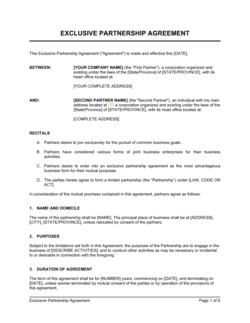
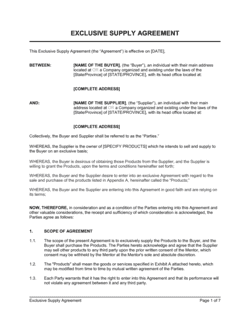
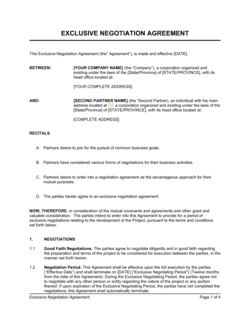
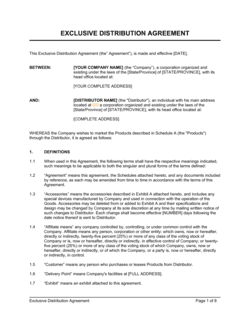
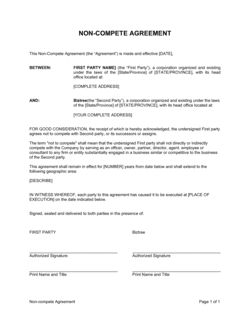
Exclusive Contractor Agreement Template

Free Word download • Edit online • Save & share with Drive • Export to PDF

6 pages25–35 min to fillDifficulty: ComplexSignature requiredLegal review recommended
Learn more ↓
FreeExclusive Contractor Agreement Template

At a glance

What it is
An Exclusive Contractor Agreement is a legally binding contract between a hiring company and an independent contractor that restricts the contractor from performing similar services for competitors or other clients during the engagement. This free Word download covers exclusivity scope, deliverables, compensation, IP assignment, confidentiality, non-compete, and termination in a single ready-to-sign document you can edit online and export as PDF.
When you need it
Use it when you need a contractor's full or near-full availability, when the work involves sensitive competitive information, or when the contractor will develop proprietary assets you cannot risk being shared with rivals. It is particularly relevant for product development, creative campaigns, software builds, and strategic consulting engagements.
What's inside
Parties and engagement terms, exclusivity scope and permitted exceptions, deliverables and timeline, compensation and payment schedule, intellectual property assignment, confidentiality obligations, non-compete and non-solicitation restrictions, independent contractor classification language, and termination provisions with notice requirements.

What is an Exclusive Contractor Agreement?

An Exclusive Contractor Agreement is a legally binding contract between a hiring company and an independent contractor that governs the terms of the engagement and includes an exclusivity clause restricting the contractor from performing substantially similar services for competitors, named rivals, or other clients within a defined industry or geography during the contract term. Unlike a standard independent contractor agreement, which permits the contractor to work for multiple clients simultaneously, an exclusive agreement dedicates the contractor's services — or a defined portion of them — to the hiring company for the duration of the engagement. The agreement also covers deliverables, compensation, intellectual property assignment, confidentiality, non-solicitation, and termination, creating a comprehensive legal framework for a high-trust, high-stakes contractor relationship.

Why You Need This Document

Engaging a contractor without an exclusivity agreement exposes your business on multiple fronts: the contractor may simultaneously develop similar work for a direct competitor, the IP they create may not legally belong to you, and there is nothing stopping them from approaching your clients the day the engagement ends. Without documented exclusivity, you have no enforceable basis to demand the contractor's focused availability or to prevent them from taking your trade secrets to a rival. The cost of discovering this after a product launch, campaign, or strategic initiative has been shared with a competitor is vastly higher than the cost of executing a well-drafted agreement before work begins. This template gives you a ready-to-use, jurisdiction-aware starting point that captures the exclusivity scope, IP ownership, and post-engagement restrictions in a single signed document — so your contractor relationship is protected from day one.

Which variant fits your situation?

If your situation is…Use this template
Engaging a contractor for a one-time project with exclusivity during the buildExclusive Contractor Agreement (Project-Based)
Engaging a contractor on an ongoing retainer with exclusivity in a market segmentRetainer Agreement
Hiring a full-time employee instead of a contractorEmployment Contract
Engaging a contractor with no exclusivity requirementIndependent Contractor Agreement
Commissioning a specific creative deliverable with IP assignment but no exclusivityCreative Services Agreement
Engaging a consultant for strategic advisory work with broad non-competeConsulting Agreement
Restricting a departing employee from competing after terminationNon-Compete Agreement

Common mistakes to avoid

❌ Overbroad exclusivity clause that covers all client work

Why it matters: A restriction that prevents the contractor from working for any other client in any industry is disproportionate to most engagement needs. Courts routinely narrow or void such clauses, and experienced contractors will refuse to sign them.

Fix: Limit exclusivity to the specific industry segment, named competitors, or service category that creates genuine competitive risk, and carve out pre-existing client relationships explicitly.

❌ No work-for-hire designation plus IP assignment fallback

Why it matters: Work-for-hire doctrine under US copyright law applies only to certain enumerated categories of works. Without a separate assignment clause, the contractor may retain copyright ownership of deliverables that fall outside those categories.

Fix: Include both a work-for-hire designation and a standalone present-tense assignment of all work product, with an obligation to execute further instruments to perfect ownership.

❌ Imposing employee-level controls inside a contractor agreement

Why it matters: Setting mandatory hours, requiring exclusive use of company equipment, or directing how (not just what) the contractor delivers are IRS and CRA indicators of employment — triggering potential misclassification audits, back taxes, and benefit liability.

Fix: Restrict controls to deliverable specifications and acceptance criteria. Define what must be delivered and by when, not how the contractor spends each working hour.

❌ Signing after the contractor has already started work

Why it matters: In common-law jurisdictions, a contractor already performing services has provided no new consideration for IP assignment, exclusivity, and non-compete provisions added after commencement — courts have voided these clauses on that basis.

Fix: Execute the agreement before the contractor's first billable day. If circumstances require late execution, provide documented additional compensation as fresh consideration.

❌ No immediate termination right for exclusivity or IP breach

Why it matters: Without a for-cause termination mechanism, a company whose contractor is actively working for a competitor must give 30 days' notice and continue paying while the breach continues.

Fix: Include an express right to terminate immediately — without notice or further payment obligation — upon material breach of the exclusivity, confidentiality, or IP assignment provisions.

❌ Governing law clause disconnected from where parties operate

Why it matters: Selecting a favorable governing law with no connection to either party's location or the place of performance is frequently disregarded by courts, which apply local mandatory employment and contractor protections regardless.

Fix: Choose the governing law of the state, province, or country where the work will primarily be performed or where the contractor is located, and confirm that the non-compete and exclusivity provisions are enforceable under that law.

The 10 key clauses, explained

Parties and engagement term

In plain language: Identifies the hiring company and contractor as legal entities, states the effective date of the agreement, and sets the duration of the engagement.

Sample language
This Exclusive Contractor Agreement ('Agreement') is entered into as of [DATE] between [COMPANY LEGAL NAME], a [STATE] [ENTITY TYPE] ('Company'), and [CONTRACTOR FULL NAME / ENTITY NAME] ('Contractor'). The engagement commences on [START DATE] and continues until [END DATE / until terminated per Section [X]].

Common mistake: Using a trade name instead of the contractor's or company's registered legal entity name — creating ambiguity about which party is bound if a dispute goes to court.

Scope of services and deliverables

In plain language: Defines exactly what the contractor is engaged to do, the specific deliverables, quality standards, and the timeline or milestones for completion.

Sample language
Contractor shall perform the services described in Exhibit A ('Services'), including [DELIVERABLE 1], [DELIVERABLE 2], and [DELIVERABLE 3], and shall deliver each milestone by the dates set out in Exhibit A. Deliverables must conform to the specifications in Exhibit A and be approved in writing by Company.

Common mistake: Attaching a vague statement of work that lists activities rather than measurable deliverables — making it impossible to determine whether the contractor has performed or breached.

Exclusivity scope and permitted exceptions

In plain language: States precisely what the contractor cannot do for others — defined by industry, service type, geography, or named competitors — and carves out any pre-existing client relationships.

Sample language
During the Term, Contractor shall not perform services substantially similar to the Services for any [COMPETITOR / entity operating in INDUSTRY] without Company's prior written consent. The following pre-existing client relationships are expressly permitted: [LIST OF PERMITTED CLIENTS, if any].

Common mistake: Drafting an exclusivity clause so broad it covers all contractor work in any industry — courts narrow or void overbroad restrictions, and contractors refuse to sign them, stalling the engagement.

Compensation and payment schedule

In plain language: States the fee structure — flat project fee, hourly rate, or monthly retainer — the invoicing cadence, payment due date, and any milestone-based payment triggers.

Sample language
Company shall pay Contractor a [flat fee of $[AMOUNT] / hourly rate of $[AMOUNT] / monthly retainer of $[AMOUNT]], payable within [30] days of receipt of a conforming invoice. Milestone payments, if applicable, are set out in Exhibit B.

Common mistake: Omitting a payment trigger tied to invoice receipt or milestone acceptance — leaving the due date ambiguous and giving the company no obligation to pay until disputed.

Intellectual property assignment

In plain language: Assigns all work product, code, designs, content, and inventions created by the contractor in connection with the engagement to the hiring company — including a present-tense assignment of future work.

Sample language
Contractor hereby irrevocably assigns to Company all right, title, and interest in and to all work product, inventions, software, designs, and other deliverables created by Contractor in the course of the Services ('Work Product'). Contractor agrees to execute any further documents reasonably requested to perfect Company's ownership.

Common mistake: Including only a work-for-hire clause without a separate assignment fallback — work-for-hire under US copyright law applies only to specific categories of works, so an assignment clause is essential to cover everything else.

Confidentiality

In plain language: Prohibits the contractor from disclosing or misusing the company's confidential information — including trade secrets, client lists, financial data, and product roadmaps — during and after the engagement.

Sample language
Contractor shall hold all Confidential Information in strict confidence and shall not disclose or use it for any purpose other than performing the Services. 'Confidential Information' means any non-public information of Company, including technical data, business plans, customer information, and financial data.

Common mistake: Failing to define 'Confidential Information' with enough specificity — an overbroad definition that encompasses publicly known facts can render the entire clause unenforceable in some jurisdictions.

Non-compete and non-solicitation

In plain language: Restricts the contractor from competing with the company or soliciting its clients or employees for a defined period and geography following the engagement.

Sample language
For [12] months following termination of this Agreement, Contractor shall not (a) provide services to any direct competitor of Company within [GEOGRAPHIC AREA], or (b) solicit or accept business from any client or customer of Company that Contractor had contact with during the engagement.

Common mistake: Applying an identical non-compete to a contractor as to a senior employee — contractors with limited access to competitive information are held to a stricter reasonableness standard, and courts void clauses that exceed what the relationship actually warrants.

Independent contractor classification

In plain language: Confirms that the contractor is not an employee, is responsible for their own taxes and benefits, retains control over how they perform the work, and that the agreement does not create an employment relationship.

Sample language
Contractor is an independent contractor and not an employee, agent, or partner of Company. Contractor is solely responsible for all taxes, withholdings, and benefits related to compensation received under this Agreement. Nothing herein shall be construed to create an employment relationship.

Common mistake: Including contractor classification language while simultaneously imposing controls — set hours, mandatory use of company equipment, exclusive availability — that courts and tax authorities treat as indicators of employment, triggering misclassification liability.

Termination and notice

In plain language: States when and how either party may end the agreement — with or without cause — and the notice period required, along with what happens to unpaid fees and deliverables upon termination.

Sample language
Either party may terminate this Agreement without cause upon [30] days' written notice. Company may terminate immediately for Cause, including Contractor's material breach of Sections [EXCLUSIVITY, CONFIDENTIALITY, or IP]. Upon termination, Company shall pay all fees earned through the termination date.

Common mistake: No immediate-termination-for-cause mechanism — leaving the company stuck paying 30 days' notice to a contractor who has already violated the exclusivity or confidentiality clause.

Governing law, dispute resolution, and indemnification

In plain language: Specifies which jurisdiction's law governs the agreement, how disputes are resolved (arbitration, mediation, or litigation), and which party bears costs arising from the other's breach.

Sample language
This Agreement is governed by the laws of [STATE / PROVINCE / COUNTRY]. Any dispute shall be resolved by binding arbitration in [CITY] under [AAA / JAMS] rules, except either party may seek injunctive relief in court. Contractor shall indemnify Company for losses arising from breach of the exclusivity, IP, or confidentiality provisions.

Common mistake: Choosing a governing law with no connection to where either party operates — courts in several jurisdictions apply local law regardless of the contract's choice-of-law clause, invalidating the selection.

How to fill it out

  1. 1

    Enter legal entity names and the engagement date

    Use the company's full registered legal name and the contractor's legal name or registered business name — not trade names. Enter the agreement's effective date and the planned start date of work.

    💡 Request a copy of the contractor's business registration or W-9 before drafting to confirm their legal name and entity type.

  2. 2

    Define the scope of services and attach a statement of work

    Write the services section at the level of specific, measurable deliverables — not activities. Move granular task descriptions and timelines to Exhibit A so the main contract body stays clean and the statement of work can be updated without amending the whole agreement.

    💡 Each deliverable in Exhibit A should include an acceptance criterion — a standard the company will use to confirm it has been satisfactorily completed.

  3. 3

    Draft the exclusivity clause with clear boundaries

    Define exclusivity by naming the specific industry, service type, or named competitors from which the contractor is restricted — not by imposing a blanket prohibition on all other work. List any permitted pre-existing clients explicitly.

    💡 Limit exclusivity to the duration of the engagement. Post-engagement exclusivity looks more like an employment covenant than a contractor restriction and is harder to enforce.

  4. 4

    Set the compensation structure and payment triggers

    Choose flat fee, hourly, or retainer and tie each payment to a specific trigger — invoice receipt, milestone acceptance, or a calendar date. Add a late-payment interest rate (typically 1.5% per month) to create a financial incentive for timely payment.

    💡 For milestone-based projects, negotiate a 20–30% upfront deposit to cover early-stage costs before the contractor delivers any billable work.

  5. 5

    Complete the IP assignment and work-for-hire language

    Include both a work-for-hire designation and a standalone present-tense assignment clause. This double coverage ensures the company owns all deliverables regardless of whether the specific work type qualifies as work-for-hire under applicable copyright law.

    💡 Add a contractor obligation to execute any further documents needed to perfect ownership — patents, copyright registrations, and domain transfers sometimes require separate instruments.

  6. 6

    Calibrate the non-compete to the contractor's actual role

    Set the geographic scope and duration proportionate to the contractor's actual exposure to competitive information. A 6–12 month restriction scoped to the relevant industry is generally more enforceable than a 24-month blanket ban.

    💡 Check the governing jurisdiction before finalizing the non-compete — California, Minnesota, and several EU member states ban or severely restrict post-engagement non-competes even for contractors.

  7. 7

    Confirm the independent contractor classification is consistent with the relationship

    Review every obligation in the agreement against the IRS common-law test and, if operating in California, the ABC test. Remove any language that imposes employee-like controls — fixed daily hours, mandatory company equipment use, or supervision of how (not just what) the contractor delivers.

    💡 If the relationship requires employee-level control, convert it to an employment contract rather than risk a misclassification audit.

  8. 8

    Execute before the contractor begins any work

    Both parties must sign before the first day of work. Post-commencement signatures create fresh-consideration problems in common-law jurisdictions, potentially voiding the IP assignment and non-compete provisions.

    💡 Use a timestamped e-signature platform to create an auditable record of exactly when each party signed, especially for remote or cross-border engagements.

Frequently asked questions

What is an exclusive contractor agreement?

An exclusive contractor agreement is a contract between a hiring company and an independent contractor that includes an exclusivity clause — a restriction preventing the contractor from performing substantially similar services for competitors or other specified clients during the engagement. It combines the standard terms of an independent contractor agreement with tailored exclusivity, IP assignment, and confidentiality provisions that protect the company's competitive position.

What is the difference between an exclusive contractor agreement and a standard independent contractor agreement?

A standard independent contractor agreement governs the scope of work, payment, and IP ownership without restricting the contractor's other client relationships. An exclusive contractor agreement adds an exclusivity clause that limits who else the contractor can work for — typically scoped to a specific industry, competitor list, or service type — during the engagement. The exclusivity obligation is usually offset by higher compensation or guaranteed minimum hours.

Can you legally require a contractor to work exclusively for you?

Yes, in most jurisdictions, parties are free to contract for exclusivity as long as the restriction is reasonable in scope and duration and is supported by adequate consideration — typically higher fees or a minimum payment guarantee. However, overly broad exclusivity clauses that prevent a contractor from earning a living elsewhere may be narrowed or voided by courts. Exclusivity that is functionally indistinguishable from employment also raises misclassification risk.

Does an exclusive contractor agreement create an employment relationship?

Not automatically, but the risk is real. If the exclusivity clause, combined with other contract terms — fixed hours, mandatory equipment use, close supervision — mirrors the control an employer exercises over an employee, tax authorities and courts may reclassify the relationship as employment. The agreement should confirm the contractor retains control over how they deliver services and is responsible for their own taxes, benefits, and tools.

Who owns the work product created under an exclusive contractor agreement?

Ownership depends on the contract language. Without an explicit IP assignment or work-for-hire clause, the contractor typically retains copyright and other IP rights in what they create. A properly drafted exclusive contractor agreement assigns all work product to the hiring company from creation. Both a work-for-hire designation and a standalone assignment clause should be included to cover all categories of deliverables under applicable copyright law.

Are non-compete clauses in contractor agreements enforceable?

Enforceability varies significantly by jurisdiction and depends on whether the restriction is reasonable in duration, geographic scope, and breadth of activity. California, Minnesota, and North Dakota ban most post-engagement non-competes even for independent contractors. In the UK, courts enforce restrictions that go no further than reasonably necessary to protect a legitimate business interest. In Canada, courts apply a reasonableness test calibrated to the contractor's actual access to competitive information.

How long should the exclusivity period last?

Exclusivity during the active engagement is generally enforceable and expected. Post-engagement exclusivity is much harder to justify for contractors than for employees, and courts apply a stricter reasonableness standard. A restriction of 3–6 months scoped to a specific industry or named competitors is more likely to be upheld than a 12–24 month blanket prohibition. Match the duration to the actual shelf life of the competitive information the contractor accessed.

What compensation is reasonable in exchange for an exclusivity requirement?

There is no fixed rule, but exclusivity commands a meaningful premium over standard contractor rates — typically 20–40% above market rate for the service type, or a guaranteed minimum monthly payment that compensates the contractor for the client relationships they are forgoing. Exclusivity clauses with no financial premium or minimum guarantee are frequently challenged as unconscionable or lacking adequate consideration.

Do I need a lawyer to draft an exclusive contractor agreement?

For straightforward domestic engagements with clear deliverables and limited competitive sensitivity, a well-structured template with jurisdiction-specific adjustments typically suffices. Legal review is strongly recommended when the contractor has access to highly sensitive IP, the engagement spans multiple jurisdictions, the non-compete provisions are material to your competitive strategy, or the fees involved are substantial. A one-hour review typically costs $300–$600 and is worthwhile for any senior or strategically critical engagement.

How this compares to alternatives

vs Independent Contractor Agreement

A standard independent contractor agreement governs deliverables, payment, and IP ownership without restricting the contractor's ability to work for other clients simultaneously. An exclusive contractor agreement adds an exclusivity clause that limits who else the contractor can serve. Use the standard agreement when concurrent client relationships pose no competitive risk; use the exclusive version when protecting sensitive IP or competitive positioning is a genuine business need.

vs Employment Contract

An employment contract creates an employer-employee relationship with statutory benefits, tax withholding, and full-time availability. An exclusive contractor agreement maintains the contractor's self-employed status while restricting competitor work. If the level of control you need over the person's time and methods looks like employment, reclassify the relationship — misclassifying an employee as a contractor carries significant tax and legal liability.

vs Non-Compete Agreement

A standalone non-compete agreement is typically used to impose post-relationship restrictions on a departing employee or contractor after the engagement ends. An exclusive contractor agreement builds both active-term exclusivity and post-engagement restrictions into a single governing document. Use a standalone non-compete only when you need to add or reinforce restrictions after an existing relationship is already in place.

vs Consulting Agreement

A consulting agreement covers advisory or strategic services with flexible client relationship terms — the consultant typically works with multiple clients simultaneously. An exclusive contractor agreement is appropriate when the engagement is more operational than advisory and when the company needs the contractor's capacity and focus dedicated exclusively to its work. Consulting agreements are rarely paired with exclusivity clauses; exclusive contractor agreements always include them.

Industry-specific considerations

Technology / SaaS

Exclusivity scoped to competing software categories; IP assignment covering source code, algorithms, and training data created during the engagement; misclassification risk heightened for full-time-equivalent remote developers.

Marketing and Creative Agencies

Exclusivity preventing a freelance creative or strategist from working for direct brand competitors; campaign deliverables defined in a detailed statement of work with acceptance criteria tied to payment milestones.

Professional Services

Consultants engaged for strategic projects where exposure to client lists and pricing models makes client non-solicitation and confidentiality provisions as critical as the exclusivity clause itself.

Manufacturing and Product Development

Engineers and designers developing proprietary product innovations require broad IP assignment covering prototypes, specifications, and patent-eligible inventions, paired with exclusivity to prevent parallel development for competitors.

Financial Services

Regulatory constraints on contractor access to client data require enhanced confidentiality provisions; exclusivity clauses must be narrowly scoped to avoid triggering securities or banking employment classification rules.

Healthcare and Life Sciences

Contractors handling patient data or clinical research materials require HIPAA-aligned confidentiality provisions; IP assignment must expressly cover research outputs, formulations, and regulatory submission materials.

Jurisdictional notes

United States

Contractor classification is governed by the IRS common-law test at the federal level and, in California, by the strict ABC test under AB5 — which presumes an employment relationship unless the company can satisfy all three prongs. Non-compete enforceability varies sharply by state: California, Minnesota, North Dakota, and Oklahoma ban post-engagement non-competes for contractors in most circumstances. IP assignment clauses should follow the work-for-hire categories in 17 U.S.C. § 101 and include a standalone assignment to cover all other works.

Canada

Canada has no federal equivalent of at-will employment, and courts scrutinize contractor classification carefully — especially in Ontario and British Columbia. A contractor deemed an employee retroactively triggers Employment Standards Act obligations including notice pay and benefits. Non-competes for contractors are enforceable only if reasonable in scope, duration, and geography. Quebec contracts should be drafted in French for provincially regulated relationships, and Quebec courts apply civil law principles to reasonableness analysis.

United Kingdom

UK employment law recognizes three categories — employee, worker, and self-employed contractor — and courts look past the contract label to the actual working relationship. Exclusivity clauses that prevent a contractor from working for any other client may trigger worker status, entitling the contractor to national minimum wage, holiday pay, and pension auto-enrolment. Post-engagement non-competes must protect a legitimate business interest and go no further than reasonably necessary; garden leave is commonly used as an alternative for senior contractors.

European Union

EU member states vary significantly in their treatment of contractor relationships. France, Germany, and the Netherlands apply economic dependency tests that can reclassify exclusive contractors as employees regardless of contract terms. GDPR imposes data processing obligations when the contractor handles personal data — a data processing agreement should be attached or incorporated. Post-engagement non-competes typically require financial compensation to the contractor to be enforceable, ranging from 25% to 100% of fees depending on the member state.

Template vs lawyer — what fits your deal?

PathBest forCostTime
Use the templateDomestic engagements with clear deliverables, straightforward exclusivity scope, and fees under $50KFree30 minutes
Template + legal reviewCross-border engagements, senior contractors with access to sensitive IP, or enforceable non-compete provisions that are material to competitive strategy$300–$7001–3 days
Custom draftedHigh-value or long-term engagements, regulated industries, contractors in multiple jurisdictions, or situations where misclassification risk requires careful structural analysis$1,500–$4,000+1–2 weeks

Glossary

Exclusivity Clause
A contractual provision restricting the contractor from performing similar services for other clients — typically limited to a defined industry, geography, or time period.
Independent Contractor
A self-employed individual or entity engaged to perform specific services under a contract, without being classified as an employee — responsible for their own taxes and benefits.
Scope of Services
The specific deliverables, tasks, and activities the contractor is engaged to perform, forming the basis for evaluating whether obligations have been met.
IP Assignment
A clause transferring ownership of all work product, inventions, and materials created by the contractor during the engagement to the hiring company.
Non-Compete Clause
A restriction preventing the contractor from working for competitors or launching a competing venture within a defined time period and geographic area after the engagement ends.
Non-Solicitation Clause
A restriction preventing the contractor from approaching the hiring company's clients, customers, or employees for business or employment during and after the engagement.
Work-for-Hire
A legal doctrine under US copyright law where work created by a contractor under a written agreement is treated as owned by the hiring party from creation — distinct from IP assignment.
Permitted Exceptions
Specific clients, industries, or activities carved out of the exclusivity restriction — for example, existing clients the contractor was already serving before the agreement commenced.
Misclassification
Treating an employee as an independent contractor, or vice versa, in a way that does not match the actual working relationship — triggering tax penalties, back pay liability, and benefit obligations.
Termination for Cause
Ending the contract immediately based on a documented breach — such as a violation of the exclusivity clause, unauthorized disclosure of confidential information, or material failure to deliver.
Consideration
Something of value exchanged between parties to make a contract legally binding — typically the contractor's services in exchange for the hiring company's payment.
Indemnification
A clause requiring one party to compensate the other for losses, damages, or legal costs arising from specified events — often including contractor breaches of the exclusivity or IP provisions.


Part of your Business Operating System

This document is one of 3,000+ business & legal templates included in Business in a Box.

  • Fill-in-the-blanks — ready in minutes
  • 100% customizable Word document
  • Compatible with all office suites
  • Export to PDF and share electronically

Create your document in 3 simple steps.

From template to signed document — all inside one Business Operating System.
1
Download or open template

Access over 3,000+ business and legal templates for any business task, project or initiative.

2
Edit and fill in the blanks with AI

Customize your ready-made business document template and save it in the cloud.

3
Save, Share, Send, Sign

Share your files and folders with your team. Create a space of seamless collaboration.

Save time, save money, and create top-quality documents.

★★★★★

"Fantastic value! I'm not sure how I'd do without it. It's worth its weight in gold and paid back for itself many times."

Managing Director · Mall Farm
Robert Whalley
Managing Director, Mall Farm Proprietary Limited
★★★★★

"I have been using Business in a Box for years. It has been the most useful source of templates I have encountered. I recommend it to anyone."

Business Owner · 4+ years
Dr Michael John Freestone
Business Owner
★★★★★

"It has been a life saver so many times I have lost count. Business in a Box has saved me so much time and as you know, time is money."

Owner · Upstate Web
David G. Moore Jr.
Owner, Upstate Web

Run your business with a system — not scattered tools

Stop downloading documents. Start operating with clarity. Business in a Box gives you the Business Operating System used by over 250,000 companies worldwide to structure, run, and grow their business.

Free Forever Plan · No credit card required