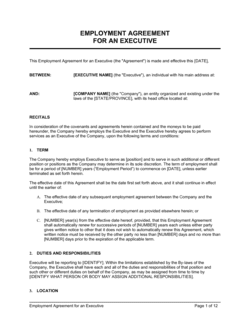
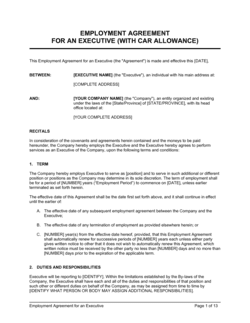
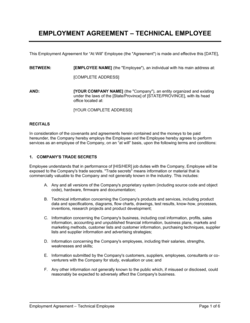
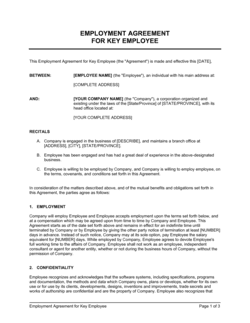
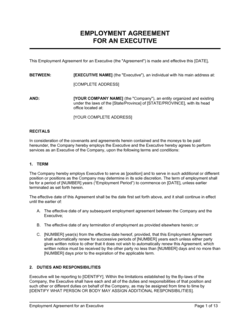
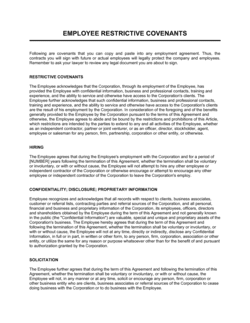
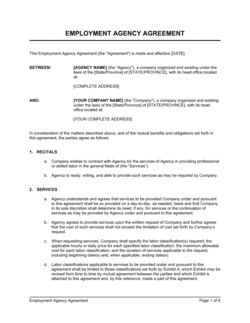
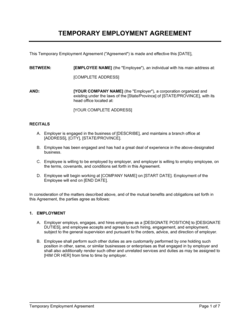
Employment Agreement Template

Free Word download β€’ Edit online β€’ Save & share with Drive β€’ Export to PDF

6 pagesβ€’25–35 min to fillβ€’Difficulty: Complexβ€’Signature requiredβ€’Legal review recommended
Learn more ↓
FreeEmployment Agreement Template

At a glance

What it is
An Employment Contract is a legally binding agreement between an employer and a new hire that defines the terms of the working relationship. This template is a free Word download you can edit online and export as PDF β€” covering position, compensation, benefits, IP assignment, confidentiality, and termination in a single 8-page document.
When you need it
Use it before a new employee's first day for any full-time, part-time, or fixed-term hire where you need enforceable obligations in writing.
What's inside
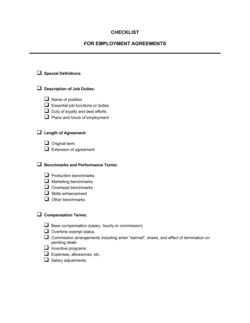
Job title and duties, start date, salary and bonus, benefits, working hours and location, term type, IP assignment, confidentiality, non-compete, non-solicit, termination, severance, and governing law.

What is an Employment Contract?

An Employment Contract is a legally binding agreement between an Employer and a new Employee that governs every material dimension of the working relationship: job title and duties, start date, salary, bonus, benefits, working hours, IP ownership, confidentiality obligations, non-compete and non-solicitation restrictions, termination notice, and severance. Unlike a casual offer letter, a properly drafted employment contract creates enforceable obligations on both sides and eliminates the ambiguity that courts otherwise fill with jurisdiction-specific defaults β€” almost always more favorable to the employee.

Why You Need This Document

Without a written employment contract, you are exposed on four fronts simultaneously. First, IP created by the employee may not belong to you β€” especially for remote workers on personal devices. Second, a departing employee faces no enforceable restrictions on joining competitors or calling your clients. Third, termination without a clear notice and severance formula triggers unlimited common-law notice claims in Canada, the UK, and Australia β€” awards of 12–24 months' pay are not unusual. Fourth, bonus disputes become credibility contests rather than contract interpretation. A signed employment contract, executed before day one, closes all four gaps for the cost of 20 minutes and a legal review where the stakes warrant it.

Which variant fits your situation?

If your situation is…Use this template
Hiring a salaried, full-time permanent employeeEmployment Contract (At-Will)
Hiring for a defined project or season with a fixed end dateFixed-Term Employment Contract
Engaging an independent contractor instead of an employeeIndependent Contractor Agreement
Hiring a C-suite or VP-level executive with equity and severanceExecutive Employment Agreement
Hiring a part-time or hourly workerPart-Time Employment Contract
Onboarding a remote worker in a different state or countryRemote Work Employment Agreement
Bringing on a temporary worker through a probationary period onlyProbationary Employment Contract

Common mistakes to avoid

❌ Signing after the employee's start date

Why it matters: In common-law jurisdictions, an employee already working has given up nothing new β€” meaning restrictive covenants (non-compete, IP assignment) signed after day one may be unenforceable without separate consideration.

Fix: Always execute the contract before or on the first day of work. If circumstances require a later signature, provide a documented benefit β€” bonus, salary increase, or additional PTO β€” as fresh consideration.

❌ Omitting an IP assignment clause

Why it matters: Without explicit assignment language, the employee may retain rights to code, designs, or inventions created on the job β€” especially for remote workers using personal equipment.

Fix: Include a broad IP assignment covering all work product created in connection with the company's business, regardless of where or when it was produced.

❌ Using an at-will clause in a jurisdiction where it is unenforceable

Why it matters: At-will employment is a US doctrine. In Canada, the UK, the EU, and Australia, employees are entitled to notice or pay in lieu regardless of what the contract says.

Fix: Replace the at-will clause with a notice-period clause that meets or exceeds the statutory minimum in the employee's work location.

❌ Setting non-compete scope too broadly

Why it matters: Courts routinely strike down non-competes that are unlimited in geography, cover unrelated industries, or apply to junior employees with no real competitive knowledge β€” voiding the clause entirely.

Fix: Limit non-competes to the specific industry, geography, and customer segment the employee actually worked with. Shorter durations (6–12 months) are more consistently enforced than 24-month restrictions.

❌ No integration or entire-agreement clause

Why it matters: Without one, prior offer letters, emails, and verbal promises can be introduced as contractual terms β€” overriding the written contract.

Fix: Include a standard entire-agreement clause: 'This Agreement constitutes the entire agreement between the parties and supersedes all prior representations, agreements, and understandings.'

❌ Referencing a specific benefits plan by name and detail

Why it matters: Benefits plans change annually. If the contract promises specific coverage levels and the plan changes, the company may be in breach.

Fix: Reference benefits by category only ('Employee is eligible for the Company's standard benefits program as amended from time to time') and link to the current plan summary separately.

The 9 key clauses, explained

Parties, Position, and Start Date

In plain language: Identifies the employer and employee as legal entities, states the job title and department, and records the official first day of employment.

Sample language
This Employment Agreement is entered into on [DATE] between [EMPLOYER LEGAL NAME], a [STATE] [ENTITY TYPE] ('Company'), and [EMPLOYEE FULL NAME] ('Employee'). Employee is engaged as [JOB TITLE] in the [DEPARTMENT] department, commencing [START DATE].

Common mistake: Using a trade name instead of the registered legal entity. If the employer entity name doesn't match payroll records, enforcing IP assignment or non-compete clauses against the right entity becomes difficult.

Duties and Reporting Structure

In plain language: Describes the employee's core responsibilities and who they report to, while preserving the employer's right to reasonably adjust duties over time.

Sample language
Employee shall perform the duties set out in Schedule A and any other duties reasonably assigned by the Company from time to time. Employee shall report directly to [TITLE / NAME].

Common mistake: Over-specifying duties so narrowly that any role change requires a contract amendment β€” or leaving them so vague that performance management becomes impossible.

Compensation, Bonus, and Equity

In plain language: States the base salary or hourly rate, payment frequency, any target bonus, and any equity grant β€” and clarifies that bonus payment is discretionary unless otherwise stated.

Sample language
Company shall pay Employee a base salary of [$X] per year, payable bi-weekly. Employee is eligible for an annual discretionary bonus of up to [Y]% of base salary, based on individual and Company performance. Equity, if any, is governed by a separate option agreement.

Common mistake: Omitting the word 'discretionary' on bonuses. Courts in several jurisdictions have found that a regularly paid bonus becomes a contractual entitlement, even without a written promise.

Benefits and Expenses

In plain language: References the company's benefits plan (health, dental, vision, retirement, PTO) and states the policy for reimbursing business expenses.

Sample language
Employee shall be entitled to participate in the Company's standard benefits program as in effect from time to time, subject to the terms of each plan. Business expenses reasonably incurred shall be reimbursed within [30] days of submission with receipts.

Common mistake: Detailing specific benefit plan terms inside the contract. Plans change annually β€” locking specifics creates amendment obligations or creates expectations the plan no longer meets.

Intellectual Property Assignment

In plain language: Assigns to the employer all work product, inventions, software, and IP created by the employee in connection with their role β€” including after-hours work on company-related projects.

Sample language
Employee agrees that all work product, inventions, developments, and improvements created by Employee in the course of employment, or relating to the Company's business, are the sole property of the Company and are hereby irrevocably assigned to the Company.

Common mistake: No IP assignment clause at all β€” or one that only covers work performed on company premises. Employees working remotely or on personal devices may create IP outside the clause's reach if the language isn't drafted broadly.

Confidentiality

In plain language: Prohibits the employee from disclosing or using the company's confidential information β€” trade secrets, financials, customer lists, and product roadmaps β€” during and after employment.

Sample language
Employee shall not, during or after employment, disclose or use any Confidential Information of the Company without prior written consent. 'Confidential Information' means any non-public information relating to the Company's business, technology, customers, or finances.

Common mistake: Failing to define 'Confidential Information' and relying on 'everything is confidential.' Courts apply a reasonableness standard β€” an overbroad definition can make the whole clause unenforceable.

Non-Compete and Non-Solicitation

In plain language: Restricts the employee from joining competitors or soliciting customers and colleagues for a defined period and geography after leaving.

Sample language
For [12] months following separation, Employee shall not (a) engage in a Competing Business within [GEOGRAPHIC AREA], or (b) solicit any customer, client, or employee of the Company.

Common mistake: Using a one-size-fits-all non-compete regardless of role seniority. Broad non-competes for junior roles are routinely struck down as unreasonable. Calibrate duration and geography to the employee's actual access to competitive information.

Termination, Notice, and Severance

In plain language: States the notice period required for voluntary or employer-initiated termination, conditions that allow termination for cause with no notice or severance, and the severance formula.

Sample language
Either party may terminate this Agreement with [X weeks'] written notice. Company may terminate for Cause immediately without notice or severance. In the event of termination without Cause, Employee shall receive [Y weeks per year of service] severance, subject to execution of a release.

Common mistake: No severance formula at all, or a formula that conflicts with statutory minimums in the applicable jurisdiction. In Canada and the UK, contractual severance can be lower than statutory minimums β€” and the statutory floor applies regardless.

Governing Law and Dispute Resolution

In plain language: Specifies which jurisdiction's employment law governs the agreement and how disputes are handled β€” arbitration, mediation, or court.

Sample language
This Agreement is governed by the laws of [STATE / PROVINCE / COUNTRY]. Any dispute arising under this Agreement shall be resolved by binding arbitration administered by [AAA / JAMS] in [CITY], except claims for injunctive relief.

Common mistake: Choosing a governing law that has no meaningful connection to where the employee works. Several jurisdictions β€” California, for example β€” apply local law regardless of what the contract says.

How to fill it out

  1. 1

    Enter legal entity names and the employee's details

    Use the employer's full registered corporate name β€” not a brand name β€” and the employee's legal name as it appears on government ID. Include the job title and department.

    πŸ’‘ Cross-reference your corporate registry filing to confirm the exact legal name before execution.

  2. 2

    Set the start date and employment type

    Choose at-will, fixed-term, or indefinite. For fixed-term, enter the exact end date. For at-will, leave the term open but ensure at-will status is prominently stated and acknowledged.

    πŸ’‘ In Canada and the UK, 'at-will' has no legal meaning β€” use notice-based termination clauses calibrated to jurisdiction-specific minimums.

  3. 3

    Complete the compensation block

    Enter base salary, payment frequency (bi-weekly is most common in North America), bonus eligibility percentage, and any equity reference. Mark all bonuses as discretionary unless you intend them to be guaranteed.

    πŸ’‘ State the currency explicitly for any employee working in a country different from the employer's home jurisdiction.

  4. 4

    Tailor the non-compete and non-solicit terms

    Set the geographic scope and duration proportionate to the employee's seniority and access to competitive information. Typical ranges: 6–12 months for most roles, up to 24 months for C-suite or sales leaders with direct customer access.

    πŸ’‘ California, Minnesota, and several EU countries ban or severely restrict post-employment non-competes β€” remove or limit the clause accordingly.

  5. 5

    Define the termination and severance terms

    Set notice periods and the severance formula (e.g., 1 week per year of service, minimum 4 weeks). Confirm the formula meets or exceeds the statutory minimums in the governing jurisdiction.

    πŸ’‘ In Ontario, common-law notice can run to 1 month per year of service for long-tenured employees β€” include an 'entire agreement' clause confirming the written contract displaces common-law entitlements.

  6. 6

    Attach a Schedule A for detailed duties

    Move granular role responsibilities to a Schedule A rather than embedding them in the body. This lets you update duties without amending the main contract.

    πŸ’‘ Have the employee initial Schedule A separately at signing to confirm they reviewed the full scope.

  7. 7

    Sign before the start date

    Both parties must sign before the employee's first day. Post-start-date signatures raise a 'fresh consideration' problem in common-law jurisdictions, potentially voiding restrictive covenants.

    πŸ’‘ Use Business in a Box eSign to timestamp execution and store the fully-executed copy in BIB Drive.

Frequently asked questions

What is an employment contract?

An employment contract is a legally binding agreement between an employer and an employee that defines the terms of the working relationship β€” position, compensation, benefits, working hours, IP ownership, confidentiality, and termination conditions. It creates enforceable obligations on both sides and replaces informal offer letters as the authoritative record of agreed terms.

What should be included in an employment contract?

At minimum: parties and job title, start date, compensation (salary, bonus, equity), benefits, working hours and location, employment type (at-will, fixed-term, or indefinite), IP assignment, confidentiality, non-compete and non-solicit restrictions, termination notice periods, severance formula, and governing law. Missing any of these creates gaps courts will fill using jurisdiction-specific defaults β€” which often favor the employee.

Is an employment contract required by law?

In the US, no federal law mandates a written employment contract, but most employers use one to establish enforceable restrictions. In the UK, employers must provide a written statement of particulars within 2 months of hire. In Canada, the EU, and Australia, written contracts are standard and certain minimum terms are legally required β€” oral arrangements expose employers to unlimited common-law notice obligations.

What is the difference between an employment contract and an offer letter?

An offer letter summarizes the role and compensation to trigger acceptance. An employment contract is the binding governing document covering confidentiality, IP, non-compete, termination, and severance in full legal detail. Relying solely on an offer letter leaves the employer without enforceable restrictive covenants and creates ambiguity on termination obligations.

Can I use an at-will clause in my employment contract?

In most US states, yes β€” at-will employment allows either party to end the relationship at any time for any lawful reason. However, at-will is a US doctrine with no equivalent in Canada, the UK, the EU, or Australia. Employers operating outside the US must use notice-period clauses meeting statutory minimums. Even in the US, Montana and certain municipalities restrict at-will termination after a probationary period.

Are non-compete clauses enforceable in an employment contract?

Enforceability depends entirely on jurisdiction and scope. California, Minnesota, North Dakota, and Oklahoma ban most post-employment non-competes. The FTC proposed a near-total ban in 2024 (blocked in court as of 2025 β€” check current status). In jurisdictions that permit them, courts enforce restrictions that are reasonable in duration (typically 6–12 months), geographic scope, and breadth of activity. Overbroad clauses are struck down entirely rather than narrowed in some states.

What happens if an employment contract is signed after the start date?

In common-law jurisdictions (US, Canada, UK, Australia), a contract requires fresh consideration to be enforceable. An employee who has already started work gave no new consideration for post-start restrictions. Courts have voided IP assignment, non-compete, and confidentiality clauses on this basis. The fix is to execute before day one or provide documented additional compensation β€” bonus, raise, extra PTO β€” at the time of signing.

How much severance should an employment contract include?

In the US, severance is not legally required unless contracted. A common formula is 1–2 weeks per year of service, with a minimum of 2–4 weeks. In Canada, contractual severance must meet Employment Standards Act minimums (1 week per year of service, capped at 8 weeks under most provincial statutes) plus potential common-law notice. In the UK, statutory redundancy pay runs 0.5–1.5 weeks per year of service depending on age, with a weekly pay cap updated annually.

Do I need a lawyer to draft an employment contract?

For straightforward domestic hires, a high-quality template is usually sufficient. Engage a lawyer when hiring executives with equity and complex severance, when the employee works in a heavily regulated jurisdiction, when the role involves sensitive IP in a competitive market, or when non-compete enforceability is critical to the business. A 1–2 hour template review typically costs $300–$600 and is worthwhile for senior hires or cross-border arrangements.

What is constructive dismissal and how does the contract protect against it?

Constructive dismissal occurs when an employer unilaterally changes employment conditions β€” reducing pay, demoting the employee, or changing location significantly β€” to the point where the employee is effectively forced to resign. To reduce exposure, include a clause granting the employer the right to make reasonable changes to duties, compensation bands, and work location with appropriate notice, and have the employee acknowledge this flexibility at signing.

How this compares to alternatives

vs Independent Contractor Agreement

A contractor agreement engages a self-employed individual for project-based work with no employment entitlements β€” no benefits, no tax withholding, no overtime. Misclassifying an employee as a contractor triggers back taxes, penalties, and benefit liability. The key distinction is the degree of control the employer exercises over how the work is performed.

vs Offer Letter

An offer letter confirms the role and compensation to secure acceptance; it is not a comprehensive legal document. It typically lacks IP assignment, non-compete, confidentiality, and detailed termination clauses. Relying on an offer letter alone leaves significant legal gaps that courts fill with jurisdiction-specific defaults β€” usually more favorable to the employee.

vs Executive Employment Agreement

An executive agreement covers the same core terms but adds equity grant details, change-of-control provisions, golden parachute or enhanced severance terms, D&O indemnification, and more heavily negotiated non-compete terms. Standard employment contracts are not appropriate for C-suite or VP hires with equity and material severance exposure.

vs Fixed-Term Employment Contract

A fixed-term contract sets a defined end date, after which employment automatically terminates without additional notice or severance beyond the contractual end. Standard employment contracts run indefinitely until terminated by notice or cause. Fixed-term arrangements suit project work, seasonal roles, or maternity cover but carry risk of implied renewal if the employee continues working past the end date.

Industry-specific considerations

Technology / SaaS

IP assignment covers software, algorithms, and training data; equity vesting schedules referenced in a parallel option agreement; remote-work addendum for distributed teams.

Financial Services

Regulatory licensing obligations, FINRA/FCA registration requirements, bonus clawback provisions, and enhanced confidentiality covering client and trading data.

Healthcare

HIPAA confidentiality obligations incorporated by reference, credentialing and licensing conditions as employment prerequisites, non-solicitation covering patients.

Professional Services

Client non-solicitation critical given fee-based relationships; billing target and utilization rate references; professional indemnity coverage coordination.

Manufacturing

Shift schedules and overtime classifications; union-agreement interaction clauses; safety training and certification conditions precedent to full duties.

Retail / Hospitality

Hourly and variable-schedule provisions; tip and gratuity handling; high turnover means at-will or short fixed-term structures are standard.

Jurisdictional notes

United States

At-will employment is the default in 49 states; Montana requires cause after a probationary period. Federal law sets FLSA overtime and minimum wage floors. Non-compete enforceability varies sharply by state β€” California, Minnesota, and Oklahoma ban most post-employment restrictions. California also voids many IP assignment clauses for off-duty inventions under Labor Code Β§2870.

Canada

At-will employment does not exist in Canada. Employment Standards Acts in each province set minimum notice, severance, and termination pay β€” contracts that provide less are void. Ontario common-law notice can reach 1 month per year of service. Quebec contracts must be in French for provincially-regulated employers. Non-competes are enforceable only if reasonable in scope and duration.

United Kingdom

Employers must provide a written statement of employment particulars on or before day one. Statutory minimum notice is 1 week per year of service after 2 years, capped at 12 weeks. Garden leave and post-termination restrictive covenants are enforceable if reasonable. IR35 rules apply when an employer engages workers through personal service companies.

European Union

The EU Transparent and Predictable Working Conditions Directive requires written terms within 7 days of hire. Minimum notice periods and severance vary by member state β€” France, Germany, and Spain impose some of the strictest protections. Post-employment non-competes typically require financial compensation to the employee to be enforceable, ranging from 25–100% of salary depending on the country.

Template vs lawyer β€” what fits your deal?

PathBest forCostTime
Use the templateStandard domestic full-time hires below senior management in a single US state or Canadian provinceFree20 minutes
Template + legal reviewCross-border hires, senior roles with equity, or jurisdictions with complex employment law (CA, ON, UK)$300–$6001–3 days
Custom draftedC-suite executives, heavily regulated industries, multi-jurisdiction employment, or material non-compete requirements$1,500–$5,000+1–3 weeks

Glossary

At-Will Employment
Employment that either party may end at any time, for any lawful reason, without advance notice or cause β€” common in most US states.
Fixed-Term Contract
An employment agreement with a defined start and end date, after which employment automatically terminates unless renewed.
Probationary Period
A defined initial period β€” typically 30 to 90 days β€” during which the employer evaluates performance with reduced termination formalities.
IP Assignment
A clause transferring ownership of any work product, inventions, or code created by the employee to the employer during the employment relationship.
Non-Compete Clause
A post-employment restriction preventing the employee from working for competitors or starting a competing business within a defined time and geography.
Non-Solicitation Clause
A restriction preventing a departing employee from poaching the employer's customers, clients, or other employees for a defined period after leaving.
Severance
Compensation paid to an employee upon termination, typically expressed as a number of weeks' pay per year of service.
Constructive Dismissal
When an employer unilaterally changes employment conditions so significantly that the employee is effectively forced to resign β€” treated legally as termination.
Garden Leave
A notice period during which the employee is paid but required to stay away from the workplace, preventing access to clients or confidential information.
Exempt vs. Non-Exempt
US classification under the FLSA: exempt employees are not entitled to overtime pay; non-exempt employees must receive 1.5Γ— their regular rate for hours over 40 per week.
Cause (for Termination)
Specific, documented grounds β€” such as misconduct, fraud, or gross negligence β€” that justify termination without severance or notice.

Part of your Business Operating System

This document is one of 3,000+ business & legal templates included in Business in a Box.

  • Fill-in-the-blanks β€” ready in minutes
  • 100% customizable Word document
  • Compatible with all office suites
  • Export to PDF and share electronically

Create your document in 3 simple steps.

From template to signed document β€” all inside one Business Operating System.
1
Download or open template

Access over 3,000+ business and legal templates for any business task, project or initiative.

2
Edit and fill in the blanks with AI

Customize your ready-made business document template and save it in the cloud.

3
Save, Share, Send, Sign

Share your files and folders with your team. Create a space of seamless collaboration.

Save time, save money, and create top-quality documents.

β˜…β˜…β˜…β˜…β˜…

"Fantastic value! I'm not sure how I'd do without it. It's worth its weight in gold and paid back for itself many times."

Managing Director Β· Mall Farm
Robert Whalley
Managing Director, Mall Farm Proprietary Limited
β˜…β˜…β˜…β˜…β˜…

"I have been using Business in a Box for years. It has been the most useful source of templates I have encountered. I recommend it to anyone."

Business Owner Β· 4+ years
Dr Michael John Freestone
Business Owner
β˜…β˜…β˜…β˜…β˜…

"It has been a life saver so many times I have lost count. Business in a Box has saved me so much time and as you know, time is money."

Owner Β· Upstate Web
David G. Moore Jr.
Owner, Upstate Web

Run your business with a system β€” not scattered tools

Stop downloading documents. Start operating with clarity. Business in a Box gives you the Business Operating System used by over 250,000 companies worldwide to structure, run, and grow their business.

Start freeΒ Β·Β No credit card required