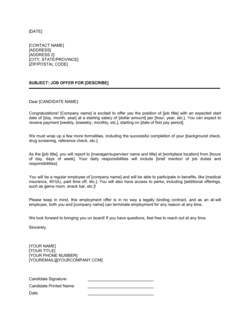
Temporary Employment Contract Template

Free Word download • Edit online • Save & share with Drive • Export to PDF

7 pages30–40 min to fillDifficulty: ComplexSignature requiredLegal review recommended
Learn more ↓
FreeTemporary Employment Contract Template

At a glance

What it is
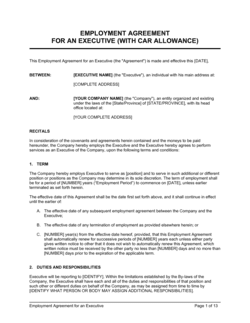
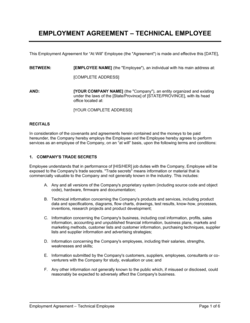
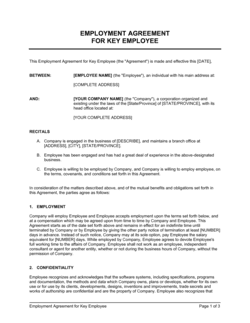
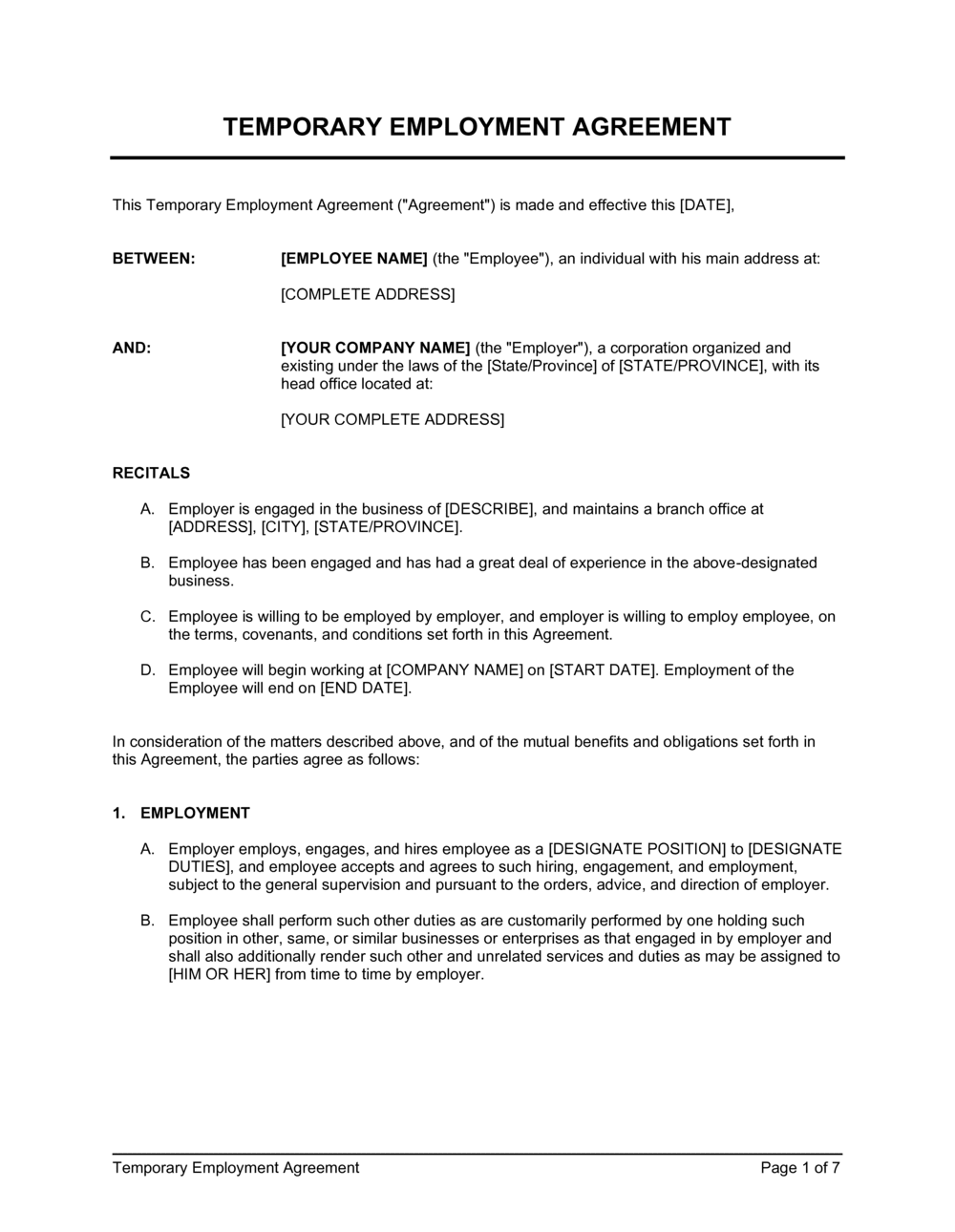
A Temporary Employment Contract is a legally binding agreement between an employer and an employee engaged for a defined period — a fixed end date, a specific project, or a seasonal peak. This free Word download gives you a structured, attorney-reviewed starting point covering duties, compensation, benefits, IP assignment, confidentiality, and termination conditions in a single editable document you can export as PDF and sign before day one.
When you need it
Use it when hiring for a project-based role, a seasonal surge, a parental leave cover, or any engagement where the employment relationship has a defined end date and you need enforceable written terms in place.
What's inside
Parties and position details, contract start and end date, compensation and benefits, duties and reporting structure, IP assignment, confidentiality obligations, early termination provisions, and governing law — all in a format courts recognize as a complete written employment agreement.

What is a Temporary Employment Contract?

A Temporary Employment Contract is a legally binding agreement between an employer and an employee engaged for a fixed, defined period — whether tied to a calendar end date, the completion of a specific project, or the duration of a seasonal peak. Unlike a permanent employment contract, it includes an automatic expiry provision that ends the relationship on the stated date without either party needing to issue a separate termination notice. Despite the fixed term, it carries the same core legal weight as a permanent agreement: it creates enforceable obligations around compensation, duties, intellectual property, and confidentiality, and it establishes the notice rights and remedies available if either party exits early.

Why You Need This Document

Hiring a temporary worker without a written contract exposes you to three serious risks simultaneously. First, if no end date is documented, courts in Canada, the UK, and the EU routinely treat the engagement as indefinite employment — triggering full statutory notice and severance obligations when the role ends. Second, without an IP assignment clause, work product created by a temporary employee — code, designs, client reports — may not legally belong to the employer when the engagement concludes. Third, an undocumented temporary hire has no enforceable confidentiality or non-solicitation restriction, meaning they can walk out the door with your client list and call your customers the next morning. A properly executed temporary employment contract closes all three gaps before day one, gives both parties a clear understanding of when and how the engagement ends, and provides the written record every jurisdiction requires to enforce restrictive covenants if a dispute arises later.

Which variant fits your situation?

If your situation is…Use this template
Ongoing indefinite employment with no fixed end dateEmployment Contract (At-Will)
Engaging a self-employed specialist rather than an employeeIndependent Contractor Agreement
Hiring a C-suite executive on a fixed term with equity and severanceExecutive Employment Agreement
Probationary hire with the intent to convert to permanentProbationary Employment Contract
Remote worker engaged for a defined project periodRemote Work Employment Agreement
Part-time variable-schedule engagement without a fixed end datePart-Time Employment Contract
Seasonal agricultural, hospitality, or retail placementSeasonal Employment Contract

Common mistakes to avoid

❌ Allowing the employee to work past the end date without a signed renewal

Why it matters: In Canada, the UK, and most EU member states, continued work after a fixed-term contract expires implies conversion to indefinite employment — stripping the employer of fixed-term protections and creating ongoing notice and severance obligations.

Fix: Include a clause expressly stating that continued work after the end date does not create permanent employment, and calendar a renewal decision at least 30 days before expiry.

❌ No early termination clause

Why it matters: Without an early termination provision, a court may award the employee the full remaining wages for the entire unexpired contract period as damages — even if the role became redundant the day after signing.

Fix: Always include an early termination clause with a defined notice period and pay-in-lieu option, plus clear grounds for immediate termination for cause.

❌ Using at-will language in a non-US jurisdiction

Why it matters: At-will employment is a US doctrine with no legal equivalent in Canada, the UK, the EU, or Australia. Inserting at-will language into a temporary contract governed by these jurisdictions is unenforceable and creates ambiguity about the actual notice obligations.

Fix: Replace at-will language with a notice-period clause calibrated to the applicable jurisdiction's statutory minimum for the role's duration and seniority.

❌ Relying on successive fixed-term contracts without legal review

Why it matters: In the EU, UK, and Canada, renewing or rolling over fixed-term contracts with the same employee multiple times triggers statutory conversion to permanent employment — often after as few as two renewals or four years of service.

Fix: Track the total duration of all fixed-term engagements with each employee and seek legal advice before issuing a third consecutive renewal in any jurisdiction.

❌ Omitting overtime eligibility status

Why it matters: Leaving overtime status silent or misclassifying a non-exempt temporary worker as exempt exposes the employer to back-pay liability for all missed overtime plus statutory penalties, even for a short engagement.

Fix: Explicitly state whether the employee is exempt or non-exempt from overtime, confirm the applicable rate, and verify classification against the FLSA, provincial ESA, or equivalent statute.

❌ Signing the contract after the employee's start date

Why it matters: In common-law jurisdictions, an employee who has already begun work has provided no new consideration for restrictive covenants signed after day one — courts have voided IP assignment, confidentiality, and non-solicitation clauses on this basis.

Fix: Always execute the contract before or on the first day of work. If late execution is unavoidable, provide documented additional compensation — a signing bonus, extra leave, or a pay increase — as fresh consideration at the time of signing.

The 10 key clauses, explained

Parties, Position, and Contract Dates

In plain language: Identifies the employer and employee as legal entities, states the job title and department, and records the official start date and end date of the fixed-term engagement.

Sample language
This Temporary Employment Agreement is entered into on [DATE] between [EMPLOYER LEGAL NAME], a [STATE/PROVINCE] [ENTITY TYPE] ('Employer'), and [EMPLOYEE FULL NAME] ('Employee'). Employee is engaged as [JOB TITLE] in the [DEPARTMENT] department from [START DATE] to [END DATE] ('Contract Term').

Common mistake: Using a trade name instead of the registered legal entity name. If the employer entity name doesn't match payroll records, enforcing IP assignment or early termination clauses becomes difficult and creates confusion during any legal dispute.

Duties, Scope, and Reporting Structure

In plain language: Describes the employee's core responsibilities during the term and identifies who they report to, while giving the employer flexibility to adjust tasks reasonably without triggering a contract amendment.

Sample language
During the Contract Term, Employee shall perform the duties set out in Schedule A and any other duties reasonably assigned by Employer. Employee shall report directly to [TITLE / NAME OF SUPERVISOR].

Common mistake: Over-specifying duties so narrowly that any minor task reassignment triggers a dispute — or leaving them so vague that performance management for early termination becomes impossible.

Compensation and Payment Schedule

In plain language: States the hourly rate or fixed salary, payment frequency, overtime eligibility, and any agreed bonus or pro-rated entitlements for the contract period.

Sample language
Employer shall pay Employee [a salary of $[X] per [week/month] OR an hourly rate of $[X]], payable [bi-weekly / semi-monthly] by direct deposit. Employee is [eligible / not eligible] for overtime pay in accordance with applicable law.

Common mistake: Omitting overtime eligibility status. Misclassifying a non-exempt temporary worker as exempt from overtime — even for a short engagement — triggers wage-and-hour liability equal to the missed overtime plus statutory penalties.

Benefits and Leave Entitlements

In plain language: States which employer benefits the temporary employee is entitled to — or explicitly excluded from — during the term, and sets out any statutory leave entitlements.

Sample language
During the Contract Term, Employee [shall / shall not] be eligible to participate in the Employer's standard health, dental, and retirement benefit programs. Employee is entitled to [X] days of paid leave and all statutory public holidays as required by applicable law.

Common mistake: Leaving benefits entitlement silent. In several jurisdictions, silence is interpreted as full entitlement. Explicitly state which benefits apply and which do not to avoid implied obligations.

Intellectual Property Assignment

In plain language: Assigns to the employer all work product, code, designs, and inventions created by the temporary employee in connection with their role during the engagement.

Sample language
Employee agrees that all work product, inventions, developments, designs, and improvements created by Employee during the Contract Term in connection with Employer's business are the sole property of Employer and are hereby irrevocably assigned to Employer.

Common mistake: No IP assignment clause at all, or one limited to work done on employer premises. Temporary employees often work remotely or use personal devices — the assignment must cover all work related to the employer's business regardless of location.

Confidentiality

In plain language: Prevents the employee from disclosing or misusing the employer's confidential information — trade secrets, client lists, financial data, and internal processes — during and after the engagement.

Sample language
During and after the Contract Term, Employee shall not disclose or use any Confidential Information of Employer without prior written consent. 'Confidential Information' means any non-public information relating to Employer's business, technology, customers, or finances.

Common mistake: Failing to define 'Confidential Information' and using a catch-all like 'everything is confidential.' Courts apply a reasonableness standard — an overbroad or undefined clause can render the entire confidentiality provision unenforceable.

Early Termination and Notice Period

In plain language: Allows either party to end the contract before the stated end date by giving written notice or paying the equivalent in lieu, and specifies the grounds for immediate termination for cause.

Sample language
Either party may terminate this Agreement before the Contract End Date by providing [X] weeks' written notice or pay in lieu thereof. Employer may terminate immediately for Cause, defined as [LIST OF GROUNDS], without notice or further compensation.

Common mistake: No early termination clause at all, assuming the fixed end date alone is sufficient. Without one, early termination may entitle the employee to the full remaining wages for the contract period — often as a lump sum.

End of Term and Renewal

In plain language: Confirms that employment ends automatically on the contract end date without further notice, and specifies the process — and any written consent required — for extension or renewal.

Sample language
Employment under this Agreement terminates automatically on [END DATE] without further notice. Any extension or renewal must be agreed in writing by both parties no later than [X] days before the Contract End Date. Continued work after [END DATE] without a signed renewal does not create a permanent employment relationship.

Common mistake: Allowing the employee to continue working past the end date without a signed renewal. In many jurisdictions, this implies conversion to indefinite employment, stripping the employer of the fixed-term protections.

Non-Solicitation

In plain language: Restricts the former employee from soliciting the employer's customers or employees for a defined period after the engagement ends.

Sample language
For [6] months following the end of the Contract Term, Employee shall not directly or indirectly solicit any customer, client, or employee of Employer with whom Employee had material contact during the engagement.

Common mistake: Applying a non-solicitation clause without regard to the employee's actual role. A non-solicitation restriction on an employee with no client or colleague contact is routinely struck down as disproportionate.

Governing Law and Entire Agreement

In plain language: Specifies which jurisdiction's employment law governs the contract and confirms that the written agreement replaces all prior oral or written representations.

Sample language
This Agreement is governed by the laws of [STATE / PROVINCE / COUNTRY]. This Agreement constitutes the entire agreement between the parties and supersedes all prior representations, negotiations, and understandings. Any amendment must be in writing and signed by both parties.

Common mistake: Choosing a governing law that has no connection to where the employee physically works. Jurisdictions such as California and Ontario apply local employment law regardless of a conflicting choice-of-law clause.

How to fill it out

  1. 1

    Enter the employer's legal entity name and the employee's details

    Use the employer's full registered corporate name — not a brand or trade name — and the employee's legal name as it appears on government-issued ID. Include the job title, department, and supervisor name.

    💡 Cross-reference your corporate registry filing to confirm the exact legal name before execution — mismatches create enforcement gaps for IP and confidentiality clauses.

  2. 2

    Set the precise start date and end date

    Enter both dates in full (e.g., June 1, 2026 to September 30, 2026). If the contract is tied to project completion rather than a calendar date, define the triggering milestone in specific, verifiable terms.

    💡 Avoid vague end-date language like 'completion of the project.' If the milestone is disputed, the end date becomes unenforceable and courts may treat the arrangement as indefinite employment.

  3. 3

    Complete the compensation block and overtime status

    State the exact rate (hourly or salary), payment frequency, and whether the employee is exempt or non-exempt from overtime. For non-exempt workers, confirm the overtime rate meets the applicable statutory minimum.

    💡 State the currency explicitly for any temporary worker engaged remotely from a different country than the employer's home jurisdiction.

  4. 4

    Define benefits entitlements explicitly

    List each benefit category the employee is entitled to during the term — health insurance, paid leave, statutory holidays — and explicitly state which standard employer benefits do not apply to temporary workers.

    💡 Review the applicable Employment Standards Act or equivalent before completing this section — statutory minimum leave and holiday entitlements often apply to temporary workers regardless of what the contract says.

  5. 5

    Tailor the IP assignment and confidentiality clauses

    Confirm the IP assignment covers work done on personal devices and outside business hours if it relates to the employer's business. Ensure the confidentiality definition is specific enough to be enforceable but not so broad it captures general industry knowledge.

    💡 For roles involving sensitive client data, add a GDPR or CCPA data-handling clause referencing the employer's privacy policy by name.

  6. 6

    Set the early termination notice period

    Enter the notice period (typically 1–4 weeks for temporary roles) and confirm it meets or exceeds the statutory minimum in the governing jurisdiction. Add the grounds for immediate termination for cause.

    💡 In Canada and the UK, contractual notice periods below the statutory minimum are void — the statutory floor applies automatically even if not written into the contract.

  7. 7

    Add the renewal and end-of-term provisions

    Confirm the automatic expiry language is present, set the renewal-decision deadline (e.g., 14 days before end date), and include a clause stating that continued work after expiry does not convert the engagement to indefinite employment.

    💡 Calendar a reminder in your HR system 30 days before the contract end date to decide and document the renewal or expiry — silence is the most common conversion trigger.

  8. 8

    Execute before the employee's first day

    Both parties must sign the contract before the employee begins work. Post-start-date signatures create a fresh-consideration problem in common-law jurisdictions that can void IP assignment and non-solicitation clauses.

    💡 Use an e-signature tool to timestamp execution and store the fully executed copy in a centralized HR document system for easy retrieval.

Frequently asked questions

What is a temporary employment contract?

A temporary employment contract is a legally binding agreement between an employer and an employee that defines the terms of an engagement with a defined end date — whether tied to a calendar date, a project milestone, or a seasonal period. It creates the same core obligations as a permanent contract — compensation, duties, IP, confidentiality — but includes fixed-term expiry provisions and early termination rights that a standard indefinite contract does not.

What is the difference between a temporary employment contract and an independent contractor agreement?

A temporary employment contract creates an employer-employee relationship, meaning the employer withholds payroll taxes, may owe statutory benefits, and exercises control over how and when the work is performed. An independent contractor agreement engages a self-employed individual who controls their own work methods, invoices for services, and handles their own taxes. Misclassifying an employee as a contractor — even temporarily — triggers back tax liability, benefit obligations, and statutory penalties in most jurisdictions.

Does a temporary employment contract become permanent automatically?

It can, depending on jurisdiction and conduct. In the EU, UK, and Canada, allowing an employee to continue working after the contract end date, or renewing fixed-term contracts beyond statutory thresholds, typically triggers automatic conversion to indefinite employment. In the US, this risk is lower but not zero — some state courts have found implied permanent employment from prolonged temporary arrangements. A clear end-of-term clause and a disciplined renewal process are the primary safeguards.

What happens if a temporary employee is terminated before the contract end date?

Without an early termination clause, the employer may owe the employee all wages and benefits for the full remaining contract period. With a properly drafted early termination clause, the employer owes only the stated notice period — or payment in lieu — plus any accrued statutory entitlements. Always include an early termination clause with defined notice and clear grounds for immediate termination for cause.

Are non-solicitation clauses enforceable in a temporary employment contract?

Generally yes, if the restriction is proportionate to the employee's actual role and duration of engagement. Courts look at whether the employee had meaningful access to the clients or colleagues being protected, the length of the restriction (6–12 months is typical), and the geographic scope. A broad non-solicitation clause applied to a short-term administrative role with no client contact is routinely struck down as disproportionate.

Do temporary employees receive the same statutory benefits as permanent employees?

In most jurisdictions, temporary employees are entitled to the same statutory minimum entitlements — minimum wage, overtime, statutory holidays, and basic leave — as permanent employees, regardless of what the contract says. Contractual benefits such as employer-sponsored health insurance, retirement contributions, and paid vacation above the statutory minimum can be excluded for temporary workers if the contract explicitly states so, subject to local law.

How much notice is required to end a temporary employment contract early?

Notice requirements depend on the jurisdiction and the contract terms. In the US, one to two weeks is common for short temporary roles, though no federal minimum exists. In Canada, provincial Employment Standards Acts set minimums ranging from one to eight weeks depending on tenure. In the UK, the statutory minimum is one week after one month of service. The contract can provide more than the statutory minimum but never less.

Can I use the same temporary employment contract template across multiple jurisdictions?

A single template can serve as the structural framework, but the governing law, notice periods, overtime classifications, and benefits entitlements must be tailored to each jurisdiction where an employee physically works. At minimum, the governing law clause, early termination notice period, and benefits section should be reviewed by a local employment lawyer before use in Canada, the UK, the EU, or Australia.

Does a temporary employment contract need to be in writing?

In the US, no federal law requires a written temporary employment contract, but oral agreements create enforcement gaps on IP, confidentiality, and termination terms. In the UK, employers must provide a written statement of particulars on or before day one of employment. In the EU and Canada, written contracts are standard and statutory minimums apply in writing or not. A signed written contract is always the safest approach regardless of jurisdiction.

How this compares to alternatives

vs Employment Contract (At-Will)

A standard at-will employment contract creates an indefinite working relationship terminable by either party at any time for any lawful reason. A temporary employment contract defines a fixed end date and automatic expiry, giving the employer a clean exit without triggering ongoing notice or severance obligations. Use a temporary contract when the engagement has a known end point; use at-will for permanent hires.

vs Independent Contractor Agreement

An independent contractor agreement engages a self-employed individual who controls their own work methods, invoices for services, and is responsible for their own tax. A temporary employment contract creates an employer-employee relationship with payroll tax obligations, statutory entitlements, and greater employer control over the work. Misclassifying a temporary employee as a contractor triggers back taxes, penalties, and benefit liability.

vs Executive Employment Agreement

An executive employment agreement is designed for C-suite or VP-level permanent hires and includes equity vesting, change-of-control provisions, enhanced severance, and D&O indemnification. A temporary employment contract is a streamlined fixed-term document for standard roles without equity or material severance exposure. Use the executive agreement for senior leaders; use the temporary contract for defined-duration operational roles.

vs Remote Work Employment Agreement

A remote work employment agreement governs where and how a permanent employee works, covering equipment, expense reimbursement, data security, and flexible scheduling. A temporary employment contract governs when the employment ends. The two are not mutually exclusive — a temporary remote hire needs both a fixed-term end date and remote-work provisions, either combined in one document or referenced by addendum.

Industry-specific considerations

Retail and E-commerce

Seasonal peak hiring for holiday periods, short fixed-term contracts with explicit end dates, and high-volume onboarding that requires a standardized template for consistent terms.

Construction and Trades

Project-duration engagements tied to site completion milestones rather than calendar dates, with specific safety training requirements as conditions precedent to full duties.

Technology / SaaS

Sprint-based or product-launch temporary hires where IP assignment and confidentiality clauses are critical to protect source code, algorithms, and unreleased product features.

Healthcare

Locum and cover arrangements requiring professional registration as a condition of employment, HIPAA or equivalent confidentiality obligations, and credentialing prerequisites embedded in the duties clause.

Professional Services

Parental leave cover and project-based specialist engagements where client non-solicitation clauses are essential and billing-rate confidentiality must be explicitly protected.

Manufacturing

Seasonal production surge staffing with shift-schedule provisions, safety certification requirements, and clearly defined overtime eligibility for non-exempt hourly workers.

Jurisdictional notes

United States

At-will employment is the default in 49 states and applies equally to temporary arrangements — most US temporary contracts end by expiry rather than termination, but early termination is lawful at any time absent a specific clause. Federal FLSA rules govern overtime for non-exempt temporary workers regardless of the contract's terms. No federal law mandates a written temporary contract, but written terms are essential to enforce IP assignment, confidentiality, and non-solicitation restrictions.

Canada

Provincial Employment Standards Acts set statutory minimums for notice, termination pay, and vacation that apply to temporary employees from day one — contracts that provide less are void to that extent. Ontario common-law notice can apply even to fixed-term arrangements if no early termination clause is present. Renewing fixed-term contracts beyond provincial thresholds can trigger conversion to indefinite employment. Quebec contracts must be drafted or translated into French for provincially regulated employers.

United Kingdom

The Fixed-Term Employees (Prevention of Less Favourable Treatment) Regulations 2002 require that temporary workers receive comparable terms to permanent employees unless objectively justified. Employees on successive fixed-term contracts totaling four or more years are automatically deemed permanent unless the employer can show objective justification. A written statement of employment particulars must be provided on or before day one. Statutory minimum notice is one week after one month of continuous service.

European Union

The EU Fixed-Term Work Directive prohibits less favorable treatment of fixed-term employees compared to comparable permanent employees. Most member states cap successive fixed-term contracts at two renewals or a total of two to three years before mandatory conversion to permanent employment — France, Germany, and Spain impose some of the strictest limits. The EU Transparent and Predictable Working Conditions Directive requires written terms within seven days of hire. Financial compensation may be required for post-employment restrictions depending on the member state.

Template vs lawyer — what fits your deal?

PathBest forCostTime
Use the templateStandard domestic temporary hires in a single US state or Canadian province where the role is below senior managementFree20–30 minutes
Template + legal reviewCross-border temporary hires, roles with significant IP or client access, or jurisdictions with complex fixed-term conversion rules (Ontario, UK, EU)$300–$6001–3 days
Custom draftedSenior temporary executives, highly regulated industries such as healthcare or financial services, or multi-jurisdiction temporary staffing programs$1,000–$3,500+1–2 weeks

Glossary

Fixed-Term Contract
An employment agreement with a defined start and end date, after which employment terminates automatically unless explicitly renewed.
Automatic Termination
The expiry of a fixed-term contract on its stated end date without either party needing to issue a separate notice of termination.
Renewal Clause
A provision allowing the parties to extend the contract by mutual written agreement before the original end date passes.
Early Termination
A clause permitting either party to end the contract before the stated end date, typically subject to a notice period or payment in lieu.
IP Assignment
A clause transferring ownership of all work product, inventions, and materials created by the employee during the engagement to the employer.
Confidentiality Obligation
A binding duty preventing the temporary employee from disclosing the employer's proprietary information during and after the engagement.
Probationary Period
A short initial window — often 30 days — within a fixed-term contract during which the employer can terminate with reduced notice if performance is unsatisfactory.
Pay in Lieu of Notice
A lump-sum payment made to the employee instead of requiring them to work out a notice period upon early termination.
Successive Fixed-Term Contracts
Multiple back-to-back temporary contracts with the same employee, which in many jurisdictions trigger an automatic conversion to permanent employment after a statutory threshold.
Constructive Dismissal
When an employer unilaterally changes employment conditions so significantly that the employee is effectively forced to resign — treated legally as a termination even within a fixed-term engagement.
Statutory Minimum Notice
The legally required minimum notice period an employer must give before ending employment, set by law in each jurisdiction regardless of what the contract says.

Part of your Business Operating System

This document is one of 3,000+ business & legal templates included in Business in a Box.

  • Fill-in-the-blanks — ready in minutes
  • 100% customizable Word document
  • Compatible with all office suites
  • Export to PDF and share electronically

Create your document in 3 simple steps.

From template to signed document — all inside one Business Operating System.
1
Download or open template

Access over 3,000+ business and legal templates for any business task, project or initiative.

2
Edit and fill in the blanks with AI

Customize your ready-made business document template and save it in the cloud.

3
Save, Share, Send, Sign

Share your files and folders with your team. Create a space of seamless collaboration.

Save time, save money, and create top-quality documents.

★★★★★

"Fantastic value! I'm not sure how I'd do without it. It's worth its weight in gold and paid back for itself many times."

Managing Director · Mall Farm
Robert Whalley
Managing Director, Mall Farm Proprietary Limited
★★★★★

"I have been using Business in a Box for years. It has been the most useful source of templates I have encountered. I recommend it to anyone."

Business Owner · 4+ years
Dr Michael John Freestone
Business Owner
★★★★★

"It has been a life saver so many times I have lost count. Business in a Box has saved me so much time and as you know, time is money."

Owner · Upstate Web
David G. Moore Jr.
Owner, Upstate Web

Run your business with a system — not scattered tools

Stop downloading documents. Start operating with clarity. Business in a Box gives you the Business Operating System used by over 250,000 companies worldwide to structure, run, and grow their business.

Free Forever Plan · No credit card required