1
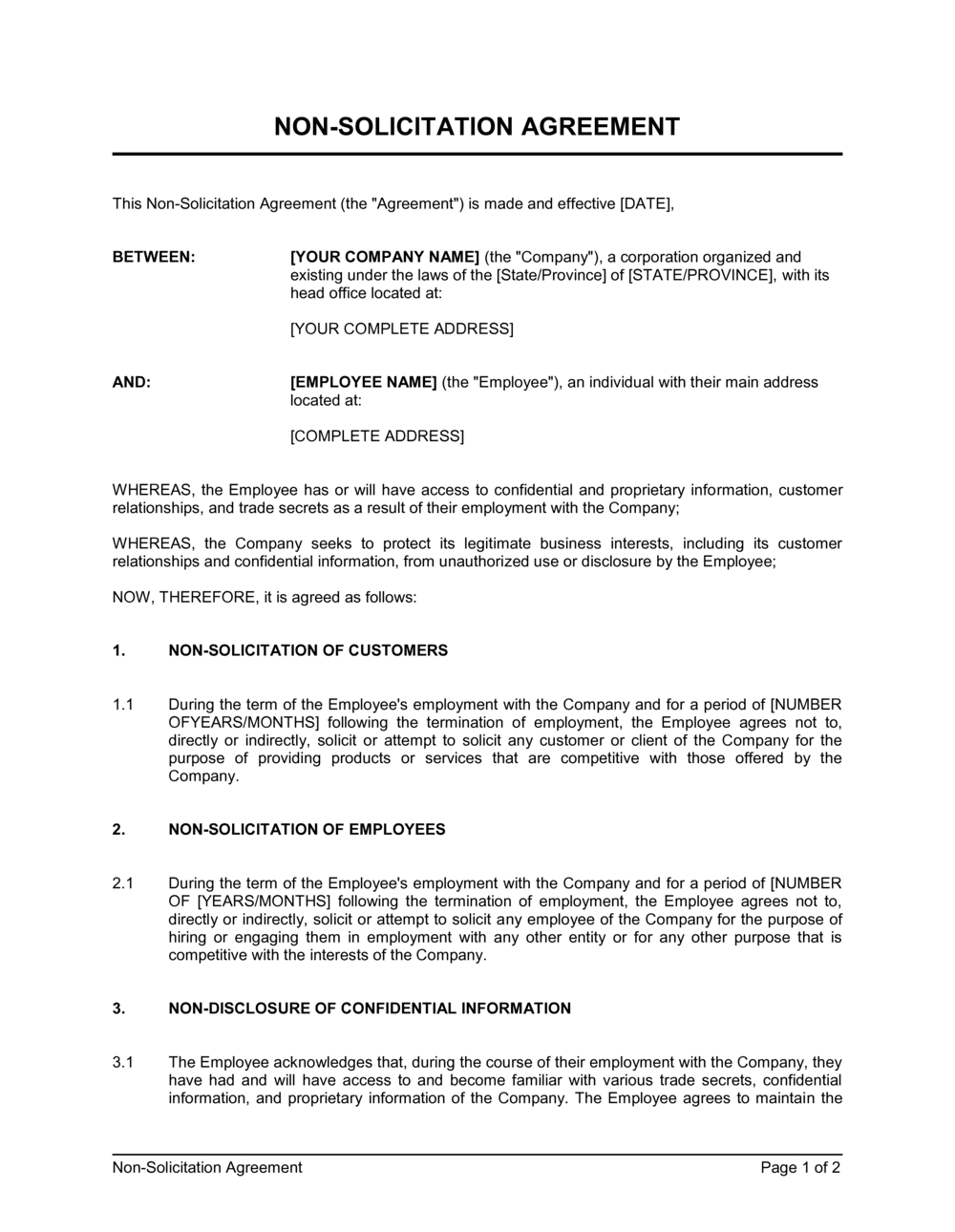
Identify the parties using their legal names
Enter the company's full registered legal name and the restricted party's full legal name as it appears on government-issued ID or their corporate registration. Specify the relationship type — employee, contractor, or business partner.
💡 Cross-reference your corporate registry filing before inserting the company name. A mismatch between the agreement and payroll records can create standing issues in enforcement proceedings.
2
Define protected customers and protected persons precisely
Write out who qualifies as a Protected Customer — limit it to individuals or entities the restricted party personally interacted with or had access to during a defined lookback period, such as 24 months. Define Protected Persons to include employees and contractors.
💡 Narrower, fact-specific definitions are enforced far more consistently than sweeping 'all customers ever served' language. Precision is a feature, not a weakness.
3
Set the restricted period proportionate to seniority
Typical enforceable ranges are 6 months for junior employees, 12 months for mid-level managers, and 18–24 months for executives with deep client or talent access. Enter the period in months, not vague language like 'a reasonable time.'
💡 Match the restricted period to the realistic commercial risk: how long does it take to replace a key client relationship or re-hire a specialist? That answer is your ceiling.
4
Add geographic scope only if operationally justified
For client non-solicitation, geographic limits are often unnecessary because the restriction follows the customer, not a territory. For employee non-solicitation, omit geography entirely — poaching can happen from anywhere.
💡 Removing an unjustified geographic limit actually strengthens the agreement; courts are less likely to find the restriction overbroad.
5
Document the consideration clearly
For new hires, state that employment itself is the consideration. For existing employees signing post-hire, record a specific benefit — a dollar amount bonus, a title change, additional PTO, or a pay increase — and ensure it is actually delivered.
💡 Keep a signed acknowledgment or payroll record of the consideration payment. If challenged, you need documentary proof that something of value changed hands.
6
Write in the carve-outs that apply
Include at minimum: inbound contact initiated by the protected customer or person, general public job postings, and any pre-existing relationships the restricted party had before joining the company.
💡 Ask yourself: what should the restricted party still be allowed to do that a strict reading would prohibit? Write those down as explicit carve-outs.
7
Execute before the first day of work
Both parties must sign the agreement before the employee or contractor begins work. In common-law jurisdictions, post-start-date signature without fresh consideration may render the restrictive covenants unenforceable.
💡 Use a dated e-signature platform to timestamp execution and store the fully executed copy securely. The timestamp is evidence in any future enforcement proceeding.
8
Confirm governing law matches the restricted party's work location
Select the governing law of the state, province, or country where the restricted party actually performs their work — not the company's headquarters if they differ. Verify that the jurisdiction permits non-solicitation agreements and review any recent statutory changes.
💡 California, Oklahoma, and North Dakota ban most post-employment restrictions. If the restricted party works there, the clause may be unenforceable regardless of what the agreement says.