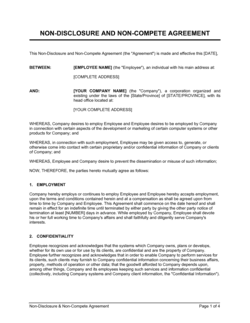
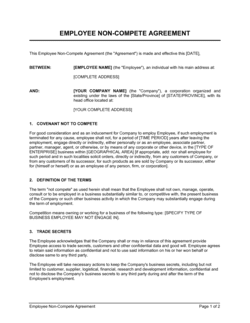
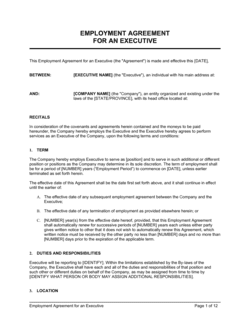
General Non-Compete Agreement Template

Free Word download • Edit online • Save & share with Drive • Export to PDF

1 page20–30 min to fillDifficulty: StandardSignature requiredLegal review recommended
Learn more ↓
FreeGeneral Non-Compete Agreement Template

At a glance

What it is
A General Non-Compete Agreement is a legally binding contract that restricts a departing employee, contractor, or business partner from engaging in competitive activities — working for a direct competitor, starting a competing business, or soliciting the company's clients — within a defined geographic area for a specified period of time. This free Word download gives you a structured, attorney-reviewed starting point you can edit online and export as PDF to execute before any hire, engagement, or business transaction.
When you need it
Use it when onboarding employees who will access trade secrets, proprietary processes, or key customer relationships; when engaging contractors on sensitive product or strategy work; or when selling or acquiring a business where the seller must agree not to compete with the buyer after closing.
What's inside
Defined parties and recitals, restricted activities and scope, geographic territory, duration, consideration for the restriction, non-solicitation of customers and employees, confidentiality cross-reference, permitted activities, remedies for breach, severability and blue-penciling, and governing law.

What is a General Non-Compete Agreement?

A General Non-Compete Agreement is a legally binding contract that restricts an employee, independent contractor, or business seller from engaging in competitive activities — joining a competing firm, launching a rival business, or soliciting the protected party's clients — within a defined geographic territory for a specified period after the relationship ends. Unlike a non-disclosure agreement, which only protects against the disclosure of confidential information, a non-compete restricts competitive conduct regardless of whether any proprietary information is actually used. Courts in jurisdictions that enforce them require the restriction to be proportionate to a legitimate business interest: protecting trade secrets, substantial investment in training, or long-standing customer relationships that the departing party developed at the company's expense.

Why You Need This Document

Without a signed non-compete agreement, a departing employee can walk out on a Friday and start at your direct competitor the following Monday — taking with them your pricing strategy, product roadmap, client contacts, and hard-won market knowledge. The damage is rarely recoverable. Customers follow relationships, not brands, and by the time you discover the competitive activity, key accounts may already be lost. A properly executed non-compete agreement gives you the legal basis to seek an emergency injunction — stopping the competitive activity immediately — and to pursue damages for business lost as a result of the breach. The Business in a Box template provides a jurisdiction-aware starting point that covers all the elements courts scrutinize: clear consideration, a defined restricted period, proportionate geographic scope, and separately enforceable non-solicitation provisions that survive even if the primary non-compete clause is challenged.

Which variant fits your situation?

If your situation is…Use this template
Restricting an employee as part of the hiring processEmployee Non-Compete Agreement
Restricting an independent contractor on a project engagementIndependent Contractor Non-Compete Agreement
Binding a business seller from competing after closingNon-Compete Agreement (Business Sale)
Preventing a departing employee from poaching clients or colleaguesNon-Solicitation Agreement
Protecting confidential information without restricting employmentNon-Disclosure Agreement (NDA)
Combining non-compete, non-solicit, and confidentiality in one documentConfidentiality and Non-Compete Agreement
Restricting a franchisee within a defined franchise territoryFranchise Non-Compete Clause

Common mistakes to avoid

❌ Overbroad definition of 'Competing Business'

Why it matters: Defining competitors as any company in the same industry — rather than the specific segment the company operates in — is the leading reason courts void non-compete clauses outright. A voided clause protects nothing.

Fix: Tie the definition to specific products, services, and customer segments the company actively sold during the 12 months before separation, and cross-reference the employee's actual role.

❌ Signing after the employment start date with no fresh consideration

Why it matters: In most US states and all Canadian provinces, continued employment alone is not sufficient consideration for a non-compete added after the employee begins working — making the restriction unenforceable.

Fix: Execute the agreement before day one, or provide a documented new benefit — a promotion, cash bonus, or additional equity — at the time of the later signing.

❌ Using a nationwide scope for a regional employee

Why it matters: A national non-compete for a salesperson who only covered the Southeast US is routinely found unreasonable. Courts will narrow or strike the restriction, potentially eliminating protection entirely in jurisdictions that do not blue-pencil.

Fix: Limit geographic scope to the specific states, cities, or radius where the employee actually had competitive impact — and be prepared to explain this in litigation.

❌ Choosing a governing-law state to evade local protections

Why it matters: Selecting Delaware or Texas law to govern an agreement for a California employee does not override California's non-compete ban. Courts in protective states apply local law regardless of the chosen governing jurisdiction.

Fix: Select governing law based on where the employee primarily works and confirm that the chosen jurisdiction permits non-compete enforcement before finalizing the agreement.

❌ Combining non-compete and non-solicitation in a single clause

Why it matters: If the merged clause is struck down as an overbroad non-compete, the non-solicitation protection disappears with it — leaving the company with no restriction on client or employee poaching.

Fix: Draft non-compete restrictions and non-solicitation restrictions in separate numbered clauses so each can survive independently if the other is challenged.

❌ No consideration of jurisdiction-specific bans before sending

Why it matters: California, Minnesota, North Dakota, and Oklahoma effectively ban post-employment non-competes. Sending an unenforceable agreement may violate state law, expose the employer to penalties, and alert the employee that the company's legal process is unreliable.

Fix: Before executing any non-compete, confirm that post-employment restrictions are permitted in the employee's work state or country — and use a jurisdiction-appropriate alternative (NDA or non-solicitation) where they are not.

The 10 key clauses, explained

Parties and recitals

In plain language: Identifies the employer or protected party and the restricted party by legal name, states the relationship (employment, contractor engagement, or business sale), and explains why the restriction is being imposed.

Sample language
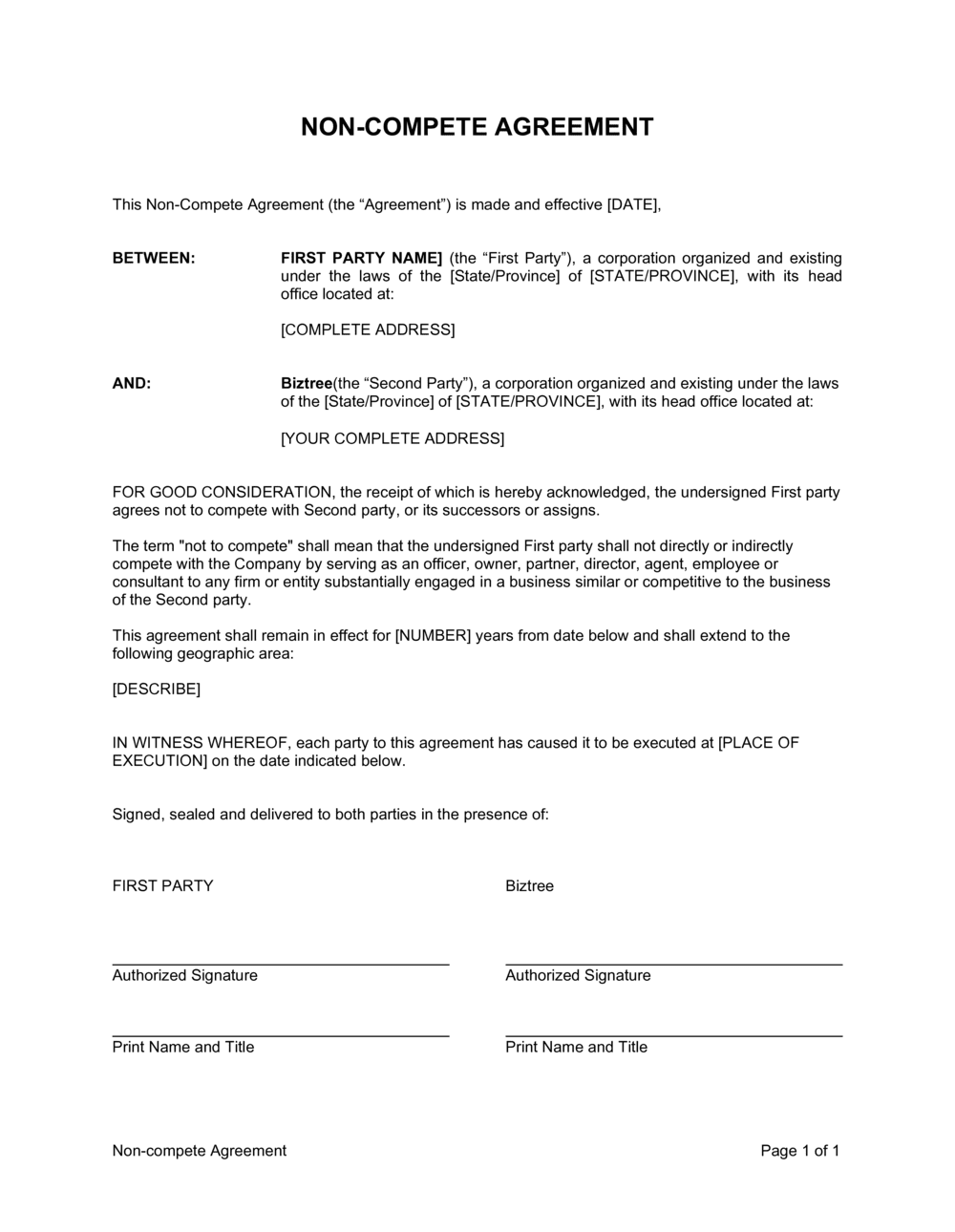
This Non-Compete Agreement is entered into as of [DATE] between [COMPANY LEGAL NAME], a [STATE] [ENTITY TYPE] ('Company'), and [RESTRICTED PARTY FULL NAME] ('Restricted Party'), in connection with Restricted Party's [employment / engagement / sale of business] commencing [DATE].

Common mistake: Using a trade name instead of the registered legal entity. If the entity name in the agreement doesn't match the employer of record, enforcement becomes procedurally complicated.

Consideration

In plain language: States specifically what the restricted party receives in exchange for accepting the restriction — without documented consideration, the agreement is generally unenforceable.

Sample language
In consideration of [employment commencing on DATE / a bonus of $[AMOUNT] / the purchase price of $[AMOUNT] paid under the Asset Purchase Agreement dated DATE], the sufficiency of which is hereby acknowledged, Restricted Party agrees as follows.

Common mistake: Relying on 'continued employment' as consideration for an agreement signed after the start date. In many US states and Canada, this is insufficient — a new, tangible benefit must be provided.

Restricted activities

In plain language: Defines precisely what competitive conduct is prohibited — typically joining, founding, advising, or investing in a competing business.

Sample language
During the Restricted Period, Restricted Party shall not, directly or indirectly: (a) own, manage, operate, control, consult for, or be employed by any Competing Business; (b) serve as a director, officer, or advisor to any Competing Business; or (c) hold more than a [2]% passive investment interest in any publicly traded Competing Business.

Common mistake: Listing restrictions so broadly that they cover industries the employee has never worked in. Courts narrow or void overbroad activity clauses — calibrate restrictions to the employee's actual role.

Definition of competing business

In plain language: Precisely defines what constitutes a 'Competing Business' so both parties — and courts — know exactly which employers or ventures are off-limits.

Sample language
'Competing Business' means any entity that [provides / sells / develops] [SPECIFIC PRODUCTS OR SERVICES] in competition with the Company's [DIVISION / PRODUCT LINE / BUSINESS UNIT] as operated during the [X] months prior to Restricted Party's separation.

Common mistake: Defining 'Competing Business' as any company in the entire industry rather than the specific segment the company operates in. This is the single most common reason non-competes are struck down as overbroad.

Geographic scope

In plain language: Sets the physical or market territory within which competition is prohibited, calibrated to where the company actually operates and where the employee had meaningful competitive impact.

Sample language
The restrictions in Section [X] apply within: (a) a [50]-mile radius of [CITY, STATE]; (b) the states of [LIST]; or (c) any country in which the Company actively marketed or sold its products during the [12] months preceding separation.

Common mistake: Setting a nationwide or worldwide geographic scope for a regional sales representative. Unreasonable geographic scope is the second most common basis for a court to void or narrow the restriction.

Restricted period (duration)

In plain language: States how long the restrictions last after the employment or engagement ends, measured from the separation date or the end of any garden-leave period.

Sample language
The Restricted Period shall commence on the date of Restricted Party's separation from the Company and continue for [12] months thereafter. If Restricted Party receives garden leave, the Restricted Period runs concurrently with the garden-leave period.

Common mistake: Setting a 36- or 48-month restricted period without a compensating benefit. Courts consistently find periods beyond 24 months unreasonable for employees, though longer terms may be enforced in a business-sale context.

Non-solicitation of customers and employees

In plain language: Separately prohibits the restricted party from approaching the company's clients to divert business and from recruiting the company's staff — even if the primary non-compete is struck down.

Sample language
During the Restricted Period, Restricted Party shall not: (a) solicit or accept business from any Customer with whom Restricted Party had material contact during the [24] months preceding separation; or (b) solicit, recruit, or induce any employee of the Company to leave the Company.

Common mistake: Combining non-solicitation with the non-compete in a single clause. If the non-compete is voided, a separately drafted non-solicitation clause can still survive and protect the business.

Permitted activities

In plain language: Carves out what the restricted party is still allowed to do — such as working in a non-competing division of a large employer or investing passively in public companies — to make the restriction appear reasonable.

Sample language
Nothing in this Agreement prevents Restricted Party from: (a) being employed by a multi-division company in a division that does not compete with the Company; or (b) holding a passive investment of less than [2]% of the outstanding shares of any publicly traded company.

Common mistake: Omitting permitted activities entirely. Courts view a complete absence of carve-outs as evidence of overreach, which weighs against enforcement of the entire agreement.

Remedies and injunctive relief

In plain language: States that monetary damages alone are inadequate for a breach and that the protected party is entitled to seek an injunction immediately in court — and typically requires the restricted party to acknowledge this in writing.

Sample language
Restricted Party acknowledges that any breach of this Agreement would cause irreparable harm to the Company for which monetary damages would be an inadequate remedy. The Company is therefore entitled to seek injunctive or other equitable relief in any court of competent jurisdiction without posting a bond.

Common mistake: No remedies clause at all. Without it, the protected party must prove specific damages at trial before the court will act — by which point the competitive harm may already be irreversible.

Governing law, severability, and blue-penciling

In plain language: Designates the jurisdiction whose law governs the agreement, confirms that invalid provisions do not void the whole contract, and — where permitted — authorizes the court to modify overbroad restrictions rather than strike them entirely.

Sample language
This Agreement is governed by the laws of [STATE / PROVINCE]. If any provision is found unenforceable, the remaining provisions shall continue in full force. The parties authorize any court to modify any restriction to the minimum extent necessary to make it enforceable.

Common mistake: Selecting a governing-law state specifically to avoid stricter protections in the state where the employee works. Courts in California, Minnesota, and other protective states apply local law regardless of what the contract specifies.

How to fill it out

  1. 1

    Identify the parties using legal entity names

    Enter the employer's full registered corporate name — not a brand name — and the restricted party's legal name as it appears on government-issued ID or corporate registration.

    💡 Cross-check the entity name against your state or provincial corporate registry before execution to avoid enforcement gaps.

  2. 2

    Document the consideration specifically

    State the precise benefit the restricted party receives: employment start date and salary, a specific bonus amount, or the purchase price in a business-sale context. Vague recitals like 'good and valuable consideration' are challenged more frequently.

    💡 For agreements signed after the hire date, provide a documented new benefit — a raise, bonus, or additional PTO — and recite it in the consideration clause.

  3. 3

    Define 'Competing Business' narrowly and precisely

    Limit the definition to the specific product line, service category, or market segment the company operates in — not the entire industry. Reference the company's actual business as conducted in the 12 months before separation.

    💡 A definition tied to the company's actual products and customer segments is far more likely to hold up in court than a definition that sweeps in any company in the same general industry.

  4. 4

    Set geographic scope proportionate to the role

    Match the territory to where the employee actually had competitive impact — the sales region, client territory, or product market. Regional roles should use a radius or state list; global product leaders may justify a broader scope.

    💡 If you cannot articulate why the employee's role required access to clients or strategy in a particular region, that region should not be in the geographic scope.

  5. 5

    Choose a defensible restricted period

    For most employee non-competes, 6–12 months is the most consistently enforced range. Sales leaders or executives with direct customer access may support 12–18 months. Business-sale non-competes routinely enforce 2–5 years because the seller received full consideration.

    💡 Pair longer restricted periods with garden leave or a compensation payment during the restriction — courts view compensated restrictions as significantly more reasonable.

  6. 6

    Draft the non-solicitation clause separately

    Place customer and employee non-solicitation in its own numbered clause, not folded into the non-compete. This allows it to survive independently if the non-compete is partially or fully invalidated.

    💡 Limit customer non-solicitation to clients the restricted party personally worked with — courts are skeptical of restrictions covering all customers the company ever served.

  7. 7

    Add the remedies and injunctive-relief acknowledgment

    Include explicit language confirming that breach causes irreparable harm and that the protected party may seek emergency injunctive relief without posting a bond. Have the restricted party initial this clause separately.

    💡 Some courts give additional weight to a separate initial or acknowledgment specifically on the remedies clause — it demonstrates the party understood this provision.

  8. 8

    Execute before the employment or engagement begins

    Both parties must sign before the employee's first day or the contractor's first engagement. Post-start signatures require fresh, documented consideration in most common-law jurisdictions.

    💡 Use a timestamped eSignature platform to create an auditable record showing execution date preceded the start date — critical if enforcement is ever litigated.

Frequently asked questions

What is a non-compete agreement?

A non-compete agreement is a legally binding contract that restricts one party — typically an employee, contractor, or business seller — from engaging in competitive activities for a defined period and within a defined geographic area after the relationship ends. It protects trade secrets, customer relationships, and proprietary processes by preventing a departing party from immediately applying insider knowledge against the company that invested in developing it.

Are non-compete agreements enforceable?

Enforceability depends entirely on jurisdiction and the reasonableness of the specific restrictions. Most US states enforce non-competes that are limited in duration (typically 6–18 months), geographic scope, and activity — and where the employer can identify a legitimate business interest being protected. California, Minnesota, North Dakota, and Oklahoma ban post-employment non-competes almost entirely. Canada, the UK, and EU member states impose strict reasonableness requirements and often require compensation during the restricted period.

What makes a non-compete agreement enforceable?

Courts generally require four elements: documented consideration exchanged at the time of signing, a restricted period that is no longer than necessary to protect a legitimate interest, a geographic scope proportionate to the employee's actual competitive impact, and a clearly defined set of restricted activities tied to the company's specific business. Overbroad terms in any one of these dimensions can result in the entire clause being struck down.

How long can a non-compete agreement last?

For employee non-competes, 6–12 months is the most consistently enforced range across US states and Canadian provinces. Periods of 12–18 months are enforced for senior executives or roles with significant customer access. Business-sale non-competes routinely run 2–5 years because the seller received substantial consideration. Restrictions beyond 24 months for employees are challenged successfully in most jurisdictions.

Do I need to pay an employee during the non-compete period?

In the US, payment during the restricted period is not legally required in most states, though providing garden leave or a compensation payment significantly increases enforceability. In several EU member states — including Germany, France, and Italy — post-employment non-competes are only enforceable if the employer pays at least 25–50% of the employee's prior salary during the restricted period. The UK permits uncompensated restrictions but courts weigh compensation as a factor in assessing reasonableness.

What is the difference between a non-compete and a non-solicitation agreement?

A non-compete prohibits working for or starting a competing business entirely. A non-solicitation agreement is narrower — it only prevents the departing party from actively approaching the company's existing clients or employees to divert their business or recruit them away. Non-solicitation clauses are enforced more consistently across jurisdictions, including in states that restrict non-competes, because they impose a smaller burden on the restricted party's ability to earn a living.

Can a non-compete agreement be enforced against an independent contractor?

Yes, non-compete agreements can be applied to independent contractors, but courts scrutinize them carefully. The contractor must receive real consideration beyond the project fee, and the restriction must be proportionate to the contractor's actual access to competitive information. Misclassifying an employee as a contractor to impose a more restrictive agreement can expose the company to additional legal liability.

What happens if someone violates a non-compete agreement?

The protected party may seek emergency injunctive relief — a court order requiring the breaching party to stop the competitive activity immediately. The protected party may also seek monetary damages for lost business or profits caused by the breach. Courts can also order the restricted period to be extended by the duration of the breach. In some jurisdictions, particularly egregious violations may support claims for misappropriation of trade secrets under the Defend Trade Secrets Act or equivalent statutes.

Do I need a lawyer to draft a non-compete agreement?

For straightforward domestic employee non-competes in a single jurisdiction, a well-structured template with appropriate customization is a reasonable starting point. Consider engaging a lawyer when the employee is senior management or an executive, when the company operates in multiple states or countries, when the restricted activities involve valuable trade secrets or proprietary technology, or when you anticipate the restriction may be challenged. A 1–2 hour review typically costs $300–$800 and is worthwhile for high-stakes hires.

How this compares to alternatives

vs Non-Disclosure Agreement (NDA)

An NDA prohibits the disclosure or use of confidential information but does not restrict where the employee may work. A non-compete restricts competitive employment regardless of whether any confidential information is actually disclosed. Use an NDA when the primary risk is information leakage; use a non-compete when the primary risk is the employee directly competing. For senior roles, both documents together provide the strongest protection.

vs Non-Solicitation Agreement

A non-solicitation agreement is narrower than a non-compete — it only prevents the departing party from approaching the company's existing clients or employees, not from working for a competitor entirely. Non-solicitation agreements are enforced more consistently across jurisdictions, including states that ban non-competes outright. Use a non-solicitation when protecting client relationships matters more than restricting broad competitive employment.

vs Employment Contract

An employment contract governs the full working relationship — duties, compensation, benefits, IP assignment, termination, and often a non-compete clause embedded within it. A standalone non-compete agreement is a separate, focused document used when the non-compete needs to be executed independently — such as with a contractor, a business seller, or an employee being offered additional consideration after hire. A standalone agreement is easier to enforce and amend without reopening the full employment contract.

vs Independent Contractor Agreement

An independent contractor agreement governs the project engagement and may include a non-compete clause, but its primary focus is defining deliverables, payment, and IP ownership. A separate non-compete agreement provides dedicated, enforceable restrictions for contractors with significant access to proprietary information or customer relationships, and is harder for the contractor to overlook or negotiate away within a broader services agreement.

Industry-specific considerations

Technology / SaaS

Non-competes protect source code, proprietary algorithms, and customer data from engineers and product managers who routinely move between competing companies.

Professional Services

Client relationships are the primary asset — non-solicitation provisions protecting named accounts are as important as the non-compete restriction itself.

Financial Services

Garden leave is standard practice for departing investment bankers and traders; broker protocol rules in the US affect non-solicit enforceability for registered representatives.

Healthcare

Many states impose additional limits on physician non-competes — Florida, Massachusetts, and Texas have specific statutes restricting their duration and scope to protect patient access to care.

Manufacturing

Non-competes protect proprietary production processes, supplier relationships, and pricing structures held by operations managers and engineers with cross-industry mobility.

Retail / Franchising

Franchisors rely on in-term and post-term non-competes to protect territory exclusivity and brand standards from franchisees who exit the system with operational know-how.

Jurisdictional notes

United States

Enforceability varies sharply by state. California, Minnesota, North Dakota, and Oklahoma ban most post-employment non-competes. The FTC's 2024 near-total ban was blocked in federal court (as of 2025 — verify current status). In states that permit them, courts require reasonable duration, geographic scope, and a legitimate business interest. Consideration must typically be provided at signing; continued employment alone is insufficient in many states after the hire date.

Canada

Canadian courts apply a strict reasonableness test and are generally skeptical of employee non-competes, preferring non-solicitation agreements as the more proportionate remedy. Ontario's Working for Workers Act (2021) bans non-compete agreements for most employees, with a narrow exception for executives. Quebec requires non-competes to be limited in time, place, and type of employment, and ambiguities are construed against the employer. Business-sale non-competes are enforced more readily than employee restrictions across all provinces.

United Kingdom

Post-termination non-competes are enforceable in the UK but must go no further than reasonably necessary to protect a legitimate business interest — courts will not blue-pencil a clause that is fundamentally unreasonable. Garden leave provisions are widely used and generally enforced. The UK government consulted on limiting non-competes to three months with mandatory compensation, though legislation had not been enacted as of early 2025. Non-solicitation and confidentiality clauses are typically more readily enforced than outright non-competes.

European Union

Requirements vary significantly by member state. Germany, France, Italy, and the Netherlands require employers to pay compensation — typically 25–100% of prior salary — during the restricted period for a non-compete to be enforceable. Maximum durations range from 6 months (Netherlands) to 2 years (Germany and France). GDPR obligations apply to any personal data processed in connection with the agreement. Employers operating across multiple EU countries should obtain jurisdiction-specific advice for each employee's work location.

Template vs lawyer — what fits your deal?

PathBest forCostTime
Use the templateStandard employee or contractor non-competes in a single US state or Canadian province where non-competes are permittedFree20–30 minutes
Template + legal reviewSenior employees, multi-state or cross-border engagements, or roles involving significant trade secrets or customer access$300–$8001–3 days
Custom draftedExecutive hires, business-sale non-competes, highly regulated industries, or jurisdictions with complex enforceability requirements$1,000–$4,000+1–2 weeks

Glossary

Restricted Period
The defined duration after separation during which the employee or contractor is prohibited from engaging in competitive activities — typically 6 to 24 months.
Geographic Scope
The physical area within which competitive activity is prohibited — defined by radius, city, state, country, or industry vertical depending on the role.
Competing Business
Any enterprise that offers products or services that are substantially similar to, or directly competitive with, those of the protected employer.
Non-Solicitation
A restriction preventing a departing party from actively recruiting the company's employees or approaching the company's clients to divert their business.
Consideration
The legal value exchanged to make the agreement enforceable — typically employment, a promotion, a bonus, equity, or a cash payment at signing.
Blue-Penciling
A court's power to modify — rather than void — an overly broad non-compete clause by narrowing its geographic scope, duration, or activity restrictions.
Garden Leave
A notice period during which the departing employee is paid full salary but kept away from clients and colleagues, effectively running concurrently with the restricted period.
Inevitable Disclosure
A legal theory holding that a departing employee would inevitably disclose trade secrets in a new competing role, sometimes used to justify injunctive relief even without an explicit non-compete.
Injunctive Relief
A court order requiring the breaching party to stop the prohibited competitive activity immediately, without waiting for a full trial — the primary remedy sought in non-compete enforcement.
Legitimate Business Interest
The specific protectable interest justifying the restriction — trade secrets, confidential customer relationships, substantial investment in training — that courts require employers to identify for the agreement to hold.
Severability
A clause stating that if any provision of the agreement is found unenforceable, the remaining provisions continue in full force and effect.

Part of your Business Operating System

This document is one of 3,000+ business & legal templates included in Business in a Box.

  • Fill-in-the-blanks — ready in minutes
  • 100% customizable Word document
  • Compatible with all office suites
  • Export to PDF and share electronically

Create your document in 3 simple steps.

From template to signed document — all inside one Business Operating System.
1
Download or open template

Access over 3,000+ business and legal templates for any business task, project or initiative.

2
Edit and fill in the blanks with AI

Customize your ready-made business document template and save it in the cloud.

3
Save, Share, Send, Sign

Share your files and folders with your team. Create a space of seamless collaboration.

Save time, save money, and create top-quality documents.

★★★★★

"Fantastic value! I'm not sure how I'd do without it. It's worth its weight in gold and paid back for itself many times."

Managing Director · Mall Farm
Robert Whalley
Managing Director, Mall Farm Proprietary Limited
★★★★★

"I have been using Business in a Box for years. It has been the most useful source of templates I have encountered. I recommend it to anyone."

Business Owner · 4+ years
Dr Michael John Freestone
Business Owner
★★★★★

"It has been a life saver so many times I have lost count. Business in a Box has saved me so much time and as you know, time is money."

Owner · Upstate Web
David G. Moore Jr.
Owner, Upstate Web

Run your business with a system — not scattered tools

Stop downloading documents. Start operating with clarity. Business in a Box gives you the Business Operating System used by over 250,000 companies worldwide to structure, run, and grow their business.

Start free · No credit card required