Independent Contractor Agreement For Programming Services Template

Free Word download • Edit online • Save & share with Drive • Export to PDF

8 pages30–40 min to fillDifficulty: ComplexSignature requiredLegal review recommended
Learn more ↓
FreeIndependent Contractor Agreement For Programming Services Template

At a glance

What it is
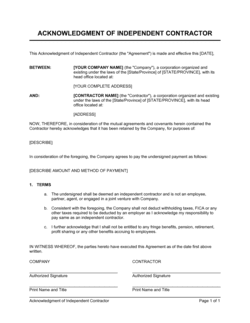
An Independent Contractor Agreement for Programming Services is a legally binding contract between a company or individual client and a freelance software developer or programming contractor that defines the scope of work, payment terms, IP ownership, confidentiality, and the conditions under which either party may end the relationship. This free Word download is editable online and exportable as PDF — ready to execute before any line of code is written.
When you need it
Use it whenever you engage a freelance developer, offshore programming team, or independent software engineer for a project — whether that is a one-time build, ongoing feature development, or a sprint-based retainer. It is especially critical when the work involves proprietary code, trade secrets, or customer data.
What's inside
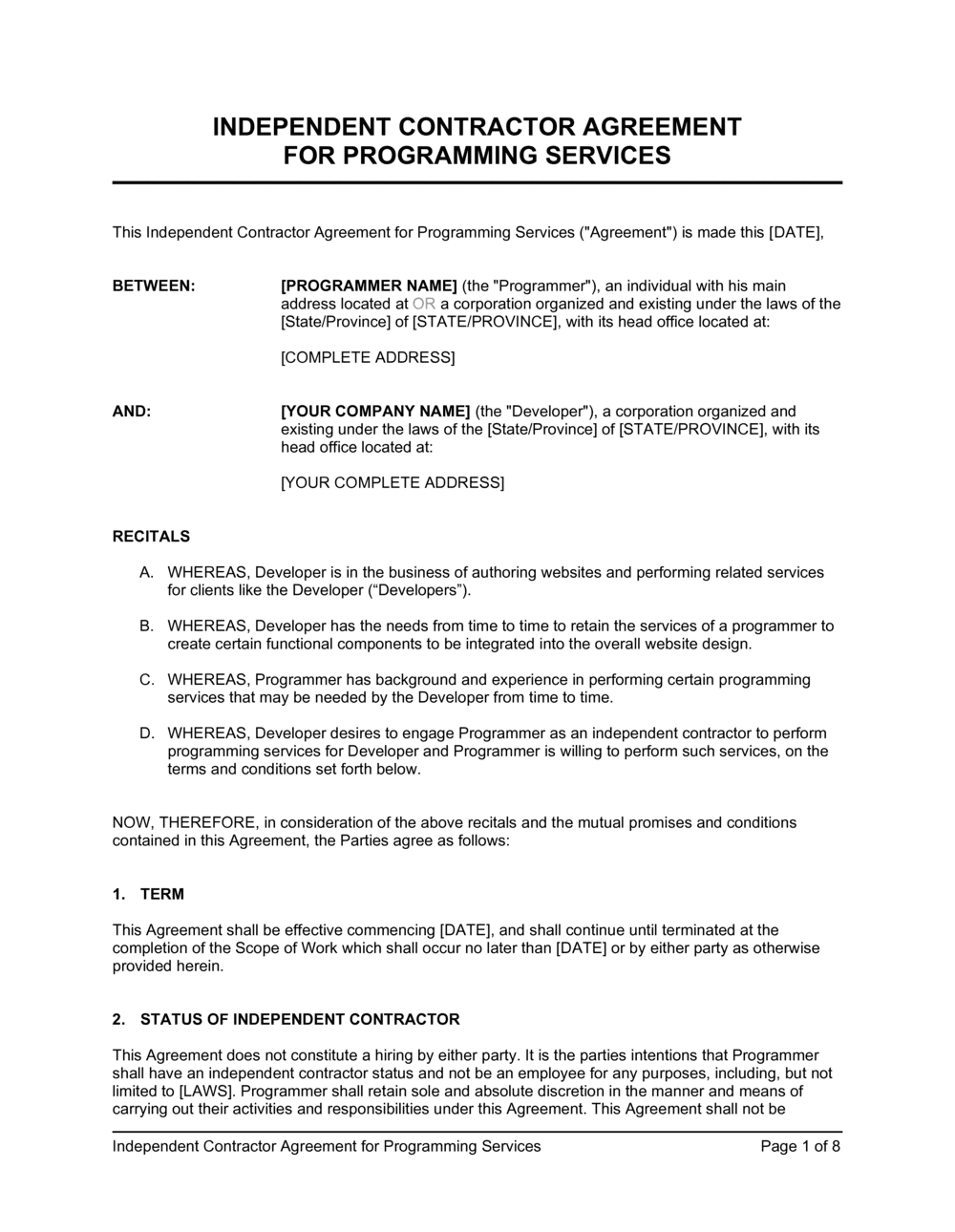
Scope of services and deliverables, payment schedule and rates, IP assignment and work-for-hire provisions, confidentiality and non-disclosure obligations, contractor status and tax classification, termination rights, warranties and liability limitations, and governing law.

What is an Independent Contractor Agreement for Programming Services?

An Independent Contractor Agreement for Programming Services is a legally binding contract between a client — company or individual — and a freelance software developer or programming contractor that governs every material dimension of the engagement: the scope of work and deliverables, payment rates and schedule, ownership of all code and related intellectual property, confidentiality obligations, representations and warranties about the delivered software, and the conditions under which either party may terminate the relationship. Unlike a general services contract, this agreement is specifically structured for software development work — addressing IP assignment under copyright law, open-source component disclosure, technical acceptance criteria, and code-handover obligations that generic contractor templates do not cover.

Why You Need This Document

Without a written contractor agreement, the code a freelance developer produces may legally belong to them, not you — copyright in contractor-created work defaults to the creator in most jurisdictions without an explicit written assignment. That gap becomes a deal-blocking problem when you raise a funding round, sell the company, or try to enforce exclusivity over your own product. Beyond IP, an unsigned engagement leaves scope disputes with no objective basis for resolution, confidentiality obligations unenforceable, and termination rights undefined — meaning a contractor who walks mid-project has no obligation to hand over partially completed code or repository access. This template closes all four gaps before a single line of code is written, giving both parties clear, enforceable terms and a professional foundation for the engagement.

Which variant fits your situation?

If your situation is…Use this template
Hiring a developer for a single fixed-scope project with a defined deliverableFixed-Price Programming Services Agreement
Engaging a developer on an ongoing hourly or monthly retainerSoftware Development Retainer Agreement
Contracting a general freelancer (non-programming) for project workIndependent Contractor Agreement
Engaging a full software development firm rather than an individualSoftware Development Agreement
Hiring a developer who will also be given access to client dataIndependent Contractor Agreement with NDA
Bringing a contractor on for a trial period before a full-time offerProbationary Employment Contract
Engaging a UX or UI designer alongside the developerGraphic Designer Independent Contractor Agreement

Common mistakes to avoid

❌ No IP assignment clause — relying on work-for-hire alone

Why it matters: In the US, work-for-hire doctrine applies automatically to employees but requires explicit written contract language for independent contractors. Without a signed IP assignment, the contractor legally owns the code they wrote, even if you paid for it.

Fix: Include both a work-for-hire designation and a separate assignment clause that transfers all right, title, and interest to the client. The belt-and-suspenders approach closes the gap under US copyright law and most international equivalents.

❌ Scope defined only in emails, not in a signed Schedule A

Why it matters: Informal scope agreements are nearly impossible to enforce. Disputes over what was included, what constitutes completion, and what qualifies as a change are the single most common cause of contractor payment conflicts.

Fix: Move all scope, deliverables, acceptance criteria, and milestones into a Schedule A that both parties sign at the same time as the main agreement.

❌ Using employment language in the contract body

Why it matters: Terms like 'employee,' 'staff,' 'our team member,' or 'working hours' in the contract text are used as evidence in worker misclassification audits by the IRS, DOL, and state labor boards, triggering back taxes, penalties, and retroactive benefit obligations.

Fix: Use 'Contractor,' 'engage,' and 'services' throughout. Confirm the contractor controls their own schedule, tools, and methods in a dedicated contractor-status clause.

❌ No open-source disclosure requirement before signing

Why it matters: A contractor who incorporates GPL or AGPL-licensed components into your proprietary codebase can trigger a viral license obligation that requires you to open-source your entire product — a consequence that cannot be undone after delivery.

Fix: Add a pre-signing disclosure obligation requiring the contractor to list all open-source components and licenses they intend to use, and a warranty that no copyleft-licensed code will be incorporated without prior written approval.

❌ No code handover clause on termination

Why it matters: Without a written obligation to deliver all code, credentials, and access on termination, a contractor who disputes their final invoice can withhold repository access indefinitely while you have no usable codebase.

Fix: Include a termination clause requiring the contractor to deliver all work product, transfer repository access, and hand over all third-party service credentials within five business days of any notice of termination.

❌ Liability cap that covers indemnification obligations

Why it matters: If the contractor delivers code that infringes a patent or incorporates stolen source code, the resulting third-party claim could easily exceed total fees paid. A standard liability cap applied to indemnification leaves the client fully exposed above the cap amount.

Fix: Carve out IP indemnification obligations from the general liability cap, or set a separate, higher cap specifically for indemnification claims — typically two to three times the total contract value.

The 10 key clauses, explained

Parties and contractor status

In plain language: Identifies the client and the contractor as legal entities, explicitly states that the contractor is an independent contractor and not an employee, and confirms they are responsible for their own taxes and benefits.

Sample language
[CONTRACTOR NAME] ('Contractor') is engaged by [CLIENT LEGAL NAME] ('Client') as an independent contractor. Nothing in this Agreement shall be construed to create an employment, partnership, or joint venture relationship. Contractor is solely responsible for all federal, state, and local taxes on compensation received under this Agreement.

Common mistake: Using a job title or language that implies employment — terms like 'staff developer' or 'our developer' in contract text can be used in misclassification disputes, triggering back taxes and benefit liability.

Scope of services and deliverables

In plain language: Defines exactly what programming work the contractor will perform, the technologies to be used, and the specific deliverables they must produce, referenced in an attached Statement of Work.

Sample language
Contractor shall perform the programming services described in Schedule A ('Statement of Work'), including all deliverables, acceptance criteria, and milestones set out therein. Any change to the scope must be agreed in writing by both parties via a Change Order.

Common mistake: Leaving scope defined only in email threads rather than a signed Schedule A. Scope creep is unenforceable without a written baseline, and disputes over 'out of scope' work are the most common source of contractor payment conflicts.

Compensation and payment schedule

In plain language: States the rate (hourly, fixed-fee, or milestone-based), invoicing frequency, payment terms, and any late-payment interest or kill fee for early termination.

Sample language
Client shall pay Contractor [RATE TYPE] of $[AMOUNT], payable within [NET 15 / NET 30] days of receipt of a compliant invoice. Milestones and acceptance criteria are set out in Schedule A. Late payments accrue interest at [1.5]% per month from the due date.

Common mistake: Omitting milestone acceptance criteria. Without a definition of 'done,' clients withhold final payments indefinitely while contractors claim full completion — a dispute with no objective resolution.

Intellectual property assignment

In plain language: Transfers ownership of all work product — code, documentation, databases, and related IP — created under the agreement from the contractor to the client, and confirms the contractor retains no rights to the delivered work.

Sample language
Contractor hereby irrevocably assigns to Client all right, title, and interest in all work product, source code, object code, documentation, and inventions created in connection with this Agreement. To the extent any work product qualifies as a 'work made for hire' under applicable copyright law, it is deemed owned by Client from creation.

Common mistake: Relying on work-for-hire doctrine alone without an explicit assignment clause. In the US, work-for-hire applies to employees automatically but requires specific written contract language for independent contractors — omitting the assignment clause leaves ownership in legal ambiguity.

Contractor's pre-existing IP and open-source components

In plain language: Identifies any tools, libraries, or pre-existing code the contractor owns and will incorporate into the deliverables, and licenses those components to the client without transferring ownership.

Sample language
Notwithstanding the IP assignment above, Contractor retains ownership of the tools, libraries, and pre-existing code listed in Schedule B ('Pre-Existing IP'). Contractor grants Client a perpetual, royalty-free, non-exclusive license to use Pre-Existing IP solely as incorporated in the deliverables.

Common mistake: No Schedule B at all — leaving the boundary between assigned IP and retained contractor tools undefined. A contractor can later claim that a core component of the delivered software is their pre-existing IP and demand royalties or deny the client license to use it.

Confidentiality and non-disclosure

In plain language: Prohibits the contractor from disclosing or using the client's confidential information — including source code, product plans, business data, and customer information — during and after the engagement.

Sample language
Contractor shall hold all Confidential Information of Client in strict confidence and shall not disclose it to any third party or use it for any purpose other than performing services under this Agreement. This obligation survives termination for a period of [3] years.

Common mistake: No definition of Confidential Information. Courts require reasonable specificity — a clause that calls 'everything' confidential is often narrowed or voided, leaving genuinely sensitive technical information unprotected.

Representations and warranties

In plain language: The contractor warrants that the delivered code is original, does not infringe third-party IP, is free of known malware, and meets the specifications in the Statement of Work.

Sample language
Contractor warrants that: (a) the work product is original and does not infringe any third-party intellectual property rights; (b) it does not contain malicious code, backdoors, or unauthorized access mechanisms; and (c) it materially conforms to the specifications in Schedule A for a period of [90] days from delivery.

Common mistake: No warranty period at all. Without a defined post-delivery warranty window, the contractor has no contractual obligation to fix defects discovered after acceptance — leaving the client to pursue breach-of-contract claims at their own expense.

Termination and wind-down

In plain language: States the notice period for termination by either party, the conditions that allow immediate termination for cause, what happens to in-progress work on termination, and any kill fee owed.

Sample language
Either party may terminate this Agreement with [14] days' written notice. Client may terminate immediately for Cause (including material breach, fraud, or delivery of infringing code). On termination, Contractor shall deliver all completed work product to Client within [5] business days. If Client terminates without Cause, Client shall pay a kill fee equal to [25]% of remaining milestone fees.

Common mistake: No handover obligation on termination. Without a code-delivery clause, a terminated contractor may withhold repository access or partially completed work, leaving the client with no usable code and no practical remedy.

Limitation of liability and indemnification

In plain language: Caps each party's financial exposure under the contract and requires the contractor to indemnify the client against third-party IP infringement claims arising from the delivered code.

Sample language
Neither party shall be liable for indirect, incidental, or consequential damages. Each party's aggregate liability under this Agreement shall not exceed the total fees paid in the [12] months preceding the claim. Contractor shall indemnify and defend Client against third-party claims alleging that the work product infringes any patent, copyright, or trade secret.

Common mistake: No carve-out from the liability cap for indemnification obligations. Capping indemnification at total fees paid can leave the client exposed to a third-party IP claim that far exceeds what they paid the contractor — consider a separate, higher cap or uncapped indemnity for IP infringement.

Governing law and dispute resolution

In plain language: Specifies which jurisdiction's law governs the contract and whether disputes are resolved by arbitration, mediation, or litigation.

Sample language
This Agreement is governed by the laws of [STATE / PROVINCE / COUNTRY]. Any dispute shall first be submitted to non-binding mediation. If unresolved within [30] days, it shall be resolved by binding arbitration administered by [AAA / JAMS] in [CITY], except that either party may seek injunctive relief in any court of competent jurisdiction.

Common mistake: Choosing a governing law state with no connection to either party's location. If the contractor is in New York and the client is in California, a Delaware governing-law clause may be disregarded in favor of the state where enforcement is sought — and California's labor and IP laws may apply regardless.

How to fill it out

  1. 1

    Enter the full legal names and contact details of both parties

    Use the contractor's legal name or registered business name — not a username or trade name — and the client's registered entity name. Include each party's address and primary contact for notices.

    💡 If the contractor operates through a single-member LLC, use the LLC name as the contracting party. This limits the contractor's personal liability and reinforces the independent contractor classification.

  2. 2

    Attach a detailed Statement of Work as Schedule A

    List every deliverable by name, the technology stack, acceptance criteria, due dates, and milestone payment amounts. The more specific the scope, the harder it is for either party to claim ambiguity later.

    💡 Use user stories or acceptance tests as acceptance criteria — 'the login feature passes all unit tests in the test suite' is more enforceable than 'the login feature works correctly.'

  3. 3

    Set the rate, invoice cadence, and payment terms

    Choose hourly, fixed-fee, or milestone-based compensation and state the exact amounts. Set a specific net-payment period (Net 15 is standard for freelance work) and include late-payment interest of 1–2% per month.

    💡 For projects over $10,000, structure at least 30% of the fee as an upfront deposit — it commits the client financially and gives the contractor working capital before delivery.

  4. 4

    Complete the IP assignment and Schedule B for pre-existing IP

    Confirm the IP assignment clause covers all code, documentation, and derivative works. In Schedule B, list any reusable libraries, frameworks, or tools the contractor will incorporate but retain ownership of.

    💡 Ask the contractor to disclose all open-source components and their licenses before signing. GPL-licensed code incorporated into proprietary software can trigger a viral licensing obligation that forces the client to open-source their product.

  5. 5

    Define confidential information and the survival period

    List the categories of information that qualify as confidential — source code, product roadmaps, customer data, pricing, and technical architecture. Set the post-engagement confidentiality period at two to three years.

    💡 If the contractor will have access to production databases or customer PII, add a data processing addendum or GDPR/CCPA-specific annex as a separate schedule.

  6. 6

    Set termination notice, kill fee, and handover obligations

    Define the notice period (14 days is standard for short projects; 30 days for long-term engagements), the kill fee percentage for client-initiated early termination, and the contractor's obligation to deliver all code and credentials within five business days of notice.

    💡 Include a specific clause requiring the contractor to transfer all repository access, API keys, and third-party service accounts — not just the code files — on termination.

  7. 7

    Choose the governing law and dispute mechanism

    Select the jurisdiction where the client is located as the governing law for most domestic engagements. For cross-border contracts, consider a neutral arbitration venue and specify the arbitration rules (AAA, JAMS, or ICC).

    💡 If the contractor is in California, do not include a non-compete clause — California courts will void it entirely, and its presence may create grounds to challenge other provisions.

  8. 8

    Execute before any work begins

    Both parties must sign the agreement and all schedules before the contractor writes a single line of code. Post-start signatures create fresh-consideration problems that can void IP assignment and confidentiality provisions.

    💡 Use Business in a Box eSign to timestamp execution and store the fully executed agreement in BIB Drive for each engagement.

Frequently asked questions

What is an independent contractor agreement for programming services?

An independent contractor agreement for programming services is a legally binding contract between a client and a freelance developer or programming contractor that defines the scope of work, payment terms, IP ownership, confidentiality obligations, and termination rights. It establishes that the developer is not an employee, that the client owns the code produced, and that both parties have clear obligations and remedies if things go wrong. It is the foundational document for any software development engagement outside of a direct employment relationship.

Who owns the code when I hire a freelance programmer?

Without a written contract, ownership depends on jurisdiction and circumstances — and in most cases defaults to the contractor, not the client. In the US, copyright in original works belongs to the creator unless there is a written work-for-hire agreement or an explicit IP assignment. A properly drafted independent contractor agreement transfers full ownership of all delivered code to the client at the moment of creation. Without one, you may have paid for code you do not own.

Do I need a separate NDA if my contractor agreement has a confidentiality clause?

A confidentiality clause in the contractor agreement generally provides the same protection as a standalone NDA for work performed under that agreement. A separate NDA is useful when you need to share confidential information during a pre-contract evaluation period — before signing the main agreement — or when you want a simpler document to sign quickly. For active engagements, the contractor agreement's confidentiality clause is typically sufficient, provided it is specific about what qualifies as confidential and how long the obligation survives.

What is the difference between a fixed-price and hourly contractor agreement?

A fixed-price agreement pays the contractor a set amount for a defined deliverable, regardless of time spent — the contractor bears the risk of underestimating complexity. An hourly agreement pays for time at an agreed rate — the client bears the risk of scope expansion. For well-defined, discrete projects (build this feature to this spec), fixed-price with milestones is generally lower risk for clients. For exploratory or ongoing work where scope evolves, hourly or retainer arrangements are more appropriate.

Can I include a non-compete clause in a programming contractor agreement?

In most US states, a reasonable non-compete restricting the contractor from working for direct competitors for six to twelve months is enforceable if supported by adequate consideration. California, Minnesota, and several other states ban or severely limit post-engagement non-competes for contractors. In the UK and EU, non-competes must be reasonable in scope and duration and typically require compensation to the contractor to be enforceable. A non-solicitation clause — preventing the contractor from poaching clients or staff — is more consistently enforceable across jurisdictions and is worth including in most agreements.

What happens if a contractor incorporates open-source code with a viral license?

If a contractor incorporates GPL or AGPL-licensed open-source code into your proprietary software without disclosure, you may be required to release your entire codebase under the same open-source license — effectively surrendering your proprietary software. This obligation cannot be undone after the fact. The fix is a pre-signing disclosure requirement and a warranty that no copyleft-licensed components will be used without written client approval. Always conduct an open-source license audit before accepting final delivery.

What should a Statement of Work include for a programming engagement?

A Statement of Work for programming services should include: a description of each deliverable by name and function, the technology stack and coding standards to be followed, specific acceptance criteria for each deliverable (ideally test-based), milestone dates and corresponding payment amounts, the client's responsibilities (providing access, feedback timelines, test environments), and the change-order process for out-of-scope requests. Vague scope is the root cause of most contractor payment disputes.

Is a contractor agreement required by law?

No jurisdiction mandates a written contractor agreement for programming services, but operating without one creates significant legal and financial exposure. Without a written agreement, IP ownership is ambiguous, confidentiality obligations are unenforceable, scope disputes have no objective basis for resolution, and worker misclassification risk increases. Most professional developers and all corporate clients require a signed agreement before work begins as standard practice.

Do I need a lawyer to use this template?

For straightforward domestic engagements with a single freelance developer, a high-quality template is generally sufficient with minor customization. You should engage a lawyer when the engagement involves significant IP assets, the contractor is in a different country, the project value exceeds $50,000, the codebase will be the basis of a fundraise or acquisition, or you need jurisdiction-specific non-compete or data protection terms. A one-hour template review typically costs $200–$400 and is well worth it for any engagement where the code is core to your business value.

How this compares to alternatives

vs Independent Contractor Agreement (General)

A general independent contractor agreement covers any type of freelance service — consulting, writing, design, or administrative work. The programming-specific version adds IP assignment tailored to software copyright, open-source disclosure requirements, a code-handover clause on termination, and technical acceptance criteria. For any engagement involving code or software, the programming-specific version is the appropriate starting point.

vs Software Development Agreement

A software development agreement is typically used with a development firm or agency rather than an individual contractor. It includes project governance, subcontracting rights, change-control processes, and source code escrow provisions suited to larger, multi-person engagements. The independent contractor agreement for programming services is designed for individual freelancers and small teams under a single contracting party.

vs Employment Contract

An employment contract creates an employer-employee relationship with full benefits, tax withholding, and statutory protections. An independent contractor agreement treats the developer as a self-employed party responsible for their own taxes and benefits. The critical difference is IP ownership — employee-created work belongs to the employer automatically, while contractor-created work requires an explicit written assignment to transfer ownership.

vs Non-Disclosure Agreement (NDA)

An NDA covers confidentiality only and is often signed before any formal engagement begins. A contractor agreement includes confidentiality alongside scope, payment, IP assignment, termination, and liability — making it the governing document for the full engagement. An NDA is appropriate for the pre-contract evaluation phase; the contractor agreement replaces or supplements it once work is agreed.

Industry-specific considerations

SaaS / Technology

IP assignment is the highest-stakes clause — VCs conduct IP chain-of-title diligence before any Series A, and gaps in contractor IP transfers are a common deal blocker.

E-commerce and retail

Contractor agreements for storefront, payment integration, and inventory system builds must address PCI DSS data handling obligations and specify that no customer payment data may be retained by the contractor.

Healthcare and MedTech

Any contractor with access to patient data must be covered by a HIPAA Business Associate Agreement in addition to the standard contractor agreement, and the contract must prohibit retention of PHI beyond the engagement.

Financial services and fintech

Source code escrow arrangements and enhanced security warranties are standard for contractors building core banking, lending, or payment systems, along with strict background-check conditions precedent to access.

Digital agencies

Agencies subcontracting programming work must flow down IP assignment obligations from their own client contracts, ensuring the agency — not the subcontractor — holds title to all deliverables for onward transfer.

Manufacturing and IoT

Embedded software and firmware engagements require the contractor to warrant compatibility with specified hardware platforms and include provisions for safety-critical software testing and certification support.

Jurisdictional notes

United States

IP assignment must be explicit and in writing for independent contractors — work-for-hire doctrine does not apply automatically as it does for employees. Worker misclassification is enforced by the IRS (20-factor test) and the DOL (economic reality test); mislabeling an employee as a contractor triggers back taxes and penalties. California, Minnesota, and Oklahoma ban most non-compete clauses for contractors. Several states have enacted ABC tests that make contractor classification harder to maintain for workers with ongoing engagements.

Canada

Canada has no statutory work-for-hire doctrine equivalent to the US — copyright in contractor-created work rests with the creator by default under the Copyright Act, making a written IP assignment clause essential. Provincial employment standards boards apply an economic dependence test to distinguish employees from contractors; Ontario and British Columbia have strict substance-over-form analysis. Non-compete clauses must be reasonable in scope and duration, and Ontario's Employment Standards Act limits non-competes for anyone who may be reclassified as an employee.

United Kingdom

IR35 off-payroll working rules require clients to assess whether a contractor would be an employee if engaged directly. If caught by IR35, the client becomes responsible for deducting income tax and National Insurance contributions at source. Copyright in contractor-created work belongs to the contractor by default under the Copyright, Designs and Patents Act 1988 unless a written assignment is in place. Post-engagement non-competes must be reasonable and supported by legitimate business interests to be enforceable.

European Union

GDPR requires a Data Processing Agreement (DPA) whenever a contractor processes personal data on behalf of the client — this is a separate mandatory document, not just a confidentiality clause. Several EU member states, including Germany and France, apply an employee-like status to economically dependent contractors, extending labor protections regardless of contract terms. IP assignment is enforceable under contract law across the EU, but moral rights — the right to attribution and integrity — cannot be fully waived in France, Germany, and several other member states.

Template vs lawyer — what fits your deal?

PathBest forCostTime
Use the templateStraightforward domestic freelance programming engagements under $25,000 with a single developerFree30–45 minutes
Template + legal reviewEngagements involving significant IP, contractors in a different state, or project value between $25,000 and $100,000$200–$6001–3 days
Custom draftedCross-border engagements, core-product IP development, fundraise or acquisition scenarios, or regulated industries requiring data processing terms$1,000–$3,500+1–2 weeks

Glossary

Independent Contractor
A self-employed individual who performs services for a client under a contract but is not an employee — they control how and when their work is done.
Work for Hire
A legal doctrine under which work created by a contractor at a client's request is deemed owned by the client from the moment of creation, provided specific conditions are met in the contract.
IP Assignment
A clause in which the contractor explicitly transfers ownership of all code, software, and related intellectual property created under the agreement to the client.
Deliverable
A specific, agreed-upon output — such as a completed feature, application module, or codebase — that the contractor must produce by a defined date.
Scope of Work
A written description of the specific programming tasks, technologies, and outputs the contractor is engaged to produce under the agreement.
Milestone Payment
A payment tied to the completion and acceptance of a defined deliverable or project phase, rather than a fixed calendar date.
Confidential Information
Non-public information — including source code, product roadmaps, customer data, and business strategy — that the contractor agrees not to disclose or use outside the engagement.
Non-Solicitation Clause
A restriction preventing the contractor from directly approaching the client's employees or customers to offer competing services for a defined period after the engagement ends.
Kill Fee
Compensation paid to the contractor if the client terminates the agreement early without cause, typically calculated as a percentage of the remaining contract value.
Indemnification
A contractual obligation by which one party agrees to compensate the other for specific losses — such as third-party IP infringement claims arising from the contractor's delivered code.
Limitation of Liability
A clause capping the maximum financial exposure of either party under the contract, typically set at the total fees paid in the preceding 12 months.

Part of your Business Operating System

This document is one of 3,000+ business & legal templates included in Business in a Box.

  • Fill-in-the-blanks — ready in minutes
  • 100% customizable Word document
  • Compatible with all office suites
  • Export to PDF and share electronically

Create your document in 3 simple steps.

From template to signed document — all inside one Business Operating System.
1
Download or open template

Access over 3,000+ business and legal templates for any business task, project or initiative.

2
Edit and fill in the blanks with AI

Customize your ready-made business document template and save it in the cloud.

3
Save, Share, Send, Sign

Share your files and folders with your team. Create a space of seamless collaboration.

Save time, save money, and create top-quality documents.

★★★★★

"Fantastic value! I'm not sure how I'd do without it. It's worth its weight in gold and paid back for itself many times."

Managing Director · Mall Farm
Robert Whalley
Managing Director, Mall Farm Proprietary Limited
★★★★★

"I have been using Business in a Box for years. It has been the most useful source of templates I have encountered. I recommend it to anyone."

Business Owner · 4+ years
Dr Michael John Freestone
Business Owner
★★★★★

"It has been a life saver so many times I have lost count. Business in a Box has saved me so much time and as you know, time is money."

Owner · Upstate Web
David G. Moore Jr.
Owner, Upstate Web

Run your business with a system — not scattered tools

Stop downloading documents. Start operating with clarity. Business in a Box gives you the Business Operating System used by over 250,000 companies worldwide to structure, run, and grow their business.

Free Forever Plan · No credit card required