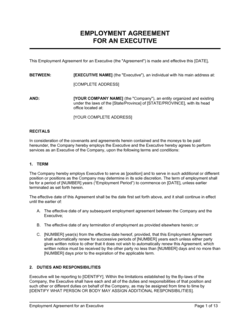
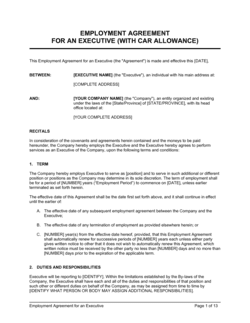
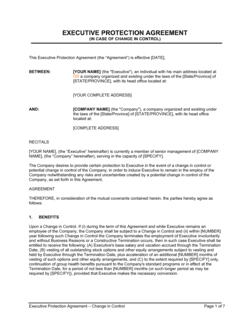
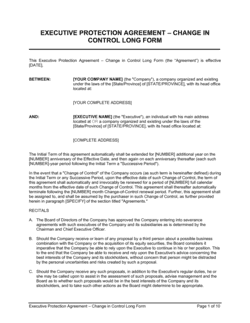
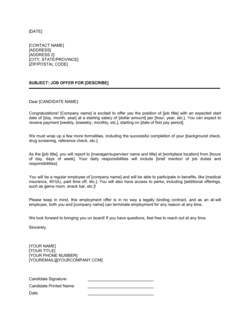
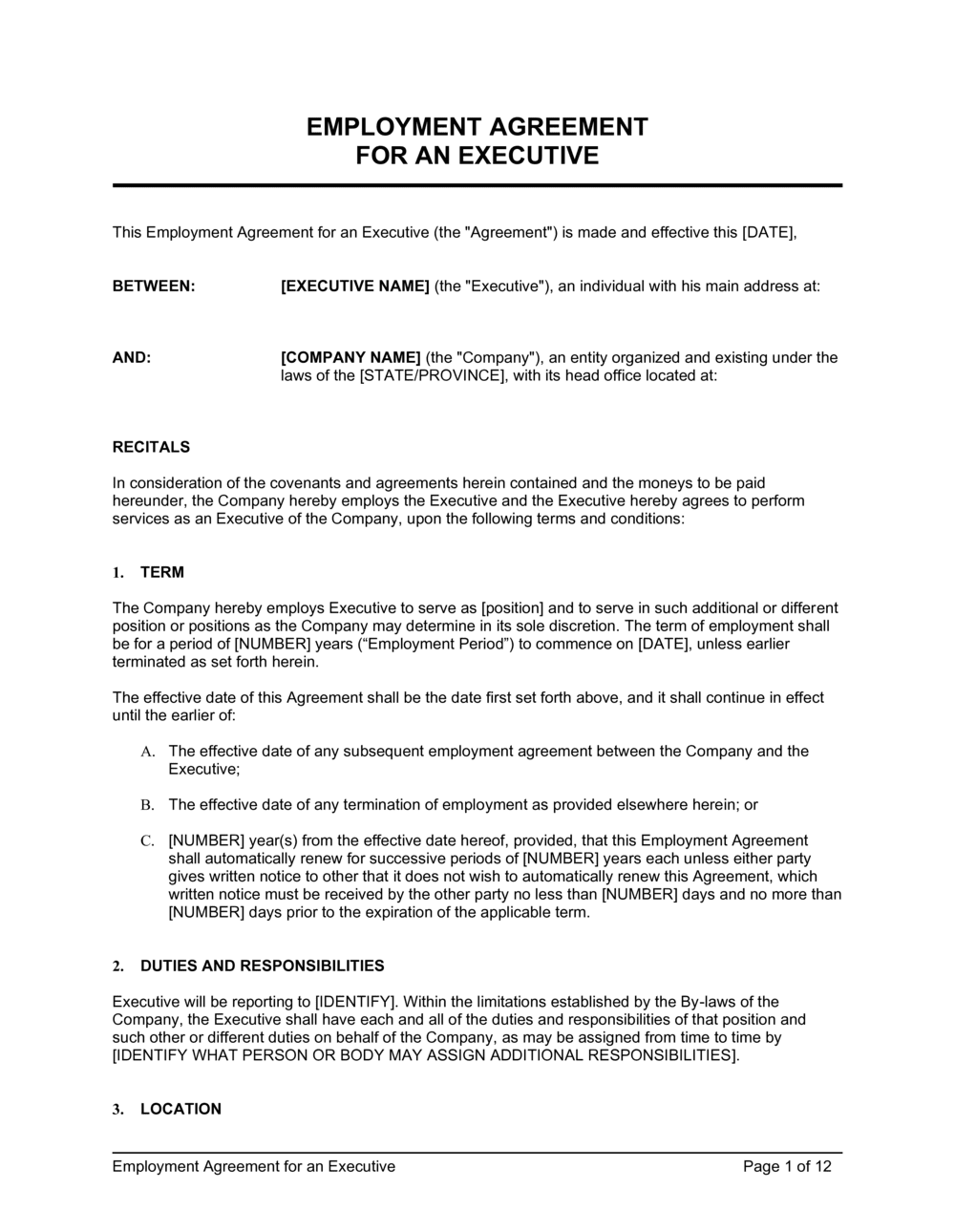
Employment Agreement Executive Template

Free Word download • Edit online • Save & share with Drive • Export to PDF

12 pages30–45 min to fillDifficulty: ComplexSignature requiredLegal review recommended
Learn more ↓
FreeEmployment Agreement Executive Template

At a glance

What it is
An Executive Employment Agreement is a legally binding contract between a company and a senior-level hire — CEO, CFO, COO, VP, or equivalent — that governs the full scope of the executive relationship. This free Word download covers base salary, annual bonus, equity grants, benefits, duties, IP assignment, confidentiality, non-compete, non-solicitation, termination triggers, severance, and change-of-control protections in a single document you can edit online and export as PDF.
When you need it
Use it before a C-suite or VP-level executive's first day, when promoting an internal employee to a senior leadership role, or when an investor or board requires documented executive terms as a condition of closing a funding round.
What's inside
Parties, title, and reporting structure; compensation including base salary, target bonus, and equity; benefits and expense reimbursement; IP assignment and confidentiality; non-compete and non-solicitation; termination for cause and without cause; severance and COBRA continuation; and change-of-control double-trigger provisions.

What is an Executive Employment Agreement?

An Executive Employment Agreement is a legally binding contract between a company and a senior-level hire — CEO, CFO, COO, President, or VP — that governs every material dimension of the executive relationship. Unlike a standard employment contract, it addresses the additional complexity that senior hires bring: negotiated equity award terms, annual and long-term bonus structures, Good Reason resignation triggers, enhanced severance formulas, change-of-control double-trigger protections, D&O indemnification commitments, and IRC Section 280G compliance. A properly drafted executive agreement creates enforceable obligations on both sides, documents board-authorized compensation terms, and eliminates the ambiguity that courts and regulators otherwise fill with jurisdiction-specific defaults.

Why You Need This Document

Without a written executive employment agreement, a company and its board carry compounding legal exposure on multiple fronts simultaneously. A departing executive with no documented severance formula may pursue common-law damages reaching 18–24 months of total compensation in Canada and the UK. An IP assignment clause that was never executed leaves the company's most sensitive technology, product strategy, and customer data vulnerable to a founder or CTO dispute. A change-of-control transaction without documented double-trigger provisions creates governance risk during diligence and potential excise tax liability under Section 280G. Investor due diligence at Series A and later rounds routinely surfaces missing or unauthorized executive agreements as a material issue that delays closing. This template gives boards and HR teams a structured, investor-ready starting point — covering every material term — that can be reviewed and executed in days rather than weeks.

Which variant fits your situation?

If your situation is…Use this template
Hiring a full-time salaried employee below VP levelEmployment Agreement (At-Will)
Engaging a senior advisor or interim executiveIndependent Contractor Agreement
Hiring an executive for a defined project or fixed termFixed-Term Employment Contract
Documenting a separation from a departing executiveExecutive Severance Agreement
Protecting trade secrets after an executive departsNon-Disclosure Agreement
Hiring a remote executive based in a different countryRemote Work Employment Agreement
Compensating an executive with equity in addition to salaryStock Option Agreement

Common mistakes to avoid

❌ Signing the agreement after the executive's start date

Why it matters: In common-law jurisdictions, an executive already employed has given no new consideration for post-start restrictions. IP assignment, non-compete, and confidentiality clauses signed without fresh consideration are routinely voided by courts.

Fix: Execute the agreement on or before day one. If circumstances require a later signature, provide documented additional compensation — a signing bonus, equity top-up, or enhanced severance — as consideration at the time of signing.

❌ Omitting a schedule of prior inventions

Why it matters: An IP assignment clause without a prior-inventions carve-out may sweep in technology or IP the executive owned before joining, creating immediate ownership disputes and exposure to claims from the executive's prior employers.

Fix: Attach a Schedule of Prior Inventions as an exhibit at signing. Even a completed 'none' schedule provides clarity and forecloses future disputes about pre-existing work.

❌ Conditioning severance on a release signed before the revocation period expires

Why it matters: Under the US Age Discrimination in Employment Act, executives over 40 must receive 21 days to consider a release (45 days for group separations) and 7 days to revoke it. Severance that begins before the revocation period expires can render the entire release unenforceable.

Fix: Structure severance to begin no earlier than the day after the 7-day revocation period expires. Include the required ADEA disclosure language in the release exhibit.

❌ No 280G safe harbor analysis for change-of-control payments

Why it matters: Total change-of-control payments — salary, bonus, accelerated equity, COBRA, and perks — that exceed 3× the executive's average W-2 compensation trigger a 20% excise tax on the executive and eliminate the company's deduction on the excess amount.

Fix: Commission a 280G analysis before finalizing change-of-control terms. Structure payments to stay below the safe harbor or include a 'best-net' or gross-up provision with full knowledge of the cost.

❌ Using the same non-compete for all jurisdictions

Why it matters: A non-compete that is enforceable in New York or Texas is void in California, Minnesota, and the UK. Applying a uniform restriction without jurisdiction-specific tailoring exposes the company to invalidation of the entire clause in the executive's work location.

Fix: Include jurisdiction-specific addenda or conditional language that limits the non-compete to jurisdictions where post-employment restrictions are enforceable, and removes it where they are not.

❌ No board authorization documented for the agreement

Why it matters: Investor diligence at Series A and beyond routinely uncovers executive agreements not approved by the board. Unauthorized agreements can be challenged as void and create governance issues that delay or derail a financing.

Fix: Pass a board consent resolution or include the agreement approval in board meeting minutes before execution. File the signed agreement and the authorization record together.

The 10 key clauses, explained

Parties, title, and reporting structure

In plain language: Identifies the company and executive as legal parties, states the precise title, defines the executive's organizational reporting line, and specifies whether the role includes a board seat.

Sample language
This Executive Employment Agreement ('Agreement') is entered into as of [DATE] between [COMPANY LEGAL NAME], a [STATE] [ENTITY TYPE] ('Company'), and [EXECUTIVE FULL NAME] ('Executive'). Executive shall serve as [TITLE] and shall report directly to [REPORTING PARTY — Board of Directors / CEO / other].

Common mistake: Using a trade name rather than the registered legal entity. If the contracting party does not match the employer of record on payroll, IP assignment and restrictive covenants may be unenforceable against the correct entity.

Compensation: base salary, bonus, and equity

In plain language: Sets the annual base salary, payment frequency, target annual bonus as a percentage of base, and references any equity grant governed by a separate option or RSU agreement.

Sample language
Company shall pay Executive a base salary of $[AMOUNT] per year, payable in accordance with the Company's standard payroll schedule. Executive is eligible for an annual target bonus of [X]% of base salary, subject to achievement of performance objectives established by the Board. Equity compensation, if any, is governed by the Company's [EQUITY PLAN NAME] and a separate award agreement.

Common mistake: Omitting the word 'target' or 'discretionary' from bonus language. Courts in multiple jurisdictions have found that a consistently paid bonus becomes a contractual entitlement, triggering severance calculations based on total cash compensation rather than base salary alone.

Benefits, perquisites, and expense reimbursement

In plain language: Entitles the executive to company benefit programs (health, dental, vision, 401(k)), identifies any executive-specific perquisites such as a car allowance or club membership, and states the expense reimbursement policy.

Sample language
Executive shall be entitled to participate in the Company's benefit programs as in effect from time to time. Executive shall receive an annual [PERQUISITE — car allowance / housing allowance / other] of $[AMOUNT]. Business expenses reasonably incurred shall be reimbursed within [30] days of submission of receipts in accordance with the Company's expense policy.

Common mistake: Specifying plan-level benefit details inside the agreement. Benefits plans change annually; locking in specific coverage levels creates amendment obligations or breach exposure when plans are modified.

Intellectual property assignment

In plain language: Transfers ownership of all work product, inventions, algorithms, data, and IP created by the executive in connection with the company's business to the company, including work performed on personal devices or outside business hours.

Sample language
Executive agrees that all inventions, developments, improvements, and work product created by Executive in connection with Executive's employment, or relating to the Company's actual or anticipated business, are the exclusive property of the Company and are hereby irrevocably assigned to the Company. Executive shall execute any documents reasonably required to perfect such assignment.

Common mistake: No carve-out for pre-existing inventions. Without a Schedule of Prior Inventions attached at signing, the company's assignment clause may inadvertently sweep in IP the executive developed before joining, creating disputes and potential litigation.

Confidentiality and trade secret protection

In plain language: Prohibits the executive from disclosing or misusing the company's confidential information — including financials, product roadmaps, customer data, and strategic plans — during employment and after departure.

Sample language
Executive shall not, during or after employment, use or disclose any Confidential Information without prior written consent of the Company. 'Confidential Information' means non-public information relating to the Company's business, technology, customers, suppliers, finances, or strategies, whether in written, electronic, or oral form.

Common mistake: Relying on a blanket 'everything is confidential' definition without enumerated categories. Courts apply a reasonableness standard — an overbroad or undefined definition can undermine enforceability of the entire clause and make trade-secret claims harder to pursue.

Non-compete and non-solicitation

In plain language: Restricts the executive from joining competitors, founding competing ventures, or soliciting the company's customers and employees for a defined period and geographic scope following departure.

Sample language
For [12–24] months following separation, Executive shall not (a) directly or indirectly engage in a Competing Business within [GEOGRAPHIC SCOPE], (b) solicit or accept business from any Company customer with whom Executive had material contact during the prior [24] months, or (c) solicit, recruit, or hire any Company employee.

Common mistake: Applying the same non-compete duration and geography to all executive roles regardless of seniority or customer access. Courts calibrate enforceability against the executive's actual competitive exposure — an overbroad clause risks being struck down entirely in jurisdictions that apply a blue-pencil rule.

Termination: for cause, without cause, and for good reason

In plain language: Defines the circumstances under which employment ends — immediate termination for cause with no severance, termination without cause with severance, and voluntary resignation for good reason (which triggers severance).

Sample language
Company may terminate Executive's employment for Cause immediately without notice or severance. Company may terminate without Cause upon [30] days' written notice. Executive may resign for Good Reason upon [30] days' written notice if a Good Reason condition exists and remains uncured for [30] days after Executive's written notice to the Board.

Common mistake: Defining 'Good Reason' too narrowly, excluding events like a material reduction in duties or failure to maintain D&O insurance coverage. An executive who cannot invoke Good Reason after a genuine role diminution may be constructively dismissed — but without severance entitlement — creating litigation risk.

Severance and COBRA continuation

In plain language: States the cash severance formula payable upon qualifying termination (without cause or for good reason), the continuation of health benefits under COBRA, and conditions precedent — typically execution of a release of claims.

Sample language
Upon a Qualifying Termination, Executive shall receive: (a) [X] months of base salary as severance, payable in accordance with normal payroll; (b) a pro-rated target bonus for the year of termination; and (c) Company-paid COBRA premiums for [X] months, subject to Executive's execution of a general release of claims within [21/45] days of separation.

Common mistake: Conditioning severance on a release signed after the severance payment has already begun. For releases to be enforceable under the ADEA (for executives over 40 in the US), the 21- or 45-day review period must run before the release is effective — severance should not begin until after the revocation period expires.

Change-of-control protections

In plain language: Defines what constitutes a change of control, sets any enhanced severance multiplier triggered by a qualifying termination following a change of control, and specifies the equity acceleration mechanism (single or double trigger).

Sample language
Upon a Change of Control followed within [24] months by a Qualifying Termination ('Double Trigger'), Executive shall receive: (a) [2×] annual base salary and target bonus; (b) [100]% acceleration of unvested equity awards; and (c) COBRA continuation for [18] months. Any payments constituting excess parachute payments under IRC §280G shall be reduced to the safe harbor amount unless a gross-up is separately agreed.

Common mistake: Agreeing to a single-trigger acceleration for all unvested equity without modeling the 280G excise tax impact. Single-trigger arrangements can push total change-of-control payments above the 3× safe harbor threshold, triggering the 20% excise tax on the executive and loss of deductibility for the company.

Governing law, dispute resolution, and D&O indemnification

In plain language: Specifies which jurisdiction's law governs the agreement, the mechanism for resolving disputes (arbitration or litigation), and the company's obligation to indemnify and insure the executive for good-faith acts taken in their officer capacity.

Sample language
This Agreement is governed by the laws of [STATE]. Disputes shall be resolved by binding arbitration before [AAA/JAMS] in [CITY], except claims for equitable relief. Company shall indemnify Executive to the fullest extent permitted by law and shall maintain D&O liability insurance covering Executive in an amount no less than $[AMOUNT] during and for [6] years after employment.

Common mistake: Omitting D&O indemnification entirely or limiting it to the statutory minimum. Without a contractual indemnification commitment and a defined insurance floor, an executive accepting a board seat or officer role assumes personal litigation exposure that may deter the hire or trigger renegotiation at closing.

How to fill it out

  1. 1

    Confirm the legal entity and executive's details

    Enter the company's full registered legal name — verified against your corporate registry filing — and the executive's legal name as it appears on government-issued ID. State the precise title and the reporting party (board, CEO, or committee).

    💡 Cross-reference the employer of record on payroll against the contracting entity. Mismatches between the two are among the most common sources of enforcement gaps in executive agreements.

  2. 2

    Set compensation with explicit bonus and equity language

    Enter the base salary, payment frequency, and target annual bonus percentage. Mark the bonus as 'target' and tie it to board-approved performance objectives. Reference equity by plan name and grant date — do not embed vesting schedules in the body of the agreement.

    💡 Attach a copy of the equity award agreement as Exhibit A and cross-reference it. Contradictions between the employment agreement and the option agreement are common and create disputes at termination.

  3. 3

    Define Good Reason with at least four enumerated triggers

    Draft Good Reason to include: (1) a material reduction in base salary or target bonus; (2) a material reduction in title or duties; (3) a relocation of more than 50 miles; and (4) a material breach of the agreement by the company. Include a 30-day cure period after written notice.

    💡 Failure to maintain D&O insurance at the agreed level is often overlooked as a Good Reason trigger — include it explicitly for executives joining the board.

  4. 4

    Calibrate non-compete scope to the executive's actual exposure

    Set geographic scope to the markets the executive will directly manage, and duration to 12–18 months for most C-suite roles. Executives with direct customer relationships may warrant 24-month non-solicitation provisions.

    💡 If the executive will work or be based in California, Minnesota, or the UK, remove or substantially limit the non-compete — post-employment restrictions are unenforceable or heavily restricted in those jurisdictions.

  5. 5

    Set severance terms and run a 280G analysis

    Enter the severance multiple (typically 1–2× for standard termination, 1.5–3× for change-of-control termination), COBRA continuation period, and pro-rated bonus entitlement. Model the total change-of-control payment against the IRC §280G safe harbor (3× average annual compensation) before finalizing.

    💡 A 280G analysis costs $500–$2,000 from a compensation attorney or tax advisor and is required for any hire where total change-of-control compensation could exceed $1M.

  6. 6

    Choose single or double trigger for equity acceleration

    Double trigger — requiring both a change of control and a qualifying termination — is standard for most venture-backed and public companies. Single trigger is reserved for founders or executives in roles likely to be eliminated immediately post-acquisition.

    💡 Institutional investors and acquirers frequently push back on single-trigger arrangements during diligence. Default to double trigger and negotiate single trigger only for roles where continuity post-acquisition is implausible.

  7. 7

    Execute before the executive's first day with board authorization

    Obtain board or compensation committee approval of the agreement before execution. Both parties must sign before the executive's first day — post-start-date execution without fresh consideration can void restrictive covenants in common-law jurisdictions.

    💡 Use a board consent resolution to formally approve the agreement and attach it to the board minutes. Investors conducting diligence will request evidence of board authorization for all executive compensation.

Frequently asked questions

What is an executive employment agreement?

An executive employment agreement is a legally binding contract between a company and a senior leader — typically C-suite or VP level — that documents the full terms of the executive relationship. It covers compensation, equity, benefits, IP assignment, confidentiality, non-compete and non-solicitation restrictions, termination triggers, severance, and change-of-control protections. Unlike a standard employment contract or offer letter, it addresses the equity-level complexity and negotiated protections that senior hires require.

What makes an executive employment agreement different from a standard employment contract?

A standard employment contract covers the basics — title, salary, benefits, IP, confidentiality, and termination — for most employee levels. An executive agreement adds equity award terms, bonus plan mechanics, good-reason resignation triggers, enhanced severance formulas, change-of-control double-trigger provisions, D&O indemnification, and 280G analysis obligations. The stakes and negotiated complexity are substantially higher at the executive level, and the document reflects that.

Does an executive employment agreement need board approval?

Yes, in virtually all jurisdictions and entity types. For corporations, executive compensation is a board function — typically delegated to a compensation committee in larger organizations. An executive agreement not formally approved by the board can be challenged as unauthorized and may be unenforceable. Investor diligence at funding rounds and M&A transactions routinely surfaces unauthorized agreements as a material issue. Pass a board consent before execution.

What severance is standard for a C-suite executive?

For a qualifying termination without cause or for good reason, 12–18 months of base salary is standard for most C-suite roles at growth-stage companies, with a 1.5× to 2× multiplier common at larger or public companies. Change-of-control severance typically runs 1.5–3× total cash compensation (base plus target bonus). COBRA continuation of 12–18 months and a pro-rated target bonus for the year of termination are also standard. All payments should be contingent on execution of a release of claims.

What is a double-trigger equity acceleration provision?

A double-trigger provision accelerates unvested equity only when two events both occur: a change of control (the first trigger) and a qualifying termination — typically without cause or for good reason — within a defined window after the change of control (the second trigger). This is the standard structure preferred by institutional investors and most acquirers because it preserves the executive's incentive to stay through a transaction without giving a windfall to executives whose roles survive the deal unchanged.

Are non-compete clauses enforceable in an executive employment agreement?

Enforceability depends entirely on the jurisdiction where the executive works and the scope of the restriction. California, Minnesota, and North Dakota ban most post-employment non-competes regardless of seniority. In most other US states, UK, Canada, and the EU, non-competes for executives are enforceable if they are reasonable in duration (typically 12–18 months), geographic scope, and competitive breadth. Overbroad restrictions are struck down entirely in some jurisdictions rather than narrowed. Always tailor the clause to the executive's actual competitive exposure and the applicable jurisdiction.

What is IRC Section 280G and why does it matter for executive agreements?

Section 280G of the US tax code imposes a 20% excise tax on executive 'excess parachute payments' — change-of-control compensation exceeding three times the executive's average annual W-2 compensation — and eliminates the company's deduction on the excess. For executives with total change-of-control compensation potentially above $1M, a 280G analysis before finalizing the agreement is essential. The agreement should include a 'best-net' provision or, in limited cases, a gross-up clause, with full modeling of the tax cost.

What is Good Reason in an executive employment agreement?

Good Reason is a contractually defined set of events — typically a material reduction in salary, a significant demotion, a forced relocation of more than 50 miles, or a material breach by the company — that entitle the executive to resign and still receive severance as if terminated without cause. Without a Good Reason provision, an executive whose role is materially changed after a change of control or board shake-up must either stay in a diminished role or resign and forfeit severance.

Do I need a lawyer to draft an executive employment agreement?

For most senior executive hires — CEO, CFO, COO, or VP with equity and meaningful severance — legal review is strongly recommended. A compensation or employment attorney typically charges $1,500–$5,000 to review or customize an executive agreement, covering 280G analysis, jurisdiction-specific non-compete tailoring, and equity award coordination. Using a high-quality template significantly reduces that cost by eliminating structural drafting time and letting counsel focus on negotiated terms.

How this compares to alternatives

vs Standard Employment Contract

A standard employment contract covers title, salary, benefits, IP, confidentiality, and termination for most employee levels. An executive agreement adds equity award coordination, good-reason resignation triggers, enhanced severance formulas, change-of-control protections, D&O indemnification, and 280G provisions. Use the standard contract for hires below VP level; use this agreement whenever equity compensation and negotiated severance are in play.

vs Offer Letter

An offer letter confirms role and compensation to secure acceptance but is not a comprehensive legal document. It typically lacks IP assignment, Good Reason definitions, severance formulas, change-of-control provisions, and D&O indemnification. Relying on an offer letter for a C-suite hire leaves the company without enforceable executive obligations and the executive without documented protections — creating disputes in every termination scenario.

vs Independent Contractor Agreement

An independent contractor agreement engages a self-employed individual for project-based work with no employment entitlements — no benefits, no equity, no severance, and no tax withholding. Engaging a de facto executive as a contractor triggers misclassification liability, back taxes, and benefit entitlement claims. Use this executive agreement whenever the engagement involves behavioral control, regular hours, and integration into company operations.

vs Separation and Severance Agreement

A separation agreement is executed at the end of the employment relationship to document severance payments and obtain a release of claims. An executive employment agreement is executed at the beginning and governs the entire relationship including the severance terms that flow into the eventual separation agreement. Both are needed — the employment agreement defines what is owed; the separation agreement documents its payment and closes the legal relationship.

Industry-specific considerations

Technology / SaaS

Equity award coordination with option or RSU plans, accelerated vesting on acquisition, clawback provisions tied to restatement events, and IP assignment covering algorithms, training data, and source code.

Financial Services

Regulatory licensing and registration conditions, deferred compensation structured for Section 409A compliance, clawback provisions aligned with Dodd-Frank requirements, and enhanced confidentiality covering trading data and client portfolios.

Healthcare and Life Sciences

Credentialing and licensure conditions precedent, HIPAA confidentiality obligations incorporated by reference, IP assignment covering clinical research and drug formulations, and compliance with Stark Law and Anti-Kickback safe harbors.

Private Equity Portfolio Companies

Management equity rollover mechanics, ratchet provisions tied to IRR thresholds, drag-along acknowledgment, and enhanced change-of-control severance calibrated to expected hold-period exit timelines.

Manufacturing and Industrial

Trade secret protection for process IP and supplier relationships, non-solicitation covering key customer accounts, and severance structures compliant with WARN Act notice obligations for executives overseeing workforce reductions.

Nonprofit and Mission-Driven Organizations

IRS intermediate sanctions compliance for reasonable compensation documentation, public disclosure obligations under Form 990, and severance caps aligned with the organization's tax-exempt status requirements.

Jurisdictional notes

United States

At-will employment is the default in 49 states, but executive agreements typically override at-will status with contractual notice and severance terms. Non-compete enforceability varies sharply by state — California, Minnesota, and North Dakota effectively ban post-employment restrictions for all employees regardless of seniority. Section 280G excise tax and Section 409A deferred compensation rules apply to any US executive with change-of-control or severance arrangements and require specific compliance drafting. ADEA requires 21-day consideration and 7-day revocation periods for releases signed by executives over 40.

Canada

At-will employment does not exist in Canada — all executive agreements require notice-period clauses that meet or exceed provincial Employment Standards Act minimums. Common-law reasonable notice for long-tenured senior executives can reach 24 months or more; a written agreement with a capped severance formula is the only reliable way to limit that exposure. Quebec requires employment agreements for provincially regulated employers to be provided in French. Non-competes for executives are enforceable in most provinces if reasonable in scope and duration, but must be negotiated at hire with explicit consideration.

United Kingdom

Employers must provide a written statement of employment particulars on or before the executive's first day. Post-employment non-competes are enforceable only if the restriction is reasonable in duration, geography, and scope, and must typically be supported by garden leave of equivalent length to be effective. Change-of-control payments may trigger PILON (payment in lieu of notice) tax treatment and National Insurance obligations. IR35 rules must be considered when the executive is engaged through a personal service company.

European Union

The EU Transparent and Predictable Working Conditions Directive requires written terms to be provided within 7 days of the start date. Post-employment non-competes generally require ongoing financial compensation to the executive — ranging from 25% to 100% of base salary depending on the member state — to be enforceable. France and Germany impose strict works-council consultation requirements for senior management changes. GDPR requires that any personal data referenced in the agreement (performance metrics, health benefit eligibility) be handled under a compliant data-processing framework.

Template vs lawyer — what fits your deal?

PathBest forCostTime
Use the templateEarly-stage startups documenting first executive hires below the $200K total compensation threshold with straightforward equityFree45–90 minutes
Template + legal reviewC-suite hires with equity, change-of-control exposure, or cross-border work locations where non-compete enforceability must be validated$1,500–$3,5003–7 days
Custom draftedPublic company officers, PE-backed portfolio executives with equity rollover, or hires with total compensation above $1M requiring 280G analysis$3,500–$10,000+1–3 weeks

Glossary

Good Reason
A contractually defined set of events — such as a material reduction in pay, a demotion, or a forced relocation — that entitle the executive to resign and still claim severance.
Cause
Specific documented grounds — fraud, gross negligence, willful misconduct, or material breach — that justify immediate termination without severance or notice.
Change of Control
A transaction in which a company is acquired, merged, or sees a majority ownership transfer, triggering special protections or accelerated vesting for the executive.
Double Trigger
An equity acceleration mechanism requiring two events — a change of control and a subsequent termination or material role change — before unvested shares accelerate.
Single Trigger
An equity acceleration mechanism that vests unvested shares automatically upon a change of control alone, regardless of whether the executive's role changes.
Golden Parachute
Enhanced severance, accelerated equity, and other benefits paid to a senior executive upon termination following a change of control.
Clawback Provision
A contractual right allowing the company to recover previously paid bonuses or equity if the executive is found to have committed fraud, restated financials, or violated key obligations.
Garden Leave
A notice period during which the executive is paid their full salary but prohibited from attending the workplace or contacting clients, protecting the company's confidential relationships.
280G Excise Tax
A US tax penalty under IRC Section 280G that applies to 'excess parachute payments' exceeding three times an executive's average annual compensation, creating a 20% excise tax on the excess.
Section 409A
A US tax code provision governing deferred compensation arrangements; non-compliant severance or bonus timing can trigger a 20% penalty tax plus interest on the executive.
D&O Indemnification
A contractual obligation by the company to defend and indemnify the executive against personal liability for acts taken in good faith in their capacity as an officer or director.

Part of your Business Operating System

This document is one of 3,000+ business & legal templates included in Business in a Box.

  • Fill-in-the-blanks — ready in minutes
  • 100% customizable Word document
  • Compatible with all office suites
  • Export to PDF and share electronically

Create your document in 3 simple steps.

From template to signed document — all inside one Business Operating System.
1
Download or open template

Access over 3,000+ business and legal templates for any business task, project or initiative.

2
Edit and fill in the blanks with AI

Customize your ready-made business document template and save it in the cloud.

3
Save, Share, Send, Sign

Share your files and folders with your team. Create a space of seamless collaboration.

Save time, save money, and create top-quality documents.

★★★★★

"Fantastic value! I'm not sure how I'd do without it. It's worth its weight in gold and paid back for itself many times."

Managing Director · Mall Farm
Robert Whalley
Managing Director, Mall Farm Proprietary Limited
★★★★★

"I have been using Business in a Box for years. It has been the most useful source of templates I have encountered. I recommend it to anyone."

Business Owner · 4+ years
Dr Michael John Freestone
Business Owner
★★★★★

"It has been a life saver so many times I have lost count. Business in a Box has saved me so much time and as you know, time is money."

Owner · Upstate Web
David G. Moore Jr.
Owner, Upstate Web

Run your business with a system — not scattered tools

Stop downloading documents. Start operating with clarity. Business in a Box gives you the Business Operating System used by over 250,000 companies worldwide to structure, run, and grow their business.

Start free · No credit card required